Sunday, October 12, 2014

Colin G. Calloway's "The Victory with No Name"

Colin G. Calloway is Professor of Native American Studies at Dartmouth College. He is the author of many books, including Scratch of a Pen and Pen and Ink Witchcraft.

He applied the “Page 99 Test” to his latest book, The Victory with No Name: The Native American Defeat of the First American Army, and reported the following:
From page 99:
Building and sustaining the confederacy depended on the character and charisma of leaders whose reputation, war record, spiritual power, oratory, and sound counsel could attract warriors and keep them committed to the cause. Those individuals sometimes differed in their positions, advocated different strategies, or altered their stance....”
On November 4, 1791 a coalition of Indian nations destroyed an American army led by General Arthur St. Clair that was invading their Ohio homeland. The battle was the biggest victory Native Americans ever won. It caused alarm and repercussions in the United States. It aggravated the growing divisions that eventually led to the creation of the first political parties. It produced the first congressional investigation in American history and in the process saw the birth of the principle of executive privilege. It increased the federal government’s role in shaping western development. It increased the president’s power to raise troops. It changed how Americans viewed, raised, organized, and paid for their armies and it provided the impetus for creating a new army to expand the American republic.

But most Americans today have not even heard of the battle, and explanations of how supposedly savage Indians could destroy an American army have usually emphasized how the Americans lost rather than how the Indians won—so the battle is called “St. Clair’s Defeat.” In fact, it was a clash between two recently formed and fragile American confederations as well as between two American armies. The United States under the new Constitution was still finding its feet and the Indian nations northwest of the Ohio River had formed a confederation primarily to defend their lands against American expansion. As the passage from page 99 indicates, establishing and maintaining a coalition of different tribes required consensus, conciliation, and accommodation. The American defeat owed much to military failings and contractor fraud but the Indian victory was as much diplomatic as military, achieved by holding together an alliance that was subject to divisive strains and local agendas, and bringing a united force of warriors to bear at the decisive moment. A new U. S. army defeated the Indian confederacy three years later and St. Clair’s Defeat was set aside as an aberration and largely forgotten. But the battle was hugely important at the time and it deserves to be remembered as both an American disaster and a Native American victory.
Learn more about The Victory with No Name at the Oxford University Press website.

The Page 99 Test: Pen and Ink Witchcraft.

--Marshal Zeringue

Saturday, October 11, 2014

Rosamond L. Naylor's "The Evolving Sphere of Food Security"

Rosamond Naylor is the Director of the Center on Food Security and the Environment, Professor of Environmental Earth System Science, and Associate Professor of Economics (by courtesy) at Stanford University. She is also the William Wrigley Senior Fellow at Stanford's Freeman Spogli Institute for International Studies and the Stanford Woods Institute for the Environment.

Naylor applied the “Page 99 Test” to the new book she edited, The Evolving Sphere of Food Security, and reported the following:
Page 99 falls within Chapter 4, "Institutions, Interests, and Incentives in American Food and Agriculture Policy." The four co-authors of this chapter - Mariano-Florentino Cuéllar, David Lazarus, Walter P. Falcon and myself - explore the history of U.S. agricultural policy (particularly the "Farm Bill"), including the Supplemental Nutrition Assistance Program (SNAP). As we write on page 99:
In 2012, the U.S. thrifty food budget resulted in a poverty line of about $24,000 for a family of four. That year, some 47 million Americans - about 15 percent of the entire nation - received SNAP payments. Support was restricted to those families with net incomes less than the poverty line, with the actual amount of support increasing the further below that line income levels fell. If a hypothetical family of four had zero net income, they would have received $8,000 in SNAP payments for the year; if their net income was $12,000, they would have received payments of $4,000. Overall, payments averaged approximately $1,600 per person for the year.

As a consequence mainly of these four factors, the SNAP portion of the Farm Bill budget totaled $73 billion in 2012. In addition, the budget provided for $19 billion for school lunches; $8 billion in assistance for nursing and pregnant women, infants and children; and $12 billion in supplemental assistance for new nutrition initiatives. The $112 billion consumer package now constitutes the core of USDA's budget, and not surprisingly, its size and prominence are making the traditional farm constituencies extremely nervous. As discussed subsequently, nutritional costs now seriously threaten the rural-urban political coalition that has been necessary to pass recent Farm Bills.
The Evolving Sphere of Food Security is global in scope - the 19 contributing authors from Stanford University bring decades of collective field research experience in Asia, Africa, Europe, Latin America and North America. Although Chapter 4, from which the above passage is quoted, is the only chapter that focuses on the United States, it remains an apt representation of the book for two reasons.

First, because it underscores the fact that despite being the wealthiest economy in the world, the U.S. still grapples with alarming rates of food insecurity. As we write in this passage, about 15% of Americans receive SNAP (food stamp) benefits because they cannot otherwise afford sufficient, nutritious food.

Second, this passage represents the book well because it demonstrates the many challenges faced by governments in addressing food insecurity. Policymakers in the U.S. - as in every country - struggle to respond to the root causes of hunger within their borders: mainly poverty, but also problems with food production, distribution, price and quality. They also face a delicate and often elusive balance between the interests of consumers, who prefer cheap food, and the interests of farmers, whose incomes rise with food prices.

In the remainder of this chapter, we delve into the history of U.S. agricultural policy, and highlight the political and economic complexities of the current U.S. Farm Bill. We examine how biofuels policy affects food prices and food availability in the United States and overseas. We explore the domestic political structure that shapes agricultural policy, as well as how U.S. farm and nutrition subsidies compare with other countries. And we look at how the Farm Bill itself - originally a rural poverty-reduction program born out of the Great Depression - has shifted the average American diet and fueled rising rates of obesity, diabetes, heart disease and other symptoms of "overnutrition."

As I write in the book's opening, "Hunger is an intensely human experience" that knows no geographic boundaries. The book's other 13 chapters (plus a foreword by Kofi Annan) explore the many faces and facets of food insecurity around the globe. Drawing on a multidisciplinary team of Stanford authors from fields as diverse as law, medicine, economics, earth science and international security, The Evolving Sphere of Food Security aims to illuminate a deeply complex issue and guide readers in how to craft sustainable solutions.
Learn more about The Evolving Sphere of Food Security at the Oxford University Press website.

--Marshal Zeringue

Friday, October 10, 2014

Brian Hayden's "The Power of Feasts"

Brian Hayden is Professor Emeritus in the Archaeology Department at Simon Fraser University.

He applied the “Page 99 Test” to his new book, The Power of Feasts: From Prehistory to the Present, and reported the following:
From page 99:
In California, Hildebrandt and Rosenthal (2009) have shown that, beginning over 2,500 years ago, marine shellfish were transported more than 25 kilometers inland, probably reflecting feasting activities in interior areas. The unusually large and well-made stone bifaces such as those displayed as wealth items as part of the Hupa feasts may also provide archaeological indications of feasting contexts (Goldschmidt and Driver 1943). As already mentioned in the ethnographic section, the large stone bowls found in many parts of California were apparently used by the elites for feasting.

In the south of California,Maxwell (2003) and Fagan et al. (2006) have identified several feasting deposits on San Nicolas Island that are similar to other deposits in the region that were identified as feasting remains associated with mourning rituals or secret society ('antap) rituals. These deposits included hundreds of large abalone shells and thousands of animal bones. Hull et al. (2013:26-7,42-3) have expanded the number of identified mourning sites in Southern California but concentrated on the ritual rather than the feasting aspects at these sites. As is common, they attribute
Page 99 features one of the most important messages of The Power of Feasts, to wit: that large competitive feasts are part and parcel of complex hunting and gathering cultures like the ones ethnographically and archaeologically recorded on the Northwest Coast, and California. Feasts are important in traditional societies because they are means of converting surpluses into key benefits for hosts, including acquiring military allies, marriage partners, and political power. Feasts were probably also the driving force behind the domestication of plants and animals, the development of important new technologies such as pottery, and constituted a major technique used to create social and economic inequalities. A key point is that feasting does not seem to occur among simple hunters and gatherers who existed for the first 2.5 million years of human existence. Feasting only seems to occur among complex hunters and gatherers who first emerged in a few resource-rich areas in the Upper Paleolithic of Europe (c. 30,000-12,000 years ago) and subsequently became more widespread following technological innovations.

Because feasts provided important survival, reproductive, and life-quality benefits, and because they were based on the production of surpluses, feasts were generally competitive. Ambitious people tried to find ways of producing more and more surplus food in order to obtain more benefits and better benefits than others. This constituted a major new force for food production that had not existed before, a sociopolitical purpose for producing food, not only more food, but foods with more appeal: beer, bread, fat-rich meats, chocolates, tobacco, emulsified nut oil drinks, and many more delicacies of the time. The extra labor required to produce these foods was more than compensated for by the potential benefits that could be obtained. The key cultural watershed was not domestication per se, as most textbooks would have it, but the development of complex hunting and gathering cultures centered on feasts like the Northwest Coast potlatch. Over generations, as people constantly strove to improve crop yields through selecting seeds for planting with desired qualities, people were eventually able to increase surplus foods in favorable localities. Greater surpluses led to more and larger feasts, more benefits, and larger debt systems that resulted in more complex social and political organizations, ultimately leading to civilization. It is no accident that early civilizations such as the Incans, the Sumerians, and the Egyptians essentially ran on beer, bread, and feasts.
Learn more about The Power of Feasts at the Cambridge University Press website.

--Marshal Zeringue

Thursday, October 9, 2014

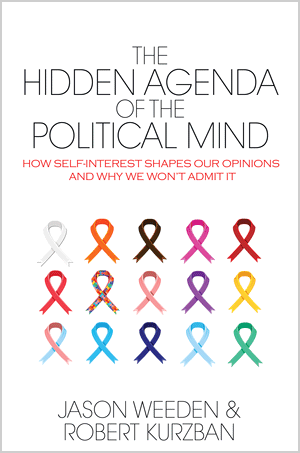
Jason Weeden & Robert Kurzban's "The Hidden Agenda of the Political Mind"

Jason Weeden is a senior researcher with the Pennsylvania Laboratory for Experimental Evolutionary Psychology (PLEEP) and a lawyer in Washington, DC. Robert Kurzban is professor of psychology at the University of Pennsylvania and founder of PLEEP. He is the author of Why Everyone (Else) Is a Hypocrite: Evolution and the Modular Mind.

They applied the “Page 99 Test” to their new book, The Hidden Agenda of the Political Mind: How Self-Interest Shapes Our Opinions and Why We Won't Admit It, and reported the following:
Page 99 of The Hidden Agenda of the Political Mind begins not with politics, but with sports:
In sports, the rules matter. And, crucially, different rules help some people and hurt others. Salary caps might help teams in smaller markets and hurt teams in larger markets. Race-based limitations might help second-tier whites and hurt top-tier African Americans. And there are countless other examples, of course. Raising the pitcher’s mound helps pitchers and hurts hitters. Requiring both feet in bounds for a catch in football hurts wide receivers but helps defensive backs. The foul-out rule in basketball hurts high-impact players but helps bench players get more minutes. Time limits in golf help speedier players and hurt slower players.

Unsurprisingly, athletes know where their interests lie and tend to support the rules that help themselves.
These paragraphs end our introductory section to chapter 5, which focuses on public opinion regarding the government’s role in helping (or harming) different people based on their race, religion, sexual orientation, the country they were born in, and so on – issues such as affirmative action, school prayer, same-sex marriage, and immigration. We use the opening section to ease into this material with sports analogies before beginning the difficult work of discussing topics about which many people (ourselves included) have passionate views. The middle of page 99 begins a section called “Back to Reality,” starting with the line: “In life as in sports, people fight over rules that help some and hurt others.”

While the previous chapter talked about sex and reproductive issues – abortion, birth control, pornography, premarital sex, and marijuana legalization -- chapter 5 talks about issues that relate to policies surrounding groups. The next chapter follows up with a discussion of issues relating to income redistribution and government safety nets.

Page 99 provides a nice overview of one of the big themes in the book. While many scholars focus on relatively abstract factors when discussing political issue opinions – ideologies, values, principles, personality features, and so on – we’re convinced that they often overlook the central fact that many issues present competing alternatives (in cases where there’s no such thing as neutral rules) that really do make some people better off at the expense of others.

We show that people’s particular issue positions are broadly predictable based on whether policies hurt or help them. This is true not only with issues relating to income redistribution, but also with issues where scholars rarely consider interest-based explanations, like abortion and marijuana legalization.

We understand, of course, that it’s not exactly polite to tell people that many of their cherished political positions are probably driven by self-interest. We add insult to injury by discussing psychological research indicating that people are fundamentally self-deceptive about being self-interested.

But, to return to sports analogies, our job as number-crunching social scientists isn’t to cheer on our own political team, but to analyze data and then call ‘em like we see ‘em.
Learn more about The Hidden Agenda of the Political Mind at the Princeton University Press website.

The Page 99 Test: Why Everyone (Else) Is a Hypocrite.

--Marshal Zeringue

Wednesday, October 8, 2014

Jessica L. Beyer's "Expect Us"

Jessica L. Beyer is a Research Scientist at the University of Washington in the Jackson School of International Studies and the Technology and Social Change Group in the Information School.

She applied the “Page 99 Test” to her new book, Expect Us: Online Communities and Political Mobilization, and reported the following:
Expect Us is a comparative ethnography that focuses on four online communities and asks why some end up mobilizing politically offline and others do not. The four communities I examine are Anonymous (4chan.org), The Pirate Bay, World of Warcraft (WoW), and the posting boards attached to IGN.com.

Page 99 brings the reader into the middle of the WoW chapter—a chapter about an online community where people know each other well, where online identities are often closely tied to offline relationships/identities, and where people debate politically significant issues all the time. WoW is not one of my communities that mobilized politically in the offline world. Most people are interested in my “sexier” cases that did mobilize offline—Anonymous and The Pirate Bay—but my favorite chapter in the book is this chapter about WoW.

WoW is a massive multiplayer online roleplaying game that had 11.5 million people playing it at the height of its popularity. I found that in WoW, people are constantly debating and negotiating norms/ideas that have political significance, such as norms of fairness, public speech, and appropriate distribution of scarce resources. I also found that the reason that this micro-level, politically significant behavior never manifests as group-level political mobilization, as it does with an online community such as Anonymous, is because the ways in which people are allowed to communicate, establish reputations, and interact in the online space thwart large-group identity. Even in-game or game-related activism is largely individualized action.

With that as backdrop, p99 comes at the end of a section about guild norms and regulation that is dedicated to the ways in which guilds – a type of stable small-group identity – are left to self-regulate. Guilds are tiny, largely undemocratic, fiefdoms, serving to splinter the WoW community into thousands of small communities. They are often the settings for debates around issues such as appropriate public speech. Through guilds, players gain reputations. And, guilds are one of the major forces for behavior regulation in the game. Guilds self-regulate to such an extent that if one were to complain about derogatory or offensive language within a guild, the official response from Blizzard would be that the offended individual should leave the guild in question, rather than pushing the guild to change its behavior.
It is important to note that Blizzard does not seem to intervene in guilds that allow only male or female players, guilds that only allow people of a certain nationality (e.g., Dutch-only), guilds restricting membership based on age, or guilds that restrict on the basis of language (e.g., French Canadian guilds). There are also many Christian guilds, with places such as the Christian Gamers Alliance hosting lists and contact information for interested gamers. Other religion-based guilds appear to be rarer—with some impossible-to-substantiate rumors that Muslim-only guilds are not allowed. There is no evidence that race-/ethnicity-based guilds exist, which indicates that Blizzard is likely regulating them quickly or there are very few.

As I have discussed, because guilds form little worlds within the larger world, players devote a great deal of effort to regulating behavior inside the guild. However, because of the importance of reputation in WoW, they also expend a great deal of effort in regulating player behavior outside the guild.
Learn more about the book and author at Jessica L. Beyer's website.

--Marshal Zeringue

Tuesday, October 7, 2014

Lorri Glover's "Founders as Fathers"

Lorri Glover is the John Francis Bannon Endowed Chair in the Department of History at Saint Louis University.

She applied the “Page 99 Test” to her new book, Founders as Fathers: The Private Lives and Politics of the American Revolutionaries, and reported the following:
The cover of Founders as Fathers depicts a rare and idealized domestic scene from the revolutionary era: George Washington’s family. On page 99, readers learn the truth behind that image.

The beautifully-attired children standing beside George and Martha Washington are her grandchildren, his step-grandchildren. Martha Custis was the wealthiest young widow in Virginia and mother of two when she accepted the overtures of George Washington. He was ambitious, and her fortune and connections smoothed his entry into the highest echelons of society. They never had children of their own, either because of his infertility or impotence.

George Washington tried to be good stepfather, but Martha’s son, Jack Custis, thwarted him at every turn. Tutors the couple hired to properly educate Jack routinely pronounced him entitled and lazy. As a young man, Custis squandered every opportunity given him, abandoned his education, and married too young and against parental advice. During the Revolutionary War and despite his stepfather’s repeated pleas, Custis sold land for a song to cover his growing gambling addiction. In the closing days of the war, he desperately sought to share the glory. But he never saw action, caught camp fever, and died the same month Cornwallis surrendered at Yorktown. Washington left the battlefield to sit at Custis’s deathbed. His was a pointless death that left an estate in chaos and four children under age six. Jack’s young widow kept the younger two and sent the older ones to be raised by the most famous couple in America. Washy and Nelly Custis are the children in the family portrait.

The truth behind the painting gets to the heart of Founders as Fathers. Too often we’ve etched the founders in amber; in statues and memorials they are literally rock-solid, larger than life. Scholarship on revolutionary leaders’ political, military, and intellectual roles typically ignores family. But that was not how the founders lived their lives. My book reveals that we cannot fully understand the revolutionary generation or the country they forged without going home with them and exploring the intimate parts of their lives. We must meet these founders as fathers.
Learn more about the book and author at Lorri Glover's website.

--Marshal Zeringue

Monday, October 6, 2014

Andrew Steane's "Faithful to Science"

Andrew Steane is a Professor of Physics at the University of Oxford, England, and occasional speaker in the area of Science and Religion.

Steane applied the “Page 99 Test” to his new book, Faithful to Science: The Role of Science in Religion, and reported as follows:
Page 99 is not typical in content for this book, but perhaps it gives a fair flavour of the style, and an impression of the author with whom the reader has embarked.

Faithful to Science is about science and religion, as it says on the cover, but it is not a portrayal of two things. It is an attempt to display a single thing: the way an integrated theistic perspective fully embraces science in its proper role. When one has come to acknowledge, with the due hesitation which surrounds all religious language, that the natural world is the product of an absolute reality that can know and be known---the fundamental claim of theism---then one's commitment to science is, or should be, just as mature and intellectually coherent as anyone else’s. Science is not an alternative to a reasonable faith, but a part of it. It is the way to address some types of question---the questions about the analysis of physical structure. But those are not the only questions worth asking.

As it happens, page 99 falls in a chapter where the book takes an interlude, a short autobiographical digression, allowing the reader to get a flavour of the way such ideas pan out in humdrum human life. In some respects this does not give a fair impression of the book, because it mentions a specific human story and a specifically Christian commitment, whereas most of the book is written from a broadly theistic perspective which could, it is hoped, embrace a much wider range of readers. Never mind; at least the page includes a few hints concerning the importance of humility, and the fact that not everything that announces itself as “Christian” is a fair representation of what the word should mean.

So page 99 illustrates where the author is “coming from”---the sense of cautious discovery, painful journey, ordinary research activity. But ultimately the book is not about its author, but about the wide-ranging discoveries and the metaphysical limits of science. Science is not the political partner, nor the all-conquering promoter, of atheism. But to get this in the right perspective does require mental effort, some care in avoiding category errors, and a willingness to bring one's whole person to bear in the unsettling but deepening entreaty: “tell me your name.”
Learn more about Faithful to Science at the Oxford University Press website.

--Marshal Zeringue

Sunday, October 5, 2014

Rebecca Hamlin's "Let Me Be a Refugee"

Rebecca Hamlin is an Assistant Professor of Political Science at Grinnell College.

She applied the “Page 99 Test” to her new book, Let Me Be a Refugee: Administrative Justice and the Politics of Asylum in the United States, Canada, and Australia, and reported the following:
Let Me Be a Refugee takes a close look at how liberal democracies decide who among the thousands of people who arrive at their borders seeking asylum qualifies for a refugee protection visa. One hundred and forty-seven states have signed on to the relevant international treaties promising to protect refugees, and all of these states use the identical definition of a refugee from the 1951 UN Refugee Convention. Yet, because international refugee law asks states to accept people who may not have followed the proper migration channels, wealthy liberal democracies are often very concerned about abuse of the system, characterizing asylum seekers as “queue jumpers” or as economic migrants in refugees’ clothing.

Page 99 describes Canada’s reaction to growing numbers of Mexican asylum seekers in the early 21st century. The agency responsible for assessing refugee claims, the Immigration and Refugee Board, issued several precedent-setting decisions that interpreted the refugee definition to make claims from Mexico very unlikely to succeed. However, the number of applications continued to rise until 2009, when the Canadian government decided to require a visa for people travelling from Mexico. Page 99 quotes the Immigration Minister defending this decision by saying:
“We’re not talking about the kinds of people that are living in UN refugee camps by the millions who are victims of war and state-sponsored persecution.... It’s an insult to the important concept of refugee protection to allow it to be systematically violated by people who are overwhelmingly economic immigrants.”
This statement highlights one of the core themes of Let Me Be a Refugee. The reasons that motivate people to migrate fall on a broad spectrum, ranging from purely economic factors on one end, to people who are forced out by oppressive regimes. The adjudication and distribution of refugee status requires decision-makers to turn this continuum into a binary, but increasingly, asylum seekers fall into the great grey middle between obvious refugees and obvious economic migrants. Rather than a dictator’s targeted persecution, they are fleeing the suffering caused by generalized violence, failed states, famine, and climate change. Decision-makers are tasked with applying a definition from 1951 to a more complex range of life experiences than ever before, leaving much room for interpretation. Further, because receiving states have resolved these questions differently from one another, whether or not someone is a refugee often depends on which border they cross.
Learn more about Let Me Be a Refugee at the Oxford University Press website.

--Marshal Zeringue

Friday, October 3, 2014

Richard E. Ocejo's "Upscaling Downtown"

Richard E. Ocejo is assistant professor of sociology at John Jay College of Criminal Justice, CUNY. He is the editor of Ethnography and the City: Readings on Doing Urban Fieldwork.

Ocejo applied the “Page 99 Test” to his new book, Upscaling Downtown: From Bowery Saloons to Cocktail Bars in New York City, and reported the following:
I have always thought that readers will be drawn to my book because it is about bars and nightlife, but they will enjoy it because of the interesting people in it. This thinking explains why page 99 is one of my favorites in the book. It comes in Chapter 3, in which I show how an important group in downtown Manhattan neighborhoods, where advanced gentrification has transformed them into an upscale destination, has reacted to the proliferation of bars and the growth of nightlife scenes. This group, which I call “early gentrifiers,” or people who moved downtown at the start of gentrification and remain there, continuously fight against more bars opening up and other changes in their neighborhood. In the chapter I show how a sense of symbolic ownership of their neighborhood and a nostalgic narrative about its past motivates their protests, which yield few positive results.

This page features one of my favorite people in the book, a man named Virgil. Like many longtime residents who protest bars, Virgil moved to the East Village in the 1970s, and encountered a poor, crime-ridden place with abandoned buildings. He also looks back on this time nostalgically, when the neighborhood was diverse and creative with colorful characters in the streets, before gentrification, new bars, and young revelers came. Here he expresses his fondness for one of these characters:
“There was this guy, Marty, who would play basketball in the morning and then he would, he actually taught a lot of the people basketball, because he came here to be in this kind of environment. Then he would hold court in the park. He had students, they would come to him and he’d teach literature, he’d teach art, history, philosophy, even though he didn’t know anything about philosophy. He would hold court, and then he would go back to his place with his ‘patients,’ whom he could psychoanalyze. This is such a characteristic thing, that this guy would just do this kind of stuff, and he would take money for it too. You’d have to pay him something. And he was highly respected here. People all over knew Marty, ‘Oh yeah, Marty!’”

“He was like the ‘mayor’?”

“Yeah, they called him the philosopher. He was the philosopher, but he was also the basketball player, and the psychoanalyst, and just a very prominent, important person.”

“What happened to him?”

“He jumped off the Williamsburg Bridge.”
For residents like Virgil, people like Marty were what made downtown an “authentic” or “real” place, and what made them feel attached to it. But lurking beneath these stories of the area’s past is the harsh reality of its negative conditions as a place in decline, which added so much of what newcomers came to appreciate about it: cheap rents, homeless bars, a diverse population, and quirky characters. These residents arrived downtown as it was transitioning into a place of rebirth, a desired destination from an unattractive slum, a process they also helped bring about. Their nostalgia narrative, then, not only compels them to protest today’s new bars, but also neglects facts from the past and shows the privileged position they are in to make such claims about what is “authentic” or “inauthentic” about their neighborhood. This page provides a short, but clear and powerful, example of this important finding in my book.
Learn more about Upscaling Downtown at the Princeton University Press website.

--Marshal Zeringue

Thursday, October 2, 2014

Lynn Hunt's "Writing History in the Global Era"

Lynn Hunt is Distinguished Research Professor at UCLA, former president of the American Historical Association, and author of numerous works, including Inventing Human Rights and Telling the Truth about History.

Hunt applied the “Page 99 Test” to her new book, Writing History in the Global Era, and reported the following:
Any single page probably gives a good sense of a writer’s style but not perhaps of their arguments. Page 99 falls in the third of four chapters of my book on how history will be written in the era of globalization. The first chapter recounts the rise and fall of cultural theories such as postmodernism or postcolonialism. The second chapter focuses on globalization; is it the new paradigm for writing history that replaces cultural theories and what might be its pluses and minuses? The third chapter, in which p. 99 appears, is about rethinking society and the self. Even as talk of globalization reshapes the writing of history, certain long lasting categories of history and social science have also come up for discussion, including society and the self. You might think these are self-evident but they are not. Page 99 shows that the concept of society has changed over time and that its highlighting in the eighteenth century served very distinct political and religious purposes.

From page 99:
Society, the individual self, and secularization were all closely linked together in the eighteenth century. Society was the space of autonomy or freedom from the demands of authoritarian rulers claiming a transcendental ground of legitimacy. Its emergence as practices and concept implied a challenge to that transcendental ground of legitimacy, whether in the form of the divine right of kings or the Biblical link between the father’s authority and the authority of the crown. In other words, the increasing attention to society propelled secularization by undermining the supernatural grounds of authority. Society authorized itself. It was self-regulating, though not always with the greatest success.

Over the course of the eighteenth century, society came to be seen as composed of individuals and not just families and status groups such as the nobility, the clergy, or the many guilds of professions and occupations. As a consequence, government was increasingly seen as representing individuals, especially individual property owners, rather than status groups. Thus, the first issue in the French Revolution of 1789 was whether the Estates General should vote by order (clergy, nobles, Third Estate) or by “head” (by individual deputy). Voting by head won out. The nation was to be composed of individual citizens, not differentially privileged status groups. In short, society’s autonomy from authoritarian rule was not enough; individuals had to be as autonomous as possible from the pressures of their families and communities as well.
Learn more about Writing History in the Global Era at the W. W. Norton website.

Writers Read: Lynn Hunt.

--Marshal Zeringue