Tuesday, January 10, 2023

Jamie L. Bronstein's "The Happiness of the British Working Class"

Jamie L. Bronstein is Professor of U.S. and British History at New Mexico State University.

She applied the "Page 99 Test" to her new book, The Happiness of the British Working Class, and reported the following:
Page 99 of The Happiness of the British Working Class lands the reader smack in the middle of one of the thematic chapters of my book, each chapter's theme drawn from nineteenth-century British working-class autobiographers' descriptions of their own happiness. On that page, part of a chapter about the environment, autobiographers reminisce about the way in which, as children, the natural world offered them spaces for unstructured play, the raw materials for simple playthings, and even food that didn't need to be paid for. The page is a microcosm of a chapter that explores working-class environmentalism generally—an overlooked topic—and is a microcosm of the book in that working people speak for themselves, sometimes at length, about the things that contributed to their joy. Samuel Bamford, walking through the countryside with his father, stopped for a rest and “luxuriated amongst the buttercups and daisies, and the glint of a little peeping primrose or two cast a whole stream of sunny thoughts and pleasant feelings into that happy moment. The trees seemed to wave a broader and richer foliage; the air was balmy and refreshing; the sun itself was more life-fraught, then when I felt it shining against the high walls and flagged yards of the workhouse.”

How well the 99th-page test works for The Happiness of the British Working Class depends on how one interprets the word “quality” in Ford Madox Ford’s quote. If by “quality” he meant “essential nature,” the test fails utterly because the chapters build on each other. A reader would not know from the single page that the book starts with a consideration of the ways that responsible historians have to think about autobiographies, or that the book contains chapters on childhood, community, work, and self-cultivation. The reader would also be very surprised to know, on the basis of that page alone, that the book considers some alternate values that emerged from the autobiographies, like the importance of religious observance or social duties. The last chapter of the book, which engages in dialogue with the modern philosophical and psychological literature on happiness, using the autobiographies as evidence, is probably the most surprising of all, because that's normally not a direction that historians take. On the other hand, if by “quality” he meant an assessment of whether the book is worth reading, I would venture to say page 99 passes the test. It's a fun read.
Follow Jamie Bronstein on Twitter.

--Marshal Zeringue

Monday, January 9, 2023

Jacqueline Jones's "No Right to an Honest Living"

Jacqueline Jones  is the Ellen C. Temple Professor of Women’s History Emerita at the University of Texas at Austin and the past president of the American Historical Association. Winner of the Bancroft Prize for Labor of Love, Labor of Sorrow and a two-time finalist for the Pulitzer Prize, she lives in Concord, Massachusetts.

Jones applied the "Page 99 Test" to her new book, No Right to an Honest Living: The Struggles of Boston’s Black Workers in the Civil War Era, and reported the following:
If browsers opened to page 99, they would see that this book takes an expansive view of themes related to making a living in mid-nineteenth-century Boston. That page focuses on Joseph F. Clash (1808-1872). He was a Black barber and dance hall proprietor in Boston’s North End, a neighborhood of dockworkers and sailors, brothels and gambling dens. Clash was a man of many talents licit and illicit, mundane and violent. This page notes that “Clash had perfected the art of separating the naïve and unsuspecting from their cash.” On June 30, 1853, Clash and a card-sharp associate took advantage of a fugitive from North Carolina by first, besting him in a game called “Seven Up,” and then offering him what they promised was “some very good wine” as a consolation prize. The beverage induced a deep sleep, allowing Clash and his confederate (a brothel owner) to lift a tidy sum from the sleeping man’s pocket. The victim sued, but Clash and his co-defendant were acquitted. The rest of the page details Clash’s business interests as an employer of prostitutes, cooks, and musicians. “Joseph Clash exhibited the kind of ruthlessness that allowed him not only to survive, but to thrive—with some outside help including the legal counsel of Robert Morris [a prominent Black lawyer], the implicit tolerance of the local law-enforcement establishment, and the growing demands [for illicit services] of his grateful customers.”

This page is part of a chapter titled “Underground Commons,” an interracial space of entertainment and criminal behavior. Some Black men and women, denied the ability to earn an “honest living,” made money by providing illegal goods and services. Joseph Clash responded as any good businessperson would to a demand for bootlegged liquor, sex, and illegal gambling. He was not afraid to defend his interests with his fists or a pistol; over the course of his career, he was witness to, or at the center of, several high-profile murder and assault cases.

At times Clash faced threats from disgruntled customers, resentful competitors, and romantic rivals. His businesses were located in an area of the city where midnight knife fights and drunken brawls were routine. At the same time, he enjoyed an unusual degree of respect from white cops on the beat, judges on the bench, and men in the jury box.

In 1857, his grand new dance venue, “American Hall,” attracted a wide range of customers who partook of a menu of hard-boiled eggs, doughnuts, cake, mine pie, baked beans, cold chicken, lobster salad and sausage. A small orchestra, with Clash playing the bass viola, entertained the boisterous crowd.

Clash was a savvy marketer of his own services. The hall sponsored special themed evening events and featured Black and white women who danced with customers for a fee. The “Great Union Ball” of May 24, 1857, attracted a police officer and a reporter for one of the local papers, the Boston Herald. The reporter wrote admiringly of the hall’s lavish decorations, and described the assemblage there that night as “a miscellaneous crowd” consisting of “sailors, shippers of vessels, mates, butchers, negros, drovers, respectable store keepers, city officials, policemen, [and] thieves and garroters,” making it a true Boston “institution.” The popularity of the place, especially among Black and white men, helps to explain why juries routinely acquitted Clash of the various violent crimes for which he stood trial.

The book focuses on the barriers faced by Black men and women in earning a decent living; but it also explores the resourcefulness and resilience of workers who created their own jobs or who engaged in activities that risked harm to themselves or to others. The Boston city directory ignored a whole realm of jobs, including those of rat catcher, fugitive imposter, pickpocket, and fencer of stolen goods, to mention a few.
Learn more about No Right to an Honest Living at the Basic Books website.

My Book, The Movie: Goddess of Anarchy.

--Marshal Zeringue

Sunday, January 8, 2023

Cathal J. Nolan's "Mercy: Humanity in War"

Cathal J. Nolan is the author of The Allure of Battle: A History of How Wars Have Been Won and Lost, for which he received both the Gilder Lehrman Prize in Military History and the first Distinguished Book Award from War on the Rocks. Nolan's other works include a two-volume Concise History of World War II; Wars of the Age of Louis XIV; a two-volume study of The Age of the Wars of Religion; a study of Principled Diplomacy, and several edited books in ethics in international affairs and international and military history. He is Professor of History at Boston University, a Progress Fellow at the Mercatus Center at George Mason University, and a Fellow of the Quincy Institute for Responsible Statecraft.

Nolan applied the "Page 99 Test" to his new book, Mercy: Humanity in War, and reported the following:
The Page 99 Test won't work for this book because it is a half paragraph that closes a chapter called “Grace.” Here is what precedes it on page 98. Right after the disaster in the Hürtgenwald, during the Battle of the Bulge in the Ardennes, one forest over, a terrified 19-year-old American GI called Norbert Gubbels is trapped with an unfamiliar platoon inside a collaborator’s castle in Luxembourg. It’s blanketed in snow and surrounded by Germans, some dead but many more alive. Looking out, he sees an arm in feldgrau weakly waiving a few hundred yards away, amidst a pile of corpses. He volunteers, along with three others, to go out with a blanket-stretcher and bring in a mortally wounded enemy who was trying to kill them all a day earlier. The Germans on the low hills don’t shoot until the rescue party is back inside, then the baffling logic of war resumes. The wounded man can’t speak. He starts to die faster as his wounds thaw and blood flows more freely from a missing foot and two large holes in his back. Some Americans want to kill him and throw his body out a high window. Norbert and several others say “no.” They nurse the German through a night of agony, providing a morsel of comfort as he weaves in and out of consciousness and the precious morphine they jab him with. He dies a day later. Fearing a tank attack, the platoon makes a run for American lines but their half-track hits a mine. Norbert is badly concussed, separated and alone, listening to Germans in the woods. He climbs into the back of a passing truck with a white star stencil, full of kitchen gear. He watches Patton’s men burn a German sniper alive and passes out. Diagnoses: “battle fatigue.” Relieved of combat duties, he’s sent to the south of France to guard POWs, whom he slips extra bits of potato. To the end of his life in 2014 Norbert Gubbels has ever worse nightmares about the bloody, silent woods of December 1944. He never forgets the mortally wounded German for whom he risked his life. Asked why he did it, he asks back in quiet humility: “What would you have done?”
Learn more about Mercy: Humanity in War at the Oxford University Press website.

The Page 99 Test: The Allure of Battle.

--Marshal Zeringue

Saturday, January 7, 2023

Rodney Hessinger's "Smitten"

Rodney Hessinger is Professor of History and Associate Dean of Humanities and Social Sciences at John Carroll University. He is the author of Seduced, Abandoned, and Reborn.

Hessinger applied the "Page 99 Test" to his new book, Smitten: Sex, Gender, and the Contest for Souls in the Second Great Awakening, and reported the following:
Page 99 concerns the relationship between Eliza Wintringham and her pastor William Parkinson. It reveals the close and complicated relationships that sometimes developed between women and ministers in the early nineteenth century. Wintringham had been a leading advocate for Parkinson as his church underwent a bitter schism. But they had a complicated falling out after Parkinson sexually assaulted Wintringham. Parkinson's subsequent trial helped reveal how church disputes could become sexually loaded. In an era when ministers were actively competing for adherents, they tried to win the hearts of followers, adding an intimacy to their mission. Assuming he had her heart, William Parkinson had taken liberties with Eliza Wintringham's body.

Page 99 gives a solid, but unsurprisingly, a partial, view of my book. Part of what I try to accomplish in my book is to connect strange bedfellows: I show that very disparate religious groups, upstarts like the Mormons and Shakers, foreign-tinged churches like the Catholics, and mainline evangelicals like the Methodists and Baptists, were all subject to the sexual dynamics of the "contest for souls" in the Second Great Awakening. This particular page is centered on a dispute within a Baptist congregation. Churches varied in how imaginatively they redefined gender roles. The Baptists certainly did not go as far as the Shakers, a group that had imagined a woman as a female Christ. But like most other churches in this era, Baptists were pulled into empowering women as a way to win their adherence. This page shows the empowerment, but also the vulnerability, of Eliza Wintringham, a woman who had taken a leading role in a church contest.

My book is about the intersection of sex and religion, but I also try to tell a larger story, that of the rise and fall of the Second Great Awakening. Page 99 shows one of many examples of church sexual scandal from this era. Publishers in the nineteenth century helped amplify local sins, ultimately bringing disgrace on enthusiastic religion writ large. My book shows how churches that engaged the heart first invited, but ultimately repelled, many Americans.
Learn more about Smitten at the Cornell University Press website.

--Marshal Zeringue

Friday, January 6, 2023

Noah Heringman's "Deep Time: A Literary History"

Noah Heringman is Curators’ Distinguished Professor of English at the University of Missouri. He is the author of Romantic Rocks, Aesthetic Geology and Sciences of Antiquity: Romantic Antiquarianism, Natural History, and Knowledge Work.

Heringman applied the "Page 99 Test" to his new book, Deep Time: A Literary History, and reported the following:
Page 99 of Deep Time: A Literary History is the first full page of a section entitled “Mammoths and Other Giants,” about halfway through a chapter on the French naturalist Buffon (1707-1788). Coincidentally or not, it is one of my favorite pages in the book, because the mammoth and its relatives enter onto the stage here in quite a dramatic fashion. I think it’s safe to say that a story about deep time would be incomplete without the mammoth. This is not because the mammoth is a particularly ancient life form. What the mammoth lacks in antiquity, it makes up for in charisma. The mystique of the mammoth owes something to its strong association with human prehistory. This was much less clear to Buffon in 1778, who only knew the mammoth and the mastodon from fossil bones, but he drew important conclusions from the differences between mammoths and modern elephants—conclusions relating to climate change and continental drift—and was the first to declare that the mastodon or “Ohio animal” must be extinct.

By stating here that “the mammoth is arguably the main actor in Buffon’s Epochs of Nature,” I am only adding emphasis to a point made by Claudine Cohen among others, but my contribution is to show how the megafauna and even earlier fossil species come into contact with ancestral humans in the geological imagination. My argument about deep time in the book is that it depends on this area of uncertainty between geological time and human prehistory. In Buffon this connection happens through a synthesis of elements we might refer to today as science and superstition: myths of human giants, for Buffon, refer to ancient hominins whose enormous size was of a piece with the size of the ancient “elephants,” tropical plants, giant ammonites, and other fossils. “Nature was then in her primitive vigour,” says Buffon. This heat may also account for Buffon’s use of a term translated as “roasted ivory” to describe the fossilized mammoth bones.

My book is not a study of the Elephantidae, but page 99 happens to express a mythical quality of these large mammals, perhaps the same quality that is captured so memorably by the muppet Snuffleupagus. When Buffon writes of the “elephants” left behind when human giants first migrated across the Isthmus of Panama to South America, because they were too unwieldy, I imagine the tears of the Snuffleupagus.
Learn more about Deep Time: A Literary History at the Princeton University Press website.

--Marshal Zeringue

Thursday, January 5, 2023

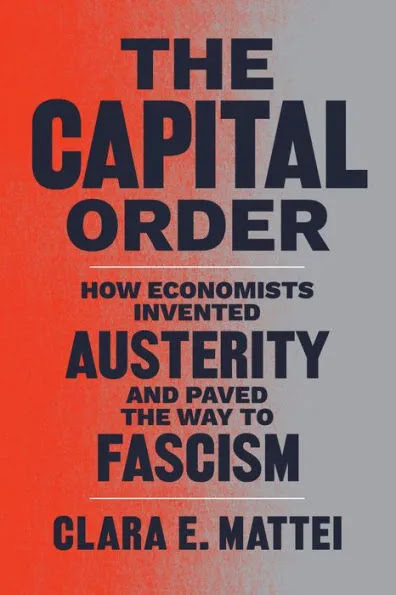
Clara E. Mattei's "The Capital Order"

Clara E. Mattei is assistant professor of economics at the New School for Social Research in New York City.

She applied the "Page 99 Test" to her new book, The Capital Order: How Economists Invented Austerity and Paved the Way to Fascism, and reported the following:
Page 99 is at the end of chapter 3, “The struggle for economic democracy.”
Conclusion

Following the economic interventions of their governments during World War I, the working classes of Britain and Italy were uninterested in a smooth reintroduction of capitalism. By 1919 the old system was in full-blown crisis, and its component parts— workers, union leaders, and economic experts— were all announcing the end of the old order. Post-capitalism, whatever its form, was on its way.

What was the basis for this conviction, which was mirrored by a sense of apocalyptic panic among the bourgeois establishment? Capitalism was strongly contested at its very core.

In these pages we have shown how political imagination toward the abolition of private property and wage relations moved from abstraction to reality. In the first place, the soaring “strikomania” of the British and Italian workers was political: it demanded new relations of production.

These demands took the form of the struggle for workers’ control that peaked in 1919– 1920 with the objective of self-government to secure the emancipation of the majority.

Certainly, the direct action of politicized workers was proving to be a far more serious enemy to capitalism than the reconstructionist project that the reader encountered in chapter 2. Indeed, the miners, the building guilds, and the cooperatives directly attacked production for profit, wage relations, and private ownership of the means of production. However, the struggles we have encountered here share with the reconstructionists a faith in state aid to defeat the old order through constitutional means. To complete the sketch of capitalism in crisis we must still address its gravest enemy.

Chapter 4 explores the movement for industrial councils that emerged in the Clydeside region of Britain and reached its peak in Turin, Italy. The efforts of these rank-and-file workers took on a clear-cut revolutionary form in opposition to both capital accumulation and the state— and pushed capitalism to the brink. In this space, a class of experts found their most useful tool: a new rationale for austerity, one that became the narrative of the threatened and powerful.
The Page 99 Test is spot on in allowing a browser to get a good sense of the content of the first part of The Capital Order. It provides a bird’s-eye view of the diverse spectrum of alternatives to capitalism that were emerging after the shock of WWI, which had shaken the pillars of western capitalist societies, especially private property of the means of production and wage relations. Part I of The Capital Order stands on its own feet. Rather than looking at the years 1919-1920 with the benefit of hindsight and thus portraying them as “weak” in their attempts to dethrone the status quo, my effort is to give voice to the spirit of the time. Indeed, by focusing on the deep interconnection between theoretical and practical alternatives to organizing production and distribution that emerged a century ago, the reader may broaden her imagination as to how to confront the deep challenges that our capitalist societies face today. Of course, this first part of the book serves the important purpose of setting the stage for the story of part II, namely the austerity reaction that captured Europe starting from the 1920s. The main thesis of The Capital Order is that the logic of austerity today can be grasped if one looks at the moment of its origin. Rather than being a stupid economic theory, austerity is a powerful disciplinary project that “tames” citizens and re-asserts capitalism as the only game in town. Cuts in the social budget, regressive taxation, interest rate hikes, privatizations, and labor deregulation (all components of what I call the austerity trinity) shift resources from the many to the few and increase our precarious conditions of market dependence. Such one-sided class warfare, which is fought also at the cost of an economic recession, serves the structural benefit of forcing the large majority to accept our condition as low-paid wage workers. The protagonists of this story are the economic experts who collaborated with Benito Mussolini and those who led the British Treasury. Both sets of technocrats devised theories that suppress workers’ agency and have lured us into internalizing a false sense of meritocracy by which if we are poor we deserve it.
Follow Clara E. Mattei on Twitter.

--Marshal Zeringue

Wednesday, January 4, 2023

Benjamin Hudson's "Macbeth before Shakespeare"

Benjamin Hudson is Professor of History and Medieval Studies at the Pennsylvania State University. His books include Viking Pirates and Christian Princes: Dynasty, Religion, and Empire in the North Atlantic and The Picts.

Hudson applied the "Page 99 Test" to his newest book, Macbeth before Shakespeare, and reported the following:
Page 99 of Macbeth before Shakespeare describes part of the long process that transformed Macbeth and his clan from heroes to villains. After his death, pretenders to the Scottish kingship claimed kinship with Macbeth and Lady Macbeth to provide legitimacy for their actions and permit them to wear the borrowed robes of royalty. One of the more intriguing was a monk turned warlord named Wimund. He was a member of the obscure Congregation of Savigny, a preaching order that expanded to the Isle of Man in the second quarter of the twelfth century. Wimund’s eloquence propelled him to the episcopal office and his diocese extended to the English coast. Landing there, Wimund claimed to be a descendant of Lady Macbeth and terrorized the region round Lancastershire until he was trapped in an ambush. Some contemporaries had doubts about his claims, but many accepted them.

This section is both representative and not representative of the book. Wimund probably was not a member of Macbeth’s family, but he wanted an association with that clan. This connects with a well-known theme in British and Irish literature: the myth of the vanquished hero with occult associations. Pretenders such as Wimund, emerging from the mists of the Irish Sea, contributed to the relationship of Macbeth with the uncanny.

Wimund’s career leads to the larger question of legitimacy. What constituted the right to rule? The early Scots, in common with other Gaelic-speaking peoples, believed it to be hereditary. There were elaborate rules of biological descent that determined who could or could not contest for high office. This, in turn, determined the lifestyle of individuals and their families. For the successful few there awaited a life of comparative comfort and freedom from most of the restrictions imposed on ordinary individuals. For the unfortunate many there beckoned a life of exhausting labor and scarce comforts.

Page 99 shows the political use of defeat. A biological connection, real or imaged, with a collapsing dynasty could rally the disaffected more effectively than astute generalship. As the historical Macbeth began the transition to a literary character, part of the process was the legend of a Lost Cause that was juxtaposed with the legend of the Deserved Defeat. We, like the twelfth-century audience, are asked to choose which is more plausible.
Learn more about Macbeth before Shakespeare at the Oxford University Press website.

--Marshal Zeringue

Tuesday, January 3, 2023

La Shonda Mims's "Drastic Dykes and Accidental Activists"

La Shonda Mims is an Assistant Professor in the Department of History at Middle Tennessee State University.

She applied the "Page 99 Test" to her new book, Drastic Dykes and Accidental Activists: Queer Women in the Urban South, and reported the following:
The following two paragraphs are taken directly from page 99 of Drastic Dykes and Accidental Activists. This chapter addresses the political climate for queer Pride celebrations in 1980s Charlotte, North Carolina. Although my book focuses on lesbian life in the urban queer South, these paragraphs introduce religious leaders who worked to limit the space available for all queer people to gather and celebrate during Charlotte’s “conservative renaissance.” The first paragraph profiles pastors who targeted Mayor Harvey Gantt, pleading with him to adopt their position on the sale of pornographic materials, which they equated to queer sexuality.
Religious leaders in Charlotte, some of whom held political aspirations, pressured Gantt to act against the sale of sexually explicit material, which they linked to lesbians and gay men. Adopting the moniker Concerned Charlotteans, the group focused on materials sold in the Charlotte Douglas Airport. Pastor Ed Adams of Charlotte’s Word of Faith Church was one of many religious leaders who wrote to Gantt and rebuked him for his supposed lack of action on the issue. Gantt faced a city that was not ready for vocal mayoral support of lesbian and gay concerns. Buoyed by their powerful status, religious leaders equated homosexuality with what they deemed to be pornographic material—and saw both as similarly harmful to Charlotte. In response to Gantt’s answers when questioned by Concerned Charlotteans, Adams wrote, “I hate to think that the Mayor of our city thinks that Playboy and Penthouse aren’t pornographic. Also your answer to, ‘do you believe homosexual acts should be legalized’ concerns me. Surely you know what homosexual acts are.” Adams pleaded with Gantt to “use the position that God has entrusted to you” so that “the city of Charlotte will know that its major is a man of integrity indeed.” The founding member of Concerned Charlotteans, Reverend Joseph Chambers, was profiled by the Charlotte Observer in a 1986 examination of his organization’s expansion of its focus to include homosexuality, abortion, and prayer in schools. The piece opened with Chambers examining a Rolling Stone magazine that featured an article on his activism: “The Rev. Joseph Chambers flips through a September issue of Rolling Stone magazine until a picture catches his eye. ‘Do you think this promotes lesbian sex?’ he asks, pointing to a Bloomingdale’s department store ad. Two pages later, there’s a color photograph of Chambers, standing with a Bible in front of a glowing cross and a U.S. flag. The article, about North Carolina’s one-year-old obscenity law, mentions Chambers and his anti-pornography group, Concerned Charlotteans.”

Charlotte’s anti-gay activism made national news that year, but because of archconservative senator Jesse Helms, the state as a whole would also gain notoriety in this arena. Just three years after the national investigative television news show 20/20 joined Rolling Stone magazine in highlighting Charlotte’s energetic, conservative religious movement, Vice President Dan Quayle attended the fifth annual Concerned Charlotteans conference at Helms’s behest. Reverend Chambers touted the visit as an indicator of North Carolina’s “‘conservative renaissance’ in the battle against pornography and other problems.”
While page 99 does not represent the whole of Drastic Dykes and Accidental Activists, the quoted materials demonstrate the ways in which religious leaders wielded power within the political landscape of the urban U.S. South. What these paragraphs do not reveal is the tenacity of queer southern women. As other chapters of my book demonstrate, lesbians created influential public and private spaces for community in Atlanta, Georgia, and Charlotte, North Carolina. The Drastic Dykes were a group of separatist lesbian feminists in Charlotte who collected women’s writing and art, publishing the work in a magazine they supported financially and distributed widely. The Atlanta Lesbian Feminist Alliance sustained a physical space for lesbian gatherings and organized a library of feminist and queer women’s words from around the world. The potency of these efforts is their survival in the face of a national discourse, like that printed on page 99, which suggested that religious power surpassed queer action in the urban U.S. South.
Follow La Shonda Mims on Twitter.

--Marshal Zeringue

Monday, January 2, 2023

Matthew Bentley & John Bloom's "The Imperial Gridiron"

Matthew Bentley (1984–2018) was an affiliate lecturer at Anglia Ruskin University. John Bloom is a professor of history at Shippensburg University. He is the author of There You Have It: The Life, Legacy, and Legend of Howard Cosell and To Show What an Indian Can Do: Sports at Native American Boarding Schools, among other books.

Bloom applied the "Page 99 Test" to their new book, The Imperial Gridiron: Manhood, Civilization, and Football at the Carlisle Indian Industrial School, and reported the following:
On page 99 we discuss some of the prominent athletes, such as distance runner Louis Tewwanima and Jim Thorpe who emerged from the Carlisle Indian Industrial School to represent the United States as medalists in the Olympics.
Tewanima first came to Carlisle as a prisoner of war. The Army had taken him from his family and clan, enforcing federal orders that had sided with Mormon farmers in a land dispute. Tewanima foreshadowed future people of color who competed successfully for the United States on an international stage, sports figures who have brought laurels to a nation that has systematically oppressed them. In fact, in the case of Tewanima during the 1912 Stockholm games, the United States was still twelve years away from granting Native Americans citizenship. Yet Tewanima and other Hopi runners always saw themselves as representing more than just one nation. In the words of historian Matthew Sakiestewa Gilbert, “Americans considered Tewanima to be their trophy of colonization,” but his “desire to join Carlisle’s track team and his participation in marathons was deeply rooted in who he was as a Hopi runner for the Bear Strap Clan.”

On the football gridiron and in the world of track and field, however, no player achieved greater fame and stature than Jim Thorpe. Few athletes anywhere in the world have ever demonstrated Thorpe’s versatility. He played for and starred for Carlisle between 1907 and 1912, helping to guide the team to twenty-three wins over his final two years, including victories over Harvard and the Army. He won gold medals for the modern pentathlon and decathlon in the 1912 Olympics. He had a twenty-year professional baseball career and was a founding member of the professional football organization that became the National Football League.
Located in Carlisle, Pennsylvania, the Carlisle Indian Industrial School was created by the federal government in order to force assimilation upon Indigenous Americans. It was a violent project whose founders showed no respect for or recognition of Indigenous societies, art, or stories. Football became an important tool that the school’s administration used to promote its mission to the nation at large. Ideas about gender were central to their use of the sport and to their ideas about assimilation.

Students came to Carlisle from over 140 different Indigenous nations, each with distinct rituals, identities, and cultural formations associated with human sexuality and gender. At the school, they encountered a curriculum and disciplinary code that narrowly defined their gendered identities within a Victorian discourse of manhood and womanhood. This gender socialization was central to the way that the school hoped to conquer their souls. School administrators like the institution’s founder, Richard Henry Pratt, believed that Indigenous men needed to become “civilized” gentlemen. These white educational leaders believed that Indigenous males were too “masculine.” In other words, they believed that Indigenous men were too physical and too much tied to what they saw as the elemental, violent, and aggressive aspects of male character. Meanwhile, elite white young men attending colleges began to develop a cult of masculinity, one that rejected gentlemanly manners and embraced physical toughness. They created and played the exceedingly violent game of football as an expression of their newfound enchantment with all things masculine. Alternatively, Pratt hoped that if young Indigenous men from Carlisle could play the violent game of football as gentlemen, they could promote his Pygmalion vision, and that he, as the school’s visionary, would silence his doubters.

As our Page 99 Test reveals, we don’t get to a discussion of the most famous Carlisle athletes until page 99 of our book. This isn’t to diminish the importance of these athletes. In fact, as the passage illustrates, we try as much as we can not to discuss them as, in the words of Matthew Sakiestewa Gilbert “trophies of colonization.” Instead, as in this passage, we hope to present their athletic success in terms of the identities that the Carlisle Indian Industrial School attempted to strip from them.
Learn more about The Imperial Gridiron at the University of Nebraska Press website.

--Marshal Zeringue

Saturday, December 31, 2022

Charlotte Bentley's "New Orleans and the Creation of Transatlantic Opera, 1819-1859"

Charlotte Bentley is a lecturer in music at the International Centre for Music Studies at Newcastle University, having previously held a research fellowship at Emmanuel College, University of Cambridge, and a teaching fellowship at the Reid School of Music, University of Edinburgh.

She applied the "Page 99 Test" to her new book, New Orleans and the Creation of Transatlantic Opera, 1819-1859, and reported the following:
At first glance, I wasn’t convinced that the Page 99 Test was going to work: my book focuses largely on francophone opera in nineteenth-century New Orleans, but page 99 begins with a brief detour to consider markets for Italian opera in the city.

But although it’s not fully representative in that sense, page 99 does go on to illuminate one of the book’s key themes. New Orleans and the Creation of Transatlantic Opera, 1819-1859 sets out to explore how transnational connections of many kinds sustained the vibrant operatic life of New Orleans; one of its conclusions, perhaps inevitably, is that although those connections created plentiful artistic, financial and personal opportunities for the people involved, they could also cause friction and discontent.

The second half of page 99 explores an example of just that. There, I return to a pair of quirky death notices from a New Orleans newspaper that I introduced a few pages earlier. These obituaries were not for a person: rather, they were satirical critiques of the city’s longest-running theatre, which was home to its opera company. Among other things, their vehement criticism targeted the theatre’s overreliance on imported Parisian works in its programming. In reaction to the dominance of this imported francophone repertoire, critics and other music lovers at the time suggested a couple of avenues for change: for some, the answer was to counterbalance French works with Italian operas performed by Italian troupes. Others, meanwhile, argued that the solution was to build a new Théâtre Louisianais, which would foster the talents of local composers and playwrights. While the latter project ultimately never came to fruition, the debates around it highlight how tensions between localising and internationalising priorities were ever-present in the operatic life of the city.

I wouldn’t, of course, recommend that a potential reader should rely solely on the Page 99 Test when deciding whether to give the book a go, but I do think that it gives an enticing glimmer of the people, places, and debates that have animated my research.
Follow Charlotte Bentley on Twitter.

--Marshal Zeringue