Saturday, January 16, 2010

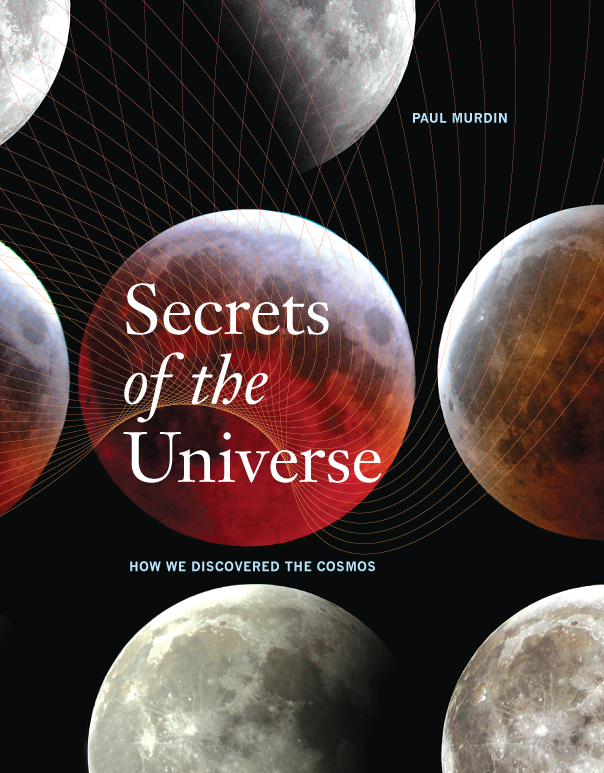
Paul Murdin's "Secrets of the Universe"

Paul Murdin is a senior fellow at the Institute of Astronomy at the University of Cambridge and editor in chief of the Encyclopedia of Astronomy and Astrophysics. Formerly, he was head of astronomy at the Particle Physics and Astronomy Research Council and director of science at the British National Space Centre. He is the author of Full Meridian of Glory: Perilous Adventures in the Competition to Measure the Earth and coauthor of The Firefly Encyclopedia of Astronomy.

He applied the “Page 99 Test” to his new book, Secrets of the Universe: How We Discovered the Cosmos, and reported the following:
Science fiction writer Isaac Asimov described the most important feature of a scientific discovery as the open mind and curiosity of the person who makes it: ‘The most exciting phrase to hear in science, the one that heralds new discoveries, is not “Eureka!”, but “That’s funny ...”.’ In this book I have tried explain what lies behind some of the great discoveries in astronomy, the train of events and thoughts that brought the scientist to exclaim ‘Eureka’ or ‘That’s funny…’ as he or she unlocked one of the major secrets of the Universe.

This book is therefore mostly scientific history – my top 65 cosmic discoveries. Their discoverers lived over the last 25,000 years, lived in many countries and on all the continents (including Antarctica). They were men and women, old and young, professional scientists and amateurs. They were experts in many different sciences. Collectively, they discovered the cosmos and set it in a context to which we can relate.

Pg. 99 pretty much illustrates this thesis. In the couple of pages beforehand I describe what we know about comets and then I turn to the question of where they came from:
It is thought that comets formed when the Sun formed, 4.5 billion years ago, from interstellar ices condensing onto grains of interstellar dust. They were originally planetesimals that congealed from scraps of dust and
gas in the presolar nebula. Since then, they remained almost unaltered in two cold, outer regions of the Solar System, until they fell towards the Sun, ultimately doomed to melt like snowmen when the Sun rises.

Short-period comets come from the Kuiper Belt, which is located in the outer Solar System beyond the orbit of Neptune. The source of the long-period or sporadic comets is thought to be the Oort Cloud, a spherical reservoir of comets surrounding the Solar System. Dutch astronomer Jan Oort discovered in 1950 that many long-period comets fall toward the Sun from a distance of between 20,000 and 200,000 times the distance from the Sun to Earth. Comets that formed inside Neptune’s orbit were ejected into distant orbits during encounters with giant planets, and formed the Oort Cloud and the Kuiper Belt. Occasional encounters with each other, or with passing stars or giant clouds of interstellar material, re-inject some comets from the Oort Cloud and Kuiper Belt back into the inner Solar System.

It is likely that, early in the history of the Solar System, there were frequent collisions of comets with Earth. Some of our ocean water may have been brought to Earth by comets. In addition to water, complex organic molecules (and especially ‘prebiotic’ organic molecules) could also have acted as seeds for the development of life on Earth.
At the end of the book I look forward to four major prospects for future discoveries: to uncover the secrets of dark matter and dark energy, to detect gravitational radiation and discover life elsewhere in the Universe – although we may not find what we expect. The challenge for the next generation of astronomers will be to put themselves in the position to uncover these momentous secrets of the universe.
See a gallery of photographs and sample pages from Secrets of the Universe.

--Marshal Zeringue

Thursday, January 14, 2010

Arianne Chernock's "Men and the Making of Modern British Feminism"

Arianne Chernock is an Assistant Professor in Boston University's Department of History specializing in modern Britain and Europe. Her work focuses on 18th- and 19th-century cultural, political, imperial, and gender history.

She applied the “Page 99 Test” to her new book, Men and the Making of Modern British Feminism, and reported the following:
Men and the Making of Modern British Feminism tells the story of a group of men in late-eighteenth-century Britain who courageously insisted that women’s rights mattered. That is, in a world in which reformers daily clamored for the “rights of man” but refused to extend these same “rights” to women, these men – progressive educators, attorneys, writers, officers, physicians, and clerics – asserted that their nation would not be truly “enlightened” until women’s grievances were also addressed. Law, custom, and tradition may have jointly conspired to keep women subjected, but they maintained that reason required them to emancipate “half the human race.” There were no logical grounds on which to bar women from fuller participation in the life of the nation, given the preponderance of evidence in favor of women’s capabilities.

These men were not necessarily the first to make such claims, nor were their statements the most extensive or eloquent – for the most impassioned and sustained defense of women’s rights during this period, see Mary Wollstonecraft’s 1792 A Vindication of the Rights of Woman. What was novel about their approach was their emphasis on the fact that men had a significant stake in female emancipation. As they repeatedly stressed, “women’s rights” were not just a women’s issue, to be dealt with by the other sex. Rather, they believed that how a people treated its women was a crucial metric for measuring the overall health of a nation, as well as of the civility and virility of the men within that polity. As such, women’s rights were a human problem.

A lofty formulation, indeed. How these men actually went about enacting this vision, though, led them into some thorny situations. While they put forward some remarkably bold recommendations – several, for example, recommended that women have the right to vote and sit in parliament – and used their professional networks and social status to help women secure employment and equal education, they also at times struggled to present female emancipation in a way that pleased, and catered to the real needs of, women. This brings me to p. 99 of my book, which falls in my fourth chapter titled “Revising the Sexual Contract.” This chapter traces men’s efforts to reform women’s legal standing, and focuses in particular on women’s problematic status within marriage. While some men believed that modifying existing laws would produce more equitable marriage arrangements, others strongly contended that the institution of marriage itself would have to be abandoned if anything approaching equality could be claimed between men and women. This is the debate that I take up on p. 99, where I describe how this latter position was best articulated by the author Thomas Holcroft:
This was the platform adopted by the Jacobin novelist and playwright Thomas Holcroft, an intimate member of the Godwin circle and vigorous contributor to the dissident republic of letters, who assumed an antimarriage stance in his controversial 1792 novel Anna St. Ives, which explored the possibilities for creating a more ‘benevolent’ culture. (It was ‘the welfare and happiness of mankind, Mary Wollstonecraft explained in her largely positive review of the novel, which Holcroft tirelessly promoted.) For Holcroft, the abolition of marriage was central to this forging of a more selfless race of people. In the novel, Holcroft’s hero, the tireless reformer Frank Henley, decries marriage as an institution encouraging jealousy and covetousness.

Anticipating a world in which there might be true parity, Holcroft insisted that the family, like Engels’s state, would eventually wither away: ‘I doubt whether in that better state of human society, to which I look forward with such ardent aspiration, the intercourse of the sexes will be altogether promiscuous and unrestrained; or whether they will admit of something that may be denominated marriage. The former may perhaps be the truth: but it is at least certain that in the sense in which we understand marriage and the affirmation—This is my wife—neither the institution nor the claim can in such a state, or indeed in justice exist.’ Holcroft viewed marriage as a dangerous obstacle to humanitarianism, a means of confining passion to particular rather than general causes. As William Hazlitt explained, in his 1816 Memoirs of the Late Thomas Holcroft, Holcroft had longed for a world marked by ‘mutual philanthropy, and generous, undivided sympathy with all men,’ a world in which ‘every man would be a brother’ and ‘[e]xclusive friendships could no longer be formed, because they would interfere with the true claims of justice and humanity.’
Holcroft’s sentiments certainly were noble, but in his rush to abandon marriage he forgot to take into account the children. Who would be responsible for child-rearing in his new “humanitarian” system, with its emphasis on “brotherly love”? For Holcroft, as for several of the other men who endorsed alternative familial arrangements, this responsibility de facto fell to women. It was for this reason in particular that so many female women’s rights advocates of this period were at times wary of their male collaborators. They by no means construed “champions of the fair sex” as interlopers, but they did call into question their judgment. As is always the case, tensions emerged when one group tried to define and defend the best interests of another.
Read more about Men and the Making of Modern British Feminism at the Stanford University Press website.

--Marshal Zeringue

Wednesday, January 13, 2010

Holger H. Herwig's "The Marne, 1914"

Holger H. Herwig holds a dual position at the University of Calgary as professor of history and as Canada Research Chair in the Centre for Military and Strategic Studies. He has published more than a dozen books, including the prize-winning The First World War: Germany and Austria-Hungary 1914-1918 and (with Richard F. Hamilton) The Origins of World War I.

He applied the “Page 99 Test” to his new book, The Marne, 1914: The Opening of World War I and the Battle That Changed the World, and reported the following:
Open the book to page ninety-nine and read, and the quality of the whole book will be revealed to you.” Yes, it is accurate for The Marne, 1914.
The going was nearly impossible. Dense fog not only inhibited accurate fire but also turned the battlefields into semidarkness. Combat was close and personal, in most cases ending with bloodcurdling bayonet charges.” The small creeks of the Vosges at times ran red. The din was unbearable. The woods rang with the screams of wounded soldiers….
For the common soldier, the Battle of the Marne consisted of six weeks of frightful slaughter in stifling heat and humidity. They marched 400 kilometers to the front and back. They suffered from fire, diarrhea, typhus, thirst and hunger. In the end, two million men lay exhausted along both sides of the Aisne River and dug in—for the next four years. When it was over, some 10 million were dead. It started at the Marne in 1914, it ended at Versailles in 1919. Europe would never be the same again.
Read an excerpt from The Marne, 1914, and learn more about the book at the publisher's website.

--Marshal Zeringue

Tuesday, January 12, 2010

Christopher F. Black's "The Italian Inquisition"

Christopher F. Black is Honorary Research Professor of Italian History at the University of Glasgow, and author of Italian Confraternities in the Sixteenth Century; Early Modern Italy: a Social History; and Church, Religion and Society in Early Modern Italy.

In answer to my request to comment on Page 99 of his The Italian Inquisition (Yale University Press, 2009), he replied:
Page 99 starts with the end of a section on death sentences under the Roman Inquisition, which emphasises that probably the first execution under the post 1542 Roman Inquisition, of a relapsed Calvinist heretic, in 1550 was a contested verdict among inquisitors, and that executions were rarer than under the Spanish Inquisition. “Under the Roman Inquisition death sentences tended to be for repeat offenders”. Page 99 then initiates a discussion on the staffing to help Italian inquisitors, indicating they had limited personnel and financial resources, and that secular supporters – from ‘familiars’ – were few and ineffective, again in contrast to the Iberian situation. “The main tribunals in Italy were not sufficiently well staffed to achieve their overall aims: to eradicate heresy and encourage correct belief and behaviour.”

The book – the first in English to analyse the Inquisitions in early modern Italy - covers the Roman Inquisition as centralised, under the Papacy from 1542 and developed to the late eighteenth century, operating through central and northern Italy, and Malta, creating eventually about 40 local tribunals. I also cover tribunals of the Spanish Inquisition operating in Sicily and Sardinia, and indirect Roman inquisition operations in the Spanish-ruled Kingdom of Naples. The book analyses inquisitional procedure from denunciation to punishment, emphasising due legal processes, the limited and controlled use of torture, and leniency of many punishments. Re-education could be as important as punishment under Roman control; plea-bargaining could mitigate punishments. Political divisions within Italy, and claims of many bishops that they should also control matters of faith, inhibited hard-line inquisition control. The book shows how the inquisition helped overcome major theological challenges to Roman orthodoxy, whether from northern Protestants, or home-bred ‘reformers’ like the followers of Juan Valdés (including Cardinal Reginald Pole, Michelangelo, and Pietro Carnesecchi burned at the stake in 1567). Thereafter the book (backed by statistical Tables), shows how the inquisitorial targets changed and expanded, including alleged practitioners of love and medicinal magic, females seen as ‘living saints’, priests sexually soliciting penitents, and people who moved – forcibly or voluntarily - between Christian affiliations, Judaism and Muslimism. A long chapter covers censorship and attempted intellectual control, its mixed effectiveness, and brings in the controversial cases of Giordano Bruno and Galileo.
Learn more about The Italian Inquisition at the Yale University Press website.

--Marshal Zeringue

Sunday, January 10, 2010

Michael Jerryson & Mark Juergensmeyer's "Buddhist Warfare"

Michael Jerryson is Assistant Professor of Religious Studies at Eckerd College and the author of Mongolian Buddhism: The Rise and Fall of the Sangha (2007). Mark Juergensmeyer is Director of the Orfalea Center for Global & International Studies and Professor of Global & International Studies, Sociology and Religious Studies at the University of California, Santa Barbara.

They applied the “Page 99 Test” to their new book, Buddhist Warfare, and reported the following:
Page 99 of Buddhist Warfare is from the chapter, “Legalized Violence: Punitive Measures of Buddhist Khans in Mongolia,” by Vesna Wallace. On this page, Wallace discusses monks being served with death sentences after they slandered Buddhist rulers. The Mongolian king, the Eighth Jebtsundamba, is supposed to follow the Buddhist doctrine and carries the title: Bestower of Happiness to All Sentient Beings. At the same time, this Buddhist ruler advocates a death penalty to anyone who defames his character including Buddhist monks.
Lower ranking monks were severely beaten or delivered to the Ministry Affairs for execution if they stole an object belonging to the Jebtsundamba’s private treasury. Those who publicly showed their irreverence for the Jebtsundamba were put to death. The Jebstsundamba was already losing the respect of Mongols of all classes because of his vices and extravagant lifestyle. As reported by Boryn Jambal, a lower-ranking monk at that time, the last such case occurred in 1921, just before the overthrow of the theocratic government. A lama by the name of Damdinsuren was executed for calling the Eighth Jebtsundamba “a wretched Tibetan beggar who has wandered here.” Since in all cases the death penalty, the final decision was made by the Eighth Jebtsundamba, the Bestower of Happiness to All Sentient Beings, himself, it is safe to conclude that Damdinsuren’s death sentence was authorized by the Jebtsundamba as well.
Buddhist Warfare challenges the common perception of a mystical, exotic and wholly peaceful tradition. This perception is all around us. It is reflected in the photos of Buddhist meditation, of grocery visits for soothing herbal teas with Buddhist aphorisms, and of posters detailing the far away monasteries on high snow-peaked mountain tops. This theme of serenity is one facet of many (a facet also found in Christian, Jewish, Muslims and other religious traditions). And like other religious traditions, there is an opposing facet in Buddhist traditions.

We provide historical accounts of Mongolian, Tibetan, Sri Lankan, Indian, Japanese, Chinese, Korean and Thai traditions to show that Buddhism has a violent side: monks have fought in wars and advocated bloodshed for centuries. Whether it is Tibetan Buddhist assaults on competing schools, Mongolian Buddhist incarnated rulers torturing monks, or recent conflicts in Sri Lanka and Thailand, we find the human proclivity for violence manifested in Buddhist doctrine and practices.

The contents of page 99 illustrate the paradoxical nature of Buddhist warfare. Jebtsundamba is not alone in the vast history of Buddhist traditions, nor does he reflect a unique theocratic stance. Buddhist precepts may disavow murder, but we find different Buddhist doctrine and practices advocating this very act. In the end, what becomes more peculiar is not the Buddhist advocacy for violence, but rather the invisibility of this trait in our recent collective perceptions of the tradition.
Learn more about Buddhist Warfare at the Oxford University Press website.

--Marshal Zeringue

Friday, January 8, 2010

John Eric Goff's "Gold Medal Physics"

John Eric Goff is an associate professor of physics and chair of the physics department at Lynchburg College.

He applied the “Page 99 Test” to his new book, Gold Medal Physics: The Science of Sports, and reported the following:
I only recently learned of Ford Madox Ford's page 99 test. My book, Gold Medal Physics: The Science of Sports (The Johns Hopkins University Press -- released December 2009), is my first book. After learning of Ford's test, I pulled my book off the shelf with a mixture of trepidation and excitement. For I had no idea what was on page 99. Would I find equations, graphs, unrelieved prose? A smile came to my face when my eyes hit upon page 99. Here is all the text contained on that page:

Figure 6.4. Katarina Witt personified grace at the 1994 Winter Olympics. Note how her arms and back leg are far from her vertical axis. (©Wally McNamee/CORBIS)

Above those words is a wonderful photograph of Witt on the ice in Lillehammer, Norway. The photo takes up nearly the entire page, and it represents what my book is all about. Sure, I have some equations and graphs in my book, but Witt's majesty on ice is part of what motivated me to write a book on sports physics.

My book is not about dehumanizing sports with a bunch of equations. My book is about taking the thrill many of us experience when awed by athletes performing at the pinnacle of their métier and adding to that thrill a modest understanding of how the universe works. The more we learn about the universe -- be it through science, music, art, literature, athletics, or any of the other joys of being human -- the richer our lives can be.

Returning to my page 99, what does one see? Witt's arms are outstretched gracefully from her body. Her left leg is thrust powerfully behind her. Her right skate -- the only one on the ice -- kicks up bits of ice. Her emotional face reveals a passion and commitment to her craft that would make the hardest of hearts skip a beat.

Those images came to my mind before anything connected to science. Later, I realized that Witt had her arms and leg stretched as far from her body for a good reason. The reason is connected to something called angular momentum conservation. The laws of physics constrain what we and everything else in the universe can do. But, those constraints liberate our minds because even a small understanding of how the universe works can enrich the way we experience the world around us.
Learn more about the book and author at John Eric Goff's website.

--Marshal Zeringue

Wednesday, January 6, 2010

William Poundstone's "Priceless"

William Poundstone is the author of Fortune’s Formula and Gaming the Vote.

He applied the “Page 99 Test” to his new book, Priceless: The Myth of Fair Value (and How to Take Advantage of It), and reported the following:
Priceless is about the hidden psychology of prices: how we map the desire to possess things onto numbers with dollar signs in front of them. As you might expect, hucksters of various stripes have always been concerned with this. More surprising is that some of the most important psychology of recent decades bears directly on this topic. In the book I trace how the science has influenced marketing, and vice-versa.

Page 99 of Priceless describes the concept of loss aversion. One of the psychologists I write about, Daniel Kahneman, said that he considered loss aversion his most important contribution to the theory of decision-making. In that sense, page 99 could be considered pivotal to the book’s argument. Loss aversion refers to the fact that losing money is not simply the mirror image of gaining money. There is an all-important asymmetry: Losses are more keenly felt. That is, losing $100 stings more than winning $100 delights. Prices are monetary losses that may be balanced by the gains of what we acquire. Loss aversion is thus central to many the tricks of today’s psychological marketers. Kahneman speculates that loss aversion also explains some of our deep-set cultural traditions:
Kahneman observed that loss aversion ‘extends to the domain of moral intuitions, in which imposing losses and failing to share gains are evaluated quite differently.’ There’s a law against being a thief, not against being a tightwad. And while avarice makes the list of seven deadly sins, and charity the top three Christian virtues, the ten commandments forbids only stealing or coveting someone else’s wife and property. Charity is only a suggestion.
Read an excerpt from Priceless, and view a brief video in which Poundstone discusses charm prices and the mysterious allure of "99 cents."

Visit William Poundstone's website and blog.

--Marshal Zeringue

Tuesday, January 5, 2010

Chuck Thompson's "To Hellholes and Back"

Chuck Thompson, the author of Smile When You’re Lying, is a former features editor for Maxim and was the first editor in chief of Travelocity magazine and served as part of the editorial team for the launch of CNNGo.com. He has traveled on assignment in more than thirty-five countries and his writing and photography have appeared in The Atlantic, Esquire, National Geographic Adventure, Playboy, Spy, Escape, WWE Magazine, Outside, Men's Journal, and the Los Angeles Times.

He applied the “Page 99 Test” to his new book, To Hellholes and Back: Bribes, Lies, and the Art of Extreme Tourism, and reported the following:
Ford Madox Ford had a prodigious memory, so my guess is that this whole Page 99 business began as some sort of Victorian-era parlor trick that allowed the old show-off to recite from memory the text of page ninety-nine from any number of the books in the average blowhard’s study — a way to dazzle would-be hookups and elicit mid-cigar grunts of grudging admiration from their husbands.

For me, I found it a frustrating assignment. I can buy off on the idea that “the quality of the whole will be revealed” by a single page. Like most writers, I pay attention to every word on every page, so I’m satisfied that the quality of my writing might be judged from any random spot. But reducing an entire organism to one of its atoms is no more an accurate way of judging a book than a close examination of a toe is an accurate way of judging a person.

To Hellholes and Back revolves around trips to four “hellholes” — the Congo, India, Mexico City, Disney World.

Page 99 finds us in Africa/Congo and features one of the stranger things I noticed on safari in Botswana — a young Austrian guy who, in addition to nodding to villagers on roadsides, had discreetly begun waving at animals on game drives.

“I kept a watch on this curious behavior out of the corner of my eye and the funny thing was that after a while I noticed Rolf waved only at the nice animals. Giraffes, turtles, and baby impalas became regular recipients of his affable alpine salutations, while baboons, crocodiles, and wild boar were passed without acknowledgment.”

Page 99 includes the standard elements of my travel writing — a couple of one-liners, anecdote, a little social observation/criticism.

In that sense, one can make the case that it reflects the book and my writing. But I wouldn’t want to rely on anyone unfamiliar with my stuff to open the book in a store and, based solely on page 99, decide to take the thing up to the counter.
Read an excerpt from To Hellholes and Back, and learn more about the book and author at Chuck Thompson's website.

--Marshal Zeringue

Sunday, January 3, 2010

Anthony F. D'Elia's "A Sudden Terror"

Anthony F. D'Elia is Associate Professor of History at Queen's University in Kingston, Ontario.

He applied the “Page 99 Test” to his new book, A Sudden Terror: The Plot to Murder the Pope in Renaissance Rome, and reported the following:
Page 99 of my book, A Sudden Terror: The Plot to Murder the Pope in Renaissance Rome, falls near the end of the fourth chapter, "A Pagan Renaissance: Sodomy and the Classical Tradition." On page 99, the reader can see some of the homoerotic verse of the leader of the conspiracy (Callimachus) and see how Renaissance intellectuals were influenced by ancient pagan authors in ways that clashed with Christian morality. The humanists wrote obscene and occasionally grotesque poems about each other. The Pope had condemned the ancient satirical poets Juvenal and Martial as being a corrupting influence on boys and the conspirators. The chapter shows how the rich homoerotic culture of pagan antiquity was received and imitated in the Christian Renaissance. At the time, many thought that the humanists had gone beyond an academic imitation of classical poetry and had themselves adopted pagan sexual morality - that they followed the ancients not only in their words but also in their bedrooms. Page 99, therefore, is representative of the book in that it exemplifies the strong relationship the humanists had with ancient texts, texts that they imitated in words and actions.

Page 99, however, is not typical of the rest of the book, in that the book narrates a compelling story - the so-called humanist conspiracy to murder the Pope in 1468 and what at the time were thought to be the motives that would inspire this group of effete intellectuals to attempt such a violent act. It paints a picture of the protagonists: the parrot loving, make-up wearing, macaroni eating pontiff and the humanists, who would wear togas, have classical banquets, and meet in the Roman Catacombs to perform pagan rites. The book discusses charges against the humanists, which included anti-papal republicanism, paganism and immorality, and a possible alliance with the much-feared Muslim Ottoman Turks. The humanists were arrested, tortured, and imprisoned in the cold damp dungeon of Castel Sant'Angelo for over a year - most never recovered fully. They wrote letters from prison, describing their ordeal, begging for release, and attempting to find consolation in ancient philosophy. In the end, classical literature failed to console these men, but their relationships with each other helped them to survive.
Read an excerpt from A Sudden Terror, and learn more about the book at the Harvard University Press website.

--Marshal Zeringue

Friday, January 1, 2010

John Lawrence Hill's "The Political Centrist"

John Lawrence Hill is Professor of Law and Adjunct Professor of Philosophy, Indiana University at Indianapolis.

He applied the “Page 99 Test” to his new book, The Political Centrist, and reported the following:
Page 99 of The Political Centrist is broadly representative of the book. On that page, I am discussing a constitutional case, DeShaney v Winnebago County Social Service Agency. In this tragic case, a father beat his four-year old son so severely that it left the boy, Joshua, brain damaged and mentally handicapped for life. Rather than suing the father (who was probably not well-off), the boy’s lawyers sued the government. Their theory was that the social service agency should have prevented the beating since there was some evidence that they had received an anonymous report of previous abuse. As tragic as the case is, and as sympathetic as any sensitive person will be to poor Joshua, his injuries were not the government’s responsibility. Justice Brennan’s dissent argued that the agency was responsible since, by creating a state agency, society discourages direct intervention by neighbors or others.

The Chapter in which this discussion takes place is entitled: “Between the Night Watchman and the Leviathan: The Centrist’s Conception of Government.” The chapter offers an approach to government that steers a coherent and sensible middle course between “progressive” and “conservative” ideas of government. More generally, the book offers a sound and principled middle way between contemporary liberalism and conservatism as these terns are understood today. Other chapters address such issues as abortion, capital punishment, illegal immigration, drug legalization, affirmative action, gay marriage and several other hot button contemporary issues.
Read the introduction to The Political Centrist, and learn more about the book at the publisher's website.

--Marshal Zeringue