Friday, February 11, 2011

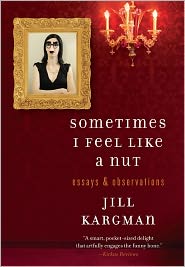
Jill Kargman's "Sometimes I Feel Like A Nut"

Jill Kargman is the author of teen books Bittersweet Sixteen, Summer Intern, and Jet Set, plus some excellent grown-up books.

She applied the “Page 99 Test” to her new book, Sometimes I Feel Like a Nut: Essays and Observations, and reported the following:
Page 99 of my book is actually sweet-- way the hell sweeter than I really am. It's part of an ode to my former life o' squalor called "A Letter To My Crappy One Bedroom," but captures not the roaches or coke-snorting neighbor or the lonely nights of shitty blind dates or sobbing atop piles of unopened boxes dropped there by the Hot Israeli Movers. By Page 99 I have reached the denouement of my personal Hades-- coming through the three years post- broken engagement and on the other side, away from horror show job, breakups, and a step closer to Happily Ever After. But the point of this chapter, and in fact the book as a whole, is that it's the bumpy parts that make us who we are, and that Harry my husband who carried me over the threshold didn't save me-- that shittyass apartment did. It was in those exposed brick walls that I found myself again, dancing alone to my blared weird music, staying up late twisting the phone cord around my fingers as I stressed to my best friends about the future while contemplating using it as a noose (joking), and began to really figure out what I wanted to do with my life. Page 99 is also miraculously devoid of profanity; one review said the F word and I are BFFs. And to that I say, Fuck yeah! If Chris Rock can say it why the fuck can't a honky mom of three? I mean, it's not like I say it front of the nuggets or anything. Unless they spill milk. Just kidding. Anyway I hope you all dig page 99 but know there's a much edgier side to the book that's not as sugary and tired with a happy ending bow; like in life there are many pitfalls and the humor of my friends and family dug me out again and again. I hope peeps enjoy this mini roller coaster of adventures and see some of their own chapters reflected. Happy reading and thank you so much!
Learn more about the book and author at Jill Kargman's website.

--Marshal Zeringue

Thursday, February 10, 2011

Philip Freeman's "Alexander the Great"

Philip Freeman is Qualley Professor of Classics at Luther College in Decorah, Iowa, and a former professor of classics at Washington University in St. Louis. He earned the first joint Ph.D. in classics and Celtic studies from Harvard University, and has been a visiting scholar at the Harvard Divinity School, the American Academy in Rome, and the Center for Hellenic Studies in Washington, D.C. His books include St. Patrick of Ireland and Julius Caesar.

He applied the “Page 99 Test” to his new book, Alexander the Great, and reported the following:
On page 99 of Alexander the Great, Alexander has just led the Macedonian army through the snows of Asia Minor to a camp on the southern coast of modern Turkey. He had defeated the Persian army along the Aegean and was now doing the unthinkable by conducting a winter campaign in the mountains. This flouting of the rules of war was typical of Alexander and would be a hallmark of his march across Asia and Africa over the next twelve years. His audacity would lead him to defeat armies twice his size and take on challenges impossible for others.

This page also introduces one of the first political intrigues against the king. He receives a warning from his oldest general Parmenion saying that one of his officers, another man named Alexander from the province of Lyncestis, was going to betray the king. The problem was that Alexander the ruler didn’t really trust Parmenion since he represented the old guard of the Macedonian nobility who had never really liked him and because he was a likely candidate for the throne himself. Was Parmenion trying to stir up mistrust among the king’s men to his own advantage or was Alexander of Lyncestis a genuine threat? As bold as Alexander was in war, he was cautious in politics. Most kings would have executed a potential threat, but Alexander told Parmenion to do nothing except keep an eye on the man. He would deal with both of them later.

In my biography of Alexander, I try to present him in all his complexity as a brilliant military leader and flawed character with a relentless drive to rule the world. At the start of his reign in his early 20’s, he controlled most of the Balkans. By the end, he reigned all the way to the Indus River. The legacy he left behind is still with us today.
Learn more about the book and author at Philip Freeman's website.

--Marshal Zeringue

Wednesday, February 9, 2011

John Woestendiek's "Dog, Inc."

Pulitzer prize-winning investigative reporter John Woestendiek is a 33-year newspaper veteran. Most recently, he worked as the features reporter at the Baltimore Sun. He writes and produces the popular dog website ohmidog! which gets over 1,000 hits a day.

Woestendiek applied the “Page 99 Test” to his new book, Dog, Inc: The Uncanny Inside Story of Cloning Man's Best Friend, and reported the following:
Page 99 of Dog, Inc.: The Uncanny Inside Story of Cloning Man’s Best Friend contains a revelation, acknowledges a hero who has stayed in the shadows, and provides an answer to the question that the last survivor of 9/11 has been asking in the nearly ten years since she was pulled from the rubble.

Wait a minute, you’re saying, isn’t this book about cloning dogs? Yes, but it’s also a book about humans, human nature, heroes true and false, legacies, love and loss, cheating death, resurrecting the past, denial, delusion, wishful thinking, dogs of course, and having something to hold onto.

It’s the nuances of those things – more so than the scientific complexities of cloning – that are at the book’s heart. It’s labeled a “science” book. It’s really not that at all.

Page 99 of Dog, Inc. comes seven pages into Chapter 9, which recounts the story of a retired police dog, a German shepherd named Trakr, whose human partner, a police officer at the time in Halifax, Nova Scotia, named James Symington, claims his dog pinpointed the location of Genelle Guzman, the fourth and final survivor to be rescued in the days after the attack on the World Trade Center.

As the chapter points out, the aftermath of 9/11 showcased the best and worst of humanity – from the selfless toil of firefighters and volunteer searchers and rescuers to blatant acts of self promotion and fraud.

On 9/11, Genelle Guzman, a 32-year-old immigrant from Trinidad who worked as a clerk for the Port Authority of New York, was at work on the 64th floor of the North Tower when she felt the impact. She had taken the stairs to the 13th floor when blackness descended and the tower collapsed. When she came to, she was trapped under a mountain of debris.

For 26 hours, lapsing in and out of consciousness, she prayed, asking God for a second chance at life.

When a hand finally reached through the rubble she was buried beneath, she grabbed it and held on tightly. She asked her rescuer his name. “Paul,” he said. Thirty minutes later she was freed and passed on a stretcher down a line of rescuers. In the hospital, and several times since, she’d try to find out who Paul was. Paul – her angel, she called him -- never stepped forward. But others would, including two volunteer firefighters from Massachusetts who would be “reunited” with Guzman by CNN. She didn’t recognize them. And again, she asked about Paul.

Page 99 of Dog, Inc. reveals that the man who found Guzman and held her hand until she was freed was Paul Somin, a lieutenant in the New York Fire Department’s Rescue 2.

True to form, Somin declined to be interviewed for the book. According to his co-workers, who confirmed the story, stepping into the spotlight is not the FDNY way – what they do, they do as a team, and seeking, or even accepting, individual glory is frowned upon.

Not everyone who descended on Ground Zero held that same philosophy, including Scott Shields, who showed up with Bear, an aging golden retriever he claimed was a search and rescue dog and in whose name Shields had established a search and rescue dog foundation. Shields, lacking any credentials, was sent away the first day by police. But that didn’t stop him from promoting his foundation, raising funds and making appearances. In at least one of those, he claimed Bear made more “live finds” at Ground Zero than any other dog. Later he’d be convicted of a different 9/11-related fraud and sent to prison.

New York police officials say dogs made no live finds at Ground Zero, and say there is no official record of Halifax police officer Symington and his dog Trakr registering at the scene. Then again, the scene was chaotic, and lots of volunteers, like Symington, just showed up and went straight to work.

By Symington’s account, he, a friend and Trakr rushed to New York from Nova Scotia and immediately began navigating through the rubble. At one spot, Trakr gave a mild alert, pawing and sniffing atop a pile of debris in a way that indicated to his handler that someone might be buried beneath.

Sources say a second dog was called over and gave a mild alert as well, but amid warnings that the pile they were on was unstable, the dogs and handlers moved on, continuing their search elsewhere.

The next day, Symington says, he was informed by firefighters that a woman had been found alive in that precise spot where Trakr had alerted. The story of Trakr’s involvement in Guzman’s rescue never made it to the big newspapers, but Symington appeared on TV, an act that led to his firing back home. He hadn’t been authorized by his department to go to Ground Zero and his actions there, his supervisors said, showed he was not incapable of working. Symington was out on sick leave from the department at the time.

Later, Symington and Trakr would receive an award for their work at Ground Zero, presented by Jane Goodall. The “Extraordinary Service to Humanity Award,” as it was called, came from The Bear Search and Rescue Dog Foundation, Scott Shields’ dubious organization.

Still, you might be asking, what does this have to do with cloning?

Trakr, as it turned out, would become one of the first cloned dogs to arrive in America.

Based on an essay by Symington, recounting Trakr’s police career, his work at 911 and his Extraordinary Service to Humanity Award, Trakr was chosen as winner of “The Golden Clone Giveaway.”

Bio Arts, a California company that in its first incarnation called itself Genetic Savings & Clone, was behind the contest. In addition to holding an online eBay style auction for five dog clonings, the company decided to offer one free one – to the dog that, based on essays, the judges chose the most “cloneworthy” in America.

Trakr won easily. His cells were sent to South Korea, and in June of 2009, several months after Trakr had died, his clones were delivered, five of them, named Solace, Valor, Prodigy, Trustt and Déjà Vu.
Visit the official Dog, Inc. website, and learn more about the book and author at John Woestendiek's website and blog.

Writers Read: John Woestendiek.

--Marshal Zeringue
Tuesday, February 8, 2011

Paula Szuchman and Jenny Anderson's "Spousonomics"

Paula Szuchman is co-author, with Jenny Anderson, of Spousonomics: Using Economics to Master Love, Marriage and Dirty Dishes. Szuchman is an editor at The Wall Street Journal, and Anderson is a reporter at the New York Times.

Szuchman applied the “Page 99 Test” to Spousonomics, their first book, and reported the following:
Turn to page 99 of Spousonomics and you won’t find a single reference to marriage. Pepto-Bismol, yes. Out-of-pocket insurance expenses, yes. Moral hazard, yes. But no marriage. No wedded bliss. No suggestions for improving your love quotient.

This says a lot about the book, mainly that it’s not your typical relationship book. Jenny and I do promise you practical solutions to some common marriage problems, but we don’t go about it in the usual way. Each chapter is tied to a different economic principle, and begins with one of the more engaging econ “lessons” you’ll ever read.

The one that starts on page 98 is called “Moral Hazard: Or, The Too-Big-To-Fail Marriage.” Moral hazard means that people will take greater risks when there are no repercussions. (Thus the out-of-pocket insurance expenses, which insurance companies use to deter people from taking advantage of their coverage and going to the doctor every time they sneeze.) Moral hazard helped drive the U.S. economy into the gutter, with giant financial firms like Citigroup and AIG taking crazy risks because they knew that if anything went wrong, Uncle Sam would bail them out.

As we say on page 99, moral hazard, in plain English, means simply: “Give an inch, take a mile. Bet the house, wait for a bailout. Go directly to jail, get out of jail free.”

All of which actually has plenty to do with your marriage, as we make clear once you get to page 102. Marriage can act a bit like insurance, which is fine if it means we feel safe and secure in our partners’ arms. But things go haywire when we take these same partners for granted, assuming they’ll be there no matter how we behave—if we stop going to the gym, get too lazy to have sex and are always too distracted to say the occasional “I love you.”

But there’s a way out of the moral-hazard trap. If you read past page 99, you’ll see how three couples overcame moral hazard in their own marriages—without paying anywhere near $25 billion.
Learn more about Spousonomics and its authors, Paula Szuchman and Jenny Anderson, at their website, their Amazon page, and on Twitter @spousonomics.

--Marshal Zeringue

Monday, February 7, 2011

Jonathan Hafetz's "Habeas Corpus after 9/11"

Jonathan Hafetz is a professor at Seton Hall Law School and has litigated numerous landmark habeas corpus detention cases. His publications include The Guantnamo Lawyers: Inside a Prison Outside the Law, co-edited with Mark Denbeaux.

He applied the “Page 99 Test” to his new book, Habeas Corpus after 9/11: Confronting America’s New Global Detention System, and reported the following:
The book examines the shift in U.S. detention policy after 9/11. As the book explains, Guantanamo is part of larger detention system created in the “war on terror.” The book thus discusses Guantanamo in the context of other off-shore prisons such as Bagram in Afghanistan and secret CIA “black sites” created to operate without judicial oversight and outside the law.

Page 99 discusses Hirota v. MacArthur, a 1948 Supreme Court decision that rejected a habeas corpus challenge to an international tribunal that had tried various Japanese officials and military officers for war crimes. (Habeas corpus is a centuries-old writ used to challenge unlawful detention). The Court rejected the challenge in Hirota, concluding that a U.S. court had “no power or authority to review, to affirm, set aside, or annul the judgments” of an international tribunal.

After 9/11, the Bush administration seized on Hirota for the more sweeping proposition that U.S. courts had no jurisdiction to hear challenges by prisoners held by the United States whenever the U.S. was acting as part of an international force, even if the prisoners were under the sole control of the United States. Under the government’s theory, the executive could invoke a U.N. Security Council resolution to shield any U.S. detention from judicial scrutiny (An ironic claim for an administration that spurned international legal obligations in its treatment of prisoners held as “enemy combatants”).

In its 2008 decision in Munaf v. Geren, the Supreme Court rejected the government’s theory in a habeas corpus case involving two American citizens imprisoned in Iraq. Since the prisoners remained under U.S. control, the Court ruled, the courts had jurisdiction over their petitions, even though the U.S. was operating in Iraq as part of a multinational force. The Court nonetheless dismissed the cases, holding that federal judges could not afford relief where the U.S. held a prisoner in another country for crimes allegedly committed in that country (one petitioner in Munaf was held on allegations of kidnapping; the other for associating with terrorists). Both men presented evidence that they would be tortured if handed over to Iraqi authorities. The U.S. government now reads Munaf broadly to extinguish judicial review over any extraterritorial prisoner transfer by the executive—even where the detainee asserts a fear of likely torture in violation of U.S. and international law. The book explains how the government’s position represents a threat to habeas corpus and the effective enforcement of human rights.
Read an excerpt from Habeas Corpus after 9/11, and learn more about the book at the publisher's website.

--Marshal Zeringue

Sunday, February 6, 2011

Oren Izenberg's "Being Numerous"

Oren Izenberg is a visiting scholar at the University of Illinois, Chicago.

He applied the “Page 99 Test” to Being Numerous: Poetry and the Ground of Social Life, his first book, and reported the following:
Page 99 of Being Numerous: Poetry and the Ground of Social Life discusses a poet, George Oppen, best known for his silences: for the austerity and fragmentation of his poems and for the 25 year period in which he wrote no poetry while working to reconcile the conflicting commitments of art and politics.

Quoting “Psalm,” written after Oppen’s return to writing—
In the small beauty of the forest

The wild deer bedding down—

That they are there!
—I describe how Oppen steers his readers away from the “small” sensual particulars so central to art’s appeal, seeking instead to bring to mind a large and difficult abstraction. The idea that something (or someone) not ourselves exists is, of course, one of the deepest occasions for skepticism. It is a conclusion that cannot follow of necessity from the evidence of our senses. Thus even as the poem confidently, joyfully, proclaims “that they are there,” it is silent (“—“) about the path that leads from its observed scene to its metaphysical certainty.

Oppen’s silence—his willingness to sacrifice his poetry in the interest of a greater knowledge—exemplifies the central question in Being Numerous: What happens when one of the traditional achievements of poetry—its ability to make another mind or voice vividly present to us through the scoring of sound and sense—comes into conflict with one of its traditional obligations: to assert and preserve the value of persons against the inevitability of forgetting or loss? These poetic triumphs and tasks have always had an uneasy economic relation; for every poem that limns a human ideal, there is a human who falls short of meeting it. Every poetic success at opening our eyes to the presence of a person produces a concomitant blindness to the existence (and perhaps the suffering) of whole classes of persons of whom no one has thought to sing. Under the pressures of a century of disasters (world war, and genocide, but also the levelings of capitalist culture), the poets I discuss come to feel this exchange to be an intolerable one. To them, the idea that (as Hannah Arendt would claim) “nothing and nobody exists in the world whose very being does not presuppose a spectator”—that persons, like poems, must be perceived in order to be valued—subjects persons to unbearable risks of inattention and failures of perception.

As the consequences of our ordinary failures to perceive and value the presence of persons comes to seem catastrophic or total, these poets are driven to turn away from the sensual richness of their strongest poems, to undermine the particularity of their imaginative or moral visions, and to reject the consolation of shared experience or sympathetic understanding—all in an effort to bring to mind concepts of personhood (“Being”) that are at once minimal, placing as few restrictions as possible upon the legitimate forms a person can take, and universal (“Numerous”), tolerating no exemptions or exclusions.
Read an excerpt from Being Numerous, and learn more about the book at the Princeton University Press.

--Marshal Zeringue

Friday, February 4, 2011

Minsoo Kang's "Sublime Dreams of Living Machines"

Minsoo Kang is an associate professor of European history at the University of Missouri - St. Louis. He is also a fiction writer and the author of the short story collection Of Tales and Enigmas.

He applied the “Page 99 Test” to his new book, Sublime Dreams of Living Machine: The Automaton in the European Imagination, and reported the following:
In my book Sublime Dreams of Living Machine, I trace the millennia-long fascination in the West with the self-moving machine that mimics a living creature that is best known today as the robot. While I look at the technological aspects of the object from the ancient Greek works of the first century CE engineer Hero of Alexandria, to the clockwork masterpieces of the Enlightenment and contemporary breakthroughs in robotics, my primary interest in the book is on how intellectuals, creative writers, and artists used the very idea of the life-imitating machine as a symbol and a conceptual tool to think about the nature of humanity. Looking at page ninety nine of the book reminded me how at one point I seriously considered putting the word ‘robot’ in the title since many people who were unfamiliar with the word ‘automaton’ asked me to define it. But I quickly decided against this: it offended my sensibilities as a historian to commit such an act of anachronism since ‘robot’ was not coined until the 1920s (by the Czech artist and writer Josef Čapek who allowed his brother Karel to use it for his science-fiction play R.U.R. Rossum’s Universal Robots). In fact, the definitions of words that denote autonomous machines is an important part of my book since I point out that ‘automaton’ itself underwent a number of changes in significance in the course of the many centuries since it was first used by ancient Greeks to denote any entity that is self-moving. Page ninety-nine features a very nice illustration of one ancient automaton designed by Hero – a figure of Heracles aiming an arrow at a serpent coiled around a tree (an apple lies between them which, when touched, releases the arrow). In the text below is a definition of yet another term for the object:
The origin of the word “android,” defined as an automaton that is specifically in the shape of a human being (as opposed to other living creatures), is obscure, but it is a medieval coinage from Greek roots (“andros,” man, and “eides,” species) and is commonly linked to Albertus Magnus.
Unfortunately, I have been unable to find the exact origin of the word, finding the earliest use of it in a sixteenth-century history book with a reference to the legend of the medieval philosopher Albertus Magnus constructing a moving statue that he employed as a servant. And so my research and obsession with automaton goes on.
Read more about Sublime Dreams of Living Machines at the Harvard University Press website.

--Marshal Zeringue

Thursday, February 3, 2011

Shamus Rahman Khan's "Privilege"

Shamus Rahman Khan is assistant professor of sociology at Columbia University. He is an alumnus and former faculty member of St. Paul's School.

He applied the “Page 99 Test” to his new book, Privilege: The Making of an Adolescent Elite at St. Paul's School, and reported the following:
In Privilege, I return to my alma mater, St. Paul’s School, to provide an account of one the nation’s most elite private boarding schools – a place with 500 students, 100s of millions of dollars at its disposal, and a stepping stone to positions of national influence. Yet in the text I argue that things have changed at places like St. Paul’s. Elite schools are now diverse. In positioning themselves to lead they have adapted to the moral codes of today: merit, hard work, talents, and individual capacity. In short, I argue that there is a new elite who are not an entitled group of boys who rely on family wealth and slide through trust-funded lives. The new elite feel their heritage is not sufficient to guarantee a seat at the top of the social hierarchy, nor should their lives require the exclusion of others. Instead, in certain fundamental ways they are like the rest of twenty-first-century America: they firmly believe in the importance of the hard work required to achieve their position at a place like St. Paul’s and the continued hard work it will take to maintain their advantaged position. Like new immigrants and middle-class Americans, they believe that anyone can achieve what they have, that upward mobility is a perpetual American possibility.

Whereas elites of the past were entitled—building their worlds around the “right” breeding, connections, and culture—new elites develop privilege: a sense of self and a mode of interaction that advantage them. The old entitled elites constituted a class that worked to construct moats and walls around the resources that advantaged them. The new elite think of themselves as far more individualized, supposing that their position is a product of what they have done. They deemphasize refined tastes and “who you know” and instead highlight how you act in and approach the world. This is a very particular approach to being an elite, a fascinating combination of contemporary cultural mores and classic American values. It harnesses a twenty-first-century global outlook, absorbing and extracting value from anything and everything, always savvy to what’s happening at the present moment. Part of the way in which institutions like St. Paul’s and the Ivy League tell their story is to look less and less like an exclusive yacht club and more and more like a microcosm of our diverse social world—albeit a microcosm with very particular social rules. Privilege takes us into the world of St. Paul’s School to outline this idea of privilege, and how it helps form a new elite.

On pp. 99, in talking about thread counts on shirts, I seek to show how exclusive cultural knowledge is no longer the mark of our social elites:
Harrison then moved to the care of such a tailored shirt. “The problem here is that there’s no place to wash them. I mean, you can’t put them in the laundry, and the dry cleaners ruin them. It’s a real problem. I’m doing them in the sink now. I guess it works. Hand washing is the best. But it really is a problem here. Something I didn’t think of.”

I didn’t know this. I had never thought of hand washing one of my own shirts. I didn’t realize I was ruining them—but I soon remembered they weren’t much to ruin. Though my brother had lived in London for the previous ten years, and I had visited him often, I still had no idea what Savile Row was or that the street was famous for quality tailors. It was clear that none of the other young students did either. As Harrison took his shirt off and let the other students touch it, I could not help but join in the ritual, appreciating the softness of the shirt. I was seduced by the moment. I was watching, so I thought, the training of the new elite.

The following Sunday, I drove the house seniors, James, Peter, and Ed, into Boston for dim sum. During the ride, they brought up the interaction that Harrison had had with the younger students.

“I heard you were on duty Tuesday when Harrison was talking to the newbs about clothes or something.”

“Yes. It was interesting.”

Almost before I could finish my sentence, Ed interrupted, “It was bullshit, is what it was.”

I was honestly shocked.

“I mean, who owns shirts like that?” Peter asked, rhetorically.

“Not even my dad,” James decided to answer. I knew James and Peter to be from fairly wealthy families. Paying what they did for St. Paul’s, their parents could also have bought them shirts like the one Harrison was wearing.

“I know. I mean, maybe Larry.”

Thinking perhaps my seniors were not like other seniors, I asked who Larry was.

Peter answered, “Oh, those guys from Hong Kong. They have crazy clothes.”

But so as to emphasize that this was unique to Hong Kong, and not St. Paul’s, James told me, “Yeah. But no one here does. Harrison doesn’t know what he’s talking about.”

After Harrison’s conversation with the new students, Ed had some of them come to his room and ask him about it. The new students were…
Read an excerpt from Privilege, and learn more about the book and author at the Princeton University Press website and Shamus Rahman Khan's website.

--Marshal Zeringue

Wednesday, February 2, 2011

Russell K. Schutt's "Homelessness, Housing and Mental Illness"

Russell K. Schutt is Professor and Chair of Sociology at the University of Massachusetts and Lecturer on Sociology in the Department of Psychiatry, Harvard Medical School. His books include: Investigating the Social World: The Process and Practice of Research; Organization in a Changing Environment; and Responding to the Homeless: Policy and Practice.

He applied the “Page 99 Test” to his new book (with Stephen M. Goldfinger), Homelessness, Housing, and Mental Illness, and reported the following:
Page 99 passes the test with flying colors. Homelessness, Housing and Mental Illness tells the story of homeless persons with severe mental illness who moved into housing as part of a federal research demonstration project and attempted to rebuild their lives. Anyone who has moved into a first home knows what an empowering experience that can be; you can imagine how that psychological effect would be magnified for persons who have been living for years in shelters and on the streets.

So empowerment in this context is a shift in psychological orientation as well as a change in physical location. It has served for years as a vision of what recovery from mental illness should look like and as an endpoint for the process of deinstitutionalizing psychiatric care.

On page 99 the empowerment process is in full swing in one of the homes, as “more tenants participated in tenant meetings and expressed their opinions more freely.” The project “empowerment coordinator” opens a house meeting by explaining “consensus thinking… we decide what a problem is…and we discuss all the sides.” The meeting is friendly and supportive, as tenants respectfully share their opinions and shoulder the responsibilities of house management.

If only the story could have remained on that page forever. But life is not so simple and social relations are not so easy and so one page is not the whole story. By the book’s end, page 99’s glowing description of empowerment seems almost like a mirage, shimmering in the distance but never quite attained.

What page 99 does not reveal is that the empowerment process encountered frequent obstacles due to drug and alcohol abuse, symptoms of psychiatric illness, functional impairments, and some discordant agency rules. Instead of turning the house keys over to an empowered group of tenants, house staff had to reassert their authority over critical house functions.

Also missing on page 99 is the other half of the story. Half of the initially homeless participants In our experiment were assigned to live in independent apartments rather than in group homes. The independent apartment tenants were to become empowered by living in the community like others, in their own home rather than as part of a group.

So the question addressed by our team of researchers was whether empowerment could best be achieved by living in a group home with others or by living on one’s own. Would there be any lasting value to the social engagement described so movingly on page 99? The answer awaits those who continue reading beyond that page.
Learn more about the book at the Harvard University Press website.

--Marshal Zeringue

Tuesday, February 1, 2011

David Sehat's "The Myth of American Religious Freedom"

David Sehat, Assistant Professor of History at Georgia State University, is a cultural and intellectual historian of the United States. His work focuses on the role of religion in law and politics from the First Amendment to the present.

He applied the “Page 99 Test” to his new book, The Myth of American Religious Freedom, and reported the following:
Page 99 of The Myth of American Religious Freedom captures one of the central themes of the book. I argue that much of our understanding of the American religious history is shrouded in myth. Rather than a happy past of religious freedom, my book shows that the United States was long controlled by Protestant Christians who sponsored a coercive and exclusionary moral regime. Dissenters from this regime—who included abolitionists, women’s rights activists, labor organizers, educational reformers, and more—were particularly acute in their criticism of the coercive arrangements of the past, so I rely upon them to point out the nature and extent of these connections of religion and state.

On page 99, I discuss Elizabeth Cady Stanton, a leader of women’s rights, fierce opponent of religion in public life, and organizer of the 1848 Seneca Falls Convention, which sought to advance women’s rights in the United States. Stanton had first attended the 1840 convention of the world antislavery societies in London, where she met the radical William Lloyd Garrison. She would later say that Garrison helped to free her from the chains of “spiritual bondage.” Once freed, she came to the conclusion that women had been oppressed in American law by an improper connection of religion and the state. This connection installed Christian patriarchy into law, putting the full force of the state behind Christian gender ideals. At the 1848 Seneca Falls convention, Stanton led the other delegates in rejecting the oppression of women in law and calling for their “immediate admission to all the rights and privileges .... as citizens of these United States.” This claim of equal and individual rights in the face of religious oppression was a common one by dissenters, who argued that the Protestant Christian control over the United States had unfairly excluded them.
Learn more about The Myth of American Religious Freedom at the Oxford University Press website.

--Marshal Zeringue