Sunday, November 13, 2011

David O. Stewart's "American Emperor"

David O. Stewart's books include the highly acclaimed The Summer of 1787, the bestselling account of the writing of the Constitution, and Impeached: The Trial of President Andrew Johnson and the Fight for Lincoln's Legacy. He has practiced law in Washington, D.C., for more than a quarter of a century, defending accused criminals and challenging government actions as unconstitutional. Stewart has argued appeals all the way to the U.S. Supreme Court and was law clerk to Justice Lewis Powell of that Court.

He applied the “Page 99 Test” to his new book, American Emperor: Aaron Burr's Challenge to Jefferson's America, and reported the following:
American Emperor tells the story of Burr’s audacious attempt to raise a private force to invade Mexico and Florida. He hoped to form a new empire consisting of those lands and as much of the American West as would be willing to join him. At Page 99, we find Burr dining on an Eden-like island in the Ohio River with Harman and Margaret Blennerhassett, two Irish expatriates who were the most implausible and the most pathetic of Burr’s recruits:
Then forty years old, Harman Blennerhassett cut an Ichabod Crane figure: six feet tall, slender, with gray hair, a large nose and weak eyes. When reading, he held books so close that his nose brushed the page. His mansion included a library and a scientific laboratory. His favorite pursuits were music and chemistry. In contrast, Margaret Blennerhassett was a skilled horsewoman, tall and athletic, able to vault the five-foot fence that surrounded their property. Educated far beyond the norm for the Ohio Valley, the Blennerhassetts liked to display their learning. Harman spouted passages from the Iliad in Greek. Margaret favored Shakespeare, though she also read to guests in French, following with her own translations.
Without a martial bone in his elongated, myopic body, Blennerhassett eagerly joined Burr. The Irishman wrote newspaper essays urging Westerners to secede from the United States, recruited his neighbors to join the effort, and shoveled so much of his money into the enterprise that he impoverished his family. Blennerhassett ended up in a Richmond, Virginia prison, facing trial for treason, though he was released after Burr won an acquittal on the treason charges brought against him.

Throwing in with Burr did not often end well. As one of Burr’s friends wrote years later (quoted on page 297 of the book):
“I have found myself sometimes in company with half a dozen of Mr. Burr’s friends, all cursing him for having duped them, and all duped in a different manner . . . always adapted to their peculiar characters.”
Fascinating fellow, that Burr!
Learn more about the book and author at David O. Stewart's website and blog.

My Book, The Movie: American Emperor.

Writers Read: David O. Stewart.

--Marshal Zeringue

Friday, November 11, 2011

Gernot Wagner's "But Will the Planet Notice?"

Gernot Wagner is an economist at the Environmental Defense Fund. He teaches at Columbia and graduated from both Harvard and Stanford. He doesn’t eat meat, doesn’t drive, and knows full well the futility of his personal choices.

He applied the “Page 99 Test” to his new book, But Will the Planet Notice?: How Smart Economics Can Save the World, and reported the following:
But Will the Planet Notice? is about environmental policies that actually make a difference. It's not about you and I recycling -- although that's good, too. It's about putting a tiny fee on plastic bags that decreased their use in Ireland by 90% and one billion bags this past decade.

Page 99 is rather wonkish. It introduces one of the fundamental concepts: making sure someone owns the rights to a particular resource is the best way of protecting it. In this case, it's fish:
That simple step makes all the difference. It’s no longer a race. Much like with the Maine lobster, what you don’t catch today will still be there for you tomorrow. You own the right to a certain number of fish. Period. Your neighbor can’t take it away from you, just because you take the day off. The motivation to treat fishing as if it were a competitive free-for-all is gone.

Bigger engines enable you to haul in your catch earlier, but the reason to go overboard in the technological arms race is gone. [...] Fishermen no longer use larger and larger boats to chase fewer and fewer fish. It is now in their interest to decrease costs. Things generally get much more relaxed. Alaska's halibut fishing season has increased from two to over two hundred days, all without additional restrictions or regulations.

Sounds like socialist nirvana with the guiding hand of regulators replacing the invisible hand of the market. In fact, it’s anything but. This is much closer to the “privatism of free enterprise” Garrett Hardin described as the other solution to the commons problem, the exact opposite of socialism. Fishermen affected by the changes wax poetic, using terms like "liberty," "freedom," and "dignity." Increasing the fishing season from two to two hundred days doesn’t just make fishing more relaxed; it also means that fishermen no longer bring in half their entire annual catch in one day. That avoids flooding the market with halibut all at once, crashing the price in the process.

With higher prices, lower costs, and more sustainable catches, revenues doubled and profits quadrupled in the first five years of the program. It doesn't get more free market than that--except that it does.
Learn more about the book and author at Gernot Wagner's website and blog.

--Marshal Zeringue

Thursday, November 10, 2011

Jena Pincott's "Do Chocolate Lovers Have Sweeter Babies?"

Jena Pincott writes about the quirky, hidden side of science — the shocking, subconscious, under-the-radar stuff. Her book Do Gentlemen Really Prefer Blondes?, on the science of love and attraction, is being translated in 17 languages.

She applied the “Page 99 Test” to her new book, Do Chocolate Lovers Have Sweeter Babies?: The Surprising Science of Pregnancy, and reported the following:
Page 99 of Do Chocolate Lovers Have Sweeter Babies? is about conflict:
I confess the only part about parenthood I’m not looking forward to is conflict. The squabbles and skirmishes. The tensions between mother and father, parents and children, grandparents and parents, not to mention sibling rivalry if we have more than one child.
Turning the page, the reader realizes that this passage isn’t about the usual family feud. It’s about genes. In particular, it’s about imprinted genes. Imprinted genes have a tag that says whether they come from Mom or from Dad, and the tag silences the gene. This means that sometimes Mom’s genes have the upper hand and sometimes Dad’s genes do. When the father’s genes have the upper hand in pregnancy, as they often do, the result can be a greedy fetus and an overeating mother. From an evolutionary perspective, it’s in the father’s best interest for the fetus that is carrying his genes to survive and pilfer the most resources from the mother. Women who overeat in pregnancy may place at least some of the blame on their partners.

This is just one example of the sort of strange, surprising, under-the-radar stuff that happens in pregnancy. There’s a lot more, from chemosignals in pregnant women's sweat to prenatal flavor-learning, fetus-friendly semen and gender-biased bodies; labor-expediting dreams, mood milk, and a lot of brainwashing and brain-boosting.
Learn more about the book and author at Jena Pincott's website and blog.

The Page 99 Test: Jena Pincott's Do Gentlemen Really Prefer Blondes?.

--Marshal Zeringue

Wednesday, November 9, 2011

Gershom Gorenberg's "The Unmaking of Israel"

Gershom Gorenberg is an Israeli historian and journalist. His previous books are The Accidental Empire: Israel and the Birth of the Settlements, 1967-1977 and The End of Days: Fundamentalism and the Struggle for the Temple Mount.

He applied the “Page 99 Test” to his new book, The Unmaking of Israel, and reported the following:
On an autumn day in 2009, at the height of the West Bank olive harvest, I drove into the Israeli settlement outpost known as Gilad's Farm, southwest of Nablus. Twenty-five families lived at the settlement, and another thirty young men were studying there at a religious seminary called Sing Unto the Lord Yeshivah. On the study-hall notice board at the yeshivah, I found a handbill. In the diction of Jewish religious law, it called on young settlers to raid Palestinian olive groves, seizing the ripe fruit for themselves if possible, destroying the groves if not.

I was in the midst of my research for The Unmaking of Israel, which describes the forces undermining Israel's democracy and Israel's existence as a state. Gilad's Farm is very tangible product of some of those forces: It's one of about a hundred outposts established by young Israeli settlers in the West Bank since the 1993 Oslo Accord. Ostensibly, the outposts settlers have defied the Israeli government and the law in force in the West Bank; in reality, government agencies have ignored or actively assisted in the outpost effort. As with previous stages of the settlement enterprise, the outposts undermine the rule of law, blur the borders of the state, and undercut basic principles of democracy.

Through supporting the settlements, the state has also helped transform religious Zionism - once a moderate political movement - into a nationalist sect centered on Jewish control of the Whole Land of Israel. As I explain on page 99, the leaflet I found at Gilad's Farm is an example of how Judaism is transmogrified in the West Bank hills:
...The handbill tacked to the notice board demonstrated an old principle: with enough determination, an interpreter of sacred texts can turn them inside out, making a sin into an obligation. On the simplest level, the writer had to explain away the explicit commandment in Deuteronomy 20:19 against chopping down fruit trees as a means of waging war. He rationalized an obvious act of theft as reclaiming one’s own property. He also ignored an ancient and well-known rabbinic gloss on the disagreement between the shepherds of Abraham and his nephew Lot in the book of Genesis: Lot’s men, the tradition says, grazed his herds in fields owned by Canaanites, rationalizing that God had promised the land to Abraham’s descendants. But Abraham rejected that excuse. The story teaches that a divine promise for the undefined future cannot justify theft from the land’s here-and-now inhabitants. This is a tradition that schoolchildren learn.

Historically, religious groups that believe God’s kingdom on earth is near are particularly vulnerable to this kind of photo-negative morality. There’s no better way to demonstrate that a new age has dawned than to say that new rules have replaced the old. In Judaism, the classic example is the seventeenth-century false messiah, Shabtai Tzvi, whose followers turned adultery into a ritual. In our time, theologies that absorb extreme political doctrines suffer similar vulnerability to sanctifying sins—as shown by Islamic radicals who have turned the forbidden act of suicide into heroism.

The religious settlement movement is doubly vulnerable: it springs from the faith expressed by Tzvi Yehudah Kook that “we are already in the middle of redemption,” and from recasting nationalism, at its most tribal, as religious doctrine....
Learn more about The Unmaking of Israel and the author at the HarperCollins website and the South Jerusalem blog.

--Marshal Zeringue

Tuesday, November 8, 2011

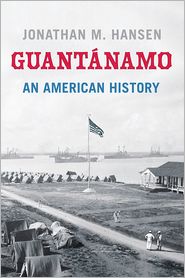
Jonathan M. Hansen's "Guantánamo: An American History"

Jonathan M. Hansen, a historian at Harvard University, is the author of The Lost Promise of Patriotism: Debating American Identity, 1890–1920.

He applied the “Page 99 Test” to his new book, Guantánamo: An American History, and reported the following:
Page 99:
...barked a century and a half earlier. Huntington described the clearing in his official report to the marine commandant. “The ridge slopes downward and to the rear from the bay, the space at the top is very small, and all the surrounding country is covered with a thick and almost impenetrable brush. The position is commanded by a mountain, the ridge of which is about 1,200 yards to the rear.” The first night the marines “slept with our clothes on and rifles by our side,” Keeler remembered. “Had the Dons surrounded the hill they could have fired upon us with deadly effect, for they could have fired from all sides without hitting their own men.”

In hindsight, Huntington’s choice of a campground seems inauspicious. In Key West, Huntington had proved incapable of checking the abuses of the Panther captain; at Guantánamo, he lacked the confidence to question the decisions of his superiors. In the three days between occupying the outer harbor and the arrival of the marines, the navy had seen little or no enemy activity along the shores of Guantánamo Bay. When the Panther pulled in, Captain McCalla directed the marines toward a landing site and campground selected in advance by a colonel in the Cuban Army. McCalla informed Huntington that it was safe to erect tents. As a veteran commander, Huntington might have thanked McCalla for his assistance and proceeded as he had been trained to do: secure a safe landing site, identify a suitable campground, and entrench. A young captain in Huntington’s command remembered the colonel declaring the position “faulty” and deploying pickets. But that’s as far as Huntington’s initiative went.

Spain opened fire the following afternoon. “I was looking at my watch,” wrote Keeler. “It was just 5 o’clock, Saturday, June 11th, when we received the greatest surprise of our lives.” Some of the men were in the water bathing; some “were asleep when the reports of the rifles rung out.” As the marines dove for their guns, the “bullets came among [them] like rain.” There was no place to hide. “We dodged about trying to find shelter but there was neither trees or big rocks to get behind.”

U.S. Marine Corps major Henry Clay Cochrane remembered being surprised by the vulnerability of the camp and disappointed in Huntington’s response to the initial onslaught. When the marines went ashore on June 10, Cochrane remained aboard the Panther to oversee the unloading of cargo. He first set foot on land just as the Spaniards
I like to think that the “quality” of research and writing is consistent throughout the book (namely, high), but the character of the book changes dramatically, as its aspiration is at once comprehensive and synoptic, encompassing natural, military, political, cultural, and intellectual history, as well as legal and critical analysis. Without overdoing it, I try to adjust literary style to subject matter. Early sections on Guantánamo’s natural history, for instance, strive for a clarity and directness that you might find in a scientific journal, though with perhaps a little more art. Page 99, quoted above, pertains to the U.S. marines’ initial capture of the bay, hence the writing tends to be a little more dramatic. Likewise, as the book moves in the last two chapters towards the present day, some readers detect a critical edge suffusing the writing, which I, too, was aware of, and which I tried to tamp down but not eradicate.

Still, if I were to pick a page or passage that conveys the “quality” of the book, I would not have chosen page ninety-nine—not because it lacks merit or interest—but because the U.S. marines’ capture of Guantánamo Bay in 1898 is one of the few things that folks who know something about Guantánamo’s history are already aware of. The book is full of surprises, not least, for example, the fact that Mount Vernon, our national shrine, is named after British rear admiral Edward Vernon, who George Washington’s half-brother Lawrence served with for three months in Guantánamo, of all places, in the summer of 1741. In ways that few of us might imagine, Guantánamo is woven into the fabric of American nation-making and imperial ambition. The very summer that Lawrence Washington was sweating it out in Guantánamo, newspapers up and down the Atlantic seaboard were advertising this section of Cuba as the “Land of Promise”—a solution to the overcrowding and economic stagnation besetting Britain’s North-American colonies.

In sum, the book brings together past and present, insisting that you can’t understand the debacle of post 9/11 Guantánamo without understanding the century-long history of America’s occupation of the naval base, and you can’t understand that occupation, in turn, unless you understand Guantánamo’s role in transforming a group of fledgling British colonies into the imperial juggernaut we know today.
Learn more about Guantánamo: An American History at the publisher's website.

--Marshal Zeringue

Monday, November 7, 2011

Dean Falk's "The Fossil Chronicles"

Dean Falk is a Senior Scholar at the School for Advanced Research in Santa Fe, New Mexico. Her books include Finding Our Tongues: Mothers, Infants, and the Origin of Language and Braindance, Revised and Expanded Edition: New Discoveries about Human Origins and Brain Evolution.

She applied the “Page 99 Test” to her new book, The Fossil Chronicles: How Two Controversial Discoveries Changed Our View of Human Evolution, and reported the following:
Amazingly, page ninety-nine of The Fossil Chronicles does, indeed, capture the essence of the book. Part of the reason is because one section ends and another begins near the middle of this page. A goal of the book is to portray the twists, turns, competitiveness, and passions that have always characterized research on human origins (what I call “paleopolitics”). In this spirit, the top of page ninety-nine reminds the reader that Raymond Dart’s discovery of the famous Taung fossil (Australopithecus africanus, 1925) was dissed for decades because of turf guarding on the part of the British scientific establishment, which continued to promote Piltdown Man as the father of us all. It was not until 1953 that Piltdown was revealed as an elaborate fraud. Meanwhile, poor Dart was psychologically bloodied and paleoanthropology was impeded by the actions of the “Piltdown Committee.” Dart died a happy (old) man, though, because the tremendous importance of his discovery was recognized while he was still alive. Page ninety-nine also observes that similar turf guarding is currently involved in the intense scientific controversy about the validity of a tiny skeleton nicknamed “Hobbit” (Homo floresiensis, 2004), which was recently discovered on the island of Flores in Indonesia. Hobbit is already changing the textbooks on human evolution, although the find is so new that the last word is not yet in. To my surprise, the acrimony over Hobbit makes the Piltdown gang look almost gentlemanly -- no small achievement.

The section that begins near the middle of page ninety-nine discusses the reactions of religious fundamentalists to Homo floresiensis, reactions similar to earlier Biblicists’ response to the discoveries of Pithecanthropus (now Homo) erectus, Neanderthals, and Australopithecus africanus. Invariably, fundamentalists suggest that important new discoveries of fossilized human relatives represent apes or pathological contemporary people -- i.e., anything but evolutionary ancestors of humans whom, they believe, were created supranaturally. I hasten to add, as does the book, that religious fundamentalists are no more invested in their explanations of human origins than some scientists are and that, in a sense, we are all asking the same big questions -- where did we come from, and where are we going? If readers of The Fossil Chronicles feel some of the excitement and drama of pursuing questions about what made us human and the thrill of refining the tentative answers in light of newly discovered fossils, the book will have achieved its goal.
Learn more about The Fossil Chronicles at the University of California Press website.

The Page 99 Test: Dean Falk's Finding Our Tongues.

--Marshal Zeringue

Saturday, November 5, 2011

Julian Go's "Patterns of Empire"

Julian Go is Associate Professor of Sociology at Boston University, where is also a Faculty Affiliate in Asian Studies and the American Studies and New England Studies program.

He applied the “Page 99 Test” to his new book, Patterns of Empire: The British and American Empires, 1688 to the Present, and reported the following:
Page 99 of Patterns of Empire refers to the rising class of educated political activists in late nineteenth century India. That class made demands upon their colonial rulers – the British – for political reforms that would give them more participation in political affairs. But the book is not just about India. Nor is it even about British colonialism. It is about how the US empire has repeated the patterns and forms of the British empire. It is about how the US empire has not been different from other empires, despite our persistent idea that the US empire is somehow “exceptional.”

British India and the demands for colonial reforms from Indian elites as discussed on p. 99 is in fact exemplary of this larger point. The page begins: “The emergence and proliferation of these groups [educated Indians’ political groups] was important. It meant that British officials faced a flurry of political activity and mobilization from educated professionals, urban elites, and powerful rural landowners who spoke their language, deployed their political concepts, and demanded the sorts of privileges and political institutions that rich Englishmen were afforded. ‘One hears a great deal at home about the immobility of the East,” Lord Ripon wrote to Gladstone in 1881, “but I have, on the contrary, been much struck by the changes which are evidently being effected in India by ... the spread of English legal ideas and methods, and by the increasing knowledge on the part of the people of their legal rights.’ Equally imposing was the fact that, beginning in the 1870s, Indian political leaders took inspiration from the Home Rule movement in Ireland and found allies in Parliament. Lord Dufferin was especially worried about this. ‘[E]vents at home in regard to Ireland,’ he noted, ‘[have] produced a very considerable effect upon the minds of the intelligent and educated sections of our own native community.’”

Page 99 thus discloses one of the critical similarities between the US and British empires. While some scholars continually insist that the US empire has been “exceptional” because it enacts benevolent colonialism aimed at promoting democracy, the examination of British colonialism in India in this chapter shows that the British empire already did this. The British responded to the educated elites’ demands by making a more liberal colonial state, open to Indian participation and even to elections. The chapter in which p. 99 occurs (“Colonial Rules”) argues that the US colonial state in the Philippines (and also Puerto Rico) did the exact same thing. The chapter also shows another similarity: while the British colonial state was seemingly “liberal” in India, just like the US colonial state in the Philippines, it was more despotic in colonies like Fiji, just as the US colonial state was in Guam and Samoa. Page 99 continues: “The post-Mutiny context [in India], the states’ fiscal considerations, and the rising educated classes and their ‘modern democratic agitation’ eventually gave colonial governmentality in India its tutelary and transformative tone, making the regime in India look very different from Fiji and more like the Philippines.”

If the United States empire, like the British empire, was “liberal” at all, it was only because it was forced to be by the agency of the colonized peoples it meant to rule. If we are to understand either the US empire today, or the British empire before it, we need to recognize that agency and respect it. This is one of the lessons of Patterns of Empire.
Learn more about Patterns of Empire: The British and American Empires, 1688 to the Present at the Cambridge University Press website.

--Marshal Zeringue

Thursday, November 3, 2011

Mia Bloom's "Bombshell: Women and Terrorism"

Mia Bloom is Associate Professor of International Studies and Women’s Studies at Penn State. She is a leading expert on suicide terrorism and is the author of Dying to Kill: The Allure of Suicide Terror (2005). In addition to her research on terrorism, Bloom conducts research on ethnic conflict, the strategic use of rape in war, and child soldiers.

She applied the “Page 99 Test” to her most recent book, Bombshell: The Many Faces of Women Terrorists, and reported the following:
I looked through page 99 of the book and in fact it is representative of the book as a whole. Page 99 discusses the suicide terror operation against the Sbarro Pizzeria in Jerusalem in which a women, Ahlam al Tamimi* scouted the located and helped the bomber, Izz Eddine Al Masri kill 15 civilians, most of whom were children and their mothers and wounded 130 others.

Allow me to provide the description of the scene:
It was 2:00 PM, and the two story restaurant was packed with families and young children eating their afternoon snack. When the bomb exploded, 15 civilians were killed instantly and another 130 wounded. Half a dozen strollers lay charred on the street where mothers had left them while they ate lunch. When rescuers ran into the restaurant, the blistered bodies were still smoking, so hot that they could not be touched. The first wave of good samaritans ran in and wrapped the pizzeria's checkered tablecloths around the victims' hair and clothes. Everyone in the restaurant and several passersby had been struck by shards of flying glass when the windows shattered. Streaks of blood ran down people's arms, legs, and torsos. (Bombshell, p. 99)
The book examines what roles women play in terrorist organizations. From scouting locations and planning attacks, to leading some groups and comprising the most elite fighting units, to suicide bombers who use their bodies as weapons. Most people think of women as being inherently more peaceful, and this stereotype is precisely the reason why more and more terrorist groups are using women.

The face of terrorism is changing—and it is now often a woman’s face. No longer can we expect terrorists to look a certain way, be a certain age, or gender. The arrests in the United States of Jihad Jane and Jihad Jamie—two blue-eyed, blonde-haired women—epitomize the increase of women participating in all levels of terrorist organizations. Women are becoming key players. They can even be found in the most seemingly chauvinistic and male-dominated terrorist organizations, like al-Qaeda.

Terrorist organizations know that female bombers generate eight times the amount of media attention that men do using the same tactics. They also know that an attractive woman can also be an excellent distraction. If there are several women from which to choose, they will select the prettier girls. The women chosen for missions are quite literally Bombshells, i.e. some of the most attractive women in their community. Looks aside, women, especially in the Middle East and South Asia, dressed in traditional clothing like the Niqab or the Silwar Kameez, can hide an Improvised Device (IED) effectively and if anything, might give the impression of late term pregnancy – yet another excellent disguise. For the terrorist organizations that use women operatives, it is a win-win scenario. The terrorist organizations increase their recruitment pool by 50% but additionally, are better able to recruit men who may balk at the fact that women are doing their job. Having women involved in terrorism shames men into participating.
[*Editor's note: Ahlam al Tamimi was one of the prisoners exchanged by Israel in October 2011 to secure the release of captured Israeli soldier Gilad Shalit.]

Learn more about Bombshell at the University of Pennsylvania Press website.

--Marshal Zeringue

Wednesday, November 2, 2011

Barron H. Lerner's "One for the Road: Drunk Driving Since 1900"

Barron H. Lerner is a physician, historian, and professor of medicine and public health at Columbia University. He is the author of Contagion and Confinement: Controlling Tuberculosis along the Skid Road, When Illness Goes Public, and The Breast Cancer Wars: Hope, Fear, and the Pursuit of a Cure in Twentieth-Century America, winner of the William H. Welch Medal of the American Association for the History of Medicine and named a notable book by the American Library Association.

He applied the “Page 99 Test” to his new book, One for the Road: Drunk Driving since 1900, and reported the following:
My book, One for the Road: Drunk Driving Since 1900, is about the many reasons why the United States has done a much less effective job of controlling drunk driving than many other countries. When I opened it to page 99, the first thought I had was: "With friends like that, who needs enemies?"

The page describes the research of sociologist H. Laurence Ross, who called into question much of the accepted wisdom of anti-drunk driving activists. Specifically, he argued that the stricter laws and punishments implemented after the founding of Mothers Against Drunk Driving (MADD) did not deter people from driving drunk. These findings frustrated MADD and other activist groups, who had finally put drunk driving on the map as a serious public health problem. One MADD official termed Ross "the drunk driver's best friend."

This was not really a fair complaint. It is hard to criticize Ross for doing high quality research that complicated fairly simplistic assumptions about drunk driving control. We are seeing some of the same issues these days as statisticians question the value of
mammograms and prostate specific-antigen to screen for cancer. The challenge for public health campaigns is to evolve when existing constructs are challenged.
Learn more about One for the Road at the Johns Hopkins University Press website.

--Marshal Zeringue

Tuesday, November 1, 2011

John Perry's "The Pretenses of Loyalty"

John Perry is McDonald Fellow for Christian Ethics & Public Life at the University of Oxford. His Ph.D. is from the University of Notre Dame and he has published articles in the Journal of Religious Ethics, Journal of the Society of Christian Ethics, and Scottish Journal of Theology, and elsewhere.

He applied the “Page 99 Test” to his latest book, The Pretenses of Loyalty: Locke, Liberal Theory, and American Political Theology, and reported the following:
The Pretenses of Loyalty is about the way we relate religion to politics. One of the best-known bits of this story is that we’ve been influenced by John Locke (1632-1704). Prior to his time, the government regulated specific details of religious life, and members of disfavored religions were persecuted (Jews, Catholics, Muslims, and certain Protestants). After Locke’s time, this was essentially—though not entirely—abandoned throughout the West. Locke is particularly influential in America. At the time of the Revolution, he was among the most-read authors in the American colonies (second only to the Bible, apparently). What most people don’t know is that Locke actually began his career as an opponent of religious freedom. How did he come to be one of its great advocates? That is the story of The Pretenses of Loyalty.

The central section explores why he changed his mind so completely, and this is where page 99 falls. On that page, I quote a letter written by Locke when he was still an opponent of religious freedom. He closes with a curious phrase: “leaving nothing to doubt but whether [toleration] now be practicable.” He’s saying that he now realizes religious freedom is desirable, but he just thinks it won’t work. Why not? Because people will take advantage of it.

The two ways in which it will be taken advantage of are (1) the Pretense of Loyalty to God (in which believers avoid legitimate civic duties with spurious religious claims) and (2) the Pretense of Loyalty to the Common Good (where religious bigotry is justified by pretending civic order is at risk). Examples of the first include not paying taxes because an angel told you not to and (true story) the British youth who hid his face with a hood, against a grocery store’s shoplifting policy, because he is a Jedi. An example of the second pretense is the French argument for banning yarmulkes in public schools because they threaten public order. The remainder of the book tells the story of how Locke thinks we can guard against these pretenses, because only once we have, can we form a safe society committed to religious freedom.
Learn more about The Pretenses of Loyalty at the Oxford University Press website.

--Marshal Zeringue