Wednesday, April 10, 2013

Elizabeth Schmidt's "Foreign Intervention in Africa"

Elizabeth Schmidt is Professor of History at Loyola University Maryland. She is the author of Cold War and Decolonization in Guinea, 1946–1958 (2007), which received the African Politics Conference Group’s 2008 Best Book Award, and Mobilizing the Masses: Gender, Ethnicity, and Class in the Nationalist Movement in Guinea, 1939–1958 (2005), which received Alpha Sigma Nu’s book award for history in 2008. Her 1992 book, Peasants, Traders, and Wives: Shona Women in the History of Zimbabwe, 1870–1939, was awarded a special mention in the Alpha Sigma Nu book competition for history, was a finalist for the African Studies Association’s Herskovits Award, and was named by Choice an “Outstanding Academic Book for 1994.”

She applied the “Page 99 Test” to her latest book, Foreign Intervention in Africa: From the Cold War to the War on Terror, and reported the following:
Foreign Intervention in Africa chronicles foreign political and military interventions in Africa during the periods of decolonization and the Cold War (1945–91), with a glimpse into the post-Cold War periods of state collapse and the “global war on terror” (1991-2010). During the first two periods, the United States, the Soviet Union, China, Cuba, and the former colonial powers entangled themselves in countless African conflicts. During the period of state collapse, African governments, sometimes assisted by extra-continental powers, supported warlords, dictators, and dissident movements in neighboring countries and fought for control of their neighbors’ resources. The global war on terror, like the Cold War, has increased the foreign military presence on the African continent and generated external support for repressive governments. The book argues that in each of these cases, external interests altered the dynamics of internal struggles, escalating local conflicts into larger conflagrations, with devastating effects on African peoples.

For this book, the Page 99 Test fails miserably. The ninety-ninth page, which includes a portion of the "Suggested Reading" section for Chapter 4, does not reveal anything significant about the quality of the book as a whole. However, if the reader turns back to page 98, the final page of a chapter titled "War and Decolonization in Portugal’s African Empire," the magnitude and consequences of foreign intervention in one internal African struggle are exposed. This page would pass the test with flying colors.

From page 98:
After independence, thousands of foreign troops poured into Angola. Having waited until November 11 to intervene directly, the Soviet Union embarked on a massive sea- and airlift, transporting more than 12,000 Cuban soldiers between November 1975 and January 1976. Moscow also sent military instructors and technicians, along with heavy weapons, tanks, missiles, and fighter planes. Meanwhile, thousands of South Africa troops and hundreds of European mercenaries, the latter recruited and paid for by the CIA, arrived to assist the MPLA’s rivals. In late November, with a final expenditure of $7 million for the Angolan operation, the CIA’s secret Contingency Reserve Fund was depleted. By that time, America’s once-covert role had been exposed. Embarrassed by the imbroglio, especially American collaboration with white-ruled South Africa, Congress passed two bills that banned further funding of covert activities in Angola, and a reluctant President Ford signed them into law. Abandoned by its allies, South Africa withdrew from Angola during the first few months of 1976. Without Pretoria’s backing, the FNLA and UNITA rapidly collapsed. By February 1976, the MPLA, with Cuban assistance, controlled all of northern Angola. Disgusted by the collaboration between the MPLA’s rivals and apartheid South Africa, the OAU and the vast majority of African nations recognized the MPLA government. By the early 1980s, only the United States and South Africa continued to withhold diplomatic recognition.
Learn more about Foreign Intervention in Africa at the Cambridge University Press website.

--Marshal Zeringue

Tuesday, April 9, 2013

Jonathan Sperber's "Karl Marx: A Nineteenth-Century Life"

Jonathan Sperber, the author of The European Revolutions, 1848–1851, is the Curators’ Professor of History at the University of Missouri. He has written extensively on the social and political history of nineteenth-century Europe.

He applied the “Page 99 Test” to his new book, Karl Marx: A Nineteenth-Century Life, and reported the following:
Page 99 of Karl Marx: A Nineteenth Century Life deals with Marx’s first public writings about communism. These were formulated in the fall of 1842, when Marx was the acting editor of the Rheinische Zeitung (the Rhineland News) in the German city of Cologne,. The newspaper was sponsored and funded by businessmen and professionals in Cologne, who inclined to the liberal opposition in the kingdom of Prussia, to which the city then belonged. The newspaper’s editorial polices were a typical example of nineteenth century European liberalism, strongly supporting free trade and the free market economy (a characteristic feature of nineteenth century liberalism, very much unlike today, when we usually associate these ideas with conservatives) and calling for a constitution in Prussia, ruled at the time by an absolute monarch.

The occasion for the piece Marx wrote was an article in another, more conservative newspaper, attacking the Rheinische Zeitung for advocating communist ideas. Marx strongly denied was the case. He asserted that as a political movement communism was not particularly dangerous, because the army could always be called out to suppress a communist workers’ uprising. As an intellectual movement, he went on, it might be more dangerous, infiltrating its ideas into other political tendencies, and he suggested that it was conservatives who were actually propounding communist ideas.

The episode described on this page is an example of three major themes of the book. One is Marx’s political and intellectual development. When he first considered communist ideas he was definitely no sympathizer with them—quite the opposite. In his first public political role, Marx’s ideas were much closer to those of moderate liberal constitutional monarchists than to communists. In fact, during the revolution of 1848, when one of the moderate liberal leaders, Ludolf Camphausen, a banker and president of the Cologne Chamber of Commerce, was appointed Prussia’s Prime Minister, he actually asked Marx to come to Berlin and join his staff. By then, Marx was already a revolutionary communist, and chapters 3-6 of the book trace Marx’s development in that direction.

Another theme of the book from page 99 is the way that Marx used his own experiences as a basis for his political ideas. Five years after writing this article for the Rheinische Zeitung Marx wrote the Communist Manifesto, at the very beginning of which (the famous passage about the specter of communism haunting Europe) he asserted that conservatives denounced liberals and radicals as communists, and radicals hurled the accusation back at conservatives. It is certainly true that conservatives of the 1840s frequently denounced their opponents as communists, but the responding accusation was quite uncommon—except when Marx himself had done it.

This point brings up the third and most important theme of the book articulated on page 99—that Marx’s intellectual and political development needs to be understood in its nineteenth century context. Although we use the same phrases to describe political tendencies today as in the nineteenth century—phrases like conservatism, liberalism, radicalism or communism—their meanings are quite different. The nineteenth century capitalism Marx analyzed was very different from today’s globalized corporate capitalism. Marx’s own ideas were, in many respects, quite different from those of his twentieth and twenty-first century followers. For much of the twentieth century, the image and ideas of Marx had been caught up in the Cold War and the confrontation between the western powers and the eastern bloc. Twenty-five years after the end of the Cold War, this Marx biography seeks to return Marx to the nineteenth century matrix of his ideas and actions.
Learn more about Karl Marx: A Nineteenth-Century Life at the publisher's website.

--Marshal Zeringue

Monday, April 8, 2013

Alison Pearlman's "Smart Casual"

Alison Pearlman is a Los Angeles–based art historian and cultural critic who blogs under the name the Eye in Dining. She teaches modern and contemporary art and design history at Cal Poly Pomona.

Pearlman is the author of Unpackaging Art of the 1980s (University of Chicago Press, 2003) and numerous articles on contemporary art and consumer culture.

She applied the “Page 99 Test” to her new book, Smart Casual: The Transformation of Gourmet Restaurant Style in America, and reported the following:
On page 99, I attempt to reconcile two seemingly contradictory public faces of the restaurant chef. One arises from the design and use of display kitchens (open to the dining room). By page 99, I’ve shown a variety of ways these “theaters of manual labor” construct an idealized image of kitchen work as constantly sensuous, fast-moving, operating on an individual (single-plate) scale, and only loosely hierarchical. Careful syncing of atmospheres between kitchen and dining room likewise creates the impression that work is like the elective and joyous realm of leisure. Exhibition kitchens tend to hide those aspects of kitchen work that are inconsistent with this picture: tasks that are disgusting, slow-moving, industrial-scale, and sharply distinguishing of rank.

A contrasting chef image has proliferated via a type of behind-the-kitchen-doors memoir popularized by Anthony Bourdain in Kitchen Confidential (2000). In that genre we invariably find war stories: about years of cruel discipline amid dirt, noise, and heat; accidentally cut fingers; and self-subordinating, military-style hierarchies.

How can the same “foodie” audience embrace—and thus sustain—both faces of the chef? On page 99, I conclude that the images “are not contradictory but complementary. Like exhibition kitchens, agonistic accounts of kitchen life have boosted the image of chefs as accomplished professionals…while preserving fans’ own distance from their manual-labor trials.”

Page 99 does not suggest the full scope of Smart Casual. But it does represent the book’s emphasis on star chefs and chefs’ idealization by the foodies who support them. I see top chefs and foodies as the principal agents of the transformation in gourmet restaurant style that Smart Casual tries to describe and explain the motives for. Since the mid-seventies, traditional forms of luxury in restaurant décor, formality in attire, ceremoniousness in service, and a relatively rigid canon of cuisine have yielded to mixtures of highbrow and lowbrow elements, which express the creativity of individual chefs. In the book, I argue that this transition is a product of star chefs and the expanding base of gourmets asserting a set of shared and distinctively contemporary interests and values. Exhibition kitchens, for instance, reinforce their meritocratic admiration for professional achievement and self-determined, personally fulfilling work.
Learn more about the book and author at Alison Pearlman's website and blog.

--Marshal Zeringue

Sunday, April 7, 2013

Cathryn J. Prince's "Death in the Baltic"

Cathryn J. Prince's books include A Professor, a President, and a Meteor: The Birth of American Science, Burn the Town and Sack the Banks: Confederates Attack Vermont!, and Shot from the Sky: American POWs in Switzerland.

She applied the “Page 99 Test” to her new book, Death in the Baltic: The World War II Sinking of the Wilhelm Gustloff, and reported the following:
On January 30, 1945, a Soviet submarine commander, Alexander I. Marinesko seeking to redeem his reputation, ordered his crew to fire on the Wilhelm Gustloff. His reputation was in shambles after military police found him drunk in a brothel. Marinesko knew he needed a victory; the Gustloff became the ideal target. Three Russian torpedoes struck the boat, causing catastrophic damage. The Gustloff sank and more than 9,000 people perished. In contrast, the Titanic claimed 1,500 lives in a peacetime disaster, and the Lusitania, claimed 1,198 lives in a military disaster.

On page 99 of Death in the Baltic readers find Alexander Marinesko, the Soviet Commander of the S-13, poised to attack the Wilhelm Gustloff. Just one command from Marinesko will decide whether thousands of people – mothers, children and wounded soldiers – will live or die. It’s tense and revealing.

Yet, because history is defined as much by what becomes part of the official record as by what is left unrecorded, few know this story. In this case, German censorship, Soviet suppression, and western indifference buried the Gustloff’s story. Refusing to let the flailing Third Reich hear of defeat, Hitler prohibited officials from reporting the sinking. The Soviet Union suppressed the story partly because it doubted the integrity of the submarine commander. In the West, the event remained buried, first because of war fatigue and then overshadowed by the Cold War.

After the sinking just about 1,000 people were rescued. After the war, many eventually escaped to the West, but not before enduring several more years under Soviet occupation. These real life characters and their human dramas resurrect history and raise provocative questions about loss, redemption, and survival. Yet, here on page 99 none of that has come to pass – no one aboard the Gustloff has any idea what of what awaits.

Excerpt from page 99:
Marinesko, diligent under the waves, borderline brash on the surface, saved his ship. And that is why Marinesko’s crews loved him even when the high command didn’t.

Marinesko’s maneuver on January 30 was a decidedly risky attack in shallow water. It was also the first time Marinesko had launched an attack in almost a month. He looked forward to a clean kill. Yet, he knew when the moment came to order his crew to fire the torpedoes, he had to remain cool, steady, and even aloof. He knew if he returned to port without a kill he could very well end up in Siberia.

So the sailor from Odessa slid his submarine along the port side of the Gustloff. The boat went unnoticed. Four torpedoes were positioned and ready to strike. He was a heartbeat away from becoming a hero.
Learn more about the book and author at Cathryn J. Prince's website and blog.

--Marshal Zeringue

Saturday, April 6, 2013

Edward G. Goetz's "New Deal Ruins"

Edward G. Goetz is Professor of Urban and Regional Planning and Director of the Center for Urban and Regional Affairs at the University of Minnesota. He is the author of Clearing the Way: Deconcentrating the Poor in Urban America and Shelter Burden: Local Politics and Progressive Housing Policy, and is the coeditor of The New Localism: Comparative Urban Politics in a Global Era.

He applied the “Page 99 Test” to his new book, New Deal Ruins: Race, Economic Justice, and Public Housing Policy, and reported the following:
The first full sentence on page 99 is a quote from a private real estate developer describing a public housing redevelopment in New Orleans:
“This will not be the redeveloped St. Bernard. This will be a high-end residential neighborhood where St. Bernard once stood.”
This quote captures a great deal of what New Deal Ruins is about. In the book I document the large-scale demolition and dismantling of public housing across the U.S. Though frequently justified as an effort to improve the lives of low-income residents, the transformation of public housing over the past 20 years is better characterized as an effort to dramatically remake the American city. During the 1990s, for example, real estate pressures in and around public housing communities were an important factor in the demolition of that housing and the forced relocation of its residents.

Race, too, is an important factor in the dismantling of public housing. New Deal Ruins shows how low-income African-Americans have borne a disproportionate burden of displacement and forced relocation over the past 20 years. The projects we have demolished during this period have typically had higher proportions of African-American residents than similar developments left standing. Since 2000, the cities that have been most aggressive in removing public housing units are those where the racial profile of public housing is more distinctly African-American compared to the city as a whole.

Thus, in many cities, including New Orleans, Chicago and Atlanta (all three the subject of short case studies in chapter three where page 99 is located), local officials, with the support and funds of the federal government, have systematically dismantled their public housing systems, triggered dramatic changes in land and housing markets, and set off striking socio-economic changes in large swaths of core neighborhoods that had previously been home to very low-income residents.

Page 99 ends with a summary of the New Orleans case study that is an apt summary of the national experience as well:
In a relatively short period of time New Orleans has eliminated thousands of units of low-cost public housing, all of which had been inhabited by low-income African Americans. In New Orleans the dismantling of public housing was part of a larger dynamic about race and poverty in which transformation played a central role in a conscious effort to deconcentrate poverty and disperse low-income blacks. The New Orleans case illustrates how public housing removal is key to efforts to redefine the city. The remaking of New Orleans was put into stark relief by the rebuilding effort after Katrina. Questions about how black or how poor the city should be were given explicit attention in ways that did not occur in other cities. Yet the effort to reduce concentrations of poverty and disperse low-income black residents was similar to Chicago’s Plan for Transformation. The dismantling of public housing in both cities is part of a fundamental redefinition of the city and a forced mobilization of the poor and of people of color to suit a different vision of what the city should be.
Learn more about New Deal Ruins at the Cornell University Press website.

--Marshal Zeringue

Friday, April 5, 2013

Charles Fernyhough's "Pieces of Light"

Charles Fernyhough is an award-winning writer and psychologist. His book A Thousand Days of Wonder: A Scientist's Chronicle of His Daughter's Developing Mind was a Parade magazine pick of the week and has been translated into seven languages. The author of two novels, The Auctioneer and A Box of Birds, Fernyhough has written for the Guardian, the Financial Times, and the Sunday Telegraph; contributes to public radio's Radiolab; blogs for Psychology Today; and is a Reader in Psychology at Durham University, UK.

Fernyhough applied the “Page 99 Test” to his new book, Pieces of Light: How the New Science of Memory Illuminates the Stories We Tell About Our Pasts, and reported the following:
Pieces of Light is a book about the science and stories of autobiographical memory. Many of us are still wedded to a view of memories as faithful representations of past events (for example, around half of people surveyed will wrongly liken memory to a video camera). I wanted to explore the new scientific consensus that memories are reconstructions, created in the present moment and shaped by who we are now. On page 99, I am about to indulge in that time-honored practice of psychologists experimenting on their own children. My father passed away some years before my kids were born, and I wanted them to have memories of him: not just factual knowledge, but real memories, in which they could picture him and hear his voice. There is plenty of scientific research to support the idea that it is possible to have vivid ‘memories’ of events that never actually happened or that you never genuinely experienced. Scientists understand these phenomena in terms of the brain stitching together many different kinds of information, some of which does not properly belong in the memory at all. If memories are reconstructions rather than literal records, I reasoned, it should be possible to give my kids the materials for making a memory of their grandfather, even though they never met him.

Ethically, of course, this is terribly problematic. What right do I have to try to ‘implant’ memories that my kids don’t genuinely have? I would argue that we are up to this kind of trick all the time. Parents are constantly making decisions, consciously or unconsciously, that will shape their children’s memories. Simply electing to take the video camera with you one day and not another; choosing what to talk about and what to cover up with silence: we are sculpting our children’s narratives of the past all the time, whether we mean to or not. And adults do the same with each other. I discuss some research that shows that adult siblings often claim another sibling’s memory as their own (often to portray themselves in a particularly good light). Just by talking about the past, we are constantly shaping each other’s take on it.

From page 99:
‘What did Grandad Philip always say?’

Isaac is doing some online shopping. He has some leftover holiday money to put towards a new game for the Wii, and I am trying to help him to work out whether, with a couple of weeks of pocket money thrown in, it will be enough.

‘Do I want it?’ His big sister starts enumerating criteria on a thumb and two fingers. ‘Do I need it? Can I afford it?’

I’m not sure that my dad always satisfied these three conditions when he went shopping. But his rule for parting with cash has become part of the children’s own decision-making processes. It is one of the mantras they know him by. He died more than a decade ago, too soon to get to know any of his grandchildren: Athena and Isaac, and their cousins Lucy and Annabel. As time has gone on, I have wondered more and more about how the children are to know him, how I myself should talk about him, and the rights and wrongs of negotiating the memory of someone who is no longer here.

Our memory of him is not a particularly visual one. We don’t spend a lot of time, as a family, going through photographs, and Dad died before digital pictures and video became ubiquitous. Talking to the children about Grandad Philip’s funny pronouncements means that he becomes more real for them than a photographic image. It allows the kids to own a bit of him, to incorporate him into their way of looking at the world. The stories of his outraged behaviour in restaurants and hotels, his subtle ploys for getting a drink when he needed one, have become real for the children, too. I want to say that they remember this affectionate, vulnerable, opinionated man, even though their stays on the planet did not overlap.
Learn more about the book and author at Charles Fernyhough's website.

--Marshal Zeringue

Thursday, April 4, 2013

Caetlin Benson-Allott's "Killer Tapes and Shattered Screens"

Caetlin Benson-Allott is Assistant Professor of English and Film and Media Studies at Georgetown University.

She applied the “Page 99 Test” to her new book, Killer Tapes and Shattered Screens: Video Spectatorship From VHS to File Sharing, and reported the following:
On page 99, I observe that David Cronenberg’s 1983 movie Videodrome stages essentially the same thesis as my book: “video means that movies no longer affect either their makers or their spectators in the same way”—that is, the same way they did when they were films. Since 1988, most US viewers have watched most of the movies they see on one video platform or another: Betamax, VHS, Laserdisc, DVD, Blu-Ray, or digital file. We still go to the theater, of course, but not nearly as often as we stay in with a video. Yet both academics and the movie industry still write about movies as though they were films, as though the cinema still dominated US movie culture. Killer Tapes and Shattered Screens argues that we need to acknowledge that watching movies on home video is different, that we experience movies differently when we pop in the tape, insert the DVD, or play the file. Filmmakers know the experience is different; Killer Tapes and Shattered Screens demonstrates how movies (specifically horror movies and thrillers) present their stories and spectacles differently for different kinds of home video spectators.

Videodrome was one of the first movies explicitly about home video technology, and as I explain on page 99, its dystopian vision of video culture seriously hampered its popular appeal. In Videodrome, a shadowy international corporation develops a new video format whose signal produces brain tumors in its viewers; these tumors produce hallucination and turn viewers into assassins for the corporation’s nefarious political schemes. Sounds like a sci-fi plot—and it is—but the same year that Videodrome was produced, two British newspapers inaugurated a public panic around “video nasties,” videotapes of foreign horror movies that were allegedly corrupting the minds and morals of British youth:
In May 1982 London’s conservative newspapers the Sunday Times and the Daily Mail ran multiple stories warning readers that “films which specialize in sadism, mutilation, and cannibalism” had become widely available to British children as video rentals. These movies were certified X or denied theatrical release by the British Board of Film Censors but were not clearly within that board’s jurisdiction once they came out on video. The Daily Mail coined the term video nasties to describe these tapes, and although the phrase was often deployed as a synonym for horror films, Julian Petley pointed out at the time that “a video nasty is not, apparently, simply a video of a film too violent to be given an X.” Rather, it was an alien threat. As James Kendrick would later prove, the video nasties were for the most part foreign—Italian or American—and were condemned as foreign assaults on British values. In fact, the nasties were routinely characterized as agents of US cultural imperialism bent on weakening the morals of working-class British teenagers regardless of their subjects or national origin.
Although Videodrome was a Canadian film about the horrors of Americanization (that shadowy international corporation seems to be headquartered in Pittsburgh), it was still suppressed in the UK. Confusion and fear about how video was different from film triggered many other social anxieties about class, gender, and sexuality.
Learn more about Killer Tapes and Shattered Screens at the University of California Press website.

--Marshal Zeringue

Wednesday, April 3, 2013

Elizabeth Cobbs Hoffman's "American Umpire"

Elizabeth Cobbs Hoffman earned a Ph.D. in American history at Stanford University, and now holds an endowed chair at San Diego State University. Her books have won four literary prizes, two for American history and two for fiction. She has been a Fulbright scholar in Ireland and a Fellow at the Woodrow Wilson International Center for Scholars in Washington, D.C, and is currently a National Fellow at Stanford University's Hoover Institution. From 1999 to 2005, she served on the Historical Advisory Committee of the U.S. State Department, advising on transparency in government and the declassification of top secret documents.

Hoffman applied the “Page 99 Test” to her latest book, American Umpire: The New Rules of World Order, 1776 to the Present, and reported the following:
One frets before a test. What if page 99 is a blank sheet between chapters, or worse, filled with antlike footnotes that spell geek?

Then, voila, Ford Madox Ford is proved right again.

On page 99 of American Umpire, the dramatis personae are all on stage. The year is 1823. The American president (played in this scene by cleft-chinned James Monroe) worries that the United States is unprepared for foreign threats. Craven Cabinet members echo and amplify his fears. The Secretary of State (starring the prickly, gimlet-eyed John Quincy Adams) suffers fools silently, if not gladly, and bides his time before introducing the solution he knows will take others by surprise. Off stage, British Foreign Minister George Canning is overheard in soliloquy, plotting the grand strategy of the Pax Britannica.

On this page and throughout, American Umpire re-examines the familiar terrain of U.S. foreign relations between 1776 and the present, discovering new overlooks and hidden trails that reveal the nation’s place on the terrain of world history.

The first thing it finds is that—contrary to many scholarly and even casual critics—the United States is not an empire. Instead, because of its unusual federal structure, the government has always functioned as a kind of umpire, compelling states’ adherence to rules that gradually earned collective approval.

This provocative reinterpretation traces America’s role in the world from the days of George Washington, Abraham Lincoln, and Franklin D. Roosevelt to the present. It argues that the United States has been the pivot of a transformation that began outside its borders, in which nation-states replaced the empires that had dominated history. The “Western” values that America is often accused of imposing were the result of this global shift. American Umpire explores the rise of three values—access to opportunity, arbitration of disputes, and transparency in government and business—and finds that the United States is distinctive not in its embrace of them but in its willingness to persuade and even coerce others to comply. Yet America’s leadership is problematic as well as potent. The nation has both upheld and violated the rules. Taking sides in explosive disputes imposes significant financial and psychic costs. By definition, umpires cannot win.

On page 99, the umpire looks outside the domestic ballpark for the first time, and onto the international playing field. Should America try to guarantee international security to ensure its own or not?

Excerpt from page 99:
The offer was an extraordinary compliment coming from the victor of Waterloo. For the first time in its brief history, the United States was being asked to sign on to a high-level international diktat. George Canning, foreign secretary of the United Kingdom and America’s former adversary, courted Washington’s opinion.

Only the U.S. secretary of state, John Quincy Adams, disagreed. He shrewdly waited until others had vented their enthusiasm and then appealed to every politician’s soft spot: vanity. Britain wanted to deter France and Spain from forcibly re-imposing imperial control over the breakaway Latin republics. This was splendid. Adams himself had acerbically lectured Britain’s minister in Washington that “the whole system of modern colonization is an abuse of government and it is time that it should come to an end.” But America ought to proudly issue its own preemptive declaration, he said, rather than rowing behind the Royal Navy. “It would be more candid, as well as more dignified,” Adams observed, “to avow our principles explicitly to Russia and France than to come in as a cock-boat in the wake of a British man-of-war.” Actually, it would have been more candid for the United States to acknowledge that the whole idea of a public protest had been England’s from the start.

By the end of the long afternoon, Monroe was nearly persuaded. The president certainly did not wish to be seen as deferring to the United Kingdom, not after the United States had just lost 2,200 men defending its honor on land and sea in the War of 1812. Not after the carpenters and painters had just finished restoring the burned-out shell of the White House, torched by British troops in 1814. But with the weight of the country on his shoulders, Monroe remained anxious that Spain, France, and Russia might send as many as 10,000 troops to quell republicanism in the Americas. He could not quite bring himself to adopt Adams’s breezy self-confidence. Britain was the only country equipped to stop the menacing European powers. Prudence counseled acceptance of its offer.
View the trailer for American Umpire, and learn more about the book and author at Elizabeth Cobbs Hoffman's website.

--Marshal Zeringue

Tuesday, April 2, 2013

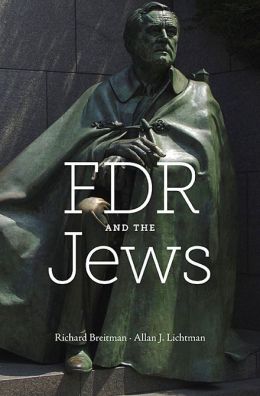
Richard Breitman & Allan Lichtman's "FDR and the Jews"

Richard Breitman is Distinguished Professor in the Department of History at American University. Allan J. Lichtman is Distinguished Professor in the Department of History at American University.

They applied the “Page 99 Test” to their latest book, FDR and the Jews, and reported the following:
Page 99 of FDR and the Jews offers a quick overview of Franklin Delano Roosevelt’s interest in moving large numbers of Jews out of Europe before the outbreak of possible war. The Neutrality Acts had sharply limited Roosevelt’s ability to shore up Britain and France against possible German expansion and aggression. By taking more German Jews into the U.S. and encouraging other Western Hemisphere countries to do so as well, in 1938 Roosevelt hoped to make a statement against Germany and at least to mitigate Nazi Germany’s “Jewish problem.” But he got precious little support from other world leaders and other major powers. Because of Roosevelt’s fear of anti-Semitism at home and abroad, Roosevelt preferred to use the term political refugees--to avoid giving the impression that most of those seeking to leave Germany were Jews.

Another part of p. 99 explains the relationship between FDR and Sumner Welles, who became undersecretary of state in 1937. Welles had ties to FDR that stretched back to his childhood, and he was more liberal than most high officials in the State Department. He was willing to serve as the facilitator of a president who, in effect, wanted to be his own secretary of state. Welles took charge of FDR’s refugee initiatives abroad, working them into a broader vision of American foreign policy.

Welles tried to appeal to American isolationists by arguing that finding refuge for these endangered populations in Central Europe might help to prevent war. Roosevelt’s and Welles’s refugee initiatives lasted into 1939, but did not survive the outbreak of war and his 1940 presidential campaign.

FDR and the Jews traces four stages of presidential attitudes and policies: an early first stage in which Roosevelt largely abstained from reactions to Nazi persecution; a second (1937-39) stage summarized above; a third stage in which Roosevelt became a narrow guardian of national security and manager of a war effort; and a fourth stage in which, under some pressure, he belatedly endorsed an effort to save the lives of Jews and others threatened by the Nazis. Our book seeks to place Roosevelt in his world--to explain him before we praise or condemn him. We present a great deal of new evidence, including some new material about his 1938 initiatives.
Learn more about FDR and the Jews at the Harvard University Press website.

--Marshal Zeringue

Monday, April 1, 2013

Ian Stewart's "Visions of Infinity"

Ian Stewart is Emeritus Professor of Mathematics and active researcher at the University of Warwick. The author of many books on mathematics, he lives in Coventry, England.

Stewart applied the “Page 99 Test” to his latest book, Visions of Infinity: The Great Mathematical Problems [UK title: The Great Mathematical Problems], and reported the following:
From Page 99:
There is a price to pay for this approach: you have to solve about 100,000 linear programming problems. The calculations are lengthy, but well within the capabilities of today’s computers. When Hales and Ferguson prepared their work for publication it ran to about 250 pages of mathematics, plus 3 gigabytes of computer files.

In 1999 Hales submitted the proof [of the Kepler conjecture] to the Annals of Mathematics, and the journal chose a panel of twelve expert referees. By 2003, the panel declared itself ‘99 per cent certain’ that the proof was correct. The remaining uncertainty concerned the computer calculations; the panel had repeated many of them, and otherwise checked the way the proof was organised and programmed, but they were unable to verify some aspects. After a delay, the journal published the paper. Hales recognised that this approach to the proof would probably never be certified 100 per cent correct, so in 2003 he announced that he was starting a project to recast the proof in a form that could be verified by a computer using standard automated proof-checking software.
Page 99 of Visions of Infinity is about the Kepler conjecture, a baffling mathematical enigma that remained unsolved from the time Johannes Kepler first posed it in 1611, in a book about snowflakes, until Thomas Hales and his student Samuel Ferguson solved it 387 years later. Is the most efficient way to pack spheres together the one that greengrocers use to stack oranges? The answer surely has to be ‘yes’, but proving it is another matter entirely.

The book as a whole is about the great mathematical problems, the ones that every mathematician would dearly love to solve. The obstacles that hold up mathematical progress, often for centuries. Whenever some genius answers one of these problems, the media start paying attention to mathematics.

However, media reports sometimes give the impression that finally, after decades of inactivity, mathematicians have produced something new. One of my aims in writing the book is to make it clear that modern mathematics is a hotbed of creativity, with new and important mathematics constantly being brought into existence. In fact, so creative are today’s mathematicians that most of the great problems of the past have crumbled under the onslaught of fresh insights.

However, the more we learn, the more we become aware of that we don’t know. So new great problems are arising all the time. The book is therefore a mixture of solved and unsolved problems. Each gets a chapter to itself, explaining how the problem arose, what mathematicians have done to tackle it, and either how someone eventually solved it, or why it remains as baffling as ever.

I have covered most of the famous problems, and all of the Clay Institute Millennium Prize Problems, with a million dollars on offer for each. I’ve included familiar problems like the four colour conjecture and Fermat’s last theorem, and others less well known, such as the P/NP problem: do genuinely hard mathematical questions exist?

My main aims in writing the book were to collect together in one place accessible descriptions of a selection of the greatest mathematical problems ever posed, and to demonstrate the ever-growing power and creativity of modern mathematics. The great mathematical problems open a fascinating window into the otherwise obscure workings of great mathematical minds.
Learn more about the book at the author's website.

See Ian Stewart's top ten popular mathematics books.

The Page 99 Test: Why Beauty Is Truth.

The Page 99 Test: In Pursuit of the Unknown.

--Marshal Zeringue