Wednesday, July 15, 2020

Zachary Dorner's "Merchants of Medicines"

Zachary Dorner is the Patrick Henry Postdoctoral Fellow in history at Johns Hopkins University.

He applied the “Page 99 Test” to his new book, Merchants of Medicines: The Commerce and Coercion of Health in Britain’s Long Eighteenth Century, and reported the following:
Page 99 of Merchants of Medicines comes at an important point in chapter three where I reinforce the argument, made earlier in the chapter, that imperial institutions incentivized the transformation of mobile populations of unfree laborers (namely soldiers, slaves, and servants) into patients who could be treated, willingly or unwillingly, with manufactured medicines. More specifically, page 99 details the complexity of healthcare in the eighteenth-century Caribbean where local and imported medicinal products coexisted in an iterative marketplace of treatment options closely tied to the transatlantic sugar economy.

Take the following quotations as examples:
Merchants of medicines provided treatments theoretically convenient and useful for disparate populations of willing or unwilling patients, but actual application varied according to the hierarchies of race and gender that structured eighteenth-century slave societies and often remain concealed in the business archive. Such records rarely capture the daily intricacies of healthcare in the plantations, households, and urban areas of the West Indies. Merchants, apothecaries, and practitioners sold local medicines and imported ones prepared in Britain, often in large quantities, for a variety of purposes…

…Therapeutic practices of folk healers and nurses most likely surpassed other forms of plantation healthcare in effectiveness, though this did not prevent practitioners, planters, manufacturers, and authors from recommending British medicines in large quantities as part of the plantation health regime. If a planter was willing to pay for imported medicines, little incentive existed for practitioners to curtail their ordering, even if enslaved people refused them.
Browsers opening Merchants of Medicines to page 99 would find the book’s themes of medicine, capitalism, difference-making, and empire, as well as its approach to business records well-represented on the page. What the test would fail to entirely convey, however, is the book’s broad scope spanning South Asia, Europe, Africa, and the Atlantic colonies in tracing the production, distribution, and consumption of medicinal commodities. Page 99 comes at a point in chapter three where I focus on the impact of an imperial system of healthcare in the Caribbean and the consequences for emergent ideas of inherent bodily difference. As a result, the book’s attention to distance, motion, and transformation embodied in European laboratories, long-distance trade, trading companies, and colonial wars can only be glimpsed on the page in favor of the ongoing deeper dive into the complexities of death and dying in the Caribbean. Readers will be able to follow analytical threads established elsewhere, but a browser would not necessarily have all the context required to see the themes and arguments reflected on the page.

As I noted above, chapter three really is a crucial chapter for Merchants of Medicines. Analytically, it elaborates on key arguments and, narratively, it transitions the book to focus more on non-European spaces moving forward. It shows that imperial institutions, such as the slave trade, East India Company, and armed forces drove the overseas medicine trade, a trade that was increasing exponentially by the mid-eighteenth century. The Atlantic colonies, and Caribbean specifically, were the engine of this growth. The needs and proceeds of a large-scale sugar economy drove the trade in medicines seen as useful in plantation management and middle passage. Consequences of this growth included: turning people into interchangeable patients, closer ties between London apothecaries and Caribbean planters, and new expectations of what medicines could and should do.

Though perhaps not directly, page 99 reflects that Merchants of Medicines is a history of medicine, of commerce, and of empire, concerned with how the long-distance trade of medicinal commodities affected not only the form of early modern empire but also people’s understandings of self and the world around them.
Visit Zachary Dorner's website.

--Marshal Zeringue

Tuesday, July 14, 2020

Brian Hare & Vanessa Woods's "Survival of the Friendliest"

Brian Hare is a professor in the Department of Evolutionary Anthropology and the Center for Cognitive Neuroscience at Duke University, where he founded the Duke Canine Cognition Center. Vanessa Woods is a research scientist, journalist, and author of children’s books. A member of the Hominoid Psychology Research Group, she works with Duke University as well as Lola Ya Bonobo in the Congo. Their books include The Genius of Dogs.

Hare and Woods applied the “Page 99 Test” to their new book, Survival of the Friendliest: Understanding Our Origins and Rediscovering Our Common Humanity, and reported the following:
From page 99:
Our species was not doing much better. Mega droughts, erupting volcanoes, and advancing glaciers threatened our survival, and we may have neared extinction.
We love the page 99 test for our book! It was so fun to actually open to page 99 and see what we had written. This quote is behind our favorite ideas because especially right now, it feels like things have never been worse. Seriously, we don’t want to curse ourselves but how could 2020 possibly get any worse??

But this is not the only moment our species has been in crisis. And as we see in the quote above, we were plagued with challenges that eclipse what we are experiencing now.

We (obviously) made it through. And understanding how we survived will help us survive again - - and it wasn’t being the strongest or meanest or even the smartest. A little known fact is that for most of the 300,000 years that Homo sapiens have existed, we shared the planet with at least four other types of humans. They had brains as big or bigger than ours. For millennia their technology rivaled our own.

But around 50,000 years ago, we made a cognitive leap that gave us an edge over the other human species. What happened? In Survival of the Friendliest, we propose that like dogs, we unintentionally domesticated ourselves. This process of ‘self domestication’ altered our bodies and minds. An increase in friendliness super-charged our ability to innovate and our technology exploded. While others have proposed our species grew friendlier or smarter, self domestication links the two; becoming friendlier caused the critical increase in our social intelligence that allowed us to thrive while the other humans died out.

Self-domestication also uncovers the neurobiological link that makes us the most tolerant and cruelest species on the planet. Just as a mother bear is most dangerous around her cubs, we are at our most dangerous when a group we love is threatened. The same brain network that allows for our friendliness, becomes dampened. We do not see people in a group threatening ours as fully human. Cruelty follows.

This new understanding has major implications for our modern world, including how we govern ourselves, educate our children, and build cities. We can develop actionable solutions based on the knowledge that to survive and flourish, we must expand our definition of who belongs.
Visit Brian Hare's website and Vanessa Woods's website.

The Page 99 Test: The Genius of Dogs.

--Marshal Zeringue

Monday, July 13, 2020

Mark Galeotti's "A Short History of Russia"

Mark Galeotti is one of the most respected and provocative writers on Russia today. A historian and expert on modern Russia, he was educated at Cambridge University and the LSE, has taught and held academic leadership roles in the USA and UK, and worked as an adviser for the British Foreign Office. He is a prolific author with more than twenty books to his name, and briefs everyone from the State Department to Fortune 100 companies on understanding Russia.

Galeotti applied the “Page 99 Test” to his new book, A Short History of Russia: How the World’s Largest Country Invented Itself, from the Pagans to Putin, and reported the following:
Is Russia European, and if so does that mean it has to surrender its claims to cultural exceptionalism? Does a self-conscious appeal to tradition mean a revival of historical ways, or a reinvention of a mythologised past? Page 99 of A Short History of Russia starts with the irony that Tsar Alexei (ruled 1645-76), while resenting the growing influence of foreigners, nonetheless made Patrick Gordon, a Roman Catholic Scottish mercenary, a tutor for his son and heir, Peter – later to be known as Peter the Great. A similar tension was all too evident within the Church, and the eloquent, forceful and unbending Nikon, Patriarch of Moscow and All the Rus’, sought to purify a faith that he felt had deviated from its Greek Byzantine origins.

Icons of new style were banned and burned, and contemporary Greek rites and liturgies were introduced, on pain of fines, excommunication and the lynch mob. Yet here is the irony: the ways of the Greek church had evolved over the centuries, just like the Russian. One could question whether the new rites were any closer to the old Byzantine ones that the Russian ones they replaced. But if one were wise, one would not ask that in Nikon’s presence.

A central theme of the book is, after all, about myths, about the stories Russians tell others and themselves about Russia, and the extent to which these are often wishful fantasies or cynical fabrications. Words make worlds, and our understanding of our place in the world is framed by them. In Russia’s case, that often means addressing the tension between its claims to being a unique civilisation and its relationship with Europe. Time and again, it would oscillate between a desperate desire to demonstrate that it was, indeed, a European and not a Eurasian or Asia power, and a stubborn determination to reject European values.

The “page 99 test” thus works rather well, although you’d need to read the other 215 pages to see how these processes fit the larger patterns of Russian history. The tsar who confined foreigners in Moscow into a ghetto of their own to avoid cultural contagion yet hired one to teach his son. The priest who thought he could reaffirm Russian uniqueness by copying a European church’s ways rites. Both were trying to reinvent Russia in their own ways, creating something new by thinking they could return it to their mythologised sense of something old.
Follow Mark Galeotti on Twitter.

--Marshal Zeringue

Saturday, July 11, 2020

Heather Houser's "Infowhelm"

Heather Houser writes on contemporary culture, the environment, and science and is an associate professor of English at The University of Texas at Austin. Her books include Infowhelm: Environmental Art & Literature in an Age of Data (2020) and Ecosickness in Contemporary U.S. Fiction: Environment and Affect (2014).

Houser applied the “Page 99 Test” to Infowhelm and reported the following:
From page 99:
In short, the new naturalist arts manage environmental data to manage loss. Yet, as the next chapters insist, writers and visual artists revive natural history not out of nostalgic yearning or to unleash a zombie Enlightenment. Rather, they rework naturalist epistemologies and cultural forms to salvage a future out of the past; they produce ways of knowing that variously accommodate, contain, or diminish emotions of loss.... Their questions chime with another that I paraphrase from Paul Farber’s history of natural history: What responsibilities do our knowledge and our knowledge systems confer on us?
At page 99, readers are one-third of the way through Infowhelm: Environmental Art and Literature in an Age of Data. More specifically, they're in the preface to part 2, "The New Natural History." Each of the book's three parts—the others being "Cultural Climate Knowledge" and "Aerial Environmentalisms"—opens with a preface in which the poetry of Juliana Spahr inspires the questions driving the next two chapters. One of those questions—"What responsibilities do our knowledge and our knowledge systems confer on us?"—appears on page 99 but pulses through the entire book. With this question and a central point about the affective dimensions of scientific information, page 99 gives someone browsing the book an accurate taste of the whole.

Infowhelm explains how the environmental arts take up scientific information—data as well as methods and explanations—to relay consensus facts about crises like climate change and species extinction but also to reflect on how environmental knowledge comes to be. Certainly, eco-knowledge arises from Eurowestern science, but it also arises from traditional ecological knowledge practices; it arises from emotions and embodied understanding; it arises from speculation and uncertainty. The question on page 99 gets at these varieties of knowledge while acknowledging that certain knowledge systems are bound up in practices of domination, extraction, and exploitation, while others promote cohabitation, reciprocity, renewal, and resilience to ongoing crises (Kyle Powys Whyte's "Indigenous climate change studies" is an inspiration here). The positivist epistemologies of classical natural history, which I'm referencing on this page, are often aligned with practices of domination and mastery. Contemporary artists challenge the colonial and exploitative currents of science by repurposing naturalist methods into a new natural history. They reimagine natural history to feel the losses of environmental crises and to envision alternative relations between humans and the more-than-human.
Learn more about Infowhelm at the Columbia University Press website and visit Heather Houser's website.

The Page 99 Test: Ecosickness in Contemporary U.S. Fiction.

--Marshal Zeringue

Thursday, July 9, 2020

Rebecca Earle's "Feeding the People: The Politics of the Potato"

Rebecca Earle is Head of the Department of History at the University of Warwick. Her publications include The Body of the Conquistador: Food, Race and the Colonial Experience in Spanish America, 1492–1700 (2012) and The Return of the Native: Indians and Mythmaking in Spanish America, 1810–1930 (2007). She has also edited a cookery book.

Earle applied the “Page 99 Test” to her new book, Feeding the People: The Politics of the Potato, and reported the following:
Page 99 discusses soup kitchens. As today, in eighteenth-century Europe ordinary people often found it difficult to feed themselves and their families. In response individuals and organisations in a number of countries set up soup kitchens, dispensing ‘poor soups’, usually based on potatoes mixed with barley or other grains, some vegetables, and a small amount of meat. Surprisingly, the organisers of these soup kitchens were at pains to stress that their soups were not only economical and nourishing, but also tasty. They tested their recipes on likely recipients, and adapted them in light of the responses. These adaptations reflect local culinary traditions. In Germany soups often included a hefty dose of vinegar, whereas in France they were seasoned with fines herbes. In Spain charitable organisations added cumin, paprika and olive oil. The resultant soups, they reported confidently, pleased local tastes, and were consumed with pleasure by the poor. Whether the beneficiaries of these charitable initiatives shared the enthusiasm of the organisers is another matter. ‘This is washy stuff, that affords no nourishment’, was the assessment of poor people in the south of England when offered charity soups.

Page 99 captures some recurrent themes in Feeding the People. Specifically, it touches on the ways in which the rhetoric of individual choice has become central to how we talk about freedom. Even the organisers of soup kitchens felt it was important to stress that poor people were ‘choosing’ to eat their soups. This is why they put some effort into testing their recipes and (so they alleged) adapting them to local tastes. Given these efforts, they felt able to dismiss any criticisms.

Being able to make one’s own choices is a cornerstone of liberal definitions of freedom, and it is interesting to see how these ideas, born in the Enlightenment, shaped even the ways in which the organisers of soup kitchens thought about their activities. Of course, many factors, including poverty, constrain our actual ability to choose what we eat and how we live our lives. Beyond this, not everyone would agree that individual choice should lie at the centre of how we organise society. These debates, and their links to eating, emerged in the eighteenth century, which is why a small history of eighteenth-century soup kitchens can reveal how the rhetoric of individualism became entangled with how we talk about eating.
Learn more about Feeding the People at  the Cambridge University Press website.

--Marshal Zeringue

Wednesday, July 8, 2020

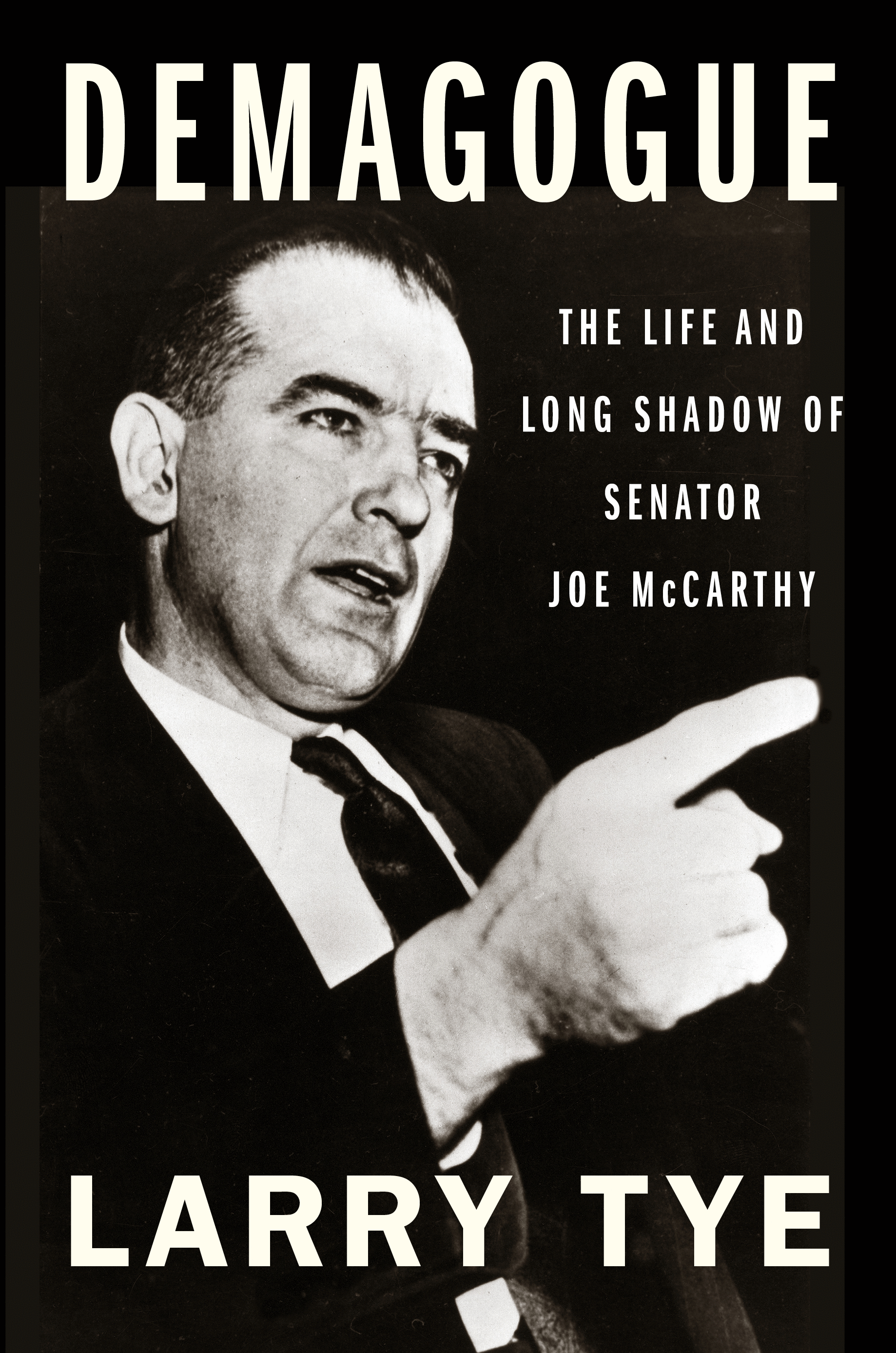
Larry Tye's "Demagogue"

Larry Tye is the best-selling author of Bobby Kennedy and Satchel, as well as Superman, The Father of Spin, Home Lands, and Rising from the Rails, and co-author, with Kitty Dukakis, of Shock. Previously an award-winning reporter and national writer at the Boston Globe and a Nieman Fellow at Harvard University, he now runs the Boston-based Health Coverage Fellowship.

Tye applied the “Page 99 Test” to his new book, Demagogue: The Life and Long Shadow of Senator Joe McCarthy, and reported the following:
Page 99 is an ideal teaser for my book, and for understanding where Joe McCarthy stood early in a Senate career that would make him the most controversial man in America.

It opens by talking about McCarthy’s personal and political friendship with the all-powerful head of the FBI. J. Edgar Hoover realized McCarthy could be an ally in his battle to root out Reds and pinkos, and he told his agents to play nice with the senator. As I write, “the affection was mutual. Joe called the FBI ‘the only bureau in Washington that gets the highest praise from everyone,’ adding that ‘many of us feel you should have more men in the FBI at this time.

I continue by noting what such schmoozing with kingmakers meant to the one-time poultry farmer and grocery clerk from rural Wisconsin:
Joe acted as if such relationships were the most natural thing in the world, but he hadn’t lost sight of how far he had come. In 1947, at an especially swank cocktail party in the Capitol, the freshman lawmaker stood in the corner with a friend reflecting on the big shots whose hands he’d been shaking: “I wonder what these people would think if they knew I once raised chickens.” Whether or not they would have cared about that, some might have been shocked at how, rather than finding a place of his own in Washington, he was camping out college-style in a small room he was renting from his office manager, Ray Kiermas. Underwear was piled up under the bed, and pants were wedged under the mattress in hopes of removing the wrinkles. “Whenever we move to a new home we tell him the address on moving day,” said Kiermas. “He comes there that night instead of going to the old place.” While Joe didn’t mean to be insensitive, he was to Ray and even more to his wife, Dolores. On the eve of one of their moves, he told her he’d invited a few people to dinner, and persisted although she explained that the dishes were packed. That night eighteen journalists turned up. She unpacked, then repacked, everything that was needed. Joe thought nothing of it: “Everyone sat around on crates and had a fine time.” [His best friend Urban] Van Susteren compared him to “a stray dog. He’d stay three days at one place, three at another, and four at another. He’d sleep on the couch, on the floor, on the porch — it didn’t matter at all to him.”
My book seeks to balance the human and public sides of Joe McCarthy, and looks for the kind of nuance we can get only now that I was given first and exclusive access to the senator’s personal and professional papers, which were under lock and key for sixty years.

It’s not often that a man’s name becomes an ism, in this case a synonym for reckless accusation, guilt by association, and fear-mongering. In the early 1950s, the senator from Wisconsin promised America a holy war against a Communist “conspiracy so immense and an infamy so black as to dwarf any previous such venture in the history of man.” While the conspiracy and infamy claims were a stretch, the body count was measurable: a government engineer, current and former US senators, and incalculable others who committed suicide to escape McCarthy and his warriors; hundreds more whose careers and reputations he crushed; and the hundreds of thousands he browbeat into a tongue-tied silence. His targets all learned the futility of taking on a tyrant who recognized no restraints and would do anything — anything — to win.

Examining all the fresh evidence of McCarthy’s official excesses and his behind-the-scenes humanity makes him more authentic, if also more confounding. Today, every schoolchild in America is introduced to Joe McCarthy, but generally as a caricature, and parents and grandparents recall the senator mainly with catchphrases like witch-hunter or with a single word: evil. The new records let us shave away the myths and understand how the junior senator from Grand Chute rose to become powerful enough not just to intimidate Dwight Eisenhower, our most popular postwar president, but to drive legislators and others to take their own lives. Pulling open the curtain, we find Senator McCarthy revealed as neither the Genghis Khan his enemies depicted nor the Joan of Arc rendered by friends. Somewhere between that saint and that sinner lies the real man. He was in fact more insecure than we imagined, more undone by his boozing, more embracing of friends and vengeful toward foes, and more sinister.

Before today’s era of unprecedented political brawling and bile, even a groundbreaking biography of Joe McCarthy might have seemed like a chapter of American history too painful to revisit, one with little relevance to a republic that had outgrown his appeals to xenophobia. An autocratically inclined Russia might unite behind the ironfisted Vladimir Putin, but surely this would never happen in the judicious, eternally fair-minded United States. After the 2016 election, nobody needs reminding that this is the story of today and of us.
Visit Larry Tye's website.

--Marshal Zeringue

Monday, July 6, 2020

Jason Blakely's "We Built Reality"

Jason Blakely is Associate Professor of Political Science at Pepperdine University. He is the author of Alasdair MacIntyre, Charles Taylor, and the Demise of Naturalism and, with Mark Bevir, of Interpretive Social Science.

Blakely applied the “Page 99 Test” to his new book, We Built Reality: How Social Science Infiltrated Culture, Politics, and Power, and reported the following:
Page 99 of We Built Reality captures in fragmented form not only a part of the whole work but also anticipates a tiny bit of the American political scene in the summer of 2020—a time of pandemic, massive unrest, and scenes of highly militarized police forces in the streets. A short excerpt from page 99 reads: “with super predators supposedly wandering open, hostile urban environments … foot soldiers would need to be deployed with the latest military technologies. What the futuristic Robocop aesthetic communicated was a technocratic fantasy of scientifically inflicted violence.” This chapter analyzes how a complex of social scientific theories from the late twentieth century developed by scholars like James Q. Wilson and Charles Murray played an important role in generating a pseudoscientific notion of race that was linked to increasingly militarized policing practices. Today we see these very same pseudo-sciences of race and crime reaching a climax in the atrocious murder of George Floyd (one in a seemingly endless cycle of killings of unarmed black citizens by police).

Page 99’s image of dystopian, futuristic policemen not only resonates with today’s newspapers but also captures in snapshot form a much broader transformation that I argue in my book has seized our society—one in which technocratic forms of scientism dominate an enormous range of phenomena in our everyday lives. The central thesis of my book is that counterfeit claims to a science of human behavior while failing to predict the political world we now live in, did play a central role in creating it. Throughout the course of the book I argue that supposedly scientific theories helped generate the 2008 financial crisis; yawning inequalities; overly medicalized notions of love and happiness; managerial and top-down notions of democracy; abstract and anesthetized forms of global drone warfare; and much more.
Follow Jason Blakeley on Twitter.

--Marshal Zeringue

Sunday, July 5, 2020

Francine Hirsch's "Soviet Judgment at Nuremberg"

Francine Hirsch is Vilas Distinguished Achievement Professor of History at the University of Wisconsin-Madison, where she teaches Soviet and Modern European history. Her first book, Empire of Nations: Ethnographic Knowledge and the Making of the Soviet Union (2005), received several prizes, including the Herbert Baxter Adams Prize of the American Historical Association.

Hirsch applied the “Page 99 Test” to her new book, Soviet Judgment at Nuremberg: A New History of the International Military Tribunal after World War II, and reported the following:
Page 99 finds us in Berlin, in October 1945, about six weeks before the start of the Nuremberg Trials. Representatives from all four countries of the prosecution (the U.S., Britain, France, and the USSR) are in the midst of deliberations that will fundamentally affect the course of the trials.

Tensions are high among the four chief prosecutors about the Indictment—a jointly authored document that lays out the charges against the former Nazi leaders and their organizations. The American, British, and French chief prosecutors have signed off on the Indictment. Soviet chief prosecutor Roman Rudenko is stalling for time; he is under strict orders “not to sign off on the final document—under any circumstances” until he gets approval from Moscow.

Meanwhile the four main Nuremberg judges work through other issues. Some are matters of pomp and circumstance. The French judge, Henri Donnedieu de Vabres, insists that the judges wear “black robes as befitting the Tribunal’s dignity.” But Soviet chief judge Iona Nikitchenko dismisses such attire as “medieval.” A compromise is reached: each judge could wear whatever he considered appropriate—leaving the Soviet judges free to wear their military uniforms.

Other more significant issues remain matters of contention. On October 11, the three Western judges decide, over Nikitchenko’s objections, that the presidency of the Tribunal would not rotate during the trials at Nuremberg. A couple of days later, the judges select the British judge, Sir Geoffrey Lawrence, as the Tribunal’s president. While the American judge Francis Biddle had coveted this post, the U.S. chief prosecutor, Robert H. Jackson, had convinced him to support Lawrence “lest the Americans, who were playing host and supplying the majority of the defendants, be seen as completely running the show.” Jackson sends President Truman a letter expressing his concern that if Biddle were to preside and anything went wrong, “all of the animosities and blame would be centered upon the United States.” Nikitchenko goes along with the choice of Lawrence, mainly because he, in turn, is selected to preside over the Tribunal during its public sessions in Berlin.

Back in Moscow, the Soviet deputy foreign minister Andrei Vyshinsky—who had been appointed by Stalin to head a secret commission to oversee the Soviet delegation for the Nuremberg Trials—is focusing his attention on the Indictment. Nikitchenko has surreptitiously sent him a copy for review and approval. Vyshinsky is well aware that the October 15 deadline for lodging the document with the Tribunal is approaching quickly. He sends copies (hastily translated into Russian) to the other members of the secret commission asking them “to send their comments that afternoon.” Matters are complicated for Vyshinsky and others in Moscow because Stalin is incommunicado. Stalin had left Moscow on October 9 for his villa in Sochi, near the Black Sea in the Caucasus, for his first vacation in nine years. Rumors abound that he had suffered two heart attacks during the Potsdam Conference in August and is gravely ill.

The page 99 test works beautifully for my book. Although the prosecutors and judges have not yet arrived in Nuremberg—and the start of the trials is still over a month away—page 99 illustrates a number of key dynamics that are at the heart of the story.

First of all, it shows that Nuremberg was a four-power affair—and it captures the difficult relationships among the wartime allies who were cooperating to bring the Nazis to justice. The Americans, the British, the French, and the Soviets came to Germany with different ideas about the meaning of justice and with competing visions of what Nuremberg should look like. They all made compromises to make Nuremberg happen and to keep the trials moving forward. Some of those compromises (over matters of wardrobe, for example) were small ones; others, involving questions of procedure and evidence, would threaten the very legitimacy of the trials.

Page 99 also shows how the particularities of Stalinism undermined the Soviets in Nuremberg—another key theme of the book. It reveals the tensions between the Soviet delegation in Germany and Soviet leaders in Moscow who were determined to shape the trials from afar. Soviet deputy foreign minister Andrei Vyshinsky and his secret Nuremberg commission play a key role throughout the trials. Vyshinsky (who had gained infamy in the 1930s as the prosecutor of the Moscow show trials) answered directly to Stalin. Moscow’s insistence on reviewing and signing off on each and every decision greatly impeded the Soviet delegation—which was continually scrambling to meet tight deadlines. Stalin’s influence over the Soviet delegation is heavily felt at all times, even when he is away from Moscow and incommunicado.

Finally, on page 99 we start to get a sense of Nuremberg as an incipient Cold War battleground—another theme that is developed more fully in the book. We see Soviet judge Iona Nikitchenko being outvoted by the other three judges on a key procedural issue; this will happen again and again. We also get a peek at U.S. chief prosecutor (and Supreme Court Justice) Robert H. Jackson’s desire to have the Americans run the show at Nuremberg without it being evident that they are doing so. (His letter to Truman is especially telling.) The Soviet-American relationship is critical to the course of the trials and also to the postwar creation of international law regarding human rights—which is a theme I explore in more depth in the final chapter of the book.
Learn more about Soviet Judgment at Nuremberg at the Oxford University Press website.

--Marshal Zeringue

Friday, July 3, 2020

Sara Mayeux's "Free Justice"

Sara Mayeux is associate professor of law at Vanderbilt University.

She applied the “Page 99 Test” to her new book, Free Justice: A History of the Public Defender in Twentieth-Century America, and reported the following:
Page 99 summarizes the U.S. Supreme Court’s 1963 decision in Gideon v. Wainwright, which held that states are constitutionally required to provide defense counsel for criminal defendants who cannot afford their own legal representation. It quotes an oft-quoted line from that opinion: “The right of one charged with crime to counsel may not be deemed fundamental and essential to fair trials in some countries, but it is in ours.” Page 99 also explains that, by the time the Court issued this ruling, it would not have been surprising to lawyers; Supreme Court case law had been tending in this direction for some time and, in a related development within the legal profession, lawyers themselves had become increasingly receptive to publicly funded counsel, at least in the criminal context.

Superficially, and oddly enough, the page 99 test works perfectly for my book—perhaps because page 99 is right about halfway through. The book examines debates within the legal profession about public defenders both before Gideon (beginning in the Progressive Era) and after Gideon. So, page 99 is, coincidentally, the exact fulcrum in the book’s overall narrative arc.

In a deeper sense, though, I think the page 99 test works less well for my book than it might seem, because the book is not primarily about the Supreme Court or Gideon per se, but rather about the larger iceberg of changes and debates within American legal culture of which Gideon represented only the most visible tip. Certainly, page 99’s brief summary of Gideon’s holding will not be novel or surprising to legally trained readers, but rather familiar law school fare.

Nevertheless, I think a reader who turned to page 99 would get a pretty good capsule summary of what the book is about. On this page, the reader encounters a brief reminder of a point developed earlier in the book, that many lawyers had once considered public defenders controversial or at least puzzling. American legal culture has historically been committed both to an adversarial model of the criminal trial and to a set of vaguely free market, capitalist background assumptions about the legal profession—i.e., that the default scenario is that people hire their own lawyers as needed to help them pursue their private interests. So, how would it work for the government to underwrite its own adversary in criminal cases? But by the early 1960s, lawyers had developed a set of arguments that made sense of the public defender as a means of extending the benefits of adversarial legal representation to everyone. Yet these arguments generally accepted and proceeded from the premise that the government had no general obligation to provide assistance to the poor, outside of unique contexts such as the criminal courts—a limitation of American legal culture also briefly discussed on page 99.
Learn more about Free Justice at the University of North Carolina Press website.

--Marshal Zeringue

Wednesday, July 1, 2020

Andrew S. Baer's "Beyond the Usual Beating"

Andrew S. Baer is assistant professor of history with a secondary appointment in African American studies at the University of Alabama at Birmingham.

He applied the “Page 99 Test” to his new book, Beyond the Usual Beating: The Jon Burge Police Torture Scandal and Social Movements for Police Accountability in Chicago, and reported the following:
Beyond the Usual Beating appears to pass the test, as page 99 does indeed include core themes of the overall manuscript. While much of the book zooms-in to specific details of police torture against Black criminal suspects on Chicago’s South and West Sides in the 1970s, 1980s, and 1990s, page 99 pulls back to reflect on the larger context of the Jon Burge police torture scandal. This page appears during a narrative of the 1982 killing of two Chicago police officers by an African American man named Andrew Wilson. Following this shooting, officers launched a manhunt for Wilson that quickly turned brutal, as cops ransacked homes, harassed families, apprehended innocent men, and beat or tortured them to enact punishment and gather information. Once detectives brought Wilson into custody, they physically assaulted him, tortured him with electroshock, and coerced a confession that would land him in prison for the rest of his life. Yet evidence of his abuse, including burns and bruises, would surface in a civil suit brought by Wilson years later. This civil suit helped bring one of Chicago’s most impactful police scandals to light.

Page 99 reveals how Black community leaders, including writers for the Chicago Defender and Reverend Jesse Jackson, employed the brutal manhunt for Andrew Wilson in 1982 as evidence that the Chicago Police Department had long turned Black Chicago into a “warzone.” Jackson “alerted city leaders and apathetic whites to the everyday violence of the nation’s racially motivated crime war” and framed the recent manhunt as symptomatic of routine racial harassment by the city’s police. Local atrocities flourished in a national climate of crime panic, law and order politics, and racist disregard for Black lives. One resident wrote to a Black-owned newspaper, “When white people kill blacks, no one cares […] but let a white policeman be killed, regardless of how rotten or dirty he might be, and it’s a city-wide catastrophe.” Another resident added, “Things just don’t balance out. Some folks think it’s time for revenge.” Page 99 offers specific details of police torture in 1982, broader analysis of the national climate that facilitated torture in Chicago, and evidence of local resistance by affected communities.
Learn more about Beyond the Usual Beating at the University of Chicago Press website.

--Marshal Zeringue