Tuesday, April 26, 2022

Neil Levy's "Bad Beliefs"

Neil Levy is Professor of Philosophy at Macquarie University, Sydney, and a Senior Research Fellow at the Oxford Uehiro Centre for Practical Ethics. He was previously a Research Council Future Fellow at the Florey Institute of Neuroscience and Mental Health. He works on the philosophy of agency and ethical issues in neuroscience, as well as related areas, and has published extensively on these topics. He is the author of Consciousness and Moral Responsibility (2014) and Hard Luck (2011), among other books.

Levy applied the “Page 99 Test” to his latest book, Bad Beliefs: Why They Happen to Good People, and reported the following:
I think it would be pretty hard to get a good idea of what the book's up to from page 99. Bad Beliefs as a whole argues that these kinds of beliefs - say, the belief that vaccinations cause autism - actually have the same kind of source as good beliefs. I believe climate change is real and serious because people I trust tell me so, and those who deny the reality of anthropogenic climate change do so because people they trust tell them so. The book argues that we should focus on these kinds of trust relations, and on making sure that they're justified, to bring people to believe better. Page 99 mentions none of that.

Instead, page 99 is in the middle of addressing a common alternative view: don't trust anyone (scientists or talking heads on Fox); instead, assess the evidence for yourself. I'm in the middle of arguing that that's a lot harder to do than people usually realize. Without genuine expertise in climate science (I argue), it's a hopeless task. It goes on to argue that when we take ourselves to doing this kind of thinking for ourselves, we're still actually following the lead of those we trust. At best, 'doing your own research' isn't an alternative to trusting well; at worst, it does a lot worse than trusting well would.

So page 99 doesn't help tell the browser what the book's about. Maybe it reveals "the quality of the whole" as Ford Madox Ford said, but it doesn't reveal its subject. It's too far in the weeds. But hey! It's a philosophy book. Expect weeds.
Learn more about Bad Beliefs at the Oxford University Press website.

--Marshal Zeringue

Monday, April 25, 2022

Cécile Fabre's "Spying Through a Glass Darkly"

Cécile Fabre is Professor of Political Philosophy at the University of Oxford, and Senior Research Fellow in Politics at All Souls College. Previously she taught at the London School of Economics and the University of Edinburgh. She holds degrees from the Sorbonne University, the University of York, and the University of Oxford. Her research interests include theories of distributive justice, issues relating to the rights we have over our own body and, more recently, just war theory and the ethics of foreign policy.

Fabre applied the “Page 99 Test” to her new book, Spying Through a Glass Darkly: The Ethics of Espionage and Counter-Intelligence, and reported the following:
Page 99 of my book Spying Through a Glass Darkly begins with a description of Operation Bodyguard, ‘thanks to which the Allies deceived Germany’s leadership as to the timing and location of their planned invasion of Western Europe.’ It argues that deception, not merely in war but in foreign policy in general, is sometimes morally permissible. The argument relies both on the case of Operation Overlord and on a hypothetical example in which the intelligence services of an imaginary country ask one of their operatives to infiltrate a transnational terrorist network.

The book defends an ethics of espionage and counterintelligence activities. This page is both a bad and a good snapshot of the book. It does not give a sense of the range of the methods used by intelligence agencies, and of the moral dilemmas which those methods raise. The book tackles topics as diverse as treason; various modes for recruiting agents such as manipulation, exploitation, and entrapment; economic espionage; cyberespionage; and mass surveillance. It argues that those activities are morally justified, indeed sometimes morally mandatory, but only to protect individuals’ fundamental moral rights from wrongful threats – not just in the context of war, but also in the context of foreign policy in general. To give but one, and depressingly relevant example, suppose that a country justifiably imposes economic sanctions on a foreign regime and that regime’s associates, on grounds of rights-protection albeit in peace time. On my account, it is also justified in resorting to espionage to check that the targets of the sanctions are compliant. Someone who would read only page 99 would not be able to guess as much.

That said, in some ways, page 99 is a good snapshot, because it gives examples of both espionage and counterintelligence. Operation Bodyguard was an extraordinarily successful piece of deceptive counterintelligence; and infiltrating someone into enemy networks is of course a good way of spying on the latter. Moreover, and more importantly, this page illustrates the way the book weaves philosophical arguments, historical examples and hypothetical scenarios – the latter being a trademark of the philosophical tradition in which I write. Whilst the Page 99 Test fares poorly regarding the content of the book, it fares very well regarding its philosophical flavour.
Visit Cécile Fabre's website.

--Marshal Zeringue

Sunday, April 24, 2022

Christopher T. Burris's "Evil in Mind"

Christopher T. Burris is a Professor of Psychology at St. Jerome's University, in the University of Waterloo, Canada. In addition to creating and teaching a course on the psychology of evil for over two decades, Dr. Burris contributes to courses in the psychologies of good, religion, and death and dying. His published research has spanned the breadth of human experience--from the self, consciousness, afterlife beliefs, atheism, and from sadism, hate, and evil to empathy. The sum of these efforts, he hopes, is to contribute to a greater understanding of some of life's big issues.

Burris applied the “Page 99 Test” to his new book, Evil in Mind: The Psychology of Harming Others, and reported the following:
The big word at the top of page 99 of Evil in Mind is “Sadism”: the title and topic of Chapter 6. I begin by asking my readers (and, now, you): “What comes to mind when you read the word ‘sadist’?” For most of us, “sadist” and “evil” go (gloved) hand-in-hand – so much so that being sadistic is practically a job requirement for those seen as embodying “pure evil.” Consequently, it’s only very recently that psychologists have begun challenging the assumption that sadism is only likely to show itself amongst perversely vicious criminal types. If we can move beyond the queasy feelings that this stereotype often provokes toward a clearer understanding of what sadism actually is… well, sadism suddenly appears to be not nearly as rare as we might hope. And what is sadism? It’s a form of hate. You’d have to read Chapter 5 (“Hate”) for the nuts-and-bolts of my reasoning but, basically, sadism is a motivational state, a desire for harm to befall some other being (i.e., hate) because that is seen as a means of securing some sort of positive emotional payoff (pleasure, satisfaction, and the like). So it’s not about what a person does or the impact that it has, it’s about what the person wants, and why they want it.

Honestly, page 99 of Evil in Mind is a pretty lucky strike. “Sadism” got a whole chapter for a reason: Along with hate, serial killers, and group-based “evil” such as genocide and corporate corruption, sadism is part of what I call the “Pantheon of Evil” – because people would probably be stunned if a book about evil didn’t address those things.

But beyond the attention grab, page 99 offers another variation on a theme present throughout the book: Despite its VIP reservation beneath evil’s big, dark umbrella, sadism is probably not what you think – or, at least, not only what you think. Yes, many serial killers are fueled by sadistic motivation (as I argue in Chapter 7, “Serial Killers”), but so are many pranksters. The motivational structure is the same: “If X suffers, I’ll feel good.” But most people don’t want to see themselves, or be seen by others, as “evil,” so they’ll tell stories to make that suffering seem okay. Like “it wasn’t a big deal.” Or “that person had it coming to them.”

This taps into themes that I deal with in the first four chapters of the book: when and why we think we “know ‘evil’ when we see it,” why we’re quietly terrified of being seen as “evil” and the lengths to which we’ll go to deflect that label, and why we’ll sometimes do things that harm others anyway despite our quiet terror.

You’ll note – probably with a sense of unease or maybe indignation – that I keep saying “we.” That’s because I don’t think “evil” is ever always about “The Other.” We’re all subject to the same pushes and pulls. We can be nice or naughty. We can be noble or nasty. Ultimately, my hope is that Evil in Mind gives readers more insight into how they themselves are pushed and pulled so they can make better – that is, less “evil” – choices.
Learn more about Evil in Mind at the Oxford University Press website.

--Marshal Zeringue

Saturday, April 23, 2022

Eve Darian-Smith's "Global Burning"

Eve Darian-Smith is Professor and Chair of the Department of Global and International Studies at the University of California, Irvine. Her books include The Global Turn: Theories, Research Designs, and Methods for Global Studies, with Philip McCarty.

Darian-Smith applied the “Page 99 Test” to her new book, Global Burning: Rising Antidemocracy and the Climate Crisis, and reported the following:
From page 99:
In the United States, the practice of deploying militarized police against citizens on behalf of corporations is also evident in the numerous protests against the Keystone XL Pipeline and the Dakota Access Pipeline which pump enormous quantities of crude oil from Canada into the United States. Beginning in 2011, protests erupted over the laying of pipeline over small farming properties and Native American reservation lands, threatening numerous tribes’ clean water and natural resources. The protestors, known as “protectors” of water and sacred lands, fought for years against possible oil spillage and toxic runoffs, and mobilized a global social movement against the projects. Former president Barack Obama halted both pipelines because of the negative impacts on Indigenous sovereign rights and the environment in 2015. But the Trump administration revived the projects, and protests continued at the Standing Rock Sioux Reservation in North Dakota involving hundreds of tribes and green activists. In 2017 Trump deployed the National Guard, who, wearing riot gear and wielding batons, dispersed crowds in what protestors called “a military style operation.”
The Page 99 Test works well for my book. It appears near the start of Chapter 4 on the state-backed violence of environmental racism. The discussion on Page 99 of protests at Standing Rock comes just after a description of India’s extreme-right Prime Minister Modi using violence against people protesting his introduction of Farm Bills that favored industrial-scale agribusiness over small farmers. And it is followed by a discussion of how the conservative government in Australia made up a story about Australian Aboriginal child abuse so it could send military and police forces into their remote townships, and then occupy and lease their lands to mining corporations.

My book connects the global rise of antidemocracy and extreme-right politics with the destruction of the environment. Unfortunately, such destruction disproportionately impacts marginalized peoples and communities of color, be they living in the global south or within wealthy northern nations. I argue that what makes today’s environmental racism different from earlier historical periods is that far-right leaders are now blatantly using military force against their own citizens to secure land grabs and defend the toxic practices of extractive industries. As multinational companies seize lands to build dams, lay pipelines, dig mines, and log forests, local small communities, farmers, and Indigenous groups are often driven from their lands and livelihoods by state troops. The book focuses on out-of-control wildfires in Brazil, Australia, and California in recent years as emblematic of an escalating climate emergency. The catastrophic wildfires share striking similarities in terms of why they occurred, who they impact most, and what they suggest about a global pattern of extreme weather events and the far-right political conditions that foster them.
Learn more about Global Burning at the Stanford University Press website.

--Marshal Zeringue

Friday, April 22, 2022

Daniel Lee's "The Right of Sovereignty"

Daniel Lee is Associate Professor of Political Science and Director of Graduate Studies in Political Science at the University of California, Berkeley. He specializes in political theory, the history of political thought, and jurisprudence. He is the author of Popular Sovereignty in Early Modern Constitutional Thought (2016) and the forthcoming A Division of the Whole Law.

Lee applied the “Page 99 Test” to his latest book, The Right of Sovereignty: Jean Bodin on the Sovereign State and the Law of Nations, and reported the following:
Page 99 of The Right of Sovereignty touches upon a central interpretive point concerning the function of sovereignty in Jean Bodin’s theory of the sovereign state. There are some who think sovereignty should be understood in terms of lawlessness, being above the law. Roman lawyers had a phrase for this that they recorded in the Digest of Justinian: ‘legibus solutus’ - roughly translating into something like being exempt from legal duties that are obligatory for everyone else. In the Middle Ages, jurists pushed this notion of lawlessness to its extreme, so that whoever is sovereign is free from any legal obligation - even, in principle, the bond of natural law. That was the extreme twist added by medieval canonists in describing the sovereignty of the Pope over all of Christendom. He becomes legally invincible.

But note that exemption doesn’t actually empower a sovereign to do anything. Suppose the State of California grants me all kinds of tax exemptions for 2022 so I don’t have to pay any taxes while everyone else does. I would technically be ‘legibus solutus’ with respect to those tax laws. That doesn’t mean I’m actually empowered to do anything to the tax laws. It’s one thing to be a beneficiary of a tax exemption. It’s another to be an author of tax legislation. How could I be sovereign if my tax exemption depends on someone else - say, a judge or a legislator - carving out that exemption for my benefit?

Sovereignty, thus, must be more than simply the exempt status of being 'legibus solutus.’ It involves something more, an active, creative power to make and unmake the laws themselves. This is perhaps one of Bodin’s most important and lasting interventions into the theory of sovereignty, and what I begin to explore on page 99 and for much of the rest of the book. Commentators on sovereignty sometimes fail to distinguish these two aspects of sovereignty - being free from the laws and having a power over the laws. But it makes the biggest difference in understanding what sovereign states - and only states - can do.
Learn more about The Right of Sovereignty at the Oxford University Press website.

--Marshal Zeringue

Thursday, April 21, 2022

Terence Dooley's "Burning the Big House"

Terence Dooley is professor of history at Maynooth University and Director at the Centre for the Study of Historic Irish Houses and Estates. He is the author of numerous books including The Decline of the Big House in Ireland.

Dooley applied the “Page 99 Test” to his new book, Burning the Big House: The Story of the Irish Country House in a Time of War and Revolution, and reported the following:
From page 99:
It was also the case that the desire for revenge, particularly in the spiral of violence that characterised the War of Independence where IRA ambushes led to reprisals from the British armed forces, served to spotlight country houses as legitimate targets for retaliatory counter-reprisals. Once again, this is typical in independence struggles. Pashman tells us that when the rebels in the American Revolution ‘saw an occupying army burn towns and turn families out of their homes, New Yorkers came to share a desire to strike back at those responsible for such calamities.’ In 1914–18, architectural destruction on an industrial scale had become an everyday occurrence across Europe, familiar to people in Ireland from newspaper photographs, cinema footage, and even from postcards sent by soldiers from the Western Front. Irish people had also witnessed the centre of their own capital city razed by British artillery in 1916. When, during the War of Independence, the Black and Tans burned villages and towns such as Balbriggan, Trim, Knockcroghery, and Cork, it reminded people of the worst excesses in Europe. Retaliation in the form of dismantling symbols of imperialism in Ireland was inevitable. Thus, Ireland in the 1920s was no different to New York in the 1770s where, in both cases, the lust for recrimination was enough to regularly unleash an orgy of arson.

For instance, Tom Barry led the most successful IRA ambush of the War of Independence at Kilmichael in Cork on 28 November 1920, in which eighteen Auxiliaries were killed. This gave rise to retribution by the crown forces in the south-western counties, including the introduction of an official reprisal policy that allowed for the burning of houses of suspected Sinn Féin or IRA sympathisers. Barry later reflected that when the British authorities agreed this policy, they ‘forgot to take into consideration [that] Ireland was studded with the castles, mansions and residences of the British ascendancy who had made their homes here.’31 He triumphantly recalled the burning of several mansions including Cor Castle, Mayfield, Bandon, Dunboy and the Earl of Bandon’s Castlebernard that ‘blazed half a day before it crumbled in ruins.’ He went on to boast in a passage that unveiled several possible motivations:
Castles, mansions and residences were sent up in flames by the IRA immediately after the British fire gangs had razed the homes of Irish Republicans. Our people were suffering in this competition of terror, but the British Loyalists were paying dearly, the demesne walls were tumbling and the British ascendancy was being destroyed. Our only fear was that, as time went on, there would be no more Loyalist’s homes to destroy, for we intended to go on to the bitter end. If the Republicans of West Cork were to be homeless and without shelter, then so too would be the British supporters. West Cork might become a barren land of desolation and misery, but at least the Britishers would have more than their full share of the sufferings.
When Marshal Zerinque approached me to write a piece to test whether Ford Madox Ford’s attributed maxim - ‘Open the book to page ninety-nine and read, and the quality of the whole will be revealed to you’ - might apply to my most recent book, I was rather sceptical. How could the random selection of page ninety-nine possibly provide a casual browser with a strong sense of what the book was about? That is, until I read page ninety-nine and to my surprise found that it very much encapsulated the central theme of the book – the reasons for the burning of the Irish aristocracy’s country mansions.

Around 300 houses were maliciously destroyed by Irish revolutionaries, both political and agrarian, between 1920 and 1923. On page ninety-nine, it is evident that one of the reasons is that such mansions were regarded by republicans as symbols of British imperialism and so were detested by IRA leaders such as Tom Barry who rejoiced in burning them in reprisal for atrocities carried out by the British forces during the War of Independence. But there were many more reasons other than ancestral grievance and counter-reprisal and from this page onwards they are explained, in the process debunking existing myths and providing an additional dimension to the scholarly understanding of the Irish revolution it in all its complexities and often murkiness.

Moreover, on page ninety-nine the reader’s attention is drawn to the similar experiences of New York loyalists during the American revolution in the 1770s. 184 pages later, one of the main conclusions points to the need for further comparative studies. Thus, while Ford’s assertion may not always apply, in this case it is not overly far-fetched.
Learn more about Burning the Big House at the Yale University Press website.

--Marshal Zeringue

Wednesday, April 20, 2022

David Silkenat's "Scars on the Land"

David Silkenat is a Senior Lecturer in American History at the University of Edinburgh. He is the author of several books, including Raising the White Flag: How Surrender Defined the American Civil War, a finalist for the Gilder Lehrman Lincoln Prize.

He applied the “Page 99 Test” to his new book, Scars on the Land: An Environmental History of Slavery in the American South, and reported the following:
Page 99 of Scars on the Land is in the middle of chapter on how enslaved labor transformed waterways in the South. Here is one paragraph:
The flooding along the Mississippi became progressively worse in the 1850s. In the decade prior the Civil War, the levees broke nearly twenty times in the stretch between the Red River and New Orleans, inundating in the neighboring cotton and sugar fields. Unfortunate riverside planters often went bankrupt when they lost a year’s crop, but enslaved families paid a much higher price. In 1851, floodwaters destroyed a year’s sugar crop on Judah P. Benjamin’s Bellechase Plantation, sixteen miles south of New Orleans. Burdened by debts, Benjamin decided to abandon sugar planting for law and politics. He hired a well-known slave auction house to liquidate his holdings. At noon on January 12, 1852, interested parties gathered in the St. Louis Hotel’s ornate rotunda, which had hosted slave auctions for more than a decade and had become notorious among abolitionists for its juxtaposition of luxury and human degradation: published later that year, Harriet Beecher Stowe’s Uncle Tom’s Cabin featured a New Orleans slave auction modeled on the site. For sale that day was not only the land, buildings, agricultural equipment, and livestock but also 129 enslaved men, women, and children, each listed by name, age, and occupation on an advertising broadside. Auctioned individually and in small lots, Bellechase’s enslaved community fragmented, dispersed to plantations up and down the Mississippi. The historical record remains silent on the eventual fate of Syphax, a thirty-five-year-old bricklayer; Armstead, a forty-year-old stable hand; fifty-five-year-old Maria Cooper and her twenty-three-year-old daughter Harriet; and the 125 other enslaved people auctioned that day. It does reveal, however, that Judah Benjamin was elected to the US Senate later that year. He would go on to serve the Confederacy as Jefferson Davis’s attorney general, secretary of war, and secretary of state.
To my surprise, this excerpt is actually a really good sample of book's contents. It highlights how environmental factors like flooding had a significant impact on the lives of enslaved Southerners. Scars on the Land tries to address two main themes: how the environment shaped the lives of the enslaved and how slavery shaped the environment. This paragraph from page 99 suggests both of these themes, but really emphasizes the former. Readers will discover that the levees that collapsed in this paragraph were the product of more than a century of enslaved labor all along the Mississippi, brutal work that transformed the river and the surrounding environment in profound ways.
Follow David Silkenat on Twitter.

--Marshal Zeringue

Tuesday, April 19, 2022

Lee Alan Dugatkin's "Power in the Wild"

Lee Alan Dugatkin is an animal behaviorist, evolutionary biologist, and historian of science in the Department of Biology at the University of Louisville. He is the author of more than one hundred and fifty papers and the author or coauthor of many books, including The Altruism Equation: Seven Scientists Search for the Origins of Goodness.

Dugatkin applied the “Page 99 Test” to his new book, Power in the Wild: The Subtle and Not-So-Subtle Ways Animals Strive for Control over Others, and reported the following:
Hat’s off to Ford Madox Ford, inspiration for the Page 99 Test. As far, as my book, Power in the Wild: The Subtle and Not-So-Subtle Ways Animals Strive for Control over Others, I’d give the Page 99 Test a B+. Page 99 captures one important aspect of power dynamics in nonhumans. It takes us to the cliffsides of Gilgil, Kenya, with researcher Stephen Emlen, as he peers into the private lives, and power struggles of the white-fronted bee-eater (Merops bullockoides). Why, oh why, Emlen wondered, were white-fronted bee-eater fathers exerting their power over their sons and suppressing their lads’ reproductive success? And why weren’t sons mounting a more vigorous attempt to stop them? Emlen knew, indeed, he had been a pioneer in showing that, natural selection favors helping genetic relatives, particularly close relatives like offspring, not impeding their reproductive success. But on those cliffsides, white-fronted bee-eater fathers repeatedly chased their sons, interfered with their courtship, blocked access to their nests and more, and their sons mounted little resistance. After a deeper dive into the data, Emlen pieced together an answer. In the end, fathers who use their power thusly end up with more grandoffspring. For the sons, the victims of this power play, calculations are different: dad is bigger and more experienced, and so if a son fights back, he might get injured. But even putting that aside, if a son stays at his own nest and breeds, he may produce offspring; if he returns to help his father, his help will almost certainly result in the survival of his siblings that would not have survived otherwise. A bit of genetic accounting shows sons lose little by staying home a bit longer should their fathers use their power to press that point.

Page 99 captures this aspect of power, but it misses many others that pepper the pages of Power in the Wild. Watching power play out in nonhumans is like watching an opera replete with spying, deception, manipulation, alliances, and so much more. Page 99 just hints at that…
Visit Lee Alan Dugatkin's website.

--Marshal Zeringue

Monday, April 18, 2022

Kevin Maurer's "Damn Lucky"

Kevin Maurer is the author of several books, including No Easy Day: The Firsthand Account of the Mission That Killed Osama Bin Laden. No Easy Day spent several weeks at #1 on the New York Times best seller list, and it was the top-selling hardcover book in the industry in 2012. The book is being translated in more than a dozen countries and also debuted at #1 in the U.K. and Canada.

Maurer has covered the military for more than ten years. In 2003, he followed the 82nd Airborne Division during the initial invasion of Iraq. He returned to cover the soldiers more than a dozen times, most recently in 2010 where he spent ten weeks with a Special Forces team in Afghanistan. He has also embedded with American soldiers in east Africa and Haiti.

Maurer applied the “Page 99 Test” to his new book, Damn Lucky: One Man's Courage During the Bloodiest Military Campaign in Aviation History, and reported the following:
Page 99 is the start of Chapter 8 – Five Miles Above. It describes climbing to altitude and begins an important part of the book because it provides a detailed account of how treacherous it was to fight at high altitude.

It ends with:
Almost five miles up. It was like being on top of Mount Everest.
I was surprised that the Page 99 Test worked. I try and focus on first lines and last lines of every chapter, so I wasn’t sure what landed on page 99. It’s interesting, because I’ll read the first 100 pages of any book, but if I’m not hooked by then, I put it down and start a new one.

I think page 99 provides a sense of the book because the passage is centered around Lucky’s actions, which is at the soul of the book, as he and his crew climb to altitude. It allows the reader a glimpse of what it was like to deal with high altitude and cold temperatures – if the reader continues to read. To my chagrin, I noticed an edit that I wish I’d made, which is why I hate going back and reading my books after they publish. But, yes, the test works, for Damn Lucky. Now I’m going to have to check my other titles.
Visit Kevin Maurer's website.

--Marshal Zeringue

Sunday, April 17, 2022

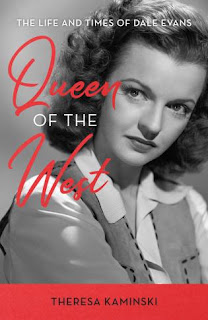
Theresa Kaminski's "Queen of the West"

Theresa Kaminski is a historian of scrappy women. After twenty-five years as a university professor, she now writes full time.

Kaminski applied the “Page 99 Test” to her new book, Queen of the West: The Life and Times of Dale Evans, and reported the following:
Any human reader or electronic browser opening up Queen of the West to page 99 would find Dale Evans living through the spring and summer of 1945. As World War II drew to a close, she experienced big changes in her personal and professional lives. Dale’s home life was breaking up. Her marriage to musician/composer R. Dale Butts was on the rocks. Her son, Tom, graduated from high school that spring, and he would move out in the fall to begin college. She was pleased and proud about her son’s accomplishments.

But Dale Evans was less pleased with her career. She had left Republic Pictures, where she had been on contract since 1943, because Herbert Yates, the studio head, refused to cast her in anything but Roy Rogers westerns. She appreciated how those movies helped boost her star power but remained convinced she could never achieve the leading lady status she sought by appearing in “horse pictures.” Dale intended to become a leading lady, and she was planning a move to a different studio where she believed that could happen. But it was happening too slowly.

A passage from page 99:
To underscore her determination to break away from westerns, Dale gave an in-depth interview to Maxine Garrison, a feature writer for the Pittsburgh Press. Dale knew she risked making waves with Republic and with her fans, but she wanted to clarify her feelings about her career. The story included a photo of the ‘Queen of the Westerns’ clad in a two-piece swimsuit and a pair of high heels. It ran on August 9, the day the atomic bombing of Nagasaki dominated American headlines.
Queen of the West brilliantly passes the Page 99 Test. It illuminates a central struggle Dale Evans faced, one many women still confront today: How to blend a happy family life with a fulfilling career. This is a theme I explore throughout the biography. In the spring and summer of 1945, Dale knew she was at a crossroads both personally and professionally. Her marriage was not going to last, and she always envisioned herself in a happy marriage with a loving husband. Her only child was about to leave home, and she wasn’t quite sure how she felt about no longer having someone to mother.

Dale took a big step with her movie career that summer and declined to sign a new annual contract with Republic Pictures. RKO wanted her to star with comedian/dancer Eddie Cantor in Show Business Out West, a “sophisticated” musical comedy. She believed this would result in a long-term contract with RKO. Until the details were finalized, Dale signed single-picture deals to appear in a few Roy Rogers movies. She needed to keep working, to keep her face up on the silver screen. But the longer RKO kept her waiting, the more uneasy she became.

Another of the book’s themes also surfaces on page 99. Dale Evans exercised as much control as she could over her image and her path to celebrity. The interview she gave with Maxine Garrison was likely well-planned, with both the choice of journalist and the carefully considered responses. (Several years later, Garrison would be hired as assistant public relations director for Roy Rogers/Dale Evans Enterprises.) Dale appreciated her “Queen of the Westerns” (later changed to “Queen of the West”) nickname, but she didn’t want it to become the dominant image of her career. The remainder of the book traces how she handled that challenge.
Visit Theresa Kaminski's website.

Coffee with a Canine: Theresa Kaminski & Hugo.

The Page 99 Test: Angels of the Underground.

The Page 99 Test: Dr. Mary Walker's Civil War.

--Marshal Zeringue