Friday, June 3, 2022

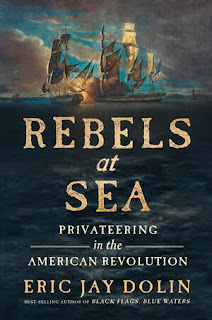
Eric Jay Dolin's "Rebels at Sea"

Eric Jay Dolin is the author of Rebels at Sea: Privateering in the American Revolution.

He applied the “Page 99 Test” to the new book and reported the following:
Page 99 of Rebels at Sea lands the reader right smack in the middle of a very large section--in fact, an entire chapter-- that describes how Benjamin Franklin, as part of a diplomatic mission that included Silas Deane and Arthur Lee, used American privateers as a means of getting France to form an alliance with the United States against Great Britain. The basic idea was that by successfully encouraging France to both clandestinely and, sometimes rather openly, to allow American privateers to use and launch from French ports on the continent and in the Caribbean, Franklin and his peers ramped up the historic animosity between the two ancient European rivals to a fever pitch.

The critical turning point in the Revolution was the defeat of British general John Burgoyne’s army at Saratoga, but privateering, while not causing a sharp turn in American fortunes on its own, helped create the situation in which a great American victory could prove decisive in bringing France into the conflict. With respect to American privateering in the Caribbean, historian Alan G. Jamieson presents a persuasive argument. The activities of those privateers “were not a major cause of the war between Britain and France in 1778, but it is clear that they played a part in sharpening the enmity between the two nations, as well as striking at the British merchant community in an area where it was particularly sensitive, the West India trade.”

A similar case can be made for the importance of American privateering out of France. Taken as a whole, America’s privateering success was, as historian Sam Willis has written, “part of a broader narrative of American successes in 1776 and 1777. Together, [all of these successes] demonstrated on an international stage that the Americans were committed to their revolution and that the British were vulnerable, and they heightened the tension between Britain and her traditional European enemies. In short, they created the opportunity for foreign intervention.”

Unfortunately, the text on page 99 only hints at this larger and most fascinating story, by talking about the subterfuges France used to allow American privateers to dispose of their prizes in French ports even though that violated treaties France had with Great Britain, and, incidentally, made the British furious. Here is that text:
That led to some creative solutions, including privateers selling their prizes far away from French ports to Frenchmen who, in turn, brought the prizes in as their own vessels. Other times, privateers would remain offshore, where they would disguise their prize as something other than a British merchantman. A skeleton crew would then sail the prize into Dunkirk (Dunkerque) or other French ports where it would be sold, whereupon the crew would return to its privateer, flush with cash. American privateers also made liberal use of the “distress” clause in the treaty, claiming that their prizes were leaking, for instance, allowing the French to let them in. Once in port, the prize could quickly and quietly be sold. As one nineteenth- century historian observed, “Distress, of course, became a chronic condition of the American privateers in European waters.”
So, I think page 99 would give the reader a poor idea of the entire book. Sorry, Ford Madox Ford, in this case, your observation fails to be of any value in capturing the "quality of the whole."
Visit Eric Jay Dolin's website.

The Page 99 Test: Fur, Fortune, and Empire.

The Page 99 Test: When America First Met China.

The Page 99 Test: Brilliant Beacons.

The Page 99 Test: Black Flags, Blue Waters.

The Page 99 Test: A Furious Sky.

Writers Read: Eric Jay Dolin.

--Marshal Zeringue

Thursday, June 2, 2022

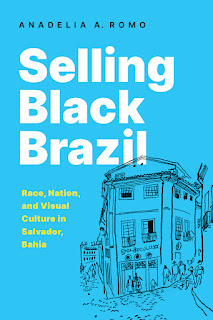
Anadelia A. Romo's "Selling Black Brazil"

Anadelia A. Romo is an associate professor of history at Texas State University. She is the author of Brazil's Living Museum: Race, Reform, and Tradition in Bahia.

Romo applied the “Page 99 Test” to her new book, Selling Black Brazil: Race, Nation, and Visual Culture in Salvador, Bahia, and reported the following:
The Page 99 Test works surprisingly well for Selling Black Brazil. Page 99 is a full-page image, one of over ninety images printed in the work, and so it represents nicely my focus on visual culture in Brazil. The image itself is an advertisement for airline travel in Brazil from 1946, the early years of the domestic travel industry there. It shows three figures looking up at an airplane, which is depicted as a “magic carpet” capable of connecting people from different regions of Brazil. Each of these figures is dressed in the distinctive garb of a particular region: the Northeast, the South, and Bahia. The state of Bahia is represented by a woman dressed in a skirt and turban, an iconic wardrobe that marks the “Baiana,” who is usually styled as an Afro-Bahian female street vendor. These regional types had a longer history in Brazil and across the Atlantic, but gained new salience in the mid-twentieth century to promote “authentic” cultures that one could experience through travel. The argument of my book is that Blackness was used to promote Bahia within Brazil, a process that proved both celebratory and inclusive as well as stereotyped and limiting. Critically, I show that visual culture was especially powerful in linking Blackness with Bahia. To chart the changes in this visual culture I use the iconography of travel guides. These guides were produced in growing numbers within Bahia through the decade of the 1950s to promote the state, and especially its capital city of Salvador. In the end, the image captures my focus on visual culture, the creation of racialized stereotypes to promote a region, and the centrality of travel for distilling an area’s essence for others. These are all central points in my book, so I’d have to conclude the test works pretty well.

The limitation to the test is that I don’t have any of my own writing on page 99, and that the image on that page is for Brazil as a whole. In this sense the national focus of page 99 sets the larger scene for the work, but is a little bit farther from the heart of the book itself which centers around images from vibrant illustrators and photographers who worked in Bahia almost exclusively. So while page 99 doesn’t capture all the nuance of the story, it still captures enough for a reader to get a glimpse into the way national identity and Blackness developed in complicated ways over twentieth-century Brazil, and how Bahia was at the center of that process.
Learn more about Selling Black Brazil at the University of Texas Press website.

--Marshal Zeringue

Wednesday, June 1, 2022

Susan Grant's "Soviet Nightingales"

Susan Grant is a Reader in Modern European History at Liverpool John Moores University. She is the author of Physical Culture and Sport in Soviet Society.

Grant applied the “Page 99 Test” to her new book, Soviet Nightingales: Care under Communism, and reported the following:
Page 99 brings us to the Stalinist 1930s and examines the role of nurses in Soviet society. It details the list of duties that Soviet nurses had to perform, a lengthy list indeed that covers more than half a paragraph! Soviet nurses, and other mid-level medical workers such as orderlies, had a great deal of work to get through. Coupled with this is a discussion of changes in middle medical education that were connected to new Stalinist policies and the new ideological standards that nurses were expected to meet. By the late 1930s nurses had to study modern history, the Soviet Constitution, math, Latin, and the Russian language in addition to medical and scientific classes.

The themes that emerge from the discussion of nurses and medical work on page 99, for example gender, values, education, and ideology, inform the book more generally. In discussing these themes here and elsewhere, I show how nurses became crucial symbols of the Soviet state. We see the increasingly paternalistic and conservative state turning to nurses as symbols of care and culture. As such, nurses had the potential to be ideal intermediaries between the state and society. But if they were to represent the state, then these nurses – almost all women – had to be cultured and educated. The idea of nurses as cultured and cultural workers is significant and one that reappears in later years. This page, and this part of the chapter, also sets the scene for debates about how the Soviet state and society interacted with nurses. It captures important questions about specialization and the kinds of skills nurses should acquire. Overall, we see how nursing and healthcare work are bound up with the state.

The book foregrounds how nursing and nurses were indelibly connected to broader social and political developments in the Soviet Union. It examines the nuances and complexities of the wider Soviet project and relates these to the history of nurses and healthcare workers. Although the Soviet state was brutal, violent, and repressive, it nonetheless drew on nurses to help show that socialist society was caring and compassionate. More broadly, I argue that the skills and work of nurses and other healthcare workers need to be properly recognised, and that ‘care’ needs to be taken seriously.
Learn more about Soviet Nightingales at the Cornell University Press website.

--Marshal Zeringue

Tuesday, May 31, 2022

Frank C. Keil's "Wonder: Childhood and the Lifelong Love of Science"

Frank C. Keil is Charles C. & Dorathea S. Dilley Professor of Psychology at Yale University, where he is also a member of the Cognition and Development Lab. He is the author of Developmental Psychology: The Growth of Mind and Behavior and other books.

Keil applied the “Page 99 Test” to his new book, Wonder: Childhood and the Lifelong Love of Science, and reported the following:
From page 99:
… children, are wizards with computers in ways that I will never know. In a few minutes they are immersed in novel video games while I am still trying to move my agent. They figure out how to use new apps or software without reading any instructions and can seamlessly blend many software programs together to accomplish a task. I surrender completely to their greater abilities in this area. But what have they mastered? If today’s computers were cars, have they learned how they work or have they merely learned how to drive them? They seem to have become experts at learning user interfaces, not at how the underlying code or physical components work.

Perhaps twenty-first-century children are learning a higher level of “mechanism” covering how programs and apps causally interact, but that isn’t how they usually talk about their skills. Their knowledge resembles procedural routines more than programming skills. If you ask a teenager to give examples of how loops, queues, stacks, and arrays interact in simple programs, you may be met with a blank and sometimes hostile stare. Most teenagers’ coding skills don’t seem to be symbolic equivalents of advanced mechanical understanding. If they were, companies would not be madly scrambling to find even marginally competent programmers. Today’s youth, the so-called digital natives, often seem to be gliding along on the surface of a vast system that they do not understand at all. They may have remarkable “native” skills at using and learning to use software-intensive interfaces, but if the real programmers have done their jobs well, the actual workings of those devices may be not at all transparent to those mastering the user interface. Software- shuffling skills at the user level may be completely different from knowing how and why. Teens may know that graphics processing unit chips are better for machine learning but not how they speed up processing. These gaps in understanding will only get worse as deep learning systems solve more and more problems for us. If a company comes up with an improved facial recognition system, people are unlikely to ask how its mechanism has changed. Even experts in the area just assume it arises from a more powerful deep learning system, which is a black box resistant to any useful interpretable explanation of how it works.

In short, the world of artifacts has been radically transformed in the past fifty years. Readily apparent underlying mechanisms have vanished into mazes of circuits and blocks of silicon with millions, and often billions, of transistors. I remember when my father brought home a ten-transistor portable radio, describing it as a huge technology leap over our prior six-transistor… “
Above is the full text from page 99 of Wonder. It resonates surprisingly well with several of the core messages of the book: Well before children start formal schooling, they reveal a drive to uncover the mechanisms that underlie and give rise to all that they encounter. I describe this drive as a joyous urge to wonder “why” and “how”. Page 99 relates to this early emerging passion to know more about mechanisms. This passage links to another central theme – wonder becomes suppressed in most children around age five or six; and the decline of wonder may be worsening as fewer and fewer devices have revealing innards. Page 99 asks whether today’s children inhabit “mechanism deserts,” where insides no longer readily reveal how devices work. This is part of a broader discussion how wonder becomes stifled in children and may stay suppressed for a lifetime, resulting in disengagement from science and susceptibility to misinformation. But that future is not inevitable. Wonder illustrates how to avoid lives of impoverished understanding with barely any sense of the remarkable causal underpinnings of all that is around us. A large body of recent empirical research tells us what we can do as individuals and as groups to maintain and revive wonder at any age. Page 99 may not be the very best page for capturing the whole book, but it is certainly a good one.
Learn more about Wonder: Childhood and the Lifelong Love of Science at The MIT Press website.

--Marshal Zeringue

Monday, May 30, 2022

Ran Abramitzky and Leah Boustan's "Streets of Gold"

Ran Abramitzky is professor of economics and the Senior Associate Dean for the Social Sciences at Stanford University, a research associate at the National Bureau of Economic Research, a senior fellow at the Stanford Institute for Economic Policy Research, and a former co-editor of Explorations in Economic History. Leah Boustan is professor of economics and director of the Industrial Relations Section at Princeton University. She is also co-director of the Development of the American Economy Program at the National Bureau of Economic Research, and serves as co-editor of the American Economic Journal: Applied Economics. Her prize-winning scholarly book, Competition in the Promised Land, examines the effect of the Great Black Migration from the rural South during and after World War II.

Boustan applied the “Page 99 Test” to their new book, Streets of Gold: America's Untold Story of Immigrant Success, and reported the following:
As it turns out, page 99 in our book is focusing on the exceptions, not the rule. Most of Streets of Gold tells the optimistic story of the upward mobility of immigrants to the US – and especially their children – over more than a century of American history. We compare immigrants from the Ellis Island generation 100 years ago, most of whom hailed from Europe, to immigrants from around the world today.

What we find surprised us: the children of immigrants from nearly every country, especially those from poor families, do better economically than the children of U.S.-born residents. This pattern has held true for more than a century.

However, there is one group that we worry about, and that is children who arrive to the US without papers. These undocumented children can face numerous barriers is trying to gain an education and find a job. In the past, nearly all immigrants entered the US legally, whereas today around one-quarter of immigrants are undocumented.

Yet, the number of children of immigrants who are undocumented is far smaller (only around five percent) because any child who is born on US soil is automatically a US citizen. Page 99 in Streets of Gold picks up the story of this small but disadvantaged group and emphasizes that they might not enjoy the same upward trajectory as their peers.

One element of this page that is consistent with the rest of the book is the way that we weave together data and story-telling. Many of the findings in the book are based on ‘big data’ from millions of immigrant families. But we also introduce stories of immigrants whose experiences illuminate these broader trends. For example, on page 99, we tell the story of Margarita, an undocumented high-school graduate whose immigrant parents only received a fourth-grade education. Yet, Margarita finds herself working with her mother (“It’s kinda ridiculous,” she says, “why did I even go to school?”). This story was originally told to the sociologist Roberto Gonzales and we reproduce it here.
Learn more about Streets of Gold at the PublicAffairs website.

--Marshal Zeringue

Saturday, May 28, 2022

Stephen L. Harp's "The Riviera, Exposed"

Stephen L. Harp is Distinguished Professor of History and Professor of French at the University of Akron. He is a specialist in nineteenth and twentieth-century France. He has authored books on primary schooling and nationalism in Alsace-Lorraine, the Michelin tire company, nudism in modern France, and the history of rubber.

Harp applied the “Page 99 Test” to his new book, The Riviera, Exposed: An Ecohistory of Postwar Tourism and North African Labor and reported the following:
On page 99, I give background on the history of the sewage system in Nice. In the 1930s, Nice pioneered an early “separate” sewer system, separating run-off rain water from human sewage. Long an elite destination, Nice was on the cutting edge. Yet that same system proved woefully inadequate after World War II, when there were far more tourists, and they consumed up to 100 times more water, most of it ending up in a sewer system characterized by regular overflows into the sea. Imagine how floating human waste could hurt tourism!

Page 99 includes a fascinating detail. Since most of Nice is on a narrow plain along the sea, sewer lines were narrow with very little pitch. To clean lines too small for humans to enter, sanitation workers used sewer dogs, chiens-égoutiers. Workers attached a cable to the dog’s harness, and the dog ran down the pipe to the next manhole. Workers then used the cable to knock waste off the inside of the pipe. I first learned about the practice from newspaper articles bemoaning the fact that foreign tourists had complained, leading to its abandonment. Sanitation workers maintained that they had treated the dogs well.

Here is a clear case of the wonders of working in the era of the internet. From newspaper accounts, I didn’t understand how dogs helped to clean sewers or even what a “sewer dog” might be. So I googled chiens-égoutiers. I ultimately found a clip from channel TF1 on the site maintained by the French Institut nationale de l’audiovisuelle (which gets a copy of everything airing on French TV, just as one copy of every book published in France ends up in the Bibliothèque nationale de France). Come to find out, sewer dogs were still hard at work in the city of Rennes in 1982. Workers in Rennes assured viewers that the dogs were cleaned, well-fed, and received caresses. Without that news segment, I don’t think I could have figured out how dogs cleaned sewers.

In the end, page 99 represents the spirit of the book, in exposing some of the grit that underlay the glamour of the French Riviera. But page 99 doesn’t fully reveal just how thoroughly mass tourism transformed the environment of the Riviera. Nor does it show how much that transformation depended on North African migrant laborers who did much of the work—often while living without access to potable water or WCs in squats and shantytowns.
Learn more about The Riviera, Exposed at the Cornell University Press website.

--Marshal Zeringue

Friday, May 27, 2022

Brian C. Wilson's "The California Days of Ralph Waldo Emerson"

Brian C. Wilson is Professor of American Religious History and WMU Distinguished Faculty Scholar in the Department of Comparative Religion at Western Michigan University. His books include John E. Fetzer and the Quest for the New Age.

Wilson applied the “Page 99 Test” to his new book, The California Days of Ralph Waldo Emerson and reported the following:
The California Days of Ralph Waldo Emerson is an old-fashioned travelogue that narrates the Concord Sage’s one and only trip to the Far West in 1871. While in California, Emerson and his party traveled widely to visit several of the state’s emerging tourist attractions. The midpoint of the trip, and the midpoint of the book, finds Emerson and friends enjoying a respite at Calistoga, a hot-springs resort in the Napa Valley founded by the Mormon 49er, Samuel Brannan. It was here that Emerson was inspired to write a paean to the Golden State, lamenting in a letter to his wife that if only they were younger, “we might each claim his quarter-section of the Government, & plant grapes & oranges, & never come back to your east winds & cold summers.” Famously, Emerson had once joked that it was “Divine Providence that the New England states should have been first settled, before the western country was known, or they would never have been settled at all.” His visit to California confirmed him in this opinion.

After a day of bucolic splendor in Calistoga, a few in Emerson’s party decided to risk the treacherous wagon road over Mount St. Helena to the Geysers, a weird volcanic region of boiling mud pots and steaming fumaroles. Their encounter with this stygian landscape is described in vivid detail on page 99 of the book:
As the group climbed the canyon of Pluton Creek—the “Ascent into Tartarus” [as the] guidebook called it—everywhere could be heard subterranean gurgling, hissing, whistling, and puffing, and the ground grew increasing warm and soft, and the air more pungent with the hot smell of sulfur that stung one’s nostrils and permeated one’s clothes. All about, the rocks were stained with crystalized sulfur, alum, copper and iron sulfate, and a variety of other minerals, yellow, white, red, green, and black. […] As the group advanced, they were introduced to the seemingly endless series of weirdly shaped features, each with hellish names like the “Devil’s Kitchen,” the “Devil’s Inkstand,” and “Pluto’s Punchbowl,” this last being a rocky basin in which thick, black water boiled and tossed ceaselessly. Next was the “Witches’ Caldron,” where “steam-jets spurt out, hissing and puffing on every side, the air [...] thick with vapors from every chemical combination possible to imagine.” The whole atmosphere radiated danger and instability, although the guide blithely reassured everyone that no major explosion had occurred in the canyon since 1860.
Until Yellowstone was developed for tourism in the 1890s, California’s Geysers were immensely popular with tourists who were fascinated by such startling geologic features. Sadly, the Geysers were tapped for geothermal power in the 1960s, and little of the original features remain today. Indeed, most of the natural sites that Emerson and his party visited—from the San Francisco Peninsula to the San Joaquin Valley to Yosemite—existed in a state of pristineness that is hard to imagine today. And this, I believe, is one of the singular strengths of The California Days of Ralph Waldo Emerson. Using letters, guidebooks, photographs, and other primary documents, I have meticulously recreated scenes of a now vanished California, allowing readers to experience the state afresh through the Transcendentalist eyes of Emerson and his fellow travelers. To this extent, I think the Page 99 Test works remarkably well, and would give browsers a good sample of the kind of “thick description” that afficionados of travel writing will find irresistibly engaging.
Learn more about The California Days of Ralph Waldo Emerson at the University of Massachusetts Press website.

--Marshal Zeringue

Thursday, May 26, 2022

Andrew Leon Hanna's "25 Million Sparks"

Andrew Leon Hanna is a first-generation Egyptian American lawyer, entrepreneur, and author from Jacksonville, Florida. He is co-founder and CEO of DreamxAmerica, a Knight-Hennessy Scholar and Siebel Scholar at Stanford Graduate School of Business, and winner of the Financial Times and McKinsey Bracken Bower Prize. Hanna has been named to the Forbes 30 Under 30 list and graduated with honors from Harvard Law School, where he was an editor of the Harvard Law Review.

He applied the “Page 99 Test” to his new book, 25 Million Sparks: The Untold Story of Refugee Entrepreneurs and reported the following:
Page 99 of 25 Million Sparks shares the stories of two inspiring women, Yasmina and Masika, as illustrations of refugee entrepreneurs’ exceptional risk-taking ability and commitment to their ventures. The page takes readers to the Sherkole refugee camp in Ethiopia and introduces them to Masika, founder of a bakery and restaurant in the camp. It also touches on the story of one of the central entrepreneurs featured in the book, Yasmina, who is a wedding dress shop and salon owner living in the Za’atari refugee camp in Jordan.

From page 99:
She would have much rather held off on selling her jewelry and waited for a return to Syria, but holding off would mean her children might not have enough to eat. Starting her salon was a risk that she knew she had to take for her family, and thus one she did not have time to second-guess as entrepreneurs with a comfortable ‘next best alternative’ might. Yasmina had to be fully committed from day one.
The Page 99 Test works reasonably well! The highest purpose of the book is to tell the stories of refugees in a way that reflects their incredible power, creativity, and beauty. Page 99 highlights the stories of two amazing refugee entrepreneurs – Yasmina and Masika – to illustrate why refugees tend to be so much more entrepreneurial than the average person. And in doing so, it emphasizes the courage of refugees to start life anew and launch their innovations – their “sparks” – even amidst the most tragic experiences imaginable.

More broadly, 25 Million Sparks follows the lives of three refugee entrepreneurs in the Za’atari refugee camp: along with Yasmina, there is Malak, a young artist infusing color and beauty throughout the camp, and Asma, a social entrepreneur leading a storytelling initiative to enrich children’s lives. Anchored by these three inspiring stories, as well as accompanying artwork and poetry by Malak and Asma, the narrative expands beyond Za’atari to explore the broader refugee entrepreneurship phenomenon in more than twenty camps and cities across the globe. What I hope emerges is a tale of power, determination, and dignity – of igniting the brightest sparks of joy, even when the rest of the world sees only the darkness.
Visit Andrew Leon Hanna's website.

--Marshal Zeringue

Wednesday, May 25, 2022

Ben Jones's "Apocalypse without God"

Ben Jones is the Assistant Director of Penn State's Rock Ethics Institute and has a Ph.D. in political science from Yale University. His research has appeared in the Journal of Applied Philosophy, European Journal of Political Theory, Political Research Quarterly, and other venues, including popular outlets like The Washington Post.

Jones applied the “Page 99 Test” to his new book, Apocalypse without God: Apocalyptic Thought, Ideal Politics, and the Limits of Utopian Hope and reported the following:
Page 99 comes in the middle of Chapter 4 on Thomas Hobbes, the influential English political philosopher of the 17th century who wrote Leviathan, which defends the state’s authority and condemns life outside of it as “solitary, poore, nasty, brutish, and short.” This chapter examines how Hobbes responds to rebellious apocalyptic sects, like the Fifth Monarchy Men, and co-opts aspects of their beliefs to bolster the state’s authority. Page 99 quotes a letter by Hobbes to King Charles II from 1662, after the English Civil War and restoration of the monarchy. Leviathan sparked a great deal of controversy, leading some of Hobbes’s opponents to label him an atheist, and the letter tries to assure Charles that his motives for writing the book were noble:
It was written in a time when the pretence to Christ’s kingdom was made use of for the most horrid actions that can be imagined; and it was in just indignation of that, that I desired to see the bottom of that doctrine of the kingdom of Christ, which divers ministers then preached for a pretence to their rebellion.
It’s a fascinating remark by Hobbes and shows that Leviathan’s many passages on apocalyptic beliefs, like the kingdom of God or Christ, are central to the project. That is often missed in how Leviathan is read and taught today.

Apocalypse without God has three parts, and page 99 serves as a nice representation of Part II. This part offers historical case studies of secular political thinkers who engage with apocalyptic texts and figures. The other two chapters of Part II examine Niccolò Machiavelli’s interest in the apocalyptic figure Girolamo Savonarola and Friedrich Engels’s fascination with the book of Revelation and German revolutionary Thomas Müntzer. These chapters show how apocalyptic thought becomes secular and its persistent appeal in political thought.

Page 99 is a bit different than what you find in Parts I and III. Part I presents a conceptual analysis of secular apocalyptic thought along with methodological recommendations for how to study it (which Part II illustrates). Part III then reflects on what secular apocalyptic thought can teach us about political philosophy and politics today.

Apocalyptic thought has two sides to it: predictions of catastrophe, but also hope for utopia. As Apocalypse without God explains, the persistent appeal of apocalyptic thought partly lies in offering strategies to “reconcile deeply held hopes for a more perfect political future with a world seemingly hostile to it.” You will not find that exact point on page 99, but it’s a building block for developing and illustrating that argument.
Learn more about Apocalypse without God at the Cambridge University Press website, and visit Ben Jones's webpage.

Coffee with a Canine: Ben Jones & Sloopy.

--Marshal Zeringue

Tuesday, May 24, 2022

Wendy Rouse's "Public Faces, Secret Lives"

Wendy Rouse is a historian whose research focuses on the history of gender and sexuality in the Progressive Era. Her most recent book, Public Faces, Secret Lives: A Queer History of the Women’s Suffrage Movement, challenges the heteronormative framing of the traditional narrative of the campaign for the vote. Her previous two books explored the history of women and children in the Progressive Era: The Children of Chinatown: Growing up Chinese American in San Francisco, 1850 to 1920 and Her Own Hero: The Origins of the Women’s Self-Defense Movement. Rouse is presently Associate Professor of History at San Jose State University where she teaches LGBTQ+ and women’s history.

Rouse applied the “Page 99 Test” to Public Faces, Secret Lives and reported the following:
Page 99 of Public Faces, Secret Lives: A Queer History of the Women’s Suffrage Movement provides a glimpse into some of the key themes in the larger book. When the reader turns to page 99 they will read a small part of the story of queer suffragist Anne Martin. Martin advocated for women’s right to vote in her home state of Nevada and later fought for the passage of a federal suffrage amendment. But page 99 tells the story of an even earlier time in Martin’s life as a suffragist.

Page 99 travels back to 1909 when Martin was living in Britain and working with the suffragists of the Women’s Social and Political Union (WSPU). Martin was one of several American suffragists who went to Britain to study the militant strategies of Emmeline Pankhurst, the leader of the WSPU. Martin participated in the WSPU’s deputations, marching with hundreds of suffragists to Parliament to petition the prime minster for the vote. Martin later used some of the tactics she learned in Britain in the suffrage campaign in the United States.

Martin also participated in the famous Black Friday deputation. This 1910 demonstration in Parliament Square ended violently when police officers physically assaulted suffragists inflicting them with black eyes, bleeding noses, and dislocated joints. Martin, along with over one hundred other suffragists, was arrested and charged with obstructing the police. After this incident, the WSPU decided to once again shift tactics. They launched mass window-breaking campaigns and encouraged other acts of vandalism to make their point heard. They also trained to physically defend themselves against police assault (see Her Own Hero: The Origins of the Women’s Self-Defense Movement).

The snippet of Martin’s story on page 99 describes the important friendships Martin formed in England with other queer suffragists such as Annie Kenney and Evelina Haverfield. Kenney allegedly had romantic relationships with other women in the movement. Haverfield was in a committed relationship with fellow WSPU member Vera “Jack” Holme. Martin continued to rely on the network of queer friendships she created in England in her later suffrage work in the United States.

Page 99 not only demonstrates the significance of queer people to the suffrage movement but the significance of queer relationships in forging the transatlantic alliances that fueled an international women’s right movement. Dive into the book to learn even more about the queer history of the women’s suffrage movement.
Visit Wendy Rouse's website.

The Page 99 Test: Her Own Hero.

--Marshal Zeringue