Sunday, June 19, 2022

Gregory Nobles's "The Education of Betsey Stockton"

Gregory Nobles is professor emeritus of history at Georgia Institute of Technology and a historian who has written extensively on the era from the American Revolution to the Civil War. He is the author or coauthor of several books, including John James Audubon: The Nature of the American Woodsman.

Nobles applied the “Page 99 Test” to his new book, The Education of Betsey Stockton: An Odyssey of Slavery and Freedom, and reported the following:
From page 99:
And so the Stewarts and Betsey Stockton found themselves ashore, likewise “most probably forever.” They also found themselves in less than commodious accommodations. The main house in the missionary enclosure— “which at home would be called small,” Stockton observed— had been essentially prefabricated, with wood measured and cut in Massachusetts, then shipped around Cape Horn to Honolulu, and assembled on-site in 1821. It didn’t have sleeping room for everyone, so most of the missionaries occupied small huts on the surrounding grounds. “We had assigned to us a little thatched house in one corner of the yard,” Stockton wrote, “consisting of one small room, with a door, and two windows— the door too small to admit a person walking in without stooping, and the windows only large enough for one person to look out at a time.” The missionaries came together for meals in the main house. As aboard the Thames, Stockton took note of the social arrangements: “The family all eat at the same table, and the ladies attend to the work by turns.” Stockton took her turn, and she found value in the time she spent serving the others: “Had I been idle, I should not in all probability been so happy in my situation as I was.”

Stockton kept to the enclosure most of the time, but she ventured away on a few occasions to fetch milk from another compound about two miles away— the home of Anthony Allen, one of the most significant Americans in Hawaiʻi, and certainly the most notable African American. Allen had first come to Hawaiʻi as a mariner in 1810 or 1811, and the following year he returned to settle on Oʻahu. Up to that point, though, his life had been anything but settled, a “story of wanderings & adventures,” as he told it, that took him around the world, eventually to the Pacific and remarkable success.
The Page 99 Test works to the extent that it catches Betsey Stockton arriving in Hawaiʻi in 1823—a critical turning point in her first 25 years of life. Born in 1798 in Princeton NJ, she was “given, as a slave” into the household of the Rev. Ashbel Green, a prominent Presbyterian pastor in Philadelphia who became the president of the College of New Jersey (later Princeton University) in 1812. During her adolescent years, Green emancipated her from slavery but kept her in his household as a servant until 1822, when she joined one of Green’s former students, Charles Samuel Stewart, as part of a “missionary family” sailing from New Haven to Hawaiʻi. She would be the only single woman and the only Black person aboard the whaleship Thames for five months, enduring turbulent seafaring, physical suffering, and spiritual trial. The main source of comfort came in her increasingly close connection to Charles Stewart, his wife Harriet, and their son, Charles Seaforth, born at sea just before the Thames came in view of Hawaiʻi.

And so Betsey Stockton and the Stewarts went ashore to take up their missionary duties. Stocktonʻs missionary contract called for her to be “employed as a teacher of a school, for which it is hoped she will be found qualified.” Qualified she certainly proved to be, and she started the first school for the makaʻāinana, or ordinary people of the islands, a significant and successful achievement. In Hawaiʻi, Betsey Stockton embraced the calling she would follow for the rest of her life, teaching people of color of the lower classes.

The Hawaiʻi chapter of her life came to a premature end, however. Harriet Stewart became too ill to remain in the islands, and the Stewarts returned to the United States in 1826, with Betsey Stockton accompanying them. She remained a loving and loyal friend of the Stewart family throughout her life, but she also pursued her own path as a teacher, returning to Princeton in 1833, where she became a founding member of the town’s Black Presbyterian church and the sole teacher at the sole—and segregated—school in Princeton’s sizeable Black community until her death, in 1865. In the face of America’s racism, which permeated the North no less than the South, Betsey Stockton engaged in a grassroots struggle for decades, working to keep a Black community together in a nation coming apart. Her persistence, I argue, was a form of resistance.
Learn more about The Education of Betsey Stockton at the University of Chicago Press website.

--Marshal Zeringue

Friday, June 17, 2022

Daniel Laurison's "Producing Politics"

Daniel Laurison is an associate professor of sociology at Swarthmore College and the associate editor of the British Journal of Sociology. He researches and writes on social class and political inequalities. His previous book was The Class Ceiling: Why It Pays to Be Privileged (coauthored with Sam Friedman).

Laurison applied the “Page 99 Test” to his new book, Producing Politics: Inside the Exclusive Campaign World Where the Privileged Few Shape Politics for All of Us, and reported the following:
Page 99 in its entirety (from Chapter 4: The Room Where it Happens):
and subjective measures of merit are almost guaranteed to benefit people whose race, gender, class origin, education, and other characteristics resemble other staffers already in place. This is homophily in action.

One reason this is a problem is fairness and equity—ideally, anyone who wants to work in politics and is willing and able to do the work ought to have an equal shot at a career. Ideally, there would be clear paths to entry and criteria for good work (and reasonable working hours, while we’re at it) so that people from all walks of life might be able to make their living in politics if they’re moved to do so. That ideal applies equally to any field, really.

But politics is special, because politics by its nature affects all of our lives. It makes a difference to all of us what campaigns do, insofar as what they do matters for who participates and how, and how people see and understand politics and politicians and government. If campaigns are making ads that speak primarily to people like their staff, or even actively generate hostility against people unlike them, that affects us all. If campaign staff advise candidates that certain policies will never fly, or that they should tone down their feminism or play up their machismo, that constitutes a large part of American political cultural content. If campaign teams believe that the White working class loves racism and hates redistribution (they actually, on the whole, like both), or that nonvoters will never vote (when they can in fact be effectively mobilized), then they will craft campaigns based on those beliefs. (fn 11) When the people running campaigns are so different from the rest of us, chances are that many people will continue to see politics as something for “other people.”
The Page 99 Test worked a lot better than I thought it would. This page gives you a pretty good idea about many (of course not all) of the main themes in the book, and I wouldn’t be sad if someone used this page to decide whether to read the whole book.

Basically all of what’s on page 99 is part of one of the central things I want to get across in Producing Politics. The last paragraph makes the case that campaigns and what happens in them are important, and not only because campaigns culminate in elections that determine who holds political power; they’re also important because they deliver information about what politics, and who it’s for, and what it can do. And for the big swathe of potential voters who don’t pay much attention to politics or news, the messages created by campaigns, the contact they get or don’t get from parties, they may not be getting connected to politics any other way.

That paragraph also alludes to the fact that a lot of the decisions campaign professionals make are not (and in many cases can’t be) driven by research.

The middle paragraph alludes to another key point - that the way political work is set up makes it very difficult for people who aren’t white men from fairly well-off backgrounds to break in, and even more difficult for anyone who wants to have some semblance of balance or a family life to stay in politics. And the fragment at the top is a nice illustration of how work in sociology (along with political science) informs the book overall.

Another key point the book makes that’s not really present on page 99, though, is that campaign professionals too often view voters as simply data points in a war they’re fighting against the other side, rather than people who might be recruited into their efforts. That way of doing politics–combined with a lot of campaigning based on conventional wisdom and group-think–is bad for our democracy and part of, as one of my interviewees put it, “why people really hate politics.”
Visit Daniel Laurison's website.

--Marshal Zeringue

Thursday, June 16, 2022

Alison Macor's "Making The Best Years of Our Lives"

Alison Macor received a Public Scholars grant from the National Endowment for the Humanities for her new book Making The Best Years of Our Lives: The Hollywood Classic That Inspired a Nation, about the 1946 blockbuster that influenced the way we talk about PTSD. She's also the author of Rewrite Man: The Life and Career of Screenwriter Warren Skaaren (2017) and Chainsaws, Slackers, and Spy Kids: Thirty Years of Filmmaking in Austin, Texas, which won the 2012 Peter C. Rollins Book of the Year Award. She holds a PhD in film history and taught for more than 20 years at the University of Texas at Austin, Texas State University, Austin Community College and the Austin Museum of Art. A former film critic, she currently works as a freelance writer and ghostwriter and lives in Austin with her husband and son.

Macor applied the “Page 99 Test” to Making The Best Years of Our Lives and reported the following:
Page 99 in Making The Best Years of Our Lives concludes a discussion about the filming of one of the emotional high points of the movie: the nighttime kitchen sequence between the handless veteran Homer Parrish (Harold Russell) and his girlfriend Wilma Cameron (Cathy O’Donnell). It is a pivotal moment in the couple’s relationship, which has been fraught ever since Homer returned from the war. The mood of the scene is complex, with elements of film noir, melodrama, and even horror in the way it is framed, lit, shot, and scored. The sequence actually starts in the kitchen and ends in Homer’s second-floor bedroom. As I write in this section, it is one of the movie’s most important sequences, and it features the production’s least experienced actors.

This particular page takes the reader through the filming of the bedroom portion of the sequence, from its complicated lighting setups to screenwriter Robert Sherwood’s screen direction. It also describes how the sequence was shot to comply with the directives from the Production Code Administration’s Breen Office, the industry’s self-censorship organization run at the time by Joseph Breen.

This section describes how director William Wyler worked with his actors on the emotionally charged scene: “Wyler was patient with Russell and O’Donnell throughout the filming of the sequence, aware that he was asking a lot of the most inexperienced actors in the Best Years ensemble. While O’Donnell struggled to convey a certain amount of impatience with Homer during the kitchen conversation, Russell downplayed his emotions too much in an effort to express Homer’s reticence and vulnerability. ‘Not acting,’ scribbled the script clerk on take after take.”

Page 99 also reveals how the Breen Office had flagged the sequence’s final moments, which include a kiss between the unmarried couple in a bedroom at night. “Before the fade-out . . . it should be clearly indicated that Wilma is about to leave the room,” Breen wrote of the scene in the first version of the script.

I think this page offers a pretty great snapshot of the book as a whole. If readers were to flip to this while browsing through the book, they would get a sense of how Making Best Years combines behind-the-scenes detail about the production and release of the movie with insight into its key players and what they brought to the project. The brief background on the Breen Office’s response to the scene in the script and their warnings about how it should be handled also offers industrial context for Hollywood circa 1946, when Best Years was filmed, something I do throughout the book.

I have to admit I was holding my breath as I turned to page 99 for this test, but I am delighted that it includes this important scene. It is quite possibly my favorite sequence in the entire film.
Visit Alison Macor's website.

--Marshal Zeringue

Wednesday, June 15, 2022

Mark Clague's "O Say Can You Hear?"

Mark Clague is associate professor of musicology and American culture at the University of Michigan; associate dean at the School of Music, Theatre & Dance; and codirector of the American Music Institute. He lives in Ann Arbor, Michigan.

Clague applied the “Page 99 Test” to his new book, O Say Can You Hear?: A Cultural Biography of "The Star-Spangled Banner", and reported the following:
War not only gave birth to “The Star-Spangled Banner,” it is pivotal to understanding the song’s role in American life. The American Civil War, in particular, forged the connection between flag and song. Most importantly, it sanctified the song as a symbol of patriotic devotion through the ultimate sacrifice—the willingness to lay one’s life down in service to the nation.

Page 99 of my book O Say Can You Hear? falls in the middle of chapter 4—"The Banner at War.” This chapter is emblematic of my approach to telling the anthem story by focusing on big-picture themes and ideas. I both want to make the story vivid and accessible, while showing how the song has grown and changed with the nation.

The page is dominated by an illustration of a Civil War recruiting poster that seeks to inspire African Americans to enlist in the Union Army. Although not permitted to fight until 1863, Blacks soon made up 10% of the Union Army. The poster features a Black soldier with sword raised aloft. He holds an American flag with a ribbon that reads “Freedom to the Slave.” In the text, I discuss how Francis Scott Key’s song became a rallying cry of the Union Army and thus helped to end the evil of slavery. While it took the U.S. Congress until 1931 to make it official, “The Star-Spangled Banner” truly became the nation’s anthem in 1861. Civil war made “The Star-Spangled Banner” sacred.

A major goal of the book is to examine if and how Key’s song can still serve today as a unifying statement for all Americans. I argue that our anthem remains viable and valuable, but the question is complex. One approach is to explore the song’s long history as a vehicle for social protest—its ability to make social conflict audible. A surprising discovery was the 600+ lyrics that have been sung to the tune in U.S. history. These include patriotic songs, but also campaign songs and protest lyrics demanding an end to slavery, advocating prohibition, arguing for women’s suffrage, and welcoming immigrants by translating Key’s text into other languages. These alternate lyrics were the viral memes and tweets of the 19th century. Their words were reprinted from newspaper to newspaper, not only to highlight important issues facing the nation, but to inspire Americans to action by leveraging the emotional power of music.

For me, “The Star-Spangled Banner” is American history. Rather than an immutable icon, the song resonates across more than two centuries to show how the American democratic experiment has always been a raucous and rebellious balancing act. On one side are the passions of individual Americans fighting for what they believe is best for the nation. On the other is a belief shared by all Americans that what unites us—particularly the values of freedom, equality, and courage celebrated in the anthem lyric—is key to bringing out the nation’s best.
Follow Mark Clague on Twitter and visit the Star Spangled Music Foundation website.

--Marshal Zeringue

Monday, June 13, 2022

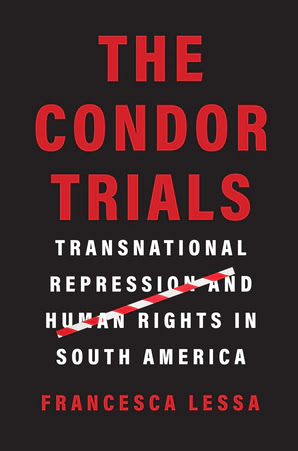
Francesca Lessa's "The Condor Trials"

Francesca Lessa is a lecturer in Latin American studies and development University of Oxford. She is also the author of Memory and Transitional Justice in Argentina and Uruguay and the honorary president of the Observatorio Luz Ibarburu (Uruguay).

Lessa applied the “Page 99 Test” to her new book, The Condor Trials: Transnational Repression and Human Rights in South America, and reported the following:
Page 99 of The Condor Trials offers a snapshot of several core themes at the heart of the book. If browsers open to that page, they will be in a central chapter entitled “The Condor System,” which unpacks in detail the inner workings and mechanisms of transnational repression that South America’s criminal states agreed in late 1975 to hunt down political opponents beyond borders. The page begins with a quote from a Uruguayan female political activist who lived in exile in Buenos Aires which painstakingly articulates the dramatic context in which refugees lived in July 1976, seeing their friends and loved ones disappear at the hands of the security forces. Page 99 quotes her exact words, saying: “Each time, I thought, that’s it, it’s my turn, and yet it wasn’t. You could touch the fear.”

The rest of page 99 narrates the spiral of violence that was unfolding in Argentina after the March 1976 military coup, with thousands of people murdered or disappeared, including hundreds of refugees who had called Argentina their home for several years. Two thirds of page 99 are occupied by a section called “Liquidating the MIR,” which focuses specifically on the case of Argentine militant Patricio Biedma, who was the representative of the Chilean Revolutionary Left Movement (MIR) to the Revolutionary Coordinating Junta (JCR) in mid-1976. Biedma was at the time responsible for helping the remaining MIR militants in Argentina flee the country, as well as coordinating the transfer of funds and messages for the JCR between Argentina and Chile. Throughout 1976, the security forces targeted and disappeared at least 20 MIR activists in Buenos Aires, including Biedma himself in July.

Page 99 is a great representation of The Condor Trials and the first core theme at the heart of the book, namely transnational repression. The page remarkably features four key elements that permeate the entire book. First, how transnational repression meticulously targeted refugees living in Argentina in the 1970s, especially militants from Uruguay and Chile. Second, the US government’s knowledge of the practices of joint collaboration by South American security forces as well as their brutal methods of repression, which included the murder of political and trade union leaders in exile. Third, the key role played by the Automotores Orletti clandestine detention centre in Buenos Aires, which was the main secret prison associated with Condor in 1976 where hundreds of foreign exiles were tortured and disappeared. Fourth, the simultaneous targeting by the security forces of both revolutionary guerrilla militants and political as well as social activists, while also cutting these groups’ access to the funds that sustained their resistance and opposition to the military regimes.

Page 99, therefore, captures clearly the book’s focus on the concerted efforts by South America’s military dictatorships to target political opponents beyond borders through transnational repression. In the 1970s, South America became a zone of terror for those who were targeted, and of impunity for those who perpetuated the violence. Browsers should, however, keep on reading beyond page 99 to explore the book’s second theme, transnational justice. The second half of The Condor Trials analyses how networks of justice seekers gradually materialized and effectively transcended national borders to achieve justice for the victims of these unspeakable transnational horrors. The story of transnational terror in South America, which page 99 brought to the fore, ultimately became one of justice seeking. Owing to the tireless work of survivors, victims’ relatives, lawyers, human rights activists, journalists, as well as judges and prosecutors, over 100 South American former civilian and military officers, including formers dictators, heads of state, and government ministers, have been convicted of transnational human rights violations against more than 260 victims. If you want to be inspired by the resilience of justice seekers and their search for accountability for past atrocities, dive into The Condor Trials.
Follow Francesca Lessa on Twitter.

--Marshal Zeringue

Saturday, June 11, 2022

Carolyn Vellenga Berman's "Dickens and Democracy in the Age of Paper"

Carolyn Vellenga Berman is an Associate Professor of literature and Co-Chair of Literary Studies at Eugene Lang College, The New School, in New York City. She is the author of Creole Crossings: Domestic Fiction and the Reform of Colonial Slavery. Her articles have appeared in Victorian Studies, Victorian Literature and Culture, Novel, Genre, and Nineteenth-Century Contexts and collections ranging from Just Below South to The Encyclopedia of Victorian Literature. She serves on the advisory board of the North American Victorian Studies Association and the editorial board of Dickens Studies Annual.

Berman applied the “Page 99 Test” to her new book, Dickens and Democracy in the Age of Paper: Representing the People, and reported the following:
On page 99 of Dickens and Democracy in the Age of Paper, you’ll find a description of Charles Dickens’s 1835 sketch “The Parlour.” This vignette features a man speaking to the crowd in an alehouse, but it’s a great example of the kind of rhetoric observed by Dickens in his work as a parliamentary reporter. Political bombast abounds: “What is an Englishman?” the man asks. “Is he to be trampled upon by every oppressor? . . . What’s freedom? Not a standing army. What’s a standing army? Not freedom.” Dickens emphasizes the performative aspects in his account: “and the red-faced man, gradually bursting into a radiating sentence, in which such adjectives as ‘dastardly,’ ‘oppressive,’ ‘violent,’ and ‘sanguinary,’ formed the most conspicuous words, knocked his hat indignantly over his eyes, left the room, and slammed the door after him.”

Does this sample reveal the quality of the whole book? Yes. It’s typical of my procedure throughout the book: using quotes from Dickens to show how parliamentary discourse was spreading across the social field in the nineteenth century. I particularly emphasize how Dickens reflects on this diffusion, to comic effect. In this case, we see not a member of the House of Commons, but a drunk saying, “if I was a Member of the House of Commons . . . I’d make ’em shake in their shoes.” This dynamic is key to Dickens’s fiction.

Page 99 also foregrounds the parliamentary debates on slavery and emancipation in the 1830s, another leitmotif of the book. Parliament voted to abolish slavery in the British colonies in 1833, but only after a period of “apprenticeship” for the enslaved, which extended until 1838. I argue throughout the book for the formative importance of these political debates in Dickens’s work.

The larger story I tell in the book involves two kinds of publications emanating from Parliament: not only the newspapers and other commercial publications representing Parliament to the public, but also the vast expanse of official publications representing the People to Parliament—and then sold to the public as readers.

For Dickens and other commentators, this historical period was an “age of paper.” I love it that page 99 ends with the word “paper,” in another quote from the sketch: “a numerous race are these red-faced men,” so, “just to hold a pattern one up . . . we took his likeness,” and “that is the reason why we have written this paper.”
Learn more about Dickens and Democracy in the Age of Paper at the Oxford University Press website and follow Carolyn Vellenga Berman on Twitter.

--Marshal Zeringue

Thursday, June 9, 2022

Brian P. Levack's "Distrust of Institutions in Early Modern Britain and America"

Brian P. Levack is John E. Green Regents Professor Emeritus in History at the University of Texas at Austin. He has written widely on the legal, political, and religious history of early modern Europe. His books include The Civil Lawyers in England 1603-1641: A Political Study; The Formation of the British State: England, Scotland and the Union, 1603-1707; The Witch-Hunt in Early Modern Europe, which has been translated into eight languages; Witch-hunting in Scotland: Law, Politics, and Religion; and The Devil Within: Possession and Exorcism in the Christian West. He is the editor of The Oxford Handbook of Witchcraft in Early Modern Europe and Colonial America.

Levack applied the “Page 99 Test” to his new book, Distrust of Institutions in Early Modern Britain and America, and reported the following:
Page 99 of my book focuses on the decision by the government of Charles I in 1626 to force his wealthier subjects to lend the Crown money with no guarantee of repayment. This forced loan, coupled with the imprisonment of five knights who refused to pay it, contributed to the loss of trust in Charles’s government, which in turn led to its collapse in 1641 and the abolition of the monarchy in 1649.

Although this page touches on one of the themes of the book, which is the connection between the loss of trust in financial and political institutions, it does not provide an adequate statement of the idea of the entire work. In particular, it does not say that the book deals with the development of distrust in a wide range of political, legal, financial, commercial, and ecclesiastical institutions during the early modern period, which stretched from the early sixteenth to the early nineteenth centuries. Nor does page 99 explain that the book, whose main focus is Britain, also deals extensively with American history during the colonial period and that of the early republic. The last chapter also compares the loss of trust in the early modern period with the crisis of institutional trust in the United states and Britain in the last fifty years, especially in the first two decades of the twenty-first century.

I would like to bring to the attention of the prospective reader two important features of the book that its brief descriptions by the publisher does not discuss. The first is the central importance of the seventeenth-century political philosopher John Locke, who is the main subject of Chapter 2 and in a certain sense the main figure in the entire book. Locke’s theory of trust, formulated in his Two Treatises of Government (1689) became an essential tenet of Anglo-American political culture.

The second is my argument that trust in institutions is more difficult to build and retain than trust in people we know personally. The reason for this is that the officials who staff central governments, judges of superior courts, directors of corporations, heads of national banks, and high-ranking clerics in national churches are known to most people only by reputation or exposure in the media. Building trust requires frequent interaction between parties, which is difficult to achieve between the members of local communities and the faceless “strangers” who run large public institutions.
Learn more about Distrust of Institutions in Early Modern Britain and America at the Oxford University Press website.

--Marshal Zeringue

Tuesday, June 7, 2022

Megan Threlkeld's "Citizens of the World"

Megan Threlkeld is Michael G. and Barbara W. Rahal Professor of History at Denison University. Her first book, Pan American Women: U.S. Internationalists and Revolutionary Mexico (2014), analyzed U.S. and Mexican women’s efforts at cooperation during the years of the Mexican Revolution (1910-1940).

Threlkeld applied the “Page 99 Test” to her new book, Citizens of the World: U.S. Women and Global Government, and reported the following:
The reader who opens Citizens of the World to page 99 drops in on Rosika Schwimmer and Lola Maverick Lloyd shopping their plan for world government. Schwimmer and Lloyd were feminist pacifists who in 1937 founded the Campaign for World Government and published Chaos, War, or New World Order? What We Must Do to Establish the All-Inclusive, Non-Military, Democratic Federation of Nations. Their plan was a radical populist vision for a world parliament that would include all nations and peoples, abolish war, and represent all world citizens equally. As part of their publicity efforts, they approached three different organizations, looking for support: the Women’s International League for Peace and Freedom, the United Pacifist Committee, and Federal Union, founded by journalist Clarence Streit. As the reader of page 99 would learn, all three groups turned them down.

Our imagined browser would not come away from page 99 with an accurate impression of the book’s larger arguments. I wrote this book because I wanted to know what women in this era meant when they called themselves, as Schwimmer and Lloyd did, “citizens of the world.” Though none of the nine women I profile in the book explicitly defined the phrase, and though there were myriad differences in their backgrounds and worldviews, I argue they meant three things. First, the phrase signified a demand to participate in shaping the world polity, particularly through a strong intergovernmental organization or a world federation. Second, it was an expression of women’s obligation to work for peace. Some of the women in the book were pacifists, others were not, but they all agreed a global government was the only way to end war, and thus they had a responsibility to help create one. Third, it was a call for gender equality. These women knew that unlike the white men who dominated international relations, they could not take any form of citizenship for granted. Their use of the phrase deliberately evoked citizenship’s equalizing potential, even though in practice many of them excluded people of color from its full benefits.

The page 99 reader would, however, get a sense of one of the book’s underlying themes, which is that women had a hard time drumming up support for world government, especially in the radical form Schwimmer and Lloyd envisioned. Despite popular support for the League of Nations and the United States’ central role in founding the United Nations, most Americans remained unwilling to relinquish the degree of sovereignty a genuine world government required. Even peace activists like members of WILPF and UPC, who believed in international cooperation and wanted to end war, rejected the concept as unrealistic. But Schwimmer and Lloyd promoted world government for the rest of their lives, because that was what they felt world citizenship obligated them to do.
Learn more about Citizens of the World at the University of Pennsylvania Press website.

--Marshal Zeringue

Sunday, June 5, 2022

Jefferson Morley's "Scorpions' Dance"

Jefferson Morley is a journalist and editor who has worked in Washington journalism for over thirty years, fifteen of which were spent as an editor and reporter at The Washington Post. The author of Our Man in Mexico, a biography of the CIA’s Mexico City station chief Winston Scott, Morley has written about intelligence, military, and political subjects for Salon, The Atlantic, and The Intercept, among others. He is the editor of JFK Facts, a blog. He lives in Washington, DC.

Morley applied the “Page 99 Test” to his new book, Scorpions' Dance: The President, the Spymaster, and Watergate, and reported the following:
Page 99 of Scorpions' Dance delivers the readers to commanding heights of American power circa 1968. The scene is a hotel suite in New York City. President-elect Richard Nixon has summoned CIA director Richard Helms for a meeting. The two men, who first meet in the opening pages of the book in 1956, have achieved their life ambitions. For two years Helms has served as chief of the powerful intelligence service with a budget in the billions and license to kill in service of American interests overseas. Nixon has been president-elect for barely ten days but he is already seizing the reins of power. On the recommendation of outgoing President Lyndon Johnson, Nixon informs Helms he is keeping him on as director. The savvy spymaster exits by a freight elevator. So this test works very well. Page 99 captures a key moment in the book. The partnership that will culminate four years later in the arrest of CIA burglars at the Watergate office complex--and the ultimate downfall of both men-- begins on this page.

But that is not all. After a subchapter heading “Honeymoon,” Page 99 goes on to tell the story of Helms’ wedding and this too is apt because future Watergate burglar Howard Hunt gives Helms a wedding present, an indicator of their longstanding friendship that will not end well. In his thank you note Helms alludes to Hunt’s spy novels. “I must confess I am awed by your ability to produce these goodies,” Helms writes, “but then I remember you have never failed to extricate your heroes from impossible situations.” Helms and wife Cynthia then fly on to Jamaica where they stay just down the road from the estate of Sir Ian Fleming, the former intelligence officer turned spy novelist and author of the James Bond books. So the browser who opens to this page will find two others key themes of the book: Helms’ largely unknown friendship with Nixon’s burglar in chief, and the way in which the fictional world of spies is woven into the real world of the secret intelligence profession.
Visit Jefferson Morley's website.

--Marshal Zeringue

Paul Kaplan and Daniel LaChance's "Crimesploitation"

Paul Kaplan is Professor of Criminal Justice in the School of Public Affairs at San Diego State University. He is the author of Murder Stories: Ideological Narratives in Capital Punishment (2013). Daniel LaChance is Winship Distinguished Research Professor in History at Emory University. He is the author of Executing Freedom: The Cultural Life of Capital Punishment in the United States (2016).

They applied the “Page 99 Test” to their new book, Crimesploitation: Crime, Punishment, and Pleasure on Reality Television, and reported the following:
Page 99 consists entirely of two pictures--still images taken from the popular and critically acclaimed Netflix series Making a Murderer. Making a Murderer told the story of a man called Steven Avery's wrongful conviction for a serious crime, exoneration after a long stay in prison, and conviction for a second crime--a murder. The first image on page 99 is of decaying automobiles with weeds growing around them, a representation of the scrapyard where Steven Avery lived with his extended family. The second image is of Steven Avery's father, Allen Avery, standing in his overgrown garden while stuffing a piece of lettuce into his mouth.

Crimesploitation explores the cultural significance of crime-focused reality television. The book considers both lowbrow crime TV, such as Cops, and also 'middlebrow' programming, which we argue is exemplified by Making a Murderer. The images on page 99 illustrate a central theme of Making a Murderer, the impoverished nature of Steven Avery's social world. Avery lived literally in a junkyard; his father behaved in a slightly unseemly way while being filmed for the program. Making a Murderer embodied a kind of 'poverty porn' in its destitute portrayals of the Avery family and its environs. We argue that this theme in middlebrow crimesploitation, exemplified by Making a Murderer, exploits its subjects and is designed more for voyeurism than critical documentary. To the extent that these two images capture that part of crimesploitation's argument, the test works well. Of course, absent any text (except the Figure Captions) these images lack explanation and context. In that sense, the test fails.

The main thrust of Crimesploitation is that crime-focused reality TV exploits viewers' fears and desires around crime. These programs are a major feature in the Anglo-American cultural mosaic that has grown alongside a neoliberal political-economic regime that promotes fear-based racist and exclusionary law-and-order politics. But with too much order, inhabitants of controlled societies seek ways to experience freedom from the iron cage. As Jack Katz explained, crime can be seductive and sometimes fun. Page 99 of our book captures a small but important part of the story of crimesploitation, an example of the limits of corporate entertainment to critically engage the legal system.
Learn more about Crimesploitation at the Stanford University Press website.

--Marshal Zeringue