Monday, September 30, 2013

Mark Larrimore's "The Book of 'Job': A Biography"

Mark Larrimore directs the Religious Studies Program at Eugene Lang College The New School for Liberal Arts. He is the editor of The Problem of Evil: A Reader and the coeditor of The German Invention of Race.

Larrimore applied the “Page 99 Test” to his new book, The Book of "Job": A Biography, and reported the following:
My book passes the test! Page 99 comes in a discussion of Thomas Aquinas’ understanding of the Book of Job, one of many places where I use a particular interpreter’s take to make a more general point. (The whole book is an argument against the supposed obsolescence of premodern ways of reading.) The point here is that since pain is real and has real effects, many premodern thinkers thought Job’s wildest words weren’t really his: It was the pain speaking. Aquinas – surprise! – endorses his suicidal wish not to be: “being and living in misery in a situation of this kind is to be renounced.” Job’s complaints are central to modern claims that he was commendably impatient and even impious, but Aquinas hears something else: even in pain, Job avoided cursing God. To premodern readers, Job was an example not of docile piety but of just how impassioned, even desperate, the words of a faithful person could be in the face of pain, loss and injustice. As Abraham teaches us what faith is, so Job – in his angy speeches as much as in his silences – defines patience.

Page 99 is representative also in drawing in earlier interpretations (the Babylonian Talmud, Gregory the Great) and engaging modern readings. My book is part of a series of “Lives of Great Religious Texts” which tries to make old interpretations relevant for contemporary debates without losing the sense of the pastness of the past. I’ve tried to bring together Jewish and Christian readings, as well as modern secular ones, without pretending they form a single story. Jews and Christians read the Book of Job differently, and should. The idea that anyone can or ought to read it on its own, without reference to the tradition-specific body of scripture and commentary in which they encounter it, is a distinctively modern idea – one I try to name and whose emergence I try to narrate.

Page 99 even discloses one of the main sources of my own way of reading readings. The phrase pain is real and has real effects alludes to William James’ conclusion, in The Varieties of Religious Experience, that “God is real because he has real effects.” My understanding of the history of religion is profoundly shaped by James’ pragmatist idea, earlier in that book, that “The gods we stand by are the gods we need and can use, the gods whose demands on us are reinforcements of our demands on ourselves and on one another.”
Learn more about  The Book of "Job": A Biography at the Princeton University Press website.

--Marshal Zeringue

Saturday, September 28, 2013

Matt J. Rossano's "Mortal Rituals"

Matt Rossano is head of the Psychology Department at Southeastern Louisiana University and the author of Evolutionary Psychology: The Science of Human Behavior and Evolution and Supernatural Selection: How Religion Evolved.

He applied the “Page 99 Test” to his new book, Mortal Rituals: What the Story of the Andes Survivors Tells Us About Human Evolution, and reported the following:
Page 99 of Mortal Rituals describes a series of studies in developmental psychology demonstrating that infants follow rules in their interactions with caregivers and they expect caregivers to follow those rules as well. For example, infants follow a simple “turn-taking” rule when interacting with mom. So mom makes a happy face at baby, then pauses and waits as baby makes a happy face in return. Then baby pauses while mom says something like “heeeellooohh.” Then mom pauses and waits as baby replies with “oooouuuuuu.” What these studies show is that baby gets upset if mom fails to wait and give baby his or her turn in the exchange which indicates that very early on baby forms rules about how these exchanges are “suppose” to go.

At first blush, this all seems quite distant from the harrowing story of the Andes’ crash survivors. But there is a deeply-rooted human connection here. Rule-following is one of the critical features of ritual. A well-done ritual choreographs every move, and it is through predictable, precisely-executed gestures that ritual achieves the power to inspire, strengthen, and emotionally elevate us. One reason why ritual possesses such power is that we are conditioned to be sensitive to its qualities very early in life. Our earliest social interactions – those between infants and caregivers – are ritualized affairs.

Having been violently and shocking severed from all the trappings of civilization, the Andes’ survivors clung to ritual as a tether to their very humanity. Nightly, as the dark and cold descended upon them, they would gather in the crumpled, putrid hulk of the plane’s fuselage – their mountain home. As they grew weary and ready to sleep, nineteen-year-old Carlitos Paez would pull out his prayer beads and lead them in reciting the rosary. Despite the wretchedness of their conditions and the gruesomeness of their acts (however necessary for survival), their rituals continually reminded them that they were still what had always been – just Catholic school boys.
Learn more about Mortal Rituals at the Columbia University Press website.

The Page 99 Test: Supernatural Selection: How Religion Evolved.

--Marshal Zeringue

Thursday, September 26, 2013

David T. Gleeson's "The Green and the Gray"

David T. Gleeson is Reader in American History at Northumbria University in Newcastle upon Tyne, England.

He applied the “Page 99 Test” to his new book, The Green and the Gray: The Irish in the Confederate States of America, and reported the following:
As I open to page 99 of my book on Sept. 10, 2013, it’s appropriate to see an illustration of Lieutenant Richard ‘Dick’ Dowling of the Davis Guards from Houston, Texas. Just over 150 years ago on Sept. 8, 1863, he, and his 40 odd fellow Irish artillerymen, halted a Union invasion fleet of 5,000 on the East Texas Gulf Coast at Sabine Pass. Though ordered to evacuate their position they refused to do. Dowling wrote in his official report that “All my men behaved like heroes; not a man flinched from his post. Our motto was ‘victory or death.’” Through rapid and accurate fire the Irishmen disabled a number of Union boats precipitating the calling off of the attack and the capture of hundreds of prisoners. Coming just two months after the Confederate disasters at Gettysburg and Vicksburg, the victory at Sabine Pass was the first bit of good news for the Confederacy since those massive defeats. Confederate bond prices jumped in London and a grateful Confederate Congress and President sent their commendations to the Irish Texans. Sabine Pass was the most significant Irish military action on behalf of the Confederacy in the War.

Yet, my book tries to pull the Irish Confederate story away from the traditional one of the “Fighting Irish.” There is some truth in many stereotypes and a number of Irish Confederate soldiers performed outstanding acts of gallantry. In general though, they were more likely to desert than to fight and die in combat. If captured they were also far more likely to take the oath of Allegiance to the United States than native soldiers. The Irish Confederate story was thus a far more ambiguous one than many have acknowledged. My book also examines the role of Irish civilians and how their support for the Confederacy also flowed, ebbed, and eventually disappeared. All this ambiguity, however, became lost in the commemoration of the war after it had ended. The “Lost Cause” narrative of Confederate heroism in the post-War South did not have room for deserters and oath takers. Ultimately then, I conclude that, despite the bravery of Dowling and others, national identity and patriotism were very fluid concepts in mid-nineteenth century America both for the Irish and natives.
Learn more about The Green and the Gray at the University of North Carolina Press website.

--Marshal Zeringue

Tuesday, September 24, 2013

Alison Brysk's "Speaking Rights to Power"

Alison Brysk is the Mellichamp Professor of Global Governance in the Global and International Studies Program at the University of California, Santa Barbara. She has authored or edited 10 books on international human rights, and teaches graduate and undergraduate courses on human rights, international relations, civil society, and Latin American politics. In 2013-2014, Brysk will be a Fellow at the Woodrow Wilson Center in Washington, D.C.

Brysk applied the “Page 99 Test” to her latest book, Speaking Rights to Power: Constructing Political Will, and reported the following:
I wrote Speaking Rights to Power to try to understand how human rights rhetoric works, and how to make it work better. I wanted to extract the lessons from twenty years of study of human rights campaigns, about how to give voice to the powerless in a way that will make the world listen. As I built out from my own studies of the power of symbolic politics for situations as diverse as Argentina's Mothers of the Disappeared, global indigenous rights, and campaigns against human trafficking, a pattern of communication politics emerged. Human rights campaigns can gain greater recognition and response when they combine compelling speakers, well-framed messages, recognizable patterns, public performances, skillful use of appropriate media, and the construction of attentive audience circuits.

Page 99 applies this framework to compare international response to two of the most urgent and massive episodes of human suffering of the past decade: Darfur and Congo. The title of the section that begins on that page is "Story vs. Silence"--the passage goes on to argue that the forms of abuse in both places had overlapping characteristics and causes, but that "what differed was not so much the reality as the representation." In this case, the power of framing the mass killing in Darfur as a genocide evoked much stronger international mobilization and a measure of intervention that contributed to a decline in the worst violence.

The implication of this analysis is that victims, advocates, and policymakers can learn better ways to construct political will to improve human rights conditions. Clearly this involves recognizing and resisting current violations—but it also means recognizing and empowering vulnerable people; speaking rights to the powers of speech, political participation, and social change to prevent future abuses.
Learn more about the book and author at Alison Brysk's website and the Speaking Rights to Power Facebook page.

--Marshal Zeringue

Sunday, September 22, 2013

Farha Ghannam's "Live and Die Like a Man"

Farha Ghannam is Associate Professor of Anthropology at Swarthmore College and author of Remaking the Modern: Space, Relocation, and the Politics of Identity in a Global Cairo.

She applied the “Page 99 Test” to her new book,  Live and Die Like a Man: Gender Dynamics in Urban Egypt, and reported the following:
From page 99:
After marriage, relatives, neighbors, and friends keep a close eye on the relationship between the husband and wife and deploy several strategies such as joking and teasing, direct criticism, verbal instructions, and, in few cases, physical discipline, to ensure that the hierarchy between the two sides is maintained. They closely monitor the interaction between the couple and pay special attention to bodily gestures (such as the way she looks at him) and language exchanges (such as the wording and intonations of her reactions) to confirm that she shows deference and obedience.
This book shifts the attention to men, who are often taken for granted in the study of gender in the Middle Easy. It explores the changing norms, the multiple contexts, diverse agents, and competing discourses that inform men’s daily life and their standing as gendered subjects. In particular, it accounts for key structures, especially gender and class, which intersect in deep ways to shape men’s conduct and identifications in a low-income neighborhood in northern Cairo, Egypt. Through tracing trajectories of several men of different age groups, the book sheds light on the importance of work and economic productivity, engagement in community life, good grooming, management of urban life, proper use of violence, getting married, and becoming a father in the construction of a masculine identification. My ethnography illustrates that while a masculine identification is embodied by individual actors, masculinity is a collective project that is negotiated through interactions between the private and the public, men and women, young and old, parents and children, and neighbors and strangers.

Page 99 does indeed capture central points the book is making. In contrast to other studies, which tend to assume that masculinity is constructed by men for men and is largely articulated in public life, my analysis pays special attention to the multiple roles women play in the making of men. It shows that women are not merely an oppositional mirror against which masculine identifications are projected and redefined. Rather, mothers, sisters, and wives actively work to help their male relatives materialize the notion of the “real man” and contribute in important ways to their standing both in private and public. Through tracing changing relationships between men and women and closely looking at the husband-wife relationship, which is carefully monitored by other family members, I show that women’s instructions, criticisms, judgments, and moral and financial support are important part of the technologies that cultivate a masculine identity that is legitimized and recognized by others. It is thus through the interaction between men and women, not their separation or simple opposition, that gendered identifications are elaborated and reproduced.
Learn more about Live and Die Like a Man at the Stanford University Press website.

--Marshal Zeringue

Friday, September 20, 2013

Mark Denny's "Lights On!"

Mark Denny is a theoretical physicist who worked in academia and industry. His books include Gliding for Gold: The Physics of Winter Sports and The Science of Navigation: From Dead Reckoning to GPS.

He applied the “Page 99 Test” to his latest book, Lights On!: The Science of Power Generation, and reported the following:
Lights On! is my tenth popular science book--the subject matter seems to be getting bigger with each publication, and in this case I examine the science of power generation. But to describe this subject as ‘big’ is like describing Attila the Hun as ‘confrontational’ or Warren Buffet as ‘well off’. The manner in which humanity generates the power it needs is a pressing matter, and will become more so soon enough. There is a crunch coming in a few years time, due to a combination of fossil fuels running out and climate change. We need to decide wisely and soon about how we are going to generate the power we need to maintain our civilization over the next several decades.

These notions are hardly new, but a lot of nonsense has been written about them by the extremists on both sides. My book takes a dispassionate look, from the point of view of a physicist from outside the power-generation industry, at our current means of generating power and the best ways for doing so in the future. The first few chapters explain present-day technology--coal, oil and gas, hydro, wind and solar--and how we move the energy sources or generated power around the world (supertankers, electricity pylons …). Then I investigate future technology trends and the best bets for the next generation. I don’t expect to win many friends with my conclusions.

Page 99 happens to land right in the middle of a coal-fired power plant. Coal is dirty but cheap: this page digs the dirt. The by-products of burning coal pollutes rivers, air and coal miners. One of the most important pollutants is heat: a picture on page 99 shows the steam rising from cooling towers of a coal-fired power plant. This is the only hot air in the book, I maintain.
Learn more about Lights On! at the Johns Hopkins University Press website and Mark Denny's website.

The Page 99 Test: The Science of Navigation.

Writers Read: Mark Denny (July 2012).

--Marshal Zeringue

Wednesday, September 18, 2013

Henry R. Nau's "Conservative Internationalism"

Henry R. Nau is professor of political science and international affairs in the Elliott School of International Affairs at George Washington University. His many books include The Myth of America's Decline, At Home Abroad, and Perspectives on International Relations.

Nau applied the “Page 99 Test” to his new book, Conservative Internationalism: Armed Diplomacy under Jefferson, Polk, Truman, and Reagan, and reported the following:
Page 99 of Conservative Internationalism discusses the purchase of the Louisiana territory by Thomas Jefferson and notes that Jefferson expanded government, in this case by a $15 million debt for Louisiana, when it helped freedom. In this case, the Louisiana Purchase widened the vote for white male citizens by making land available, ownership of which in those days was required to vote. Jefferson opposed central government when it threatened freedom, as in the case of the Sedition Acts of the 1790s.

This book is about how Jefferson and other limited government conservatives have thought about US foreign policy ever since. It features James K. Polk, who thought very much like Jefferson, Harry Truman, who was a more conservative president than Franklin Roosevelt, and Ronald Reagan who was the quintessential small government advocate at home and champion of freedom abroad. Each of these presidents combined a commitment to defend and spread freedom with a muscular foreign policy to confront despots and a willingness to compromise to keep the costs of foreign policy from undermining our domestic freedoms.

The book's message is more timely than ever. Libertarian, social, economic and reformed conservatives have far more in common with each other, on both domestic and foreign policy, than they do with liberals. This book helps them see that and hastens the day when Republicans can take back the reins of American foreign policy and at acceptable cost reassert American exceptionalism and leadership.
Learn more about Conservative Internationalism at the Princeton University Press website.

--Marshal Zeringue

Tuesday, September 17, 2013

Karen M. Dunak's "As Long as We Both Shall Love"

Karen M. Dunak is Assistant Professor of History at Muskingum University in New Concord, Ohio. She earned her BA in History at American University and her PhD in Modern US History at Indiana University.

Dunak applied the “Page 99 Test” to her new book, As Long as We Both Shall Love: The White Wedding in Postwar America, and reported the following:
Page 99 features one of my favorite sources used in As Long as We Both Shall Love: Robin Morgan’s “Barbarous Rituals.” Among those listed:
  • quarreling with your fiancĂ© over whether “and obey” should be in the marriage ceremony
  • secretly being bitched because the ceremony says “man and wife” – not “husband and wife” or “man and woman.” Resenting having to change your (actually, your father’s) name
  • having been up since 6:00 A.M. on your wedding day seeing family and friends you don’t even really like and being exhausted from standing just so and not creasing your gown and from the ceremony and reception and traveling and now being alone with this strange man who wants to “make love” when you don’t know that you even like him and even if you did you desperately want to sleep for fourteen hours…
Coming toward the end of the third chapter – on the rise of hippie or alternative weddings – the page concludes a discussion of the influence of women’s liberation on the style of celebration emerging in the 1960s and 1970s. Morgan’s list reveals the limitations of the day assumed to be the crowning glory of every woman’s life. She critiqued the standard white wedding celebration with its focus on language, roles, and appearances marked by limited, old-fashioned expectations of gender. As other women read her list, they too identified with the confines of the celebration and realized they were not alone in their dissatisfaction with the celebration and all it communicated about men and women. Like other feminists of the era, Morgan suggested that not all women could be expected to desire the same experiences and that those who were looking for more egalitarian unions might need to develop an alternative to the standard wedding form.

As I argue throughout the book, the 1960s philosophy that the personal was political directly influenced men and women as they aimed to infuse their celebrations with individual touches that expressed something distinct about their relationships and expectations of married life. Women (and men) realized that they need not follow the cultural expectations laid before them. They could review and revise such expectations as they saw fit, and ultimately, this is exactly what couples did and what couples well beyond the 1960s and 1970s have been doing as they’ve celebrated their weddings and entered into marital unions.
Learn more about As Long as We Both Shall Love at the New York University Press website.

--Marshal Zeringue

Monday, September 16, 2013

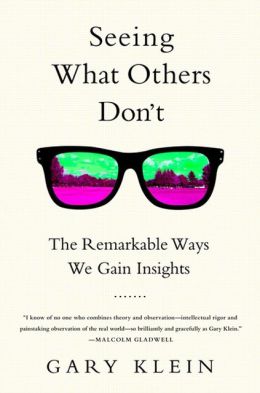
Gary Klein's "Seeing What Others Don’t"

Gary Klein, a senior scientist at MacroCognition LLC, was instrumental in founding the field of naturalistic decision making. Klein received his PhD in experimental psychology from the University of Pittsburgh in 1969. He spent the first phase of his career in academia and the second phase working for the government as a research psychologist for the U.S. Air Force. The third phase, in private industry, started in 1978 when he founded Klein Associates, a research and development company that had grown to thirty-seven employees by the time he sold it in 2005. He is the author of Sources of Power: How People Make Decisions; The Power of Intuition; Working Minds: A Practitioner's Guide to Cognitive Task Analysis (with Beth Crandall and Robert Hoffman); and Streetlights and Shadows: Searching for the Keys to Adaptive Decision Making.

Klein applied the “Page 99 Test” to his latest book, Seeing What Others Don't: The Remarkable Ways We Gain Insights, and reported the following:
I accepted the challenge to perform the page 99 test – open my new book Seeing What Others Don’t to page 99 and see what that page tells about the entire book. Then I got a bit nervous because I hadn’t checked to see what was on page 99.

As it turns out, page 99 is a wonderful description of the book. The page starts a new section titled “Looking at the Stories.” This section falls within a chapter that describes different ways I tried to understand how we gain insights.

First, I examined the data I had collected from 120 actual incidents in which people arrived at insights. I had started with the formal coding I had performed on the data. I had derived 14 different categories and coded each incident on all 14. This approach produced some useful findings, but nothing exceptional.

Next I looked at the scientific literature on insight. Again, some nice information but mostly disappointment. The insight researchers had restricted their studies to simple tasks they could perform in a laboratory in an hour; these restrictions didn’t fit the kinds of incidents I had assembled.

Finally, I plunged into the 120 incidents themselves to see what I could learn. This is the section “Looking at the Stories” that begins on page 99. And here I hit paydirt. I discovered what the laboratory studies had been missing. I uncovered several different pathways for attaining insights.

The strategy of looking directly at the stories of how insights appeared isn’t as controlled as laboratory studies. You can’t define in advance how you’ll be running statistics. But what you get is the opportunity to make discoveries – to learn things from the stories that you hadn’t previously imagined.

Here is what I had to say about the story method on page 99:
Naturalistic methods can be a bit nerve-wracking because you never know what you are looking for. You sift through the stories, on the lookout for patterns that might be meaningful. When you do laboratory studies in psychology you define in advance what data you’re going to collect, what hypotheses you’re going to test, what statistics you’re going to use. But the story-based strategy leaves all of that open. You can’t define in advance how you are going to analyze your data because you don’t know what patterns might emerge. Reviewing the stories is scary and exciting.

The incident-based method is well-suited for the early stages of science in which you try to explore some phenomenon. I hoped to find some answers in the 120 stories of insights.
Learn more about Seeing What Others Don't at the publisher's website.

--Marshal Zeringue

Saturday, September 14, 2013

Paul Schneider's "Old Man River"

Paul Schneider is the acclaimed author of Bonnie and Clyde, Brutal Journey, The Enduring Shore, and The Adirondacks, a New York Times Book Review Notable Book.

He applied the “Page 99 Test” to his new book, Old Man River: The Mississippi River in North American History, and reported the following:
Page 99 of Old Man River was one of the first pages of the book to be written. It falls near the beginning of a brief description of a voyage I took with my then-15-year-old son in kayaks on the Mississippi River from St. Louis, where the Missouri joins the river, to Cairo, where the Ohio arrives. We camped on sandbars, ran along the tops of boxcars on sidings above the river, or squirreled our boats among the weeds and crept into river towns like Huck and Jim might have if they carried credit cards that could buy them a night in a hotel and a steak dinner.

Old Man River is not, however, primarily a travel narrative: page 99 is one of a relatively few pages describing adventures up and down the watershed during the course of researching the role the river has played in the history of the continent. Far more pages are devoted to the ancient mastodon hunters and mound-builders, to the failed conquistadors and fearless French, the marching Anglos and enslaved Africans, the river rats and backwoods pirates. And of course to Twain, Dickens, Trollope, Melville, Audubon and the other 19th century riverboat tourists.

Yet, the moments of personal reflection on the river--whether in kayaks on the Lower Mississippi, in canoes on the Bayou Teche, in a tin-boat on the Ohio--are to me more than mere leavening for the more traditional “history.” I am not one who is particularly convinced by the argument that those who don’t know history are doomed to repeat it: would that it were true that educated leaders could learn from the mistakes of the past.
For me the main reason to study history is to enhance our experience of the immediate present, which after all is a part of the past as soon as it is noticed. Just as a person who knows the ins and outs and rosters and rules of baseball is likely to enjoy the world series more than a neophyte, so a knowledge of where we have come from informs where we are.

So I travel. “As soon as you are on the coffee-colored water,” I wrote on page 99, “you know immediately that you belong to the Mississippi River.”
Learn more about the book and author at Paul Schneider's website.

--Marshal Zeringue