Monday, February 3, 2020

Michael Hunter's "The Decline of Magic"

Michael Hunter is Emeritus Professor of History, Birkbeck, University of London. He is the author of numerous works on early modern science and culture such as The Occult Laboratory and the award-winning Boyle: Between God and Science.

Hunter applied the “Page 99 Test” to his newest book, The Decline of Magic: Britain in the Enlightenment, and reported the following:
Page 99 forms part of a lengthy account of a famous poltergeist case, the 'Drummer of Tedworth', when strange and violent disturbances afflicted the house of John Mompesson in Wiltshire. It describes the visit to the house of two aristocrats on behalf of King Charles II, one of whom, the Earl of Chesterfield, recorded in his diary his deep scepticism about the whole affair -- which he wrote off as a "Cheat" -- and about the motives of its chief protagonist, the cleric and demonologist, Joseph Glanvill.

This conflict of ideas is at the heart of The Decline of Magic, which uses case-studies to pursue the antithesis between sceptical views put forward by the fashionable elite and the earnest efforts of scientists and other serious-minded figures to vindicate the reality of supernatural phenomena as part of the defence of religion against the supposed threat of "atheism".

It transpires that gradually the sceptical viewpoint triumphed, due to the efforts first of freethinkers – men like the Deist, Robert, Viscount Molesworth, who wrote: “As ignorance vanishes so does all Spectres, Second Sights, Hobgoblins, fayries, Haunted Houses, apparitions & 100 such fooleryes” -- and then of medical men like Sir Hans Sloane, who wrote a scathing critique of magic and believed that he could cure those susceptible to such beliefs by a regime of bleeding and purging. In fact, this more physiological tradition of scepticism became increasingly predominant, as accusations that magic was the result of fraud or ‘priestcraft’ dwindled in plausibility: superstitious beliefs thus came to be seen less as the result of imposture than of error, indeed potentially well-intended or even unconscious error. Yet the book ends by arguing that, with regard to magic, post-Enlightenment culture has tolerated a ‘balance of Antagonisms’, with the dominant culture rejecting phenomena that minorities vociferously espouse.
Learn more about The Decline of Magic at the Yale University Press website.

--Marshal Zeringue

Sunday, February 2, 2020

Allan V. Horwitz's "Between Sanity and Madness"

Allan V. Horwitz is Board of Governors Distinguished Professor Emeritus in the Department of Sociology at Rutgers University. He has published over 100 articles and chapters about various aspects of mental health and illness as well as nine books, including Creating Mental Illness (2002), The Loss of Sadness: How Psychiatry Transformed Normal Misery into Depressive Disorder (2007, with Jerome Wakefield), All We Have to Fear (2012. with Jerome Wakefield), A Short History of Anxiety (2013), and PTSD: A Short History (2018).

Horwitz applied the “Page 99 Test” to his latest book, Between Sanity and Madness: Mental Illness from Ancient Greece to the Neuroscientific Era, and reported the following:
Page 99 in Between Sanity and Madness discusses the second stage of psychoanalyst Sigmund Freud’s career. It highlights how The Interpretation of Dreams (1900) sharply turned away from Freud’s attempts in the 1890s to distinguish various neurotic conditions (e.g. hysteria, anxiety, neurasthenia) from each other. From this point until the end of his career, Freud emphasized the commonalities rather than the differences between normal and abnormal mental states. “But when it came to dreams,” Freud reflected, “it was no longer dealing with a pathological symptom, but with a phenomenon of normal mental life which might occur in any healthy person.” This book changed Freud’s focus from the psychopathological to a single framework that strove to understand all human behavior, not just neurotic behavior.

Page 99 is representative of my book because Freud is perhaps the best example of someone who did not sharply distinguish sanity from madness. Instead, he strove to show how both ordinary and neurotic behavior stemmed from common roots in universal childhood experiences such as unresolved oedipal complexes, parental giving and withholding of love and hostility, or toilet training practices. While the book itself does not adopt or endorse a psychoanalytic perspective, it is sympathetic to efforts – such as Freud’s – to ground the abnormal and normal alike in common psychosocial experiences.
Learn more about Between Sanity and Madness at the Oxford University Press website.

--Marshal Zeringue

Saturday, February 1, 2020

Sophia Stamatopoulou-Robbins's "Waste Siege"

Sophia Stamatopoulou-Robbins is Assistant Professor of Anthropology at Bard College.

She applied the “Page 99 Test” to her new book, Waste Siege: The Life of Infrastructure in Palestine, and reported the following:
Page 99 finds us in chapter 2, which describes the trade and value of used Israeli goods in the Israeli-occupied West Bank city of Jenin. It tells the story of one of my daily visits to Jenin’s rabish (“rubbish”) market, during which I was accompanied by Mais, a college-educated young woman from a middle class family. In the rabish, Abu Mahmoud and his son Mahmoud, men of lower socioeconomic status, held forth. They told me and Mais tales of Israeli everyday life that they had gleaned through their work illicitly importing discarded materials from across the Green Line separating the West Bank from Israel. Through their storytelling they performed authoritative knowledge of Israeli lifeways that are now inaccessible to Mais and most other West Bank Palestinians who live under a strict military permit regime that prevents them from entering Israel. The page also describes how the fact that rabish goods are often marked with the patina of former use, and the fact that former use is assumed to have been carried out by Jewish Israelis, gives the otherwise stigmatized men who sell them added authority to speak about Israel. This authority translates into rare cultural capital for these men and is based on their capacity to offer a sense of--if not actual--access to Israel for Palestinians stuck on the West Bank side of the Wall.

The Page 99 Test is probably not made for this book. This page does show a reader that by “waste” I mean more than municipal trash and sewage. It exemplifies the ways in which the book cares about how people give meaning to things and to one another, about how wastes mediate sociality and politics, and can become objects of unexpected desire. This page hints at the way in which the trade in used Israeli goods has become an infrastructure for a set of relationships in Jenin. But it doesn't get to the heart of the counterintuitive argument I make in chapter 2, which also means it falls short of demonstrating the full extent of the main concept of the book—“waste siege.” Waste siege is a condition of inundatedness by matter that is unwanted, toxic or out of place, a condition to which West Bank Palestinians have been confined since the turn of the twenty-first century. One of its key features is that it can obscure or confuse the causes of the besieged's ethical, political and material burdens, for example by making its relationship to settler colonialism or occupation opaque. Chapter 2 argues that, while Jenin residents sell, purchase, wear and desire discarded Israeli goods (which we can, and they often did, think of as waste), they do so in large part because they seek to escape the inundation they feel by the new (i.e. unused) goods that constitute the main markets where they shop. The latter, imported objects besiege because they are perceived to be of inferior quality (a waste of money, easily becoming trash) and because they have become one of Jenin residents’ only options since the Israeli government made Palestinians’ movement into Israel and Jordan onerous, and since it severed the Israeli and Palestinian economies.The Page 99 Test also fails to capture the effects of specific ideas about environmental protection having become dominant in Israel, among the foreign donors who fund the Palestinian Authority and in the PA itself. Chapters 1, 3 and 5 describe how Palestinians' waste siege has been shaped by this emergent, militarized environmental politics.
Learn more about Waste Siege at the Stanford University Press website.

--Marshal Zeringue

Friday, January 31, 2020

Gary A. Rosen's "Adventures of a Jazz Age Lawyer"

Gary A. Rosen has practiced intellectual property law for more than thirty years and is Adjunct Professor of Law at the Kline School of Law at Drexel University. He is the author of a book on popular music and copyright, Unfair to Genius: The Strange and Litigious Career of Ira B. Arnstein, and he writes a blog on law and popular culture called Jazz Age Lawyer.

Rosen applied the “Page 99 Test” to his new book, Adventures of a Jazz Age Lawyer: Nathan Burkan and the Making of American Popular Culture, and reported the following:
Page 99 of Adventures of a Jazz Age Lawyer finds Charlie Chaplin at a career crossroads. After two years in Hollywood as a poorly paid contract player―an apprenticeship which allowed him to hone his cinematic art while becoming a worldwide sensation―Charlie has, with the help of his new lawyer, Nathan Burkan, signed a one-year contract with a new studio at the stupendous salary of $670,000 ($16.5 million in current dollars). The new contract gives him an unprecedented level of artistic control over his productions. But before he can even begin work, he learns that his former studio is about to release the last two-reel picture he had delivered to it, Charlie Chaplin’s Burlesque on Carmen, as a four-reeler, padded with 20 minutes of Chaplin’s outtakes and new, interpolated footage featuring another comic actor. Chaplin instructs Burkan to take legal action to stop distribution of the adulterated film.

The problem Burkan faces is that neither copyright law nor Chaplin’s prior employment contract gave him any legal basis to do so. Burkan’s solution is to implicitly invoke a concept imported from the European continent: the “moral right” of an author to defend the integrity of a work against alterations that are damaging to an author’s honor or reputation. By presenting the four-reeler as a “Chaplin brand” picture, Burkan argued, the studio created “an unfavorable and disappointing impression on the public and damaged Chaplin’s reputation as a motion picture star and as an author and producer of photoplays.” But moral rights, as distinct from any economic rights an author may have under copyright or contract, were not recognized in U.S. law in 1916, nor was it likely that any judge of that day would embrace a proto-auteur theory of cinema.

Indeed, Chaplin’s former employer hits back hard against the notion that Chaplin’s fame rested on anything other than “his eccentricities and peculiarities as a comedian” or that he had any “reputation as an author or producer of motion pictures of any kind.” Far from the solitary genius toiling away feverishly on every aspect of the pictures that bore his name―an image cultivated by Chaplin and supported by the great weight of contemporary accounts―the Chaplin described in these legal papers is an indolent, money-grubbing prima donna reliant on the technical skills of others, working within the standard Hollywood factory model.

The browser who turns straight to page 99 and stops there will learn two important things about Adventures of a Jazz Age Lawyer. First, that it is narrative history, not a densely-argued monograph. It makes its case for the importance of Nathan Burkan in the coming of age of the institutions, attitudes, and archetypes that define American popular culture through leisurely and engagingly told stories of his work on behalf of clients whose influence and importance scarcely require any argument. Second, the reader will encounter one of the recurring themes of the book, that Burkan’s work to secure compensation, freedom, and control for creators in what Gilbert Seldes called the “seven lively arts,” work that was often bitterly opposed by producers and distributors and which required the conception and making of wholly-new legal paradigms, stands as a testament that the technological dislocation, creative ferment, and shattering of social taboos roiling popular culture today is not a singularity, but rather just one phase in a historical continuum that slowly lurches toward greater creative freedom, artistic achievement, and cultural diversity.
Visit Gary A. Rosen's website.

--Marshal Zeringue

Thursday, January 30, 2020

Julie Des Jardins's "American Queenmaker"

Julie Des Jardins is a historian of American women and gender who has taught and written extensively in the field, particularly on the history of women in the professions. Along with pieces on gender and women’s history for blogs, journals, and Oxford’s History of History Writing, she has written several books, including Women and the Historical Enterprise in America: Gender, Race, and the Politics of Memory; The Madame Curie Complex: The Hidden History of Women in Science; Lillian Gilbreth: Redefining Domesticity; and the study of American masculinity, Walter Camp: Football and the Modern Man.

Des Jardins applied the “Page 99 Test” to her newest book, American Queenmaker: How Missy Meloney Brought Women Into Politics, and reported the following:
The Page 99 Test amplifies a challenge I have had throughout writing American Queenmaker: encapsulating all that is important about Missy Meloney in a narrative with focus.

The subtitle suggests that Missy made her mark in American politics. In actuality, she also made it in American journalism, art, science, literature, media, reform, and diplomacy--and internationally too. No page of any book could possibly convey the totality of Missy's force, though I was hoping 99 might do a better job than others.

Missy Meloney (1878-1943) was a pioneering journalist, editor, presidential advisor, PR maven, and overall social, cultural, and political rainmaker. And yet page 99 merely explores one small, albeit crucial, facet of Missy's power: Her ability to sense the next best thing (in this case literary) and to seize on it for the sake of women. Here she is helping to make women authors culturally relevant in the 1920s, amidst the "Lost Generation" of men generally credited with shaping the literary tastes of the decade. As editor of national magazines, Missy paid female serial writers what she paid prominent men, offering Kathleen Norris $50,000 for a serial in the early 1920s, for instance, the same amount Sinclair Lewis fetched for a work of similar length. If Missy liked an author's work but couldn't make space for it, she took the time to find reputable editors who could. In years when newspaper book-review sections, Great Books groups, and Book of the Month Clubs helped to create the wide-ranging readership Margaret Widdemer called "the Middlebrow," Missy afforded women unprecedented opportunities to shape middlebrow tastes, both as literary producers and consumers. I defer to Page 99 on "the middlebrow" and Missy's determination not to make it a derogatory label:
Though not erudite, this demographic was increasingly educated; Missy would know, since she was pretty sure that her readers made up a good bit of its bulk. It's also why she figured women writers would best appeal to it. She valued writers' ability to make meaning for the masses over their ability to achieve critical acclaim, and hence she never had to rid herself of the notion that supporting female writers was commending lesser literature. She saw herself as a facilitator, introducing female readers to a diversified range of writers and vice versa, broadening palates and best-seller lists ultimately for the advancement of women, but also for the social good.

So Missy gave women their breaks and paid them like men. It was not always enough to eradicate women's deeply rooted insecurities as artists, but it was a start. She understood that it would take time to make them believe in their own voices and in their transcendent powers as shapers, communicators, and interpreters of the modern sensibility...
Visit Julie Des Jardins's website.

The Page 99 Test: Walter Camp: Football and the Modern Man.

--Marshal Zeringue

Wednesday, January 29, 2020

Tamara Venit Shelton's "Herbs and Roots"

Tamara Venit Shelton is associate professor of history at Claremont McKenna College and author of A Squatter’s Republic: Land and the Politics of Monopoly in California, 1850–1900.

She applied the “Page 99 Test” to her latest book, Herbs and Roots: A History of Chinese Doctors in the American Medical Marketplace, and reported the following:
On page 99 of Herbs and Roots, readers will find a discussion of how Chinese herbalists practicing in the late nineteenth-century United States borrowed advertising strategies from makers of proprietary (or patent) medicines. These strategies included the invocation of the “magical” and “miraculous.” Chinese herbalists promised to do what regular physicians could not: to cure the seemingly incurable with their remedies. What distinguished the advertising strategies of the Chinese from other makers of patent medicines was the former’s pairing of the “miracle cure” with the exoticism of the “Orient.” Page 99 begins to explain how Chinese herbalists self-Orientalized in their appeals to non-Chinese patients. They capitalized on their American patients’ racialized expectations of Asian alterity to articulate the superiority of their therapies over those of scientific medicine and to compete in the medical marketplace.

The Page 99 Test works very well for my book. Although Herbs and Roots chronicles a much longer history of traditional Chinese medicine in the United States and the lived experiences of its practitioners, the book’s principal concern is with the moment described on page 99: what historians call the “long Progressive Era,” the late nineteenth and early twentieth centuries. In this era, Chinese herbalists became increasingly active in the American medical marketplace. As Chinese Exclusion shrank their co-ethnic clientele, Chinese herbalists reached out to new, non-Chinese patients, often via advertising in English- and Spanish-language media as described on page 99. This advertising tended to rely on easily recognizable, Orientalist stereotypes of the Chinese as mystical and otherworldly. The references to the “miraculous” were just the tip of the iceberg. The middle section of the book goes on to explore the varied and sometimes contradictory ways that Chinese herbalists repurposed the racist tropes used against them. They profited from their own social and professional marginalization and the perpetuation of anti-Chinese racism. The book concludes with an exploration of the persistence of these marketing strategies into our time and their implications for the place of traditional Chinese therapies in the American health care system.
Learn more about Herbs and Roots at the Yale University Press website.

--Marshal Zeringue

Tuesday, January 28, 2020

Larry Wolff's "Woodrow Wilson and the Reimagining of Eastern Europe"

Larry Wolff is Silver Professor of European History at New York University, Executive Director of the NYU Remarque Institute, and Co-Director of NYU Florence.

He applied the “Page 99 Test” to his new book, Woodrow Wilson and the Reimagining of Eastern Europe, and reported the following:
On Page 99 of Woodrow Wilson and the Reimagining of Eastern Europe, Wilson confronts the imminent collapse of the Habsburg monarchy at the beginning of November 1918, with World War One about to end. This is, in fact, a pivotal moment in my book, and a pivotal moment in European history. For Eastern Europe it represents the moment at which the prewar map of multinational empires was about to give way to the new twentieth-century map of interlocking national states. Wilson, at the Paris Peace Conference, would preside over this geopolitical transformation.

Though Wilson had advocated “autonomous development” for the peoples of Austria-Hungary as early as the Fourteen Points Speech of January 1918, he was hesitant to endorse the abolition of the Habsburg monarchy until the very end of the war. What I’m trying to understand in my book is how Wilson conceived of the whole region of Eastern Europe: his “mental mapping” of this region which he would never visit, but which he would fundamentally redesign through the peacemaking process. From 1917, when America entered the war, Wilson quickly accumulated knowledge and opinions, impressions and prejudices, about a region that had been hitherto of little interest to him, though many of the nations of Eastern Europe had representative immigrant groups in the United States. On Page 99, on November 5, 1918, Wilson was having a personal message to the nations of Austria-Hungary distributed from Switzerland, addressed to the peoples who were about to achieve “liberation from the yoke of the Austro-Hungarian Empire.” While Wilson was always inimical to the Ottoman empire, and enthusiastic about seeing it disappear from the map, he only persuaded himself to accept the abolition of the Habsburg empire by convincing himself that its peoples were living under a “yoke,” that they were “enslaved” as he sometimes said (an extreme overstatement), that he was fighting a war for their “liberation,” even their “emancipation.” In short Wilson—whose presidency coincided with the building of the Lincoln Memorial in Washington— convinced himself that he was fighting a Lincolnesque war for the emancipation of enslaved peoples: in Eastern Europe. At the same time, he came to feel that he himself possessed a special sensitivity to those peoples and their political hopes and dreams, and that he could speak to them directly, as he did in his personal message of November 5, 1918, promising “to assist the liberated peoples of the world to establish themselves in genuine freedom.” Wilson’s sense of his own mission in Eastern Europe was almost messianic in his conviction that he was leading these peoples into the promised land of freedom; his actual work at the peace conference, however, involved translating that messianic commitment into a geopolitical settlement. He would help to produce the modern map of interlocking national states in Eastern Europe, states that he would never visit, but where he would be long remembered. The statue of Wilson at the train station in Prague, erected after World War One, was taken down by the Nazis after 1939— but was returned to its prominent pedestal as recently as 2011.
Visit Larry Wolff's NYU faculty webpage.

The Page 99 Test: The Idea of Galicia.

The Page 99 Test: The Singing Turk.

--Marshal Zeringue

Monday, January 27, 2020

Philip G. Schrag's "Baby Jails"

Philip G. Schrag is the Delaney Family Professor of Public Interest Law at Georgetown University and the author or coauthor of sixteen books, including Asylum Denied.

He applied the “Page 99 Test” to his new book, Baby Jails: The Fight to End the Incarceration of Refugee Children in America, and reported the following:
Page 99 of Baby Jails is representative of the book, which relates the 35-year history of the legal and political effort to stop the U.S. government from jailing children who have fled from persecution and torture in their home countries to seek safety in America. Page 99 deals with the first “baby jail,” the T. Don Hutto Family Detention Center in Texas, a brainchild of the George W. Bush administration which was operated by a private prison company. It housed migrant mothers and children, sometimes for more than a year, while they awaited hearings on their asylum claims in overburdened immigration courts. When Barbara Hines, who directed the immigration law clinic at the University of Texas, heard about the horrific conditions for children in Hutto, she called in the American Civil Liberties Union (ACLU). The case was assigned to federal judge Sam Sparks. Page 99 describes the hard time that Sparks gave to both Vanita Gupta, the ACLU lawyer, and to Victor Lawrence, who represented ICE.

Baby Jails starts with the now-famous Flores case. Jennie Flores from El Salvador was jailed during the Reagan administration. The class action case that she brought, seeking to end the arbitrary detention of children, went to the Supreme Court in 1993, but even though the plaintiffs lost in the high court, the Flores case continues to this day. For years, the government repeatedly violated court orders in the case that the Supreme Court had left in place, and in 1997 the Clinton administration settled with the plaintiffs. Thereafter, violations of the Flores settlement agreement continued to occur. The book devotes several chapters to the battle over Hutto, the Obama administration’s closing of that facility in 2009, and its policy reversal in 2014, when it authorized two other large family detention centers. In 2015, federal courts ruled that the Flores settlement barred the government from detaining children in those centers for more than twenty days. But 50 pages toward the end of the book reveal the Trump administration’s determined efforts to overturn the Flores settlement by litigation, by asking Congress to pass a new law, and by issuing a new regulation. Frustrated by its lack of success by all of those means, it tried the tactic of separating families in 2018, which turned into what was probably the biggest domestic policy debacle of the Trump presidency.

Baby Jails is based on court records, journalistic accounts, human rights reports, and the author’s interviews with many of the people who were involved in the controversy over the years. It concludes with recommendations for humanitarian treatment of child refugees while they await hearings to assess their claims for protection.
Learn more about Baby Jails at the University of California Press website.

--Marshal Zeringue

Sunday, January 26, 2020

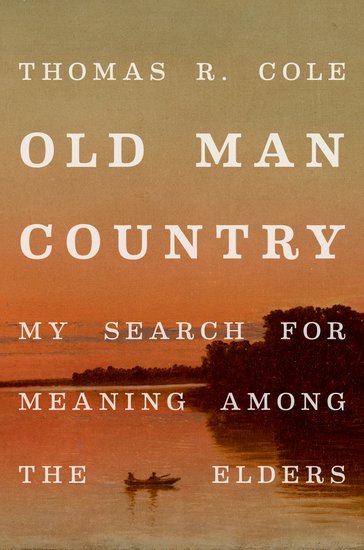
Thomas Cole's "Old Man Country"

Thomas R. Cole is the McGovern Chair and Director of the McGovern Center for Humanities and Ethics at University of Texas Health Science Center in Houston. His work has been featured in the New York Times, NPR, and PBS. Cole has served as an advisor to the President's Council on Bioethics and the United Nations NGO Committee on Ageing. His book The Journey of Life: A Cultural History of Aging in America was nominated for a Pulitzer Prize. He is Senior Editor of The Oxford Book of Aging, which The New Yorker cited as one of the most memorable books of the year. Cole's book No Color Is My Kind: the Life of Eldrewey Stearns and the Desegregation of Houston (1997) was adapted into the film, The Strange Demise of Jim Crow, which was broadcast nationally on over 60 PBS stations. In 2007, he co-produced Stroke: Conversations and Explanations, a prize-winning film about the invisible world of stroke survivors.

Cole applied the “Page 99 Test” to his new book, Old Man Country: My Search for Meaning Among the Elders, and reported the following:
From page 99:
My tears are the closest thing I know to transcendence—the emotional experience of being swept up by a benevolent force beyond my thinking self. The music is a prayer filled with love. It is thrilling, expansive, hopeful.

I don’t think Downs yearns for God. I think he finds God in the purity of the highest forms of music and the most advanced forms of physics. The Greeks considered music to be a branch of physics; they showed us that harmony arises out of numerical ratios of sound waves. Instruments and voices produce vibrations that we hear as music--music that bursts into beauty and then fades silently into the universe. Listening to Downs makes me think about the beauty of aging, the beauty of each of us bursting into life and fading away after our lives have run their course.

When I ask Downs to talk about his own experience of deep old age, he talks about masculinity, particularly the challenge of reconciling manhood with physical decline. “Are you less of a man now than you were 30 years ago?”

“Well, it depends on what category you want to say,” Downs replies. “Sexually, I’m much less of a man. Athletically, I’m much less of a man. Intellectually, I think I’m more of a man than I was then, in what I pursue and what I enjoy and take pleasure from.” At the same time, he believes that he is more accepting of being an old man than when he was in his sixties:
It bothered me when—I bet I was not quite 60—when somebody wanted to help me out of a car. I was offended. Why would they think I needed help? It doesn’t bother me now that people think of me as old, because I am, and it is comfortable for me.
Throughout his career, Downs has challenged ageism—stereotypes of and prejudice against old people, along with discrimination in employment, inadequate and demeaning nursing home care, and a general cultural story of aging as decline. The PBS program Over Easy, which won an Emmy in 1981, set out Downs’ critique of ageism by emphasizing the uniqueness and value of all individuals, regardless of age. In 1979, when he was a mere child of 58, Downs published Thirty Dirty Lies about Old, an important popular book challenging pervasive negative stereotypes about aging and old people. Downs takes on such “lies” as: “Old Age is an Illness;” “Old people have no interest in sex;” “Intelligence declines with Age;” “You can’t do anything about getting old;” “Older people stand little chance in a country that accents youth.” Downs characterized these “lies” as sometimes conscious and sometimes unconscious, sometimes well-meaning and sometimes vicious.

“If we hang around long enough,” he says, “loose lies will victimize all of us.” In the end, Downs argues, it is a mistake to think that we have
This page gives a good sense of how it feels to read the book. It offers a good example of my encounter with one elder, Hugh Downs. It doesn’t provide a view of the book as a whole.

Old Man Country explores how twelve men face (or faced) the challenges of living a good old age. All who appear in this volume are highly accomplished. Some are friends. Some are strangers. Some are famous: Paul Volcker, the former head of the Federal Reserve under Presidents Reagan and Carter; Denton Cooley, the first surgeon to implant an artificial heart into a human being; Ram Dass, his generation’s foremost American teacher of Eastern Spirituality; and Hugh Downs, veteran TV broadcaster and creator of The Today Show.

The excerpt on Page 99 offers a glimpse of Downs’s successful, wide-ranging career. Over the course of this dizzying career—he worked in a puppet show, a soap opera, a game show, and hosted The Today Show from 1962-1971—he grew up professionally at the same time television emerged as a mass medium. As news programs sprouted up, he shaped them by developing his signature persona as a calm, thoughtful, and reassuring television presence. His smooth and affable demeanor secured his place as one of the most trusted news people in American television.

Before the interview, I had no idea that Downs was a polymath and tremendous adventurer whose career took him all over the world. In 1982, to cite just one example, he learned that scientists had determined more precisely the location of the earth’s axis at the South Pole and were traveling to mark the new spot. Downs contacted the head of the National Science Foundation and asked to accompany the team to Antarctica. On December 10, at 6:10 PM, he picked up the fifteen-foot bamboo pole (the South Pole is literally marked by a pole) and planted it in the correct position.

As the excerpt from Downs also shows, Old Man Country explores four basic questions that every man faces as he moves into the last stage of life: Am I Still a Man? Do I Still Matter? What is the Meaning of My Life? Am I Loved? The book suggests that, in deep old age, men (and women) can flourish if they have good and positive answers.
Visit Thomas Cole's website.

--Marshal Zeringue

Saturday, January 25, 2020

Shai M. Dromi's "Above the Fray"

Shai M. Dromi is a lecturer at the Department of Sociology at Harvard University, where he teaches courses in the areas of organizations, global and transnational sociology, and cultural sociology.

Dromi applied the “Page 99 Test” to his new book, Above the Fray: The Red Cross and the Making of the Humanitarian NGO Sector, and reported the following:
Readers opening Above the Fray to page 99 will encounter a full-page reproduction of a sketch that appeared in The Sunday News Tribune in 1898. It depicts a smiling woman in nurse’s uniform pushing a wheelchair with a child seated. A young girl—perhaps 10 or 12 years old—holds the chair for support as she hobbles along on a crutch. The caption reads: “Peace hath her duties no less than war – A Red Cross nurse off duty, passing her vacation at New York’s seaside home for children.”

While browsers flipping to page 99 would only get a partial idea of the whole work, they would be touching on one of the central themes in the book: the honor that involvement in nineteenth-century Red Cross activities conferred on volunteers. The Red Cross Movement, which was established in 1863 as a network of volunteer aid societies for the war wounded, gained considerable international standing over the late-nineteenth-century. It popularized the image of the humanitarian aid worker as a courageous and impartial figure who represents common human (implicitly Christian) values in the face of rampant warfare. Red Cross societies offered volunteers significant symbolic rewards, such as medals and news coverage, which appealed in particular to women. While barred from front line military service, women found in Red Cross societies an alternate route to the battlefield. While this route confined women volunteers to caring, emotional duties in line with gender expectations at the time, it also allowed them to receive honors and social distinction that resembled those of veterans. With the influx of volunteers and donations, many Red Cross societies expanded their work from battlefield relief to other activities such as caring for the sick and for orphans at home.

The rapid expansion in size and influence of the humanitarian sector is explained, in part, by the way multiple types of professionals—nurses, journalists, international lawyers—leveraged their involvement in humanitarian activities to reap social rewards. This, in turn, reinforced the prestige of humanitarian organizations and drew additional volunteers and donations. Media depictions—such as the one on page 99—demonstrate the honorable social standing a Red Cross nurse could gain at the time, and the public interest in this then-new sector.
Visit Shai M. Dromi's website.

--Marshal Zeringue