Sunday, March 3, 2024

John Eglin's "The Gambling Century"

John Eglin is currently Professor of History at the University of Montana. His published work includes Venice Transfigured: The Myth of Venice in British Culture, 1660-1797 (2001), and The Imaginary Autocrat: Beau Nash and the Invention of Bath (2005). He is nearing completion of his edition of James Boswell's journals in Italy and France for the research edition of the Boswell papers published by Edinburgh University Press.

Eglin applied the “Page 99 Test” to his new book, The Gambling Century: Commercial Gaming in Britain from Restoration to Regency, and reported the following:
As it happens, page 99 of The Gambling Century provides as accurate a sample of the book’s themes and arguments as any other individual page chosen at random would! We might well ask what the chances are of that — raising an important question (in a book that deals with probability, after all) to which I’ll return. Serendipitously, page 99 falls at a section break in its chapter. At the end of the section entitled “The Stamp of Approval,” the reader learns of the futility of one official effort to regulate gambling, namely the imposition of increasingly heavy taxation on playing cards and dice through the medium of stamp duties of the sort to which American colonists objected in 1765. The next section, “Drawing a Blank,” begins to expose the ulterior motive that the British Crown was pursuing when it sought to close gambling off to middle income individuals that it saw as the primary market for its lotteries (which were less like the Powerball and more like bond issues).

Page 99, then, speaks to two major themes of the book: first, the factors that undercut official efforts to proscribe or regulate commercial gambling, and second, the government’s own complicity in gambling ventures. To the first point, authorities tasked with policing gambling consistently failed in their objectives from their inability to understand how commercial gambling operations worked, and why they were so profitable. Officials persisted in believing that unwary players were being cheated by “sharpers,” professional tricksters of the sort found in novels and plays, rather than recognizing that mathematical probability guaranteed gambling entrepreneurs a profit. On the second point, the Crown actively sponsored enterprises like the Royal Oak Lottery, which despite its name was a game of chance similar to roulette. For another example, the royal household was exempted from legislation that regulated stakes, and housed an official, the Groom Porter, who was allowed to keep what amounted to a casino in royal residences under royal auspices.

One important point that emerges from the book’s exploration of these themes is that it took about a century for everyone — gamblers, gambling entrepreneurs, and government officials — to absorb fully the lessons of probability. Until the middle of the 18th century, gambling operators promoted games like faro that featured long odds, or games like hazard that allowed them to collect “box money,” essentially user fees collected independently of wins or losses. As they began to understand that time as well as chance favored the “house,” games began to appear that featured nearly “even money” odds, such as Rouge et Noir, and EO, the ancestor of roulette.

Appropriately enough, in the end, Victorian legislation brought the gambling century to a close, but important shifts in notions of respectability, newly associated with that bankable commodity known as credit, paved the way (as did judicial rulings that prevented gambling creditors from collecting gambling debts via civil action).
Learn more about The Gambling Century at the Oxford University Press website.

--Marshal Zeringue

Friday, March 1, 2024

Frank L. Holt's "A Mystery from the Mummy-Pits"

Frank L. Holt is Professor of History at the University of Houston. His previous books include When Money Talks: A History of Coins and Numismatics, The Treasures of Alexander the Great: How One Man's Wealth Shaped the World, Lost World of the Golden King: In Search of Ancient Afghanistan, and Into the Land of Bones: Alexander the Great in Afghanistan. Holt is also a prolific writer for the public, with essays appearing in Newsweek, American Scientist, Archaeology, History Today, Archaeology Odyssey, The Chronicle of Higher Education, Saudi Aramco World, and other widely read publications.

Holt applied the “Page 99 Test” to his new book, A Mystery from the Mummy-Pits: The Amazing Journey of Ankh-Hap, and reported the following:
Every detective wonders what little clue might finally resolve a perplexing mystery. It might be a whiff of poison, a spent bullet, or lipstick left on a champagne glass. On page 99 of A Mystery from the Mummy-Pits, that clue takes the form of a few scraps of newspaper and an American Express mailing label. The real surprise is that this incriminating evidence was found stuffed inside the coffin of an ancient Egyptian mummy. Most detectives do not face a millennial ‘crimeline’, but this case was unusual in every respect – including the bizarre clue that would eventually turn the tide:
Inside the coffin of Ankh-Hap... the extraneous materials all date to a nine-week span between March 25 and May 29, 1914. Most of the scraps came from Rochester, New York, with a connection there to a company founded in 1862 called Ward’s Scientific Establishment. What was the possible link between this business and the HMNS mummy?
I had moved the mummy of Ankh-Hap from the Houston Museum of Natural Science to a research lab for a pioneering CT-scan. The resulting images looked like crime scene photos. Hidden beneath his wrappings, the deceased was missing much of his skeletal structure including most of his ribs, spine, and arms. There were wasp nests in his fractured skull and a set of wooden poles ran through his body from head to ankles. Radiocarbon analysis showed that the coffin, wrappings, and internal poles dated from very different periods. To explain these findings, I needed to retrace the mummy’s travels. The paper scraps led me to Henry Augustus Ward (1834-1906) and the story of commercial mummy trafficking in America. His correspondence and company records revealed a macabre trail between the mummy-pits of Egypt and his storage shelves stocked with mummies and assorted body parts. How and when poor Ankh-Hap left those shelves for a busy afterlife in Texas, including being lost in an abandoned restroom, would call upon other clues beyond the scope of page 99.

Overall, readers will find page 99 a fair reflection of this book, which unfolds as a true-to-life (and death) mystery based upon numerous historical and scientific clues. If there is any shortcoming in the test, it is that whole chapters take us beyond the individual case of Ankh-Hap to examine the larger context of mummies in modern American life, literature, and movies.
Learn more about A Mystery from the Mummy-Pits at the Oxford University Press website.

The Page 99 Test: The Treasures of Alexander the Great.

The Page 99 Test: When Money Talks.

--Marshal Zeringue

Thursday, February 29, 2024

Frank Trentmann's "Out of the Darkness"

Frank Trentmann, author of Empire of Things, is professor of history at Birkbeck, University of London, and at the University of Helsinki. Previously, he taught at Princeton University. He has been awarded the Whitfield Prize and a Humboldt Research Award, and he was a Moore Scholar at Caltech. Empire of Things was named the science book of the year by the Austrian government. Trentmann grew up in Hamburg and lives in London.

He applied the “Page 99 Test” to his new book, Out of the Darkness: The Germans, 1942-2022, and reported the following:
Page 99 in this book is an important page because it alerts readers to the extraordinary fact that there was so little revenge and violence inside Germany immediately after the Second World War. After all, that war had been a war of extermination and the Holocaust, and, alongside the millions of people murdered, left millions of displaced persons (DPs) and Jews stranded in the land of their tormentors. Why was there not a wave of revenge killings?

The page follows Earl G. Harrison, who had been sent by President Truman to inspect the camps for Nazi victims in the American zone of occupied Germany in the summer of 1945. When Harrison arrived, many of the victims were still wearing their striped concentration camp pajamas or bleached SS uniforms. German police entered the camps as they pleased. Harrison introduced better rations for the victims and made their camps self-governing. That the victims exercised restraint was just as important. The page ends by listening to Zahman Grinberg, a doctor who was the first chairman of the central committee of liberated Jews, and who said that to take revenge would mean to drop to the lowest level of morality to which the Germans had fallen. Most Jews and DPs hoped to leave Germany as soon as possible, to the United States or Israel.

Page 99, therefore, occupies a critical place in this book. How Germans related to victims, migrants and refugees is one thread that runs through the entire book – and it raises questions about guilt, shame and the limits of atonement and difficulty of tolerance and compassion.
Learn more about Out of the Darkness at the Knopf website.

--Marshal Zeringue

Tuesday, February 27, 2024

Marc-William Palen's "Pax Economica"

Marc-William Palen is a historian at the University of Exeter and the author of The “Conspiracy” of Free Trade: The Anglo-American Struggle over Empire and Economic Globalisation, 1846–1896.

He applied the “Page 99 Test” to his new book, Pax Economica: Left-Wing Visions of a Free Trade World, and reported the following:
The Page 99 Test provides an illustrative example of what the book is about by taking the reader into Chapter 3, which explores the intimate relationship between free trade, socialist internationalism, anti-imperialism, and peace. In this case, page 99 begins by briefly summarizing the thrust of Chapter 1 on how US-style economic nationalist policies of high tariffs and government subsidies came to monopolize the industrializing imperial world of the late 19th century. This protectionist and imperial backdrop is crucial for understanding how and why early-20th-century socialist theorists of imperialism built upon Marx and Engels’s mid-19th-century indictment of protectionism in order to make free trade a key component of an ideal socialist anti-imperial economic order. Thus, from around 1900,
While free trade kept its hold upon Britain, economic nationalism gripped the imperial world, as did the monopolistic rise of trusts and cartels and a new wave of Western colonialism in Africa, Latin America, and Asia. For turn-of-the-century socialist theorists of imperialism like Kōtoku Shūsui, Rudolf Hilferding, Vladimir Lenin, Karl Kautsky, and Eduard Bernstein, these protectionist, monopolistic, and imperial trends were interrelated. They accordingly honed their theories of imperialism from within this evolving Marxist free-trade tradition, and updated it to account for the turbulent, protectionist, and militant world order. They at once critiqued protectionism for being a root cause of monopoly capitalism and imperialism – much like contemporary non-Marxist liberal radical theorists – while at the same time they inverted Marx and Engels’s stages of capitalist trade development.
Pax Economica uncovers how free trade was an essential left-wing ingredient for curing the world from wont and war since the mid-19th-century. In particular, it examines how free trade underpinned visions of peace, prosperity, democracy, and anti-imperialism from the left-wing perspectives of liberal radicals, socialist internationalists, feminists, and Christians. The book also shows how their combined efforts ultimately helped create the more liberal economic order that arose after the Second World War, with timely lessons for today’s increasingly economic nationalist war-torn world.
Learn more about Pax Economica at the Princeton University Press website.

--Marshal Zeringue

Sunday, February 25, 2024

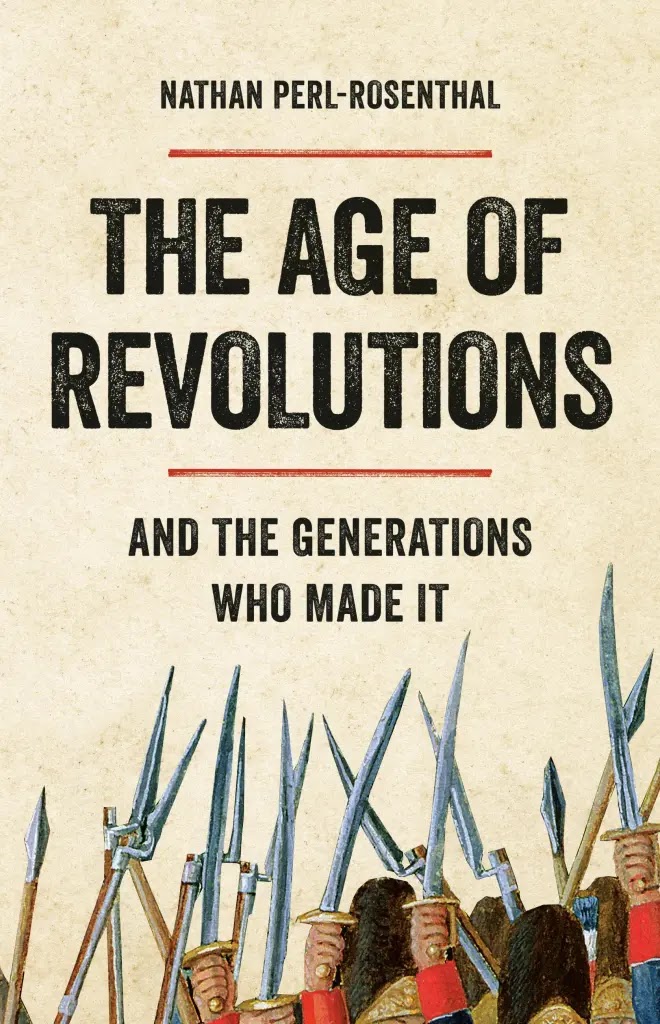
Nathan Perl-Rosenthal's "The Age of Revolutions and the Generations Who Made It"

Nathan Perl-Rosenthal is an historian of the eighteenth- and early nineteenth-century Atlantic world. He focuses on the political and cultural history of Europe and the Americas in the age of revolution, with particular attention to the transnational influences that shaped modern national politics. He received his PhD in history from Columbia University in 2011, with a dissertation on epistolarity and revolutionary organizing, and published a first book on a different topic in 2015: Citizen Sailors: Becoming American in the Age of Revolution. That book, which argues that American sailors of the revolutionary era had an unknown and significant role in the formation of modern practices of national identification, won the Society for French Historical Studies’ Gilbert Chinard Prize, for “a distinguished scholarly book published in North America in the history of themes shared by France and North, Central, or South America.”

Perl-Rosenthal applied the “Page 99 Test” to his new book, The Age of Revolutions and the Generations Who Made It, and reported the following:
The ninety-ninth page of The Age of Revolutions and the Generations Who Made It drops you into a gathering political crisis in the city of Cuzco, high in the Andes mountains of South America, in 1783. I have admit that this page is not half bad as an introduction to the book’s scope, characters, and themes. Cuzco and Peru are main settings for the book—I return to them repeatedly throughout its pages, alongside examinations of North America, Haiti, France, and the Netherlands. This page describes a struggle for power between Spanish royal officials and Cuzco criollos (American-born Spaniards). Conflicts of this sort appear over and over in the book. And the main figure on this page, Madre Maria de la Concepción Rivadeneyra, is one of the six amazing individuals around whom I built a large part of the book’s story. (Spoiler alert: she was a noblewoman-turned-nun, fond of chocolate, mother-of-pearl, and high-stakes legal maneuvers!)

Still, this page is something of an outlier in the book. The political confrontation it describes is acute, while the book’s approach to politics is generational. That is, I aim to show how political change in the age of Atlantic revolutions (circa 1760 to 1825) unfolded over the course of decades, not weeks, months or even years. These long revolutionary processes had to start somewhere—sometimes with the sort of acute conflict that we see on page 99—but their full unfolding took years. A second oddity of this page, in the context of the book, is that there is not much in it about political organizing. The argument of The Age of Revolutions, in a nutshell, is that revolutionaries before 1800 had a very difficult time organizing sustained mass movements, especially across lines of class and racial difference, but that after 1800, as a new generation took command, sustained mass political movements became easier to form and keep together. To see how Madre Maria fits into this thesis, though, all you have to do is read the rest of chapter four (pp.79-104)!
Learn more about The Age of Revolutions at the Basic Books website.

--Marshal Zeringue

Friday, February 23, 2024

Merry Morash's "In a Box"

Merry Morash is Professor of Criminal Justice and University Distinguished Professor at Michigan State University. She is the author of Women on Probation and Parole: A Feminist Critique of Community Programs and Services.

She applied the “Page 99 Test” to her new book, In a Box: Gender-Responsive Reform, Mass Community Supervision, and Neoliberal Policies, and reported the following:
Page 99 presents the words of three women whose probation or parole agents referred them to mental health counseling. Two of the women described a connection between counseling and stopping illegal activity and one did not. This page, like most other pages, gives a good indication of what is contained in In a Box, because it cites what 3 of the 118 women who told their life stories said about themselves. It is also a good indication of the book’s contents because it focuses on some helpful actions that probation and parole agents take, and it is therefore consistent with a theme that runs through the book, which is that the Michigan Department of Corrections gender responsive reforms, and more generally reforms in supervision for everyone, “worked.” This is very different than the many books and articles that show harm after harm perpetuated by correctional actions and interventions. It is also consistent with the book’s recognition that some women in the criminal legal system continue breaking the law despite seemingly helpful interventions.

It is important to recognize that page 99 only gives a glimpse into the book’s contents. That page does not show deviations from the reforms and how they have harmful effects. Even more important, this page does not show how juvenile courts, neoliberal housing and welfare policies, and time limitations and other reasons for unavailability of mental health and substance abuse services undermine reforms. This page does not capture the flow of the book which entices the reader to get on to the next chapter after reading about Starting Points in life and moving towards Endpoints for 6 of the women. Finally, this page is 67 pages away from the last chapter, which highlights policy reforms including but much more encompassing than correctional change that the women on probation and parole recommend and that I back up with empirical evidence of success.
Learn more about In a Box at the University of California Press website.

--Marshal Zeringue

Wednesday, February 21, 2024

Michael Sierra-Arévalo's "The Danger Imperative"

Michael Sierra-Arévalo is an Assistant Professor in the Department of Sociology and Associate Director of the Liberal Arts Honors Program at the University of Texas at Austin.

His new book, The Danger Imperative: Violence, Death, and the Soul of Policing, shows how policing’s preoccupation with danger shapes police culture and violence in the United States.

Sierra-Arévalo applied the “Page 99 Test” to The Danger Imperative and reported the following:
Half of page 99 is taken up by the image of a Dallas police car swathed in stuffed animals, flowers, balloons, and signs supporting police. The shrine was erected in the days following the July 7, 2016, ambush on Dallas police which killed 5 officers and injured an additional 9. One of those signs reads, “#BackTheBlue Because Someone I Call Dad Is on the Force!” The photograph was sent to me by an officer from West River who flew to Dallas with other WPD officers to pay their respects to the fallen officers. The remainder of the page begins to describe the days following the ambush, during which nearly a thousand officers from across the country rushed to Dallas to attend fallen officers’ memorial services. During one such service, President Barack Obama reminded every officer present of the unique danger of their work.

The Page 99 Test captures a core element of The Danger Imperative — the rare but no less real violence that claims the lives of officers. But it does not articulate my broader argument about how such violence is core to the recreation of police culture and inequalities in police violence.

Ironically enough, though, that the one page a potential reader turns to is about a tragic incident of violence and its use as proof of policing’s profound danger is an eerily concise reflection of The Danger Imperative’s argument. As I describe in the book, though deadly violence is exceedingly rare in the scope of officers’ work, the preoccupation with violence and the provision of officer safety are emphasized at all levels of the police institution. Incidents like the Dallas ambush serve as dramatic proof not only for officers in Dallas, but for any officer, no matter where they work, that any shift might be one in which they are confronted with a fight for their very lives.

Through academy training, unquestioned rituals, powerful symbols, and the daily task of making sure they go home at the end of their shift, officers reconstruct their world and work as one defined by the possibility of violence and death. As I continually reiterate throughout The Danger Imperative, police face very real violence. But the intense emphasis on such violence within police culture encourages behaviors that undermine police legitimacy, harm public wellbeing, and even lead to the injury and death of officers themselves.
Visit Michael Sierra-Arévalo's website.

--Marshal Zeringue

Tuesday, February 20, 2024

David L. Weimer and Aidan R. Vining's "Dog Economics"

David L. Weimer is Fellow of the National Academy of Public Administration. His contributions to public policy scholarship have been widely recognized as he has received the Policy Field Distinguished Contribution Award from the Association for Public Policy Analysis and Management and the Outstanding Achievement Award from the Society for Benefit-Cost Analysis. Aidan R. Vining is Emeritus CNABS Professor of Business and Government Relations, Simon Fraser University. He is a winner of the John Vanderkamp Prize (Canadian Economics Association) and the J.E. Hodgetts Award (Institute of Public Administration of Canada). He has published widely.

They applied the “Page 99 Test” to their new book, Dog Economics: Perspectives on Our Canine Relationships, and reported the following:
Page 99 falls in a chapter reporting on original empirical research by one of the authors showing how economists ask people about their willingness to make tradeoffs between money and mortality risk­––in this case for their dog! More generally, Dog Economics draws on economic theory and evidence to organize a synthesis of the relationship between dogs and humans. It might (incorrectly, we think) imply a book aimed primarily at professional economists rather than general readers interested in dogs. However, the page 99 chapter provides an accessible explanation of how economists estimate the implicit value people place on their lives and especially the lives of their pet dogs.

Economists use a variety of methods to measure the value of statistical life (VSL). The VSL estimates the implicit value an average person places on his or her own life in making decisions that affect his or her own mortality. The VSL is used by regulators to place a monetary value on avoided deaths that are predicted to occur from proposed rules aimed at reducing mortality risk. Rules, such as those that set standards for pet food quality, aim to reduce the mortality risk for dogs: the value of a statistical dog life (VSDL). To value these reductions, however, regulators need a plausible estimate of the VSDL, which is the implicit value that people on average place on the lives of their dog when making decisions relevant to changes in the mortality risk faced by their dogs. The page 99 chapter carefully explains how a survey experiment was used to estimate the VSDL. Interestingly, the VSDL has a number of potential uses related to a dog’s life, such as in determining compensation in cases of the wrongful death of a dog and the allocation of dog custody in divorce cases.
Learn more about Dog Economics at the Cambridge University Press website.

--Marshal Zeringue

Monday, February 19, 2024

George Fisher's "Beware Euphoria"

George Fisher is the Judge John Crown Professor of Law at Stanford Law School, where he has been teaching evidence, prosecution practice, and criminal legal history since 1995. He began practice as a Massachusetts prosecutor and later taught at Boston College Law School, Harvard Law School, and Yale Law School.

Fisher applied the “Page 99 Test” to his new book, Beware Euphoria: The Moral Roots and Racial Myths of America's War on Drugs, and reported the following:
Page 99 of Beware Euphoria recounts a singular episode in the history of American attitudes toward alcohol prohibition. Set in Philadelphia in 1788, this vignette concerns an address by Dr. Benjamin Rush, widely thought the leading physician of his day, to a congress of American Methodists. Rush counseled the congress to tighten the faith's rule governing distilled alcohol. That rule traced to Methodism's founders, John and Charles Wesley, who enjoined followers in 1743 to shun "[d]runkenness, buying or selling spirituous liquors, or drinking them, unless in cases of extreme necessity." Speaking from a medical standpoint, Rush declared spirits necessary only when "a person was chilled with cold, or wet, or was ready to faint with fatigue." After Rush's address the congress struck out the last six words of the Wesleys' original injunction -- "unless in cases of extreme necessity" -- rendering the rule an absolute ban against "buying or selling spirituous liquors, or drinking them." This new rigidity, however, proved a bridge too far. It staked out an extreme moral position, one that outstripped mainstream morality. Only two years later the Methodists reversed the change.

From this episode the reader can discern four themes of my book. The first is that this study of the moral roots of America's war on drugs takes a long look backward at the regulation of alcohol and, even earlier, of nonprocreative sex. The second is that all three moral regimes -- those governing sex, alcohol, and recreational drugs -- reflect a moral revulsion to appetitive pleasures that blot out reason. Third, all three moral regimes extended an indulgence in cases of necessity, especially medical necessity. Hence no moral teacher ever rejected all sex, for humans must procreate. Anti-alcohol regimes, likewise, always made provision for medicinal use. And dangerous addictive drugs, even fentanyl, are perfectly legal when prescribed or employed by physicians. A fourth theme, finally, is that legal regimes governing euphoric substances or activities that outstrip mainstream morality typically cannot hold. Hence almost no Western prohibition of even nonintoxicating drinking has survived much longer than a dozen years.

These four themes define the first half of the book and explain the first half of my subtitle: "The Moral Roots and Racial Myths of America's War on Drugs." The book's latter half considers those "racial myths." If moral impulses largely motivated our earliest anti-drug laws, racial hatred did not. Hence the book documents overwhelming historical evidence disproving commonly uttered claims that racial prejudice prompted early lawmaking against opium, cocaine, and cannabis. Such claims prove not merely mistaken -- they are exactly wrong. For these were laws about whites, written by white lawmakers anxious to protect the moral purity of white women and youth. White cops enforced these laws primarily against white users and those who sold to them. So a very different form of racism was at work, one that exposed indifference to the moral welfare of nonwhites.
Learn more about Beware Euphoria at the Oxford University Press website.

--Marshal Zeringue

Sunday, February 18, 2024

Alexa Bankert's "When Politics Becomes Personal"

Alexa Bankert is Associate Professor in the Department of Political Science at the University of Georgia. Her work has appeared in peer-reviewed journals such as the Journal of Politics, Political Psychology, and Political Behavior. She is the recipient of several awards, including the Distinguished Junior Scholars Award, given by the Political Psychology Section of the American Political Science Association.

Bankert applied the “Page 99 Test” to her new book, When Politics Becomes Personal: The Effect of Partisan Identity on Anti-Democratic Behavior, and reported the following:
Page 99 provides a detailed description of party affiliations among Dutch respondents in one of the many data samples I analyze in the book to show the distinction between negative and positive partisanship. While page 99 is necessary to assess the extent to which these two types of partisanship exist among Dutch voters, it does not provide any insights into their relationship or their differential effects on political behavior. It also focuses exclusively on the Netherlands - which presents only one of the five countries I investigate in the book. Yet, page 99 reiterates two interesting findings: First, negative partisanship is stronger than positive partisanship in many European multi-party system – which means that negativity in politics is not an exclusively American phenomenon. Second, right-wing parties tend to evoke the strongest levels of negative partisanship in many European multi-party systems. Ultimately, the book argues that partisan animus is not inevitable: We can be strong partisans without demonizing our political opponents.
Visit Alexa Bankert's website.

--Marshal Zeringue