Monday, January 14, 2019

Andrew R. Murphy's "William Penn: A Life"

Andrew R. Murphy is Professor of Political Science at Rutgers University, New Brunswick. He is the author of Liberty, Conscience, and Toleration: The Political Thought of William Penn and Prodigal Nation: Moral Decline and Divine Punishment from New England to 9/11.

Murphy applied the “Page 99 Test” to his latest book, William Penn: A Life, and reported the following:
Page 99 of William Penn: A Life appears about halfway through Chapter 5, “The Great Opinionist.” The chapter’s title refers to a description of Penn offered by Silas Taylor, keeper of the naval stores in the port town of Harwich, on October 26, 1671: “On Tuesday, out of a packet-boat from Holland, arrived here Sir William Penn’s eldest son, the great opinionist; he went presently and associated himself with the Quakers of this town.” At this point in his life – about to turn 27 years old – William Penn had been a convinced Quaker for about four years. Returning from his first visit to the Continent as a Quaker, he was about to begin a rapid rise to leadership in the Society of Friends, as a loyal lieutenant to, and energetic defender of, George Fox, the sect’s founder.

Page 99 and the pages that follow it chronicle the many interlocutors with whom this “great opinionist” did battle in the contentious world of early modern religious and political debate: Anglicans, Socinians, Baptists, Congregationalists, and Presbyterians, to say nothing of fellow Quakers, many of whom chafed under the organizational structures that Fox (with Penn’s solid support) was then putting into place. These debates took place in person, in print, in Parliament, and even before the King himself (access Penn gained by virtue of his father’s friendship with the royals and service as Navy Commissioner).

More broadly, the 1670s were a time of enormous personal and professional growth in Penn’s life. The decade kicked off with his celebrated trial, in which a jury refused to convict him and fellow defendant William Mead despite being browbeaten by an enraged judge. An anonymously-published “transcript” of that trial (likely authored, at least partially, by Penn himself) portrayed Penn as a heroic figure standing up for English liberties: it was wildly popular, going through nine printings in late 1670 alone and making Penn a celebrated figure in the Dissenting community. Shortly after the trial, his father died, and Penn inherited lands in Ireland. In the spring of 1672, he married Gulielma Springett, whom he had been courting for four years. Although he did not receive his colonial charter for Pennsylvania until 1681, the public profile that proved so invaluable to that undertaking owed much to the emergence of this “great opinionist” during the early 1670s.
Learn more about Andrew R. Murphy's research and publications at his faculty webpage and follow him on Twitter.

The Page 99 Test: Prodigal Nation.

--Marshal Zeringue

Sunday, January 13, 2019

Karin Vélez's "The Miraculous Flying House of Loreto"

Karin Vélez is associate professor of history at Macalester College.

She applied the “Page 99 Test” to her new book, The Miraculous Flying House of Loreto: Spreading Catholicism in the Early Modern World, and reported the following:
Hilariously and unexpectedly, the Page 99 Test works for my history monograph The Miraculous Flying House of Loreto because it showcases the essential points of my book (I'll refrain from commenting on the quality). Interestingly, the Holy House in my book’s title is not the focus of the book’s page 99. On page 99, the house is overshadowed by three comparatively unknown seventeenth-century individuals who were “touched” (and some who literally got to touch) that sacred relic. These three men of note on page 99 include: 1) an Italian pilgrim, Nicolà Albani, who detoured to visit the Holy House on his way to more prominent Christian pilgrimage sites in Rome; 2) a Huron refugee and convert to Catholicism, Ignace Tsaouenhohoui, whose escape from enemy hands led him to Québec City and the eastern Canadian mission town eventually named Lorette; and 3) the unwitting bridge between them, the French Jesuit Pierre-Joseph-Marie Chaumonot. Like Albani and Tsaouenhohoui, Chaumonot was an “accidental pilgrim” who stumbled upon the shrine of Loreto as a young runaway. The visit inspired him to later become a Jesuit and to vow to build a replica of Italy’s Holy House on the Canadian frontier, where he was assigned to work as a missionary. Page 99 of my book summarizes “the parallel patterns of spiritual growth” between this Jesuit, Huron convert, and common Italian pilgrim. These patterns include “approach[ing] holy sites desperately and without advance planning” and making “journeys to certify their membership in a mixed company that was neither exclusive nor polished.” Their stories of coincidence and re-routing are not those traditionally mustered to explain the spread of Catholicism. The usual narrative of how Christianity expanded out into the world stresses deliberate planning, organization, and often military might. But my page 99 foreshadows my alternative, Wikipedia-style model for understanding how Christianity took hold globally in the 1600s (see Chapter 8 of the book for a full discussion of how the early overseas portaging of Loreto resembles today’s Wikipedia). As the diverse players on page 99 suggest, the Holy House of Loreto and the particular form of Christianity that it embodied were carried to new moorings by self-appointed, mixed-rank, often peripheral amateurs. The “miraculous” here is the “accidental,” genuinely inadvertent randomness of movement so evident in the historical record...and so evident when one flips to page 99 of this publication.
Learn more about The Miraculous Flying House of Loreto at the Princeton University Press website.

My Book, The Movie: The Miraculous Flying House of Loreto.

--Marshal Zeringue

Saturday, January 12, 2019

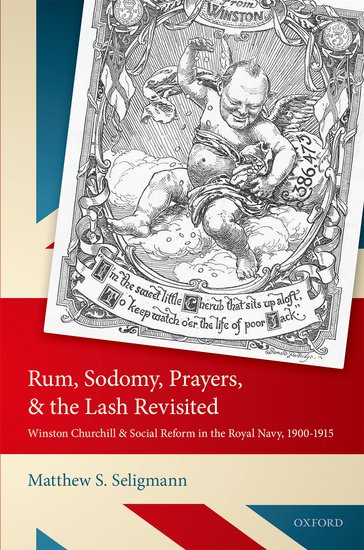
Matthew S. Seligmann's "Rum, Sodomy, Prayers and the Lash Revisited"

Matthew S. Seligmann was born in London. He was educated at the universities of Edinburgh, Pennsylvania, and Sussex and has held posts at the University of Northampton and Brunel University London, where he is currently professor of naval history. An expert on the Anglo-German naval race and Anglo-German relations before and during the First World War, he has written numerous books and articles on this subject, as well as making radio and television appearances.

Seligmann applied the “Page 99 Test” to his latest book, Rum, Sodomy, Prayers, and the Lash Revisited: Winston Churchill and Social Reform in the Royal Navy, 1900-1915, and reported the following:
First as President of the Board of Trade (1908-1910) and then as Home Secretary (1910-1911) Winston Churchill was a radical liberal reformer advancing a strongly progressive social agenda. However, according to most historians, when he was appointed First Lord of the Admiralty in October 1911 he abandoned his former reformist credentials in order to concentrate exclusively on the more martial task of preparing the Royal Navy for war. This book argues otherwise. Using as its springboard the apocryphal quotation, often attributed to Churchill, that naval tradition was nothing but ‘rum, sodomy, prayers and the lash’, it demonstrates that in the run up to the First World War and most especially in the period when Churchill was in charge, a major series of reforms were introduced designed to improve the life of British sailors. These included efforts to reduce over-drinking, regulate sexuality, introduce more and better access to spiritual services, and lessen the role of corporal punishment. In short, whether by accident or design, these were reforms focusing on ‘rum, sodomy, prayers and the lash’.

Page 99 of the book is part way into chapter four, the section of the book that addresses the question of ‘prayer’. This particular page focuses on one of the earliest attempts to improve the quality of religious provision in the Royal Navy by changing the terms of service of the Navy’s Anglican chaplains. In place of older chaplains who served for life, the object was to lure into the Navy younger more energetic and more vibrant clergy who would serve aboard ship for three to five years only. From there the chapter goes on to examine reforms designed to provide for the spiritual needs of the Navy’s non-conformist and catholic sailors, a task made difficult by the fact that at that time the law required all naval chaplains to be Anglican. Considerable efforts were made to widen the scope of spiritual provision within the confines of a constitutional system that privileged the state church.

Alcohol, sexuality, religion and punishment all shaped the life and experiences of British sailors at the start of the twentieth century. The British state was eager to improve their lives and better their conditions. As this book shows, none of its leaders was more committed to this than Churchill.
Learn more about Rum, Sodomy, Prayers, and the Lash Revisited at the Oxford University Press website.

--Marshal Zeringue

Friday, January 11, 2019

Lisa Greenwald's "Daughters of 1968"

Lisa Greenwald, PhD, spent almost a decade working in and researching the women’s movement in France, supported by an Andrew W. Mellon Fellowship and grants from the French government. She has worked as a consultant and in-house historian for a variety of nonprofits and foundations in France, Chicago, and New York. She currently teaches history at Stuyvesant High School in New York City.

Greenwald applied the “Page 99 Test” to her new book, Daughters of 1968: Redefining French Feminism and the Women's Liberation Movement, and reported the following:
Page 99 locates the origin of the political and radical wing of feminism:
Two small groups already functioning when the street fighting began in May 1968 would become very important to the evolution of second wave French feminism. The MDF (Mouvement démocratique féminin or the Democratic Women’s Movement) and its daughter group, FMA (Féminin-Masculin-Avenir—Feminine-Masculine-Future), produced a synthesis of revolutionary theory and dynamic activism. Perhaps most important, they opened the field of political action and political critique to include personal relations between the sexes, a position that would mark contemporary French feminism for the next two decades.
Daughters of 1968: Redefining French Feminism and the Women’s Liberation Movement, is the story of modern-day French feminism which was both impactful and full of intellectual and personal conflict. It is the book that has been clamoring to be written since American academics decades ago claimed second wave “French feminism” as a literary movement divorced from the politics that shaped it. A small collection of women psychoanalysts, novelists, and philosophers who have written about and for women since the 1970s have enjoyed significant academic interest beyond France and are often seen by foreign academics as epitomizing French feminism. This belief continues among American academics and much of the French public, thus this book intends to shift the understanding of French feminism in a more political direction. Between women’s suffrage in 1944 and the Socialist electoral win in 1981, using feminist arguments to attract voters, French feminism played a central political role in the history of France. The women who drove this feminist epoch and were at the forefront of action on women’s behalf were often social scientists, teachers, and workers—leftists committed to a materialist critique of society. They were part of a longer tradition, which flourished in the postwar period, and which produced widespread social change, revamping the workplace and laws governing everything from marriage to abortion.

The book emphasizes three points: First, that French feminism sought to rectify women’s secondary status but also to tear apart patriarchal society and reinvent it in feminist terms; second, that the way French feminism developed was indeed singular but not as it has been described by philosophers, having more to do with the influence of Marxism as well as Catholicism; and third that there were many contradictions and strands of French feminism, some of which invoked the principle of corporatism to deny feminist demands and others who cultivated a universalist vision of France to bolster them.
Learn more about Daughters of 1968 at the University of Nebraska Press website.

--Marshal Zeringue

Thursday, January 10, 2019

David A. Taylor's "Cork Wars"

Journalist David A. Taylor teaches science writing at Johns Hopkins University. He is the author of Soul of a People: The WPA Writers’ Project Uncovers Depression America and Ginseng, the Divine Root: The Curious History of the Plant That Captivated the World.

Taylor applied the “Page 99 Test” to his new book, Cork Wars: Intrigue and Industry in World War II, and reported the following:
The Page 99 test is uncanny in the case of Cork Wars. When I open to that page in the published version, it's the start of a key chapter illuminating the hidden world at the heart of the story: the industrial espionage during World War II that embroiled worked in the cork industry in the intelligence game, caught in neutral countries and reporting to U.S. spy agencies on what they found. The chapter, "Among the Spies in Lisbon," follows American businessman Melchor Marsa, whom we've already met. A naturalized American who settled in Brooklyn and raised a family, and returned to Europe in the 1930s to manage the plants in Spain and Portugal for the American company, Crown Cork and Seal.

Page 99 notes, as Marsa returns to Lisbon in the spring of 1943 with support of the OSS (predecessor to the CIA): "The city was awash with spies from both sides. Ian Fleming, Graham Greene, and the notorious Kim Philby were busy sleuthing for the British..." It goes on to describe how Marsa, while new to the ways of espionage, was at home in the world of Lisbon's convoluted business relationships, and how his family received news of him.

The book weaves together three family stories of the war as it affected working people: from the company owner to the manager to the people working on the factory floor. For Marsa's story, his daughter Gloria proved an invaluable guide, as she lived with her parents in Lisbon before the U.S. entered the war, and could describe the tumultuous atmosphere of the city as well as relate what she knew of her father's experience. She brought Melchor Marsa to life, the person behind the documents and declassified secret government files that I had found in my research.
Visit The Cork Wars website.

--Marshal Zeringue

Wednesday, January 9, 2019

Murad Idris's "War for Peace"

Murad Idris is an Assistant Professor of Politics, University of Virginia, and co-editor of forthcoming Oxford Handbook of Comparative Political Theory.

He applied the “Page 99 Test” to his new book, War for Peace: Genealogies of a Violent Ideal in Western and Islamic Thought, and reported the following:
On page 99 of War for Peace, I argue through a close reading of the philosopher al-Fārābī (c. 872–950/1) that the form of a collective bond is predicated on an enemy. The bond does not only enfold those who live together; it establishes those alongside whom they wage war and those against whom they wage war. The page distinguishes this interpretation of al-Fārābī from Carl Schmitt’s friend/enemy distinction; summarizes how al-Fārābī schematizes each bond and its corollary antagonism; and introduces al-Fārābī’s description of the view that people must seek conquest after conquest, or war for its own sake. The page ends with a contrast: “Recall Cleinias’s claim in book 1 of Plato’s Laws, that there” is an everlasting war against cities, between cities, or between neighborhoods, households, men, and inside each person.

Al-Farabi’s descriptions are symmetrical. My discussions of symmetry underscore how aesthetic features quietly arrange constructions of the world—the agents and spaces that a schema prioritizes, and the erasures and hierarchies it installs. He lists “bonds (and antagonisms) produced through procreation or intermarriage (against other kin-based groups); a shared first or original ruler (against outsiders); alliances (against other forces); similarity in a nation’s character, nature, and language (against other nations),” and so on. Thus, “clan is distinguished from clan, city from city, a set of allies from another set of allies, and nation from nation.” Al-Fārābī then describes the view of warlike groups and of a “peaceful” city. Other scholars have taken al-Farabi to suggest that the “peace-loving cities” are either insignificant or non-violent. I show that, based on al-Farabi’s own description, this group’s structure is actually strikingly similar to the “warlike cities” that al-Fārābī discusses in another text. The “peaceful city” wages war, insists on peace, and resembles those whom it designates as warlike.

This analysis is part of the chapter’s attempt to interrogate the economies of morals that configure “war for the sake of peace” and to recover their logics beyond the grammar of “just war” and “good intentions.” This grammar’s neutrality is too often taken for granted. The chapter pursues this argument through its juxtaposition of al-Fārābī and Thomas Aquinas.

Page 99 reflects the book’s challenge to critically situate thinkers, their concepts, and their schematizations across histories of political thought. It turns from al-Farabi back to Plato’s Cleinias; later chapters resituate both in light of the schematizations of war and peace by Erasmus, Ibn Khaldun, Hobbes, Pufendorf, Kant, and Sayyid Qutb, among others, to tease out how idealizations of peace re-entrench hierarchies within humanity, reflect the distinction between empire and native, and authorize various forms of policing in the name of peace. From this page alone, one could say that War for Peace gives the genealogies of the frames that structure theorizations of universal peace, war, and the globe.
Learn more about War for Peace at the Oxford University Pres website.

--Marshal Zeringue

Tuesday, January 8, 2019

Raymond Taras's "Nationhood, Migration and Global Politics"

Raymond Taras is Professor of Political Science at Tulane University. In 2019 he is Fulbright Distinguished Chair at Australian National University in Canberra.

Taras applied the “Page 99 Test” to his new book, Nationhood, Migration and Global Politics: An Introduction, and reported the following:
This book considers six separate cases of migrants seeking to integrate into receiving societies in the northern and southern hemispheres: Russia, Britain, the US, India, South Africa, and Peru. I set up a migration politics test: how different these societies are with their prerequisites for achieving social cohesion – the glue that binds nativists with recent migrant arrivals. I even resort to comparing the national anthems of these six states to determine which is most exclusionary and which is least.

As luck would have it, however, page 99 falls on endnotes to the Russia case, a country that I have studied painstakingly since the 1970s. I am shamefaced to admit that the first endnote on page 99 is to my 1990s volume, edited with media illuminatus and puppet model Ian Bremmer, on Nations and Politics in the Soviet Successor States.

I spent inordinate time deconstructing Winston Churchill’s often-cited puzzle which he identified in a BBC radio broadcast on 1 October 1939. The devastating beginnings of World War II had struck Poland hardest. Britain was sidelined fighting a phony war while Russia was kept busy thanks to the Ribbentrop-Molotov Pact that kept the Red Army occupied swallowing up chunks of Poland and parts of eastern Europe. Churchill decided to keep his options open in October and proclaimed that Russia “is a riddle wrapped in a mystery inside an enigma; but perhaps there is a key. That key is Russian national interest.” Churchill himself indulged therefore in cryptic signaling.

So much for Russia in my study of nationhood. The greater part of this cross-national research concerns migrants who are viewed as belonging or not belonging to receiving societies. Prejudices run deep in many countries, sometimes in favor of assisting certain migrant communities but in others rejecting them out of hand. Overall, the list of “unwelcome people” has grown since my book was published. For example, in Latin America alone there are groups of Brazilians, Colombians, and Mexicans in northern border towns rallying against the influx of refugees.

I define nationhood, predictably enough, on page 1: “It abandons ideas of monoculturalism and assimilationism that were previously demanded of society and which had insisted on blind loyalty by immigrants to the majority culture. Nationhood was being nudged from a primordial, ethnic understanding of the nation towards a civic one.” Following cues from a number of writers, I claim that nationhood and nation should no longer be viewed as synonyms, that nationhood should have a distinct meaning underscoring reciprocity and affinity between nativists and recently-arrived immigrants. The end goal is to form an organic whole, that is, a socially cohesive society.

Compulsively I have to return to Russia. In concluding his broadcast, in a rarely-referenced addendum Churchill cautioned how “It cannot be in accordance with the interest of the safety of Russia that Germany should plant itself upon the shores of the Black Sea.” Put simply, “That would be contrary to the historic life-interests of Russia.” Is this not an example of Vladimir Putin’s Realpolitik over NATO enlargement, that is, if we assume that NATO comprises something more ominous than a bunch of wild and
crazy democracy-loving states? Recent books by realists John Mearsheimer and Stephen Walt make the case that it is the liberal hegemonists that are more warlike than realists.

What is the tie-in with migration? Vladimir Vladimirovich appears to be up to an old trick to boost his economy: encouraging in-migration to the country in order to create a reserve army of cheap labor. The country now trails only the US worldwide in terms of the numbers of migrant arrivals. But immigration alone, never mind diversity, does not add up to nationhood unless there is some form of social and labor market integration on migrants’ part. Can a popular, inescapably Russian backlash against occur, as has happened in so many countries in Europe and abroad, to Putin’s revised immigration policy? A nation no more is what may confront Russia in the near future should Putin be serious about this approach.
Learn more about Nationhood, Migration and Global Politics at the publisher's website.

--Marshal Zeringue

Monday, January 7, 2019

Robert Lyman's "Under a Darkening Sky"

Robert Lyman is the author of numerous books, including Among the Headhunters and The Real X-Men. Widely regarded as one of Britain's most talented historians, he is a former officer in the British Army and a fellow of the Royal Historical Society. He lives in Berkshire, England.

Lyman applied the “Page 99 Test” to his latest book, Under a Darkening Sky: The American Experience in Nazi Europe: 1939-1941, and reported the following:
The book sets out to record the views of expatriate Americans in Europe in the period leading up to Hitler’s declaration of war on the United States in December 1941. An amazing 30,000 Americans were known to be in Europe at this point, 5,000 in France, from a high point in the 1930s when there were 30,000 in France alone. It starts in fact with letters, diaries, newspaper articles and books published as early as 1933. I wrote the book as an exercise in discovery, not knowing what I would find in terms of American observer’s attitudes to the increasing power and influence of the Nazi party in Germany, or of the outworking of Nazi policies in Germany – and further afield – as the decade progressed. While it’s true that I focused on published views, which itself is somewhat self-selecting, I found that the overwhelming majority of voices loudly expressed their fears for the safety of Germany, and of the free world with a stridency and alarm not heard from within a Europe desperate to appease Hitler in a misguided attempt to prevent another war. Page 99 finds us in Berlin on the day that France and Great Britain declared war on Germany, in response to the illegal invasion of Poland three days before. William Russell, a consular clerk in the US embassy, attempted to understand how millions of Germans were willing to believe Nazi propaganda. He concluded that apathy had much to do with it. I write:
One Sunday he asked a German friend—no Nazi, a member of an old aristocratic family—for the reason behind the Nazi hold on the German people. The man thought carefully before he replied. “Four percent of the people are for Adolf Hitler,” he said quietly. “Six percent of the people are against him, and the other ninety percent don’t care one way or the other.” Germany was en route to destruction because of the 4 percent who had voted for repression and the 90 percent who had foolishly abdicated from playing any sort of role in the political process. The self-immolation of a nation that had begun on January 30, 1933, and which was to last for twelve and a half hellish years, was the result of the carelessness of an entire nation.
This pretty much sums up the entire book!
Visit Robert Lyman's website.

--Marshal Zeringue

Sunday, January 6, 2019

Michael Messner's "Guys Like Me"

Michael A. Messner is Professor of Sociology and Gender Studies at the University of Southern California.

He applied the “Page 99 Test” to his new book, Guys Like Me: Five Wars, Five Veterans for Peace, and reported the following:
Page 99 of Guys Like Me is as a transition point between chapters that sets up the story of Vietnam War veteran Gregory Ross. Centered on the page is a powerful excerpt from Dr. Martin Luther King Jr.’s famous anti-war speech, “Beyond Vietnam,” delivered in 1967 at Riverside Church in New York:
“This business of burning human beings with napalm, of filling our nation’s homes with orphans and widows, of injecting poisonous drugs of hate into the veins of peoples normally humane, of sending men home from dark and bloody battlefields physically handicapped and psychologically deranged, cannot be reconciled with wisdom, justice, and love. A nation that continues year after year to spend more money on military defense than on programs of social uplift is approaching spiritual death.”
King’s statement encapsulates two of the themes that run through the following chapter, and throughout the book. The first concerns the awesome costs and lasting trauma of war—to soldiers and civilians who have been defined as enemies, and also to the young men we send off to fight in our name, who are killed, wounded, and often emotionally scarred for life. The second theme offers a humane vision for the future of the United States. A nation founded on “wisdom, justice and love” instead of militarism would convert swords to plowshares, shifting national priorities toward meeting human needs.

Guys like Me tells the story of five ordinary men, scarred by their service in five U.S. wars, who later became extraordinary advocates for peace. In telling these individual stories, the book illustrates the lasting costs of war to those who fought them, and also the ways that veterans for peace are forging a path to peace and justice.
Visit Michael Messner's website.

--Marshal Zeringue

Friday, January 4, 2019

Mary Stockwell's "Interrupted Odyssey"

Mary Stockwell is the former chair of the history department at Lourdes University in Ohio and the author of Unlikely General: "Mad" Anthony Wayne and the Battle for America, The Other Trail of Tears: The Removal of the Ohio Indians and other books.

Stockwell applied the “Page 99 Test” to her new book, Interrupted Odyssey: Ulysses S. Grant and the American Indians, and reported the following:
No one could deny that Ely Samuel Parker, President Ulysses S. Grant’s Commissioner of Indian Affairs, was a remarkable man. Born in 1828 on the Seneca’s Tonawanda Reserve, he was named his tribe’s official spokesman when he was just eighteen. Five years later, he was chosen as the Seneca’s Grand Sachem. He studied law and helped argue a case in the U.S. Supreme Court on behalf of his people. He negotiated a treaty with the government that allowed the Seneca to stay in Tonawanda, making them one of the few eastern tribes that avoided removal across the Mississippi. He studied engineering, and found work first on the Erie Canal and later as the superintendent of lighthouses on the Upper Great Lakes. In 1860, Parker moved to Galena, Illinois to oversee the construction of a customhouse and naval hospital. There he befriended a quiet young man who worked as a clerk in his father’s leather goods store. He was Ulysses S. Grant who would soon win fame as a Union general in the Civil War. Shortly after Grant’s victory at Vicksburg, Parker became his military secretary. When Robert E. Lee surrendered at Appomattox, Parker wrote down the surrender terms. In 1869, when Grant was sworn in as president, Parker became his commissioner of Indian affairs.

But for all his success, Commissioner Parker, on the morning of January 17, 1871, as described on Page 99 of Interrupted Odyssey: Ulysses S. Grant and the American Indians, refused to get out of bed. He was hiding there so he would not have to testify before a special committee of the House of Representatives that was investigating him for corruption. Parker had been accused of negotiating an unnecessary million dollar contract to supply the Sioux on the Upper Missouri in June 1870 and then pocketing most of the money for himself. The charges were baseless but that did not stop his political enemies, who hated him as the “savage” whom Grant had chosen to run the Indian service, from doing everything in their power to oust him from his post. By removing Parker, they hoped to overturn the Indian policy that Grant had carefully crafted with the help of his Seneca friend. The president had planned to move the Indians to reservations where the army would protect them from the onslaught of settlers. Working at their own pace, over a generation or two, the tribes would learn modern ways to support themselves and so enter the American mainstream as citizens of the United States.

Parker finally worked up the nerve to face the House panel. While he was exonerated, his reputation was ruined and he soon resigned his position. Without an ally like Parker at his side, Grant watched as his Indian policy came undone. A succession of Commissioners of Indian Affairs took over but none of them had the vision that Parker had provided. They de-emphasized the goal of American citizenship for the Indians and instead argued that Grant was maintaining the peace like no President before him. Their optimistic claims exploded when the Far West descended into worst Indian Wars in American history, including the Modoc War in 1873, the Red River War in 1874, and the Great Sioux War in 1876. While Grant never discussed his Indian policy after leaving office, Parker could never forget its failure. Until the day he died, he would always remember that terrible January morning when the policy that he had developed with Ulysses Grant, along with their friendship, began to unravel past all repair.
Visit Mary Stockwell's website.

My Book, The Movie: Interrupted Odyssey.

--Marshal Zeringue