Sunday, September 10, 2023

Kalyani Ramnath's "Boats in a Storm"

Kalyani Ramnath is Assistant Professor of History at University of Georgia.

She applied the “Page 99 Test” to her new book, Boats in a Storm: Law, Migration, and Decolonization in South and Southeast Asia, 1942–1962, and reported the following:
Page 99 – from Chapter 3 titled ‘Tax Receipts’ – describes the impact of the postwar economic conditions in Burma (now Myanmar) on the Nattukkottai Chettiars, a diasporic trading and moneylending community from south India who had operations across South and Southeast Asia. By the time of Indian and Burmese independence from British rule, in 1947 and 1948 respectively, many Chettiar firms wound up operations in Burma, unable to navigate the strict restrictions on travel, movement, residence, trade, and land ownership placed on migrants, opting instead to invest in educational institutions or industry in India. At the same time, Chettiar firms also faced the prospect of income tax liability in two countries even as nationalization threatened to deprive them of their landed wealth. Page 99 describes how Indian income tax legislation was initially poised to take advantage of this “refugee capital,” suggesting that the tax residence of Chettiar firms had shifted during the War. But later, these moves were reversed because of the tax implications for those displaced by the India- Pakistan Partition in 1947 (“the Partition”) It describes how double taxation regimes to deal with the aftermath of the World War, the struggles for independence, and the formation of new national borders in India, Myanmar, and Sri Lanka were based on those developed for the Partition.

A browser who turns to page 99 might get a good sense of the context of the book – the postwar world in South Asia (India, Sri Lanka) and Southeast Asia (Myanmar, Malaysia) in the age of decolonization. They might also see an illustration of an important historiographic reframing that Boats in a Storm offers – that the unraveling of economic networks across these two regions in the aftermath of the War are the lesser-known “other partitions” in the region. As the seemingly banal example of income tax liability shows, the long shadow of the better-known territorial Partition and the violent and traumatic displacement that it occasioned – was cast over diasporic Indians unconnected with it elsewhere in Asia. This led, as in the case of the Chettiar firms, to unexpected and devastating consequences where they could not return to their homes and places of work. Everyday legal encounters – with the income tax authorities or the offices that issued immigration documents – rather than widely publicized courtroom trials, feature throughout the book. At the same time, the account on page 99 does not capture the broad sweep that Boats has – it is not only about migrant traders or moneylenders, but also about those who may not have had access to resources to help them navigate stormy legal seas, from laborers who worked on tea plantations in Ceylon (now Sri Lanka) and to dockworkers and clerks at the Singapore Harbor. The descendants of plantation laborers, for example, form part of marginalized communities in Sri Lanka and Malaysia. Page 99 also does not feature any lawyers, journalists, or trade unionists, many of whom figure prominently in the narrative elsewhere, such as SP Amarasingam, the lawyer and newspaper journalist who wrote about immigration across the Palk Strait between India and Sri Lanka, and later, advocated for plantation laborers to be naturalized as Ceylon citizens before the Supreme Court. As the book proceeds – page 99 is chapter three of seven – the reader might also note how taxation regimes seeped into immigration and later, deportation regimes, unsettling and rearranging rhythms and patterns of migrant life: families spread out across two different countries had to choose one “home” to prove their political loyalties, people charged with being “communists” for engaging in activities perceived as political dissent in south India and Singapore, yet others faced the risk of statelessness for not possessing the right documents. In other words - to push the literary metaphor in the title of the book even further! - page 99 is a glimpse of the brewing storm, the aftermath of which the book chronicles.
Learn more about Boats in a Storm at the Stanford University Press website.

--Marshal Zeringue

Saturday, September 9, 2023

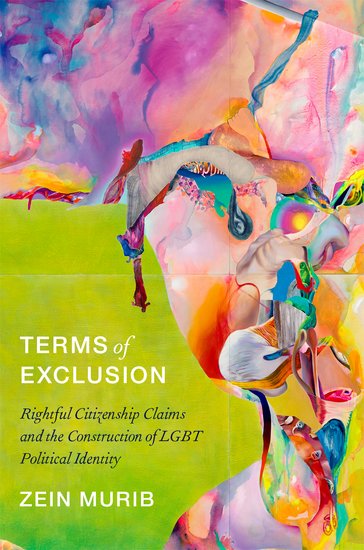
Zein Murib's "Terms of Exclusion"

Zein Murib is an Associate Professor of Political Science and affiliated faculty in Women's, Gender, and Sexuality Studies at Fordham University. Murib's research and teaching interests are informed by feminist and queer theory and located at the intersection of scholarship on gender and sexuality, interest groups and social movements, and marginalized political identities in US politics.

Murib applied the “Page 99 Test” to their new book, Terms of Exclusion: Rightful Citizenship Claims and the Construction of LGBT Political Identity, and reported the following:
My book forwards the argument that what I call "rightful citizenship claims" only bring those members of the group who can compellingly argue that they are being denied rights to which they are owed as citizens over the finish line. This strategy neglects those who are either not citizens or, more perniciously, those whose citizenship is shaped by laws and norms that afford them only what scholars refer to as "partial citizenship." This includes Black, Latine, Asian, Native, Arab members as well as people with disabilities. Excluding these members from political agendas helps to consolidate group membership as proximate to the prototypical normative citizen, or White men. With respect to the LGBT group, this means that it is only White gay men (and some lesbians) who fully enjoy rights wins.

On page 99 I advance this argument by explaining how Black and Third World lesbian feminist thinkers challenged their exclusion from White feminist spaces by putting forward a vision of political praxis that views difference is a resource to be harnessed, not an obstacle to overcome.
Visit Zein Murib's website.

--Marshal Zeringue

Friday, September 8, 2023

Mark Thomas Edwards's "Walter Lippmann"

Mark Thomas Edwards is professor of US history and politics at Spring Arbor University in Michigan. He has published articles in Religion and American Culture, Diplomatic History, Anglican and Episcopal History, Totalitarian Movements and Political Religions, and the Journal of Religious History. His first book, The Right of the Protestant Left: God’s Totalitarianism (2012) offers a new view of Reinhold Niebuhr, Christian Realism, and the geopolitics of the ecumenical movement.

Edwards applied the “Page 99 Test” to his new book, Walter Lippmann: American Skeptic, American Pastor, and reported the following:
The Page 99 Test both does and doesn't work for my book. Page 99 is entitled “The Older Lippmann” and offers a brief overview of chapters four through seven. The concluding sentence, “Lippmann’s deepened affiliation with and distance from Christian and Jewish traditions, as well as his embrace and rejection of civil religions, is emphasized throughout,” does hint at major themes of the book, but it is not much to work with apart from reading the introduction of preceding text. That said, readers could infer that, if there was an “Older Lippmann,” there must have been a “Younger Lippmann,” and thus they would have stumbled upon the major organizational framework for the biography. For some time, Lippmann has served as a pawn in the culture wars, with liberals remembering him as a “Tired Radical” who abandoned socialism and conservatives embracing him for his critiques of New Deal liberalism. In fact, Lippmann can't be carved up so neatly in terms of his political, cultural, and religious affiliations. Lippmann did live long enough to endorse both Teddy Roosevelt and Richard Nixon for President twice. Yet elements of his self-professed conservativism of the 1970s could be seen in his Harvard term papers of 1909 when he identified as a socialist. Conversely, Lippmann expected Nixon to continue the Keynesian economics he had learned to love as a critical New Dealer. And so the notion of “Younger” and “Older” Lippmanns is predominantly chronological in nature: Lippmann was once young, then he became old. I do date his transition around 1932 when he began writing his “Today and Tomorrow” op eds for the New York Herald Tribune a Republican newspaper confident enough to bring someone on board that Time magazine had called the “Moses of liberalism.” Lippmann’s weekly tone after that time was more settled, mature, and clerical—“Older”—even if his books became more, in his own words, “incurably eclectic.” Yet my hope is that readers will find much to admire and despise in all of the Lippmanns.
Learn more about Walter Lippmann at the Oxford University Press website.

--Marshal Zeringue

Thursday, September 7, 2023

Laura Meckler's "Dream Town"

Laura Meckler is national education writer for the Washington Post, where she covers education across the country as well as national education policy and politics. She previously reported on the White House, presidential politics, immigration, and health care for the Wall Street Journal, as well as health and social policy for the Associated Press. Her honors include a Nieman Fellowship and Livingston Award for National Reporting, and she was part of a team that won the George Polk Award for Justice Reporting. She lives in Washington, D.C., with her husband and two sons.

Meckler applied the “Page 99 Test” to her new book, Dream Town: Shaker Heights and the Quest for Racial Equity, and reported the following:
Page 99 of my book comes near the beginning of Chapter 6, the story of how Jack Lawson, superintendent of the Shaker Heights City School District, led the community to adopt a voluntary school busing program to desegregate the elementary schools. The plan’s focus was on Moreland Elementary School, where 88 percent of the students were Black. This page describes Lawson’s planning. That includes how he and his staff developed the arguments he would make for the plan, as well as how he secured private foundation funding for it. It also covers his vision of busing children out of Moreland and into majority white schools and turning Moreland into a special services school, where students from across the district would rotate for certain programming and services. Finally, the page shows Lawson’s political savvy, as he scheduled a school board meeting to discuss the plan at a time when he correctly predicted board members would be in a good mood (right after a tax levy increase had been approved by voters). The very end of the page sets up one of the central tensions of the chapter: “It’s unclear how much, if at all, he consulted with the Moreland community itself about the details or even the general concept. A meeting in November 1969 suggests any attempt to win buy-in was minimal.”

After being invited to participate in the page 99 challenge, and after re-reading page 99, my first feeling was disappointment. Page 99 of my book is not all that exciting. There are no great scenes or interesting bits of dialogue or huge revelations. It does not contain particularly exciting or vivid descriptions. Other pages are far more compelling.

However, I do think my page 99 gives readers a sense of one of the book’s important themes: the work Shaker Heights has done over the years toward racial integration. This page deals with integration of the schools; previous chapters discuss housing integration; and subsequent chapters examine integration of classrooms. It also is important in setting up the events described in the rest of the chapter, where we learn how school Superintendent Jack Lawson’s busing proposal played out.

The page also speaks to another theme in the book. There generally are not heroes or villains--just good people with good intentions, making progress and making mistakes. In this case, we see Lawson’s good intentions and his truly visionary leadership. He led the district to adopt a voluntary busing plan at a time when other communities were fighting court orders to do the same. But we also see his limits. He proposed a one-way busing plan, where virtually the only students to be bused would be Black, even as the Black community made clear that they opposed this. Ultimately, the district adopted a more equitable two-way busing plan. But that change came about only after white parents also argued that a one-way plan was unfair and volunteered to bus their own children into the majority-Black elementary school. So while the district eventually arrived at a balanced solution, and while Lawson rightfully gets the credit for this plan, he also had some blind spots.

Understanding that leadership does not mean perfection, and that progress is often accompanied by setbacks, is critical to understanding the story of Shaker Heights and the greater story of almost any effort to do hard things.
Visit Laura Meckler's website.

--Marshal Zeringue

Wednesday, September 6, 2023

Miriam H. Baer's "Myths and Misunderstandings in White-Collar Crime"

Miriam H. Baer is Vice Dean and Centennial Professor of Law at Brooklyn Law School.

She applied the “Page 99 Test” to her new book, Myths and Misunderstandings in White-Collar Crime, and reported the following:
White-collar crime is a frustrating problem. It’s frustrating because it always seems to be with us. Pick up a newspaper or magazine and you will inevitably read a story about the corrupt politician, the CEO who lied to the public, even the manager or small-business owner who destroyed documents to avoid a fine or short-circuit expensive regulatory requirement. Everyone cheats, and too many people seem to get away with it.

That is, for most people, the standard narrative of white-collar crime and its enforcement. The government is perhaps tough on rank-and-file employees and ordinary citizens and allows the famous and the powerful to escape liability. This narrative is compelling – but it does not tell the whole story.

The aim of my book is to illuminate a series of myths and misunderstandings that hamper our understanding of white-collar crime and its enforcement. A series of pathologies – in lawmaking, enforcement and discourse – oversimplify the problem and undermine our ability to redress white-collar crime. The book is divided into chapters that focus on the ways we generate and craft criminal statutes, the ways we enforce (or fail to enforce) those statutes, and the ways we talk about our statutes and (more often) our failed efforts at enforcement.

Page 99 of my book falls in the middle of one of the lawmaking chapters. Criminal law is often said to be a “statutory” subject, meaning that it is the product of democratically elected legislatures who codify prohibitions in lengthy criminal codes. The federal criminal code is no exception, except that it is poorly put together, bundles numerous conceptually distinct crimes into single, umbrella-like statutes, and uses opaque terms that no ordinary person could easily understand. It therefore falls to other institutions – the judiciary, prosecutors, regulatory agencies – to “make” criminal law by interpreting statutory language and creating shadow rules alongside the written law. The aim of Chapter 4 (which includes page 99) is to demonstrate that “outsourcing” itself has many flavors. Some types of outsourcing – such as corporate criminal liability –are truly unilateral in that one institution (in this case, the Department of Justice) creates a quasi-legal system and no other institution (not even the courts) has the ability to impose any checks or balances. Other types of outsourcing – such as the judiciary and SEC’s joint creation of insider trading liability – reflects a sequential back-and-forth involving multiple agencies and many checks and balances. Thus, the aim of page 99 is to show readers that “outsourcing” as a label reflects different types of lawmaking. As I say in the middle of the page:
The insider trading and corporate crime examples teach us something about legislative outsourcing. Both doctrines rely heavily on the common law’s lawmaking modality, on administrative agencies (assuming one treats the DOJ as a quasi-administrator in the corporate crime context), and both concepts can be traced to profoundly underwritten rules.
Then I go on to say, “From a functional perspective, this is where the commonalities end.” My point is that insider trading’s trajectory looks a lot different -and frankly, a lot less threatening where rule of law values are concerned – than corporate criminal liability. And on the next page, I go on to argue that many of the common criticisms lobbed at outsourcing (it renders lawmaking “too easy” and creates an “imperial” unchecked prosecutor) cash out differently depending on the type of outsourcing. “[S]ay what you will about insider trading, but its evolution as a body of law could not be fairly be described as ‘easy’ or solely in service of prosecutorial power.” (p. 101).

So, the aim here, as in the rest of the book, is to teach readers that some of the behaviors that concern us, such as the legislature’s “outsourcing” criminal lawmaking, can produce “divergent outcomes” depending on context (p. 104). And we owe it to ourselves to explore those different contexts and outcomes if we are serious about reforming white-collar crime and identifying outsourcing’s drawbacks.

The chapter closes by highlighting a particular drawback that the rest of the book takes up in later chapters – namely, that by leaving our statutes underwritten, and thereby relying on other agencies to define their meaning, our legislature abandons any attempt to subdivide crimes into better and worse versions. That is, we spend so much time trying to figure out what is and is not “insider trading,” that we forego the attempt to create laws that describe and forbid different variations of “insider trading” from bad to worse. I thus end the chapter on page 106 with this critique:
We almost certainly would prefer a series of insider trading laws that recognize distinctions between insiders, misappropriators, and gift tippers and tippees. But we instead rely on courts to interpret a single, undifferentiated fraud statue to encompass all insider trading. A reflective legislature would ask why these activities are wrong, how much harm they cause collectively, and relative to one another, and how much culpability they reflect, as both an absolute and relative matter. A well-designed legislative code wouldn’t punt these distinctions to a prosecutor’s office or a sentencing judge; it would incorporate these principled distinctions into the code itself, signaling to both citizens and legal actors alike that these distinctions matter… That’s a far better world than the one we currently have.
Interested in how I try to resolve these issues and come up with a better code? Buy the book! And do be sure to take a look at several of the later chapters.
Learn more about Myths and Misunderstandings in White-Collar Crime at the Cambridge University Press website.

--Marshal Zeringue

Tuesday, September 5, 2023

Shelton Woods's "Governor of the Cordillera"

Shelton Woods is the author of seven books and numerous articles. He earned his MA in Modern Chinese History from California State University, Northridge, and his PhD in Southeast Asian History from UCLA. Born and raised in the Philippines, Woods spent his first eighteen years in Baguio City, an urban center within Luzon’s highlands. He has served as a dean and associate dean at Boise State University since 2000, while also winning numerous awards including the university’s highest teaching honor the Foundation Teaching Award.

Woods applied the “Page 99 Test” to his latest book, Governor of the Cordillera: John C. Early among the Philippine Highlanders, and reported the following:
The 99th page of The Governor of the Cordillera: John C. Early Among the Philippine Highlanders reads:
alliance because, as he later wrote, “A school of thought had arisen in the Philippines which based its creed upon the postulate that you must first use force to the uttermost, then when the opponent is crushed extend him gradual leniency. Here we found people coming in contact with government for the first time, eager and willing to conform because personal safety and ordered government appealed to them. This dissipated all arguments of the advocates of flattening punishment as a matter of policy.” Early’s conviction did not align with Hale’s ideas. The Apo of Kalinga was on the move from Lubuagan, and nothing and no one was going to stop him from destroying Bacarri. A showdown between the two lieutenant governors was now just two days away.
Page 99 of The Governor of the Cordillera slightly passes the Page 99 Test. The text only takes up one-third of the page because it is the end of chapter thirteen, “The Bacarri Problem.” Most of the text is a quote from the book’s main character, John Early. But that quote encapsulates his unpopular position that the Philippine indigenous, head-hunting, highland peoples (Igorots) were neither the noble savage romanticized in Western novels nor representatives of the inferior Darwinian evolutionary species. Early fought against the prevailing racism that characterized American colonial officials in their newly-acquired Southeast Asia colony.

For more than three centuries Spain attempted to control the fiercely independent Igorots. Living in the Cordillera range in northern Luzon—the Philippine’s main island—the Igorots’ seven tribes successfully repelled hundreds of attempts by Spanish soldiers and priests to integrate them into the colonial paradigm that lowland Filipinos accepted.

When America purchased the Philippines from Spain in 1898, it succeeded in the highlands where Spain had failed. But some of its methods were illegal and ignored human rights. While many accepted these depredations as the price for “civilizing the wild tribes,” John Early—an obscure American teacher with a checkered background—rose to defend the Igorots against colonial exploitation and carnage. He was fired for doing this and banished from Luzon. But just a decade later, the Igorots demanded that Early be returned—not as their teacher—but as the governor of the entire Cordillera. Three years into his governance, the US press declared that Early was the best governor in the Philippines. But cancer cut Early’s redemptive career short and his story was lost to history, until now.

Page 99 is the showdown between Early ‘s conviction in the equality of all humans, and the impending destruction of entire villages by American-led forces.
Visit Shelton Woods's website.

--Marshal Zeringue

Monday, September 4, 2023

Jonathan Alexander Cook's "Neither Believer nor Infidel"

Jonathan A. Cook is a literary scholar, educator, and musician born in Washington, DC, raised in the Hudson Valley of New York, and currently living in Northern Virginia. He has a B.A. from Harvard College and a Ph.D. from Columbia University. He has taught literature and writing over the span of three decades at various institutions. His major field of concentration as a literary scholar is nineteenth-century American literature, and he is a specialist in the writings of Herman Melville. He has published an extensive roster of books, articles, and reviews, and has recorded numerous one-hour podcasts on selected works of American and English literature, available on YouTube and SoundCloud.

Cook applied the “Page 99 Test” to his new book, Neither Believer nor Infidel: Skepticism and Faith in Melville's Shorter Fiction and Poetry, and reported the following:
On page 99 of Neither Believer nor Infidel: Skepticism and Faith in Melville’s Shorter Fiction and Poetry I argue that the character of Hunilla in the eighth sketch of Melville’s “The Encantadas,” set on one of the Galapagos Islands, plays the role of a modern female version of the Old Testament Job while also being inspired by the real-life history of Agatha Robinson, another comparable Job figure in Melville’s imagination. Melville had heard about the latter figure on a trip to Cape Cod and Nantucket in July 1852 during which he became acquainted with the long-suffering wives of the region, and more particularly, in Agatha’s case, the suffering she uncomplainingly endured because of her morally remiss bigamous husband. In this chapter I trace a genealogical line of literary descent from the character of the Job-like “patient Griselda” of Chaucer’s Clerk’s Tale, to the abandoned wife in Hawthorne’s story “Wakefield,” to the contemporary Cape Cod abandoned wife Agatha, to the abandoned Chola widow Hunilla, who loses her husband and brother to drowning in the ocean while they are harvesting turtle oil on one of the uninhabited Galapagos Islands. All these figures represented a type of passive female suffering that appealed to Melville’s imagination in the wake of his creation of the heroic male rebels of his two most recent novels, Moby-Dick and Pierre, whose moral and metaphysical rebellions led to their suicidal (Pierre) or quasi-suicidal (Ahab) deaths. As the longest sketch of “The Encantadas,” “Norfolk Island and the Chola Widow” conveys the aura of unjust divine punishment that seems to overhang the desolate history of the Galapagos Islands in Melville’s imagination.

The contents of page 99 of my book provide a small hint of my larger argument regarding Melville’s religious skepticism and his use of biblical themes and motifs to critique the injustice of the Judeo-Christian god, but the page is largely devoted to evoking the contents of the eighth sketch of “The Encantadas” and so does not suggest the full range of my argument. My larger aim in this book is to examine the nature of Melville’s religious skepticism in the wake of the two outspoken tragic narratives, Moby-Dick and Pierre, that nearly ended his career as a novelist. Like other Victorian-age writers, Melville exemplifies the division of head and heart in his loss of religious faith, but Melville critics are often baffled to explain the seemingly paradoxical nature of his attitude toward religion as an author whose fiction regularly attacked the injustices of the Judeo-Christian god and critiqued the failings of Christian dogma while relying on the Bible to frame many of his themes and narrative structures. An explanation of this paradox can be found in his religious skepticism which renounced any personal commitment to Christianity even as many of his literary works explored the ineffectual or oppressive influence of evangelical Christianity within the mid-nineteenth-century world.

Recognizing that he had to disguise his ongoing critique of Christianity in his writings following the critical and commercial disaster of Pierre, Melville produced a series of shorter works in the 1850s that reflected his idea of the obsolescence of Christian dogmas such as Pauline ideas of charity (in “Bartleby, the Scrivner”) and the doctrine of the Resurrection (in “Cock-a-Doodle-Doo!”). Relying on the skepticism implicit in the Old Testament books of Job and Ecclesiastes, Melville also produced in the sketches of “The Encantadas” and in his Revolutionary War novella Israel Potter similar challenges to the providential history of the nation’s Protestant heritage. Examining his mid-career shift to poetry, I similarly demonstrate that in the poems memorializing the Union dead of the Civil War, Melville used a modified form of forensic Christianity along with motifs derived from literary and cultural forms of memorialization from ancient Greece and Rome. In his penultimate book of poetry Timoleon etc., Melville again mixed Christian and classical motifs in a collection of poems exemplifying the increasingly pluralistic religious universe of the late nineteenth-century. Finally, in an examination of the Christian paradigm of the Fall in Billy Budd, I trace the impact of Melville’s literary models in Genesis and Paradise Lost while demonstrating the appropriateness of Melville’s reading of the works of Schopenhauer as he worked on the novella left unfinished at his death. Eschewing academic jargon, Neither Believer nor Infidel is a work of literary criticism that will appeal to both the educated general reader and the Melville scholar interested in a key aspect of the author’s literary creativity.
Visit Jonathan Alexander Cook's website.

--Marshal Zeringue

Sunday, September 3, 2023

Jacob Eisler's "The Law of Freedom"

Jacob Eisler is James Edmund and Margaret Elizabeth Hennessey Corry Professor at the Florida State University College of Law.

He applied the “Page 99 Test” to his new book, The Law of Freedom: The Supreme Court and Democracy, and reported the following:
Page 99 is a moment where The Law of Freedom ties together the two main themes of the book: the beautiful principle of democratic self-rule as reflective of a people’s moral freedom, and the paradox of how legitimate (that is to say, non-political) judicial review can intervene to shape it. Page 99 captures the soul of this paradox of elite judges dictating to a people the terms of their own self-rule:
If a “right” configuration of democratic rules can be legitimately externally determined and imposed on a polity…one of two conditions must apply. The first is that democratic rules do not need to conform to requirements of constituent self-determination and democratic justice. But if this is the case… then presumably electoral procedures do not have any normative weight, and are morally and politically insignificant. The second condition is that electoral rules are significant, but that the right answer can be reached through technocratic moral philosophy rather than constituent self-determination. But if this is the case, the basic premise of democracy – constituent self-rule – does not apply. If the terms of democratic procedure can be externally imposed rather than self-determined by constituents, either the animating value of democracy (constituent self-determination) is irrelevant and the entire debate devoid of significance, or the rules do not matter because they do not affect democratic determination. If democratic procedure is morally relevant as a fulcrum of constituent self-determination, constituents must exert control over it with the same (indeed, arguably even more) urgency that they do over first-order political decisions.
This is passage, really, the foundation of the book. Either judicial review of democratic process is special and matters, or not. If it does matter (and its special characteristic of judicial review is rule of law neutrality, that is to say independence from politics), we need to explain why it doesn’t contravene democratic autonomy.

The rest of The Law of Freedom offers an answer. In very brief, judicial review of election law must consist of ongoing struggle over electoral process to avoid contravening popular autonomy. This is precisely what has happened on the Supreme Court, with a battle between libertarians (who think politics is a matter of private power and thus inequality is ok) and egalitarians (who think that politics is a matter of civic community and thus that inequality should be eliminated from democratic process).
Learn more about The Law of Freedom at the Cambridge University Press website.

--Marshal Zeringue

Saturday, September 2, 2023

William Cook Miller's "The Enthusiast"

William Cook Miller is Assistant Professor of English at the University of Rochester. His work has appeared in the journals New Literary History and Studies in Philology.

Miller applied the “Page 99 Test” to his first book, The Enthusiast: Anatomy of the Fanatic in Seventeenth-Century British Culture, and reported the following:
On page 99 of The Enthusiast, we see Henry More, the most famous English philosopher of his era, investigating the “enthusiasm,” that is, the false prophetic emotionality, of Henry Nicholis, the founder of the sixteenth-century mystical movement known as the Family of Love. (More refers to Nicholis, for complicated reasons, by his initials, H. N.) More describes H. N.’s enthusiasm as consisting in his (false) revelation that Christ is not an external but an internal figure—a sort of allegory of personal rebirth. More registers his disgust at this position in his literary style. He describes H. N. “riveting” and “thwacking” Christ’s hands and feet onto his own—replaying the Crucifixion, now with H. N.’s body as the cross. On the basis of H. N.’s example, More launches into a more general condemnation of “blind Enthusiasm,” which he calls “the Triumphal Chariot of the Devil.” Finally, More repeats a point he often makes in his writings: that he has discovered the “condition” of H. N.’s “Spirit” because he has explored this spirit in his “own heart.” He has experienced something like H. N.’s enthusiasm and survived to tell of it—hence he is trustworthy as a prophetic vehicle, an author capable of understanding, comprehending, and transcending the limitations of false prophets, thus of subjecting their errors to his own higher reality.

So—is this most representative page in The Enthusiast? Not really. But it opens a window in certain ways. For one thing, it concerns Henry More—probably the protagonist of The Enthusiast. More’s importance is easy to miss, because almost nothing he wrote, aside from his correspondence with Descartes, holds much interest for scholars. But he was someone who deeply influenced Locke, Shaftesbury, and Swift, to choose a few names, and was particularly important for the project at the heart of my book: how to distinguish true from false prophets without relying on heresy courts or episcopal proclamations. On this page, he is battling the final boss of false prophecy: “H. N.,” the “Homo Novus” (new man), who declares Jesus Christ relevant only insofar as he sets up a pattern for personal and private illumination. One sees in this encounter an eerie foreshadowing of currents we still cannot escape: for instance, the dialectical relationship of enlightenment secularity and reactionary fundamentalism, which are often seen as stark opposites but which we might more clearly see as codependent twins born from the same early modern matrix.

This page also reflects how false prophecy was internalized and ironized in the course of the seventeenth century, which is the main argument of the book as a whole. During stabler times, false prophets were reliably cast as demonic idolators. With the Protestant Reformation, another sort of fear creeps in as well: that one’s neighbor, one’s mother or father, or even an earlier, more immature version of oneself might be a false prophet. A surprising twist followed: those who confessed and explored their false prophetic humors, their “enthusiasm,” tended to find thereby an ironic prophetic authority. Those who insisted they weren’t enthusiastic, on the contrary, were increasingly suspicious. This paradox helped to give a peculiar ironic flavor to later writers of the period—that hint of a new sort of prophet of Enlightenment who denied prophecy. The Enthusiast tries to catch this maneuver in the moment of its execution. One feels it, for sure, on page 99.
Visit William Cook Miller's website.

--Marshal Zeringue

Friday, September 1, 2023

Gillian Brock's "Corruption and Global Justice"

Gillian Brock is Professor of Philosophy at the University of Auckland in New Zealand. She has published widely on issues in political and social philosophy, ethics, and applied ethics. Her books include Global Justice: A Cosmopolitan Account (2009), Debating Brain Drain (with Michael Blake, 2015), Cosmopolitanism versus Non-Cosmopolitanism (2013), Justice for People on the Move (2020), and Migration and Political Theory (2021). She has received several prestigious awards including a Fulbright Award in 2005 and she was joint winner of the 2014 Amartya Sen Prize.

Brock applied the “Page 99 Test” to her new book, Corruption and Global Justice, and reported the following:
In this book I argue that those concerned with global justice matters should also be concerned with corruption, a major obstacle to achieving peaceful, inclusive and just communities across the world. I offer a normatively justified account of how to allocate responsibilities for addressing corruption across the many agents who can and should play a role. In order to know who should take responsibility and how they should do so, we need to understand multiple forms of corruption, the corruption risks associated with various activities, the interventions that tackle corruption effectively, and current policy and legal frameworks in place for addressing corruption.

An important part of the book is offering an account of how to assign responsibilities for addressing corruption fairly. So we need a deep understanding of how to address corruption effectively. What we ought to do concerning addressing corruption must track evidence about the kinds of interventions that are likely to be effective. Such understanding is also crucial to assigning responsibilities to particular agents fairly. Throughout the book I introduce different case studies to illustrate the multiplicity of corruption risks we face and how they manifest to thwart global justice efforts. As we come to appreciate, corruption takes many forms and many tools are needed to address it. These examples illustrate the complexities involved and the details of what needs to change in particular sectors to tackle particular corruption problems while also illustrating some dominant commonalities.

After canvassing some of the impressive insights on how to address corruption in Chapter 4, in Chapter 5 I begin to consider how well they have been brought to bear on real world initiatives, treaties, policies and other measures, so we can assess the effectiveness of various corruption-reducing mechanisms. On page 99 I discuss evidence of effectiveness for a particular initiative operating in some countries to curb corruption in extractive industries (such as mining for oil). I show that this initiative, which aims to promote transparency and accountability around revenue related to extraction, has an impressive track record of success so far. It serves as one example of the kind of measure that particular agents should support. Together with the many other cases of specific measures that assist in addressing corruption discussed throughout the book, readers gain an understanding of how to tackle this global scourge and how to fulfill important obligations to build relevant collaborations to form corruption-resisting communities.
Learn more about Corruption and Global Justice at the Oxford University Press website.

--Marshal Zeringue