Friday, June 6, 2025

Jordan Thomas's "When It All Burns"

Jordan Thomas is an anthropologist and former Los Padres hotshot wildland firefighter. His work has appeared in the Los Angeles Times, the San Francisco Chronicle, The Seattle Times, and The Drift. Thomas is a Marshall Scholar with graduate degrees from the University of Cambridge and Durham University. He is currently a Chancellor’s Fellow at the University of California.

Thomas applied the "Page 99 Test" to his new book, When It All Burns: Fighting Fire in a Transformed World, with the following results:
From page 99:
“And so we waited, hoping for an initial attack. An initial attack, or IA, is the zenith of fire suppression operations, allowing us to be the first crew on the fire’s edge. “That’s what hotshot’s live for,” Scheer told me.

Then, just when an initial attack seemed a distant dream, when the routine of running and practicing and pranking had softened my nerves, and when it seemed inevitable that we would sulk home as faux heroes— just then, we heard a noise. It started in a high pitch before dropping in frequency, zapping us all like an electric shock coming from the radio in Aoki’s truck. A voice followed the sound, announcing a lighting fire in the Apache-Sitgreaves National Forests. Within thirty seconds, we were gone.
* ** *
The American West is full of pyrophiles, or fire lovers— species of plants, animals, and fungi whose existence depends upon their ability to follow ignitions. Of these species, the fire beetle is perhaps the most tenacious. These beetles are black, the size of a fingernail, and are equipped with heat receptors the width of a human hair. Their receptors hold liquid that expands when absorbing radiant heat, allowing the beetles to detect flames from over one hundred miles away. Wildfires act like magnets, pulling the beetles in swarms of millions, where they mate amid the flames, waxy bellies dispelling heat as they bore into charred wood to lay their eggs. In California in the 1940s, football games were occasionally disrupted when the collective embers of spectators’ cigarettes attracted beetles that, finding—"
If readers open to page 99, they’ll get a strong sense of the book’s overall approach. I move between close-up scenes of life on a hotshot crew—its rhythms, language, tensions, and jokes—and wider reflections on fire as an ecological and political force. That pairing is at the heart of the book: the human experience of wildfire nested inside the broader systems that create and respond to it. And I like to slip in cool facts and details—like fire beetles drawn to flames from over a hundred miles away. This, of course, is a metaphor for what we were doing as wildland firefighters who had traveled some 800 miles to be present in the Southwest when the monsoons brought lightning fires. The difference was, we followed the cycle of fire in order to break it.

As the fire season progresses and the fires grow more dangerous and difficult, the interplay between lived experience and broader context deepens. The book sinks into the historical forces and power structures that have made 21st-century fire so violent—centuries of suppression policy, colonial land management, and extractive economic systems. At the same time, I keep the story grounded in my crew and our lives on the fireline, where humor, banter, and friendship coexist with exhaustion, stress, and absurdity. That balance is the rhythm of the book, just as it was the rhythm of the fire season.
Learn more about When It All Burns at the Riverhead Books website.

--Marshal Zeringue

Thursday, June 5, 2025

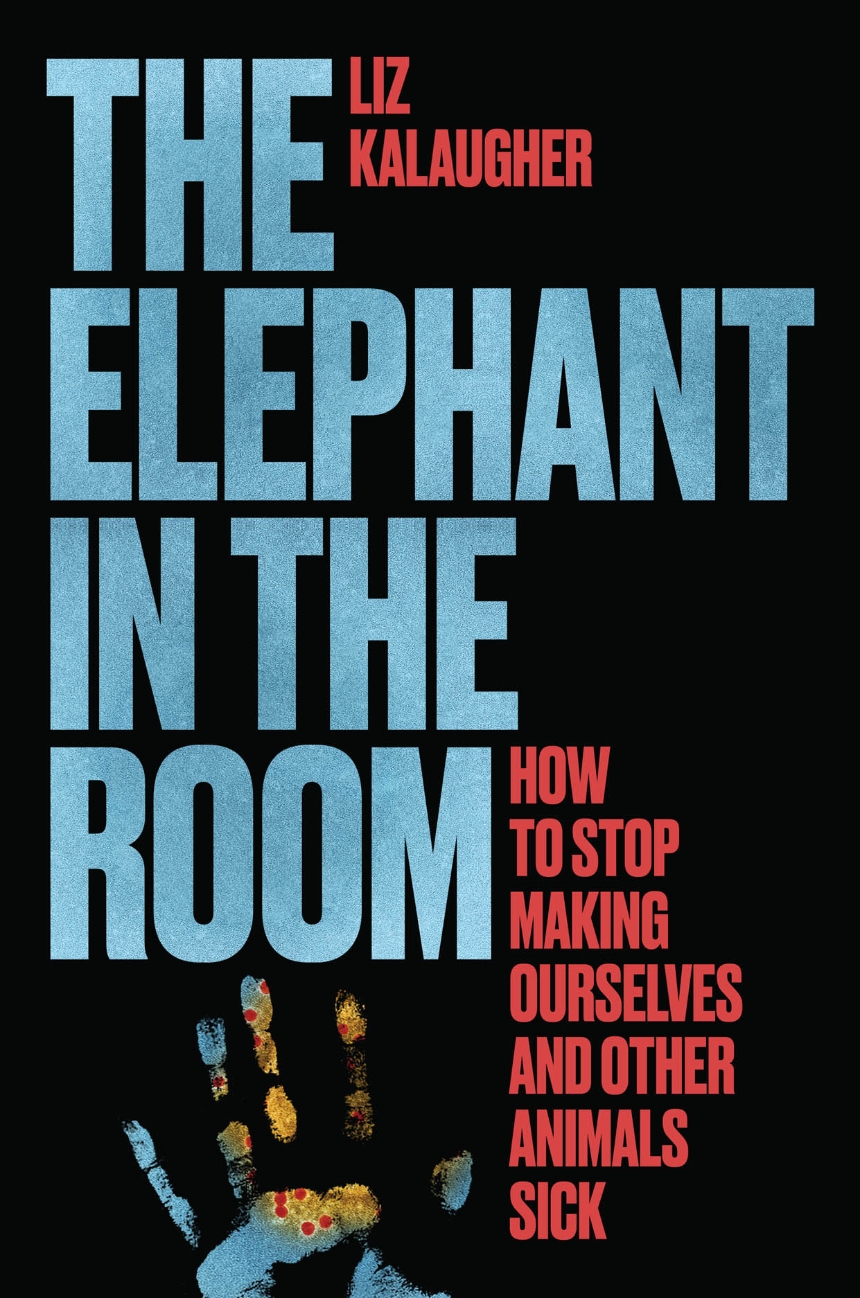
Liz Kalaugher's "The Elephant in the Room"

Liz Kalaugher is a science journalist and the coauthor of Furry Logic: The Physics of Animal Life. Her writing has appeared in BBC Focus magazine, the Guardian, New Scientist, and Physics World, among other outlets. She lives in Bristol, UK.

Kalaugher applied the “Page 99 Test” to her new book, The Elephant in the Room: How to Stop Making Ourselves and Other Animals Sick, and shared the following:
From page 99:
‘People take their dogs out and think it’s funny that they chase prairie dogs,’ says Fraser. ‘That may be entertaining but your dog may come home with a plague-infested flea. Why take that chance?’
It’s by chance, too, that Kimberly Fraser of the National Black-footed Ferret Conservation Center’s words fall on page 99 of The Elephant in the Room: How to Stop Making Ourselves and Other Animals Sick. They’re deep in the chapter about black-footed ferrets, which feed on prairie dogs and have been plagued - if you’ll excuse the pun - by not one but two diseases. So much so that these animals only survive thanks to a lucky find by a Wyoming farmer’s dog.

For this book I’d rate the Page 99 Test at six out of ten. As it’s near the end of a chapter, page 99 reveals ways people are counteracting some of our earlier damage to ferret health: by feeding prairie dogs peanut butter laced with plague vaccine, and releasing captive-bred ferrets into the wild. Almost every chapter finishes with solutions for the species it covers; the final chapter examines strategies for safeguarding the health of all animals, including ourselves. Also typical is the inclusion of interviews with experts, who tell us why they work with wildlife and what it’s like to be out in the field.

Because it’s focused on solutions, page 99 spends less time than other pages describing a wild animal and its habits, habitat and challenges, as well as less time detailing how humans inadvertently harmed that animal’s health. For the black-footed ferret, this harm began in the early 20th century when we transported the bacteria that cause plague to North America via a flea-infested rat onboard a ship from Hong Kong. Other chapters look at other ways that humans have exacerbated disease - farming, habitat loss, trade and climate change.

What’s more, the chapter around page 99 concerns a mammal whereas some of the others cover birds, frogs and, briefly, shellfish. When it comes to setting, page 99 is based in North America, whilst other stories trot the globe from Antarctica to the Arctic via Australia, South America, Europe and Asia.

In essence, page 99 gives a flavour of the book but not the whole taste.
Visit Liz Kalaugher's website.

The Page 99 Test: Furry Logic: The Physics of Animal Life by Matin Durrani and Liz Kalaugher.

--Marshal Zeringue

Wednesday, June 4, 2025

Bonnie Yochelson's "Too Good to Get Married"

Bonnie Yochelson is a former Curator of Prints and Photographs at the Museum of the City of New York and an established historian of New York City’s photographic history. Her notable works include Jacob A. Riis: Revealing New York’s Other Half, Alfred Stieglitz New York, and Berenice Abbott: Changing New York.

Yochelson applied the “Page 99 Test” to her new book, Too Good to Get Married: The Life and Photographs of Miss Alice Austen, and reported the following:
The top half of page 99 shows an 1893 self-portrait of Alice Austen. The caption reads, “When Alice left for the World’s Columbian Exposition in Chicago – the farthest she had been from home – she took a self-portrait with Punch [her dog].” The bottom half of the page describes the photographs she took at the Exposition, two of which are shown on page 100.

The Page 99 Test works very well for this book! The page features one of Austen’s many carefully considered self-portraits, and it demonstrates the key features of the book’s design: illustrations were placed in close relation to the relevant text, yet the descriptive captions allow the reader to follow the story independent of the text. The quality of the paper and the printing, which were subsidized, is also apparent.

As it happens, this photograph marks a major turning point in Austen’s life. The first full sentence on the page suggests as much: “The purposeful young woman in the smart traveling suit is a far cry from the feminine charmer in lace decollete and elbow length gloves of the previous summer.” In the 1880s, Austen was a social butterfly, playing tennis, and going swimming and boating, with a full social calendar of dances, concert, dinners and balls, both at home and on vacation. What she called “the larky life” was the primary subject of her photographs. As she and her friends approached 25 in 1890, the pleasure of these social rituals gave way to the expectation of marriage and children, a rocky road for most of them. At this point, Austen briefly took up the idea of professional photography, which she first attempted at the Chicago Exposition.
Visit Bonnie Yochelson's website.

--Marshal Zeringue

Tuesday, June 3, 2025

Matthew Hongoltz-Hetling's "The Ghost Lab"

Matthew Hongoltz-Hetling is a freelance journalist specializing in narrative features and investigative reporting. He has been named a finalist for the Pulitzer Prize, won a George Polk Award, and been voted Journalist of the Year by the Maine Press association, among numerous other honors. His work has appeared in Foreign Policy, USA Today, Popular Science, Atavist Magazine, Pulitzer Center on Crisis Reporting, the Associated Press, and elsewhere. His books include A Libertarian Walks into a Bear and If It Sounds Like a Quack....

Hongoltz-Hetling applied the “Page 99 Test” to his new book, The Ghost Lab: How Bigfoot Hunters, Mediums, and Alien Enthusiasts Are Wrecking Science, and shared the following:
Page 99 of The Ghost Lab opens with a discussion of the Betty and Barney Hill Case, one of the most famous alien abduction reports in American history. The top of the page includes some of the evidence that supported the Hills' claims"
There were also several tantalizingly physical pieces of evidence: circular shiny spots on the back of their car that caused a compass needle to go haywire; a pink powder and rips on Betty’s dress; scuffs on the top of Barney’s shoes, allegedly caused when he was dragged up the ramp of the spacecraft; and a star map that Betty drew from memory that bore a resemblance to an actual star system about which she had no knowledge.
But then I transition to some of the reasons that skeptics point to not believe the Hills encountered aliens, after which I summarize the little-known path the couple took after their famous encounter:
Betty came to believe that she could send mental messages to the aliens, and encourage them to pilot their craft to a specific location. A network of legitimate scientists and UFO enthusiasts formed around the Hills. They spent several nights at Betty’s family farm in Kingston, to see if aliens that Betty had invited would show up. They never did.
I then transition to a sympathetically-described scene about Barney's death at their New England home.

The Page 99 Test does shed some light on what readers who pick up The Ghost Lab can expect -- the book is chock full of weird and colorful tales of the paranormal told from an objective viewpoint that is respectful and sympathetic of the "experiencer," but doesn't shy from information that contradicts the veracity of their outlandish claims.

But the test would also lead a browser to walk away with some misunderstandings about the book. I have to admit that the prose on this particular page is fairly straightforward and businesslike; but the book as a whole is suffused with humor and a more dramatic writing style. It also gives the impression that the book is primarily some sort of history, when in reality it's a modern tale about a group of ghost hunters, psychics and alien abductees, presented with historical and cultural context.

I hope that The Ghost Lab will appeal to believers and skeptics alike; the main characters come together with a shared, noble quest to inject science into the paranormal fields that they've become so interested in. They spend 9 years having all sorts of fun and bizarre misadventures, including an undercover mission to liberate the ghosts being held in a former insane asylum, communicating with aliens aboard a UFO, and a hunt for Bigfoot on the forested mountains of New Hampshire.The characters are colorful and relatable, right up until the moment that they do something too strange to be believed. While I've better appreciated the value of the Page 99 Test on my first two books, this one fell a bit flat, suggesting a more sedate journey than the actual ride, which is wild.
Visit Matt Hongoltz-Hetling's website.

The Page 99 Test: If It Sounds Like a Quack....

--Marshal Zeringue

Monday, June 2, 2025

Aviva Briefel's "Ghosts and Things"

Aviva Briefel is Edward Little Professor of the English Language and Literature and Cinema Studies at Bowdoin College. She is the author of The Deceivers and The Racial Hand in the Victorian Imagination.

Briefel applied the "Page 99 Test" to her new book, Ghosts and Things: The Material Culture of Nineteenth-Century Spiritualism, with the following results:
I was relieved to find that page 99 captures the book as a whole: it introduces the concept of “exposure,” which I argue was essential to the cultures of Victorian spiritualism and skepticism. (Understandably, I had been somewhat nervous that my book itself would be exposed as failing the Page 99 Test.) One of the recurring themes of Ghosts and Things describes the complex interactions that occurred between those who adamantly believed that material objects could be used to communicate with ghosts during séances and those who were ready to expose spiritualists as frauds.

Page 99 initiates a discussion of how the concept of exposure was applied to the Davenport Brothers, American spiritualists who claimed to be able to interact with spirits by using a wooden cabinet. During their public séances, the brothers sat in the cabinet, which also contained a selection of musical instruments, and asked audience members to tie them with ropes and shut the doors. Spectators would witness spirit manifestations emanating from the closed cabinet, including musical instruments playing and spectral hands reaching out of the cabinet’s aperture. After a while, the doors to the cabinet swung open and the brothers could be seen, freed from their ropes, allegedly through the intervention of spirits. These feats led the Davenports to become renowned mediums in the United States and Britain. On page 99, I preview the various types of exposure that would befall the brothers a few months after journeying to England in 1865, both through the destruction of their cabinet during performances in Liverpool, Huddersfield, and Leeds, and through the appropriation of their trick by “anti-spiritualist” magicians who used their own versions of the cabinet to discredit the brothers.

Both of these strategies for exposing the Davenport Brothers reveal the tenuousness of the term “exposure” itself. When an angry audience rushed the stage and destroyed the cabinet on February 15, 1865, at St. George’s Hall in Liverpool, they did not find any hidden mechanisms or tricks. And yet, newspaper headlines announced the “Defeat and Exposure of the Davenport Brothers,” raising the question of what exposure without proof of fraud might mean. Given that the Davenports’ humiliation emphasized the breaking of the cabinet, does the term take on other meanings, such as an “exposure” to the elements? Or does it represent a loss of value through an unpackaging, not dissimilar to what happens now to action figures or dolls when taken out of their original containers? Likewise, the repetition of the Davenports’ acts by anti-Spiritualists such as Jean-Eugène Robert-Houdin and John Nevil Maskelyne also signal the instability of the idea of exposure. The replication of cabinets on stages throughout Europe and the United States blurred the line between homage and parody, as well as between the role of skeptics and believers in spiritualism, one of the main claims of my book.

In the rest of the chapter, I discuss the ways in which the Davenports themselves might have eventually been subject to yet another form of exposure. I contend that it is possible they borrowed their act from Henry Box Brown, who famously escaped from enslavement in March 1849 by arranging to have himself shipped in a wooden container from Richmond to Philadelphia. He subsequently went on to reenact this feat in front of audiences, including in England, when in May 1851, he traveled in his original box by from Bradford to Leeds, to the acclaim of large audiences. He later undertook his own anti-Spiritualist performances, seeking to expose the Davenport Brothers, which I argue might point to another meaning of exposure, this time of the brothers’ secretive adoption of a “gimmick” that Brown himself had devised. The dizzying significations of the term “exposure” are one example of the ways in which spiritualism offered new terminologies for grasping the visible and invisible worlds of Victorian culture.
Learn more about Ghosts and Things at the Cornell University Press website.

--Marshal Zeringue

Saturday, May 31, 2025

Catherine Hartmann's "Making the Invisible Real"

Catherine Hartmann is Assistant Professor of Religious Studies in the Department of Philosophy and Religious Studies at the University of Wyoming. She primarily works on the intellectual history of Tibetan pilgrimage, and also writes about karma, Buddhist ethics, and Buddhist approaches to addiction and recovery.

Hartmann applied the “Page 99 Test” to her new book, Making the Invisible Real: Practices of Seeing in Tibetan Pilgrimage, and reported the following:
Readers who open Making the Invisible Real: Practices of Seeing in Tibetan Pilgrimage to page 99 will learn about a 17th century Tibetan Buddhist author named Chökyi Drakpa, whose Guidebook to Gyangme: Vajradhāra's Feast is the focus of that chapter. Page 99 attempts to establish a date of composition for the text and gives background on the author and affiliation with the Drikung Kagyu school of Tibetan Buddhism.

Readers of page 99 might worry that the whole book is going to be boring and technical, but the rest of the chapter analyzes Vajradhāra's Feast itself, which narrates Chökyi Drakpa's adventures "opening the doors" of a holy mountain. According to Tibetan Buddhist pilgrimage tradition, holy mountains like Gyangme possess great numinous power, but this attracts fierce demons who try to keep the "doors" to the mountain closed to outsiders. To "open" the mountain and make it safe for pilgrims, a powerful master (the "vajradhāra" of the text's title) must go to the mountain, interpret the mysterious geomantic signs, defeat the demons with tantric magic, and obtain a vision of the mountain's true identity as a mandala–a holy palace for a tantric Buddha. Vajradhāra's Feast is Chökyi Drakpa's claim to have done all this and lived to tell the tale.

The book explores this and many other texts about Tibetan pilgrimage to holy mountains, such as advice texts, guidebooks, philosophical debates, diaries, and founding accounts. I'm interested in the goal that they share: transforming pilgrims' perception of the holy mountain. These texts tell pilgrims to overcome their ordinary perception of the mountain as rocks and snow and instead learn to see it as a divine mandala. Transforming perception is a difficult goal! The tradition knows that, and so I examine the methods the Tibetan pilgrimage tradition has developed to try and overcome these difficulties and learn to see the ordinarily invisible realities.

This may seem like a niche concern, but religious traditions from many times and places have shared similar goals of learning to perceive ordinarily invisible beings or realities. My book hopes to help us understand how that works.

I would say that my book fails the Page 99 Test in that page 99 deals with boring historical dating and doesn't give much sense of the overall flavor or argument of the book, but you wouldn't want a history book without all the dull legwork!
Visit Kate Hartmann's website.

--Marshal Zeringue

Friday, May 30, 2025

A. Tunç Şen's "Forgotten Experts"

A. Tunç Şen is Assistant Professor of History at Columbia University.

He applied the “Page 99 Test” to his new book, Forgotten Experts: Astrologers, Science, and Authority in the Ottoman Empire, 1450–1600, and shared the following:
From page 99:
Rukn al-Amuli contends that the astrolabe is the best instrument for executing these astronomical operations, which are essential for casting horoscopes and practicing electional astrology. He nonetheless posits that this craft, along with the mathematical sciences more broadly, is a type of intellectual endeavor that cannot flourish without “the support of rulers and statesmen.” For the past twenty years—since he completed his zij (astronomical handbook with tables) and another treatise on the celestial globe that has yet to be discovered—Rukn al-Amuli laments that he has been bereft of royal support. Notwithstanding possible exaggeration as a plea to his new patron, Abu’l-Qasim Babur Mirza (d. 1457), the Timurid ruler in Khurasan, to whom he dedicates his treatise on the astrolabe, al-Amuli’s life over the past two decades seems to have devolved into an unmitigated disaster. He details a series of afflictions that beset him, not the least of which was his prolonged separation from loved ones and constant relocations to distant places. More recently, his odyssey took him to India and Kerman, during which he was plagued by political turmoil, massacres, and famine.
The Page 99 Test works intriguingly well for my book, which traces the lives of several astral experts—known as munajjims—from the Ottoman and broader Persianate worlds of the fifteenth and sixteenth centuries. These experts shared similar life trajectories: they were well versed in mathematical and astral sciences, constantly sought the patronage of powerful figures, asserted their intellectual superiority over peers and rivals, and offered vital services to audiences eager for interpretations of the heavens. Yet despite their enduring presence and significant contributions, they were largely forgotten—not only in modern times, but even in their own.

There are various reasons why they fell into oblivion. Their expertise over the workings of the heavens is perhaps best characterized by its ambivalent nature. It was a kind of expertise both transmitted and omitted, prized and stigmatized. Munajjims demonstrated technical proficiency in the mathematical sciences, astronomical knowledge, and astrological techniques but were often criticized, even caricatured—both in the medieval and early modern periods and in contemporary times—as simpletons lacking reliable bodies of knowledge. The knowledge required to practice their profession, especially as related to astrology, was text-centered and openly circulated, yet it was not commonly taught within the formal educational institutions of madrasas. While munajjims’ services—such as calculating auspicious hours, casting horoscopes, producing annual almanacs, and providing on-site astrological counsel—appealed to royals and the general public alike, they also faced skepticism from various segments of society, and sometimes even harbored their own doubts about the limitations of their science. Finally, munajjims were not the sole experts in the domain of predicting the future. They operated alongside, and sometimes in competition with, other figures—so-called occult practitioners or masters of esoteric arts—such as dream interpreters, geomancers, experts in the science of lettrism, and mystics claiming to possess mantic powers, whose authority relied upon distinct bodies of knowledge and hence occasionally came into conflict with munajjims’ expertise.
Learn more about Forgotten Experts at the Stanford University Press website.

--Marshal Zeringue

Thursday, May 29, 2025

Michael Gubser's "Their Future"

Michael Gubser is professor of history at James Madison University. He has published three books on European intellectual history and international development.

Gubser applied the "Page 99 Test" to his new book, Their Future: A History of Ahistoricism in International Development, with the following results:
The ninety-ninth page of my new book Their Future: A History of Ahistoricism in International Development provides an interesting angle on the whole work, but I think it suggests that the book is more persistently theoretical than is in fact the case. It occurs early in the fourth chapter, which is entitled “The History Wars.” The chapter discusses two major mid-century development theories: modernization theory, which emerged in the United States, and structuralism, pioneered in Latin America. In particular, page 99 summarizes one of the most famous theories in the recent history of development: Walt Rostow’s Five Stages of Economic Development (1960). Drawing on the history of Western industrialization, Rostow argued that the evolution from traditional agrarian societies to the modern industrial ones always passed through the same five historical stages. Unless they were somehow stalled along the way (by, for example, a war or a communist takeover), all developing societies would follow the path blazed by the West and would eventually come to resemble the modern USA. Thus, while his five-stage model was a historical theory, it denied the value and relevance of actual historical experiences outside Europe and the US – and even Western history was radically simplified into a five-step schema. I call this approach historical ahistoricism – the use of an abstract history to deny the detail and variety of actual histories. The suppression of local history and experience is a central theme of my book. Rostow himself went on to advise John F. Kennedy and support the Vietnam War, partly in the name of modernization. And his modernization theory was revived and updated at the end of the Cold War by Francis Fukuyama in a famous article on the end of history.

But Their Future discusses more than theories of development. It also examines development projects and practices in several countries and continents, most notably Guatemala, Zambia, and Bangladesh. So the page 99 focus on a key economic development theory accurately reflects parts of my analysis, but it misses the book’s geographic range as well as the many discussions of local projects and histories around the globe.
Learn more about Their Future at the Yale University Press website.

--Marshal Zeringue

Wednesday, May 28, 2025

Andrew Hartman's "Karl Marx in America"

Andrew Hartman is professor of history at Illinois State University. He is the author of A War for the Soul of America: A History of the Culture Wars and Education and the Cold War: The Battle for the American School. He is also the coeditor of American Labyrinth: Intellectual History for Complicated Times.

Hartman applied the “Page 99 Test” to his new book, Karl Marx in America, and reported the following:
From page 99:
… course, since the AFL had the most to lose to it. But even some within SLP ranks condemned the strategy.

A group of SLP dissidents led by Morris Hillquit revolted in 1899. These “kangaroos,” as DeLeon loyalists nicknamed them—a nineteenth-century political term of derision for a crook—opposed both dual unionism and DeLeon’s regime. At the annual SLP meeting, the kangaroos attempted to take physical possession of the party’s printing press. A brawl broke out, but the Hillquit group failed to dislodge the DeLeon stalwarts. The rebels then took the matter to court, where they sued for the name and property of the SLP, only to lose. DeLeon maintained control, but he and the party were damaged by this schism. DeLeon and the SLP fell from their perch atop the socialist movement, replaced by Eugene Debs and the Socialist Party of America that formed in 1901.

Eugene Debs and the Socialist Party

If anyone in history personifies American Marxism, it is Eugene Victor Debs. He rallied more Americans to the cause of class struggle than anyone else. Yet Debs was not always a fire-breathing class warrior. The Indiana-born revolutionary started his political career promoting the idea of a “grand cooperative scheme” that would allow people to “work together in harmony in every branch of industry.” Rather than a working-class struggle over the means of production, the young Debs called for the creation of utopian colonies modeled on a Christian vision of a city on a hill. The future of socialism, for him at the time, lay in the vision imagined by Robert Owen. Debs believed that a rapacious form of capitalism had betrayed the spirit of brotherhood—a spirit that had long animated Americans—and that the moral example set by the utopian community would help convince others to live up to their highest ideals.

Sinclair Lewis called Debs the John the Baptist of American socialism. Daniel Bell described him as “the man whose gentleness and…
Page 99 of Karl Marx in America does indeed convey something central to the book, where I argue that Marx’s thought was more important in shaping American political discourse than most people realize. Page 99 is part of Chapter Two—“Working Class Hero”—about how the militant labor and socialist movements of the Gilded Age took up Marx as inspiration and as strategic guide to fighting against the emergent industrial and corporate capitalism that had taken shape in the United States and had made the lives of millions of workers pretty miserable.

Page 99 represents a transition in the chapter from discussing the Socialist Labor Party (SLP) led by the explicitly Marxist Daniel DeLeon, which ultimately failed to capture the hearts and minds of most radical workers, to discussing the Socialist Party of America led by the incomparable Eugene Debs. Although Debs, much more so than DeLeon, was immersed in longstanding American political traditions like Christianity, republicanism, and populism, his experience with the labor movement and even more so, capital’s repression of the labor movement, made him more amenable to Marx’s ideas. And when he read Marx while in prison in 1894, he was converted to Marxism and took American socialism down the Marxist road. The Gilded Age was thus one of what I call the "Marx booms," periods in US History when lots of Americans read the bearded communist philosopher favorably.

The book consists of nine chapters, chronologically ordered from the US Civil War to the present, which dig deep into how Marx interpreted the United States (the focus of Chapter One—“American Revolutionary”) and even more so, about how Marx’s ideas came into contact with people working out political problems in America. Out of what might be called “the Marx-America dialectic,” three distinct versions of Marx emerged: the Marx who famously centered labor as the driving force of value in a capitalist society; the Marx whose ideas mixed with other American political traditions to form hybrid political tendencies; and the Marx whose repulsive theories helped liberals and conservatives work out their own ideas about America.
Learn more about Karl Marx in America at the University of Chicago Press website.

The Page 99 Test: A War for the Soul of America.

--Marshal Zeringue

Tuesday, May 27, 2025

Frank Krutnik's "Thrillers, Chillers, and Killers"

Frank Krutnik is an emeritus reader in film studies at the University of Sussex in Brighton. His publications include Popular Film and Television Comedy; In a Lonely Street: Film Noir, Genre, Masculinity; and Inventing Jerry Lewis; and he is coeditor of Un-American Hollywood: Politics and Film in the Blacklist Era.

Krutnik applied the “Page 99 Test” to his new book, Thrillers, Chillers, and Killers: Radio and Film Noir, and shared the following:
Page 99 concludes the chapter “The Transmedial Seriality of Michael Shayne #1: From Book to Film”. The page wraps up the discussion of the low-budget B-film series in which the Producers Releasing Corporation (PRC) cast Hugh Marlowe as Brett Halliday’s private eye Michael Shayne. Even though reviewers complained that the PRC series was hampered by budgetary restrictions, with verbal exposition often substituting for dramatized action, these films were more faithful to Halliday’s version of Michael Shayne than the earlier Twentieth Century-Fox series, in which Lloyd Nolan took a broadly comic approach to Shayne.

The final paragraph summarizes the differences between these two film series and the common conception of what a film noir is and does. These series films “are modest in their budgets and their ambitions, never engaging seriously with the implications of the murderous activities their detectives investigate”. Unlike many cherished noir movies, they avoid complex storytelling strategies or an emphasis on the ‘fallen world’ of American modernity. Even so, such B-film series performed a valuable role in contributing to double-feature programming and the studios’ obligation to theatre owners, as well as representing “significant developments in the Michael Shayne media franchise”. At the same time as audiences were able to watch the PRC films in cinemas, they could also listen to the detective’s adventures on the radio, courtesy of a popular series from the Mutual Broadcasting System, as well as engaging with Halliday’s ongoing book series. The various media “produced widely differing versions of Shayne, but they were recognizable iterations of an established cultural figure, the hard-boiled private eye, that had achieved substantial familiarity across U.S. popular culture by the late 1940s”

The Page 99 Test does not really provide a successful snapshot of the book as a whole. It certainly illustrates one of its key themes - the questioning of conventional approaches to (film) noir - but there is no mention of the central topic of radio drama. It is the following chapter that examines in detail the various appearances of Michael Shayne on the airwaves, including a convincingly noir approach to the detective by Jeff Chandler.
Visit Frank Krutnik's website.

--Marshal Zeringue