Showing posts sorted by date for query Wright. Sort by relevance Show all posts

Monday, June 16, 2025

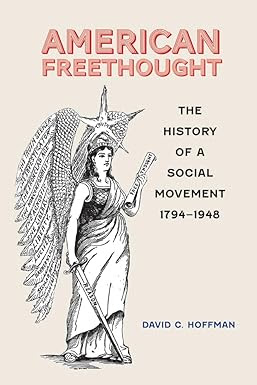
David C. Hoffman's "American Freethought"

David C. Hoffman is an associate professor in the Marxe School of Public and International Affairs at the City University of New York.

He applied the “Page 99 Test” to his new book, American Freethought: The History of a Social Movement, 1794–1948, and reported the following:
Page 99 of American Freethought takes readers right to the heart of the book’s subject matter. It begins a section devoted to a freethinking feminist named Frances Wright who lived from 1795 to 1852. The section is titled, “Frances Wright: Utopian Abolitionist and Apostle of Science.” It opens,
Frances Wright was one of the most luminous of the British activists who immigrated to the United States in the early nineteenth century. She is honored today as a pioneering feminist and abolitionist who was the first woman to go on a public speaking tour in America, but she also should be remembered for carrying forward [Thomas] Paine’s vision for science by promoting secular scientific education for both women and men.
By way of background, the revolutionary pamphleteer Thomas Paine, whose Common Sense set America on the path to independence, argued that science rather than traditional religion should be the common pursuit that unites a free republic. Wright promoted this idea in her public lectures, urging her followers to establish “Halls of Science,” where a free scientific education would be available to all regardless of gender or social standing.

I am glad to have the opportunity to introduce the readers of the Page 99 Test to Frances Wright, who was a major figure in the freethought, abolitionist, and feminist movements of the early nineteenth century that is all but forgotten today. In the 1820s she invented and pursued a workable scheme for ending slavery in the United States that might have changed the course of history if it had not been brought down by lack of funding and an outbreak of malaria. Wright’s collected works should have a place on the shelf of Penguin Classics next to her mentor Jeremy Bentham, but there is no modern edition of them in any series.

Wright is just one of the many freethinking women and men that readers will encounter on the pages of American Freethought. Among the others are Ernestine Rose, the atheistic daughter of a Polish rabbi who led efforts to establish married women’s property right in New York State; Frances Ellingwood Abbott, a radical Unitarian whose “Nine Demands of Liberalism” ignited the revival of American freethought after the civil war; Ida Craddock, a fervent spiritualist who was persecuted for writing a sex manual; and Queen Silver, a precocious child whose first public lecture in defense of atheism was given at the age of ten in the 1920s. These are some of the many characters in American history who have contributed to the freethought movement’s defense of every American’s right to believe or disbelieve by the light of their own conscience without state interference.
Learn more about American Freethought at the Johns Hopkins University Press website.

--Marshal Zeringue

Sunday, June 8, 2025

Deborah Mutnick's "No Race, No Country"

Deborah Mutnick is professor of English at Long Island University.

She applied the “Page 99 Test” to her new book, No Race, No Country: The Politics and Poetics of Richard Wright, and shared the following:
I love Ford Madox Ford’s theory of opening a book to page ninety-nine to find the quality of the whole revealed. Of course, I had no idea what would be on page 99 of my recently published book until I looked. Ford is right, at least about No Race, No Country: The Politics and Poetics of Richard Wright, except that I have to start with the sentence on page 98, which continues onto 99: “As he recounts in Black Boy, he stayed up all night to read issues of the New Masses after his first visit to the John Reed Club in 1933 and woke up to write ‘I Have Seen Black Hands,’ expressing the core principle in interracial, working-class solidarity that would guide him throughout his life, even when he chafed against it.” I then cite this stanza from the poem:
I am black and I have seen black hands
Raised in fists of revolt, side by side with the white fists of white workers.
And some day—and it is only this which sustains me—
Some day there shall be millions and millions of them,
On some red day in a burst of fists on a new horizon!
Then comes a section break with the subtitle, “The Marxist Threads of Wright’s Sociology,” in which I contest the idea that Wright appropriated the sociological perspective of the Chicago school of urban sociology, according to literary scholar Carla Cappetti, thus attesting to the “1930s dying movement” of US Communism (40). To the contrary, not only did sociology during the Cold War fall into line with US policy to equate communism with totalitarianism and fascism, a perspective Wright explored and ultimately rejected in his 1953 novel The Outsider, but also the resurgence of Marxist sociology in the 1960s countered that narrative with a critique that he would have shared. For Wright, who remained a Marxist for the rest of his life, the Chicago school of sociology offered useful tools of inquiry, but as was always the case with him, he approached them critically, taking what he needed to pursue his own quest for a more just, egalitarian world.
Learn more about No Race, No Country at the University of North Carolina Press website.

--Marshal Zeringue

Tuesday, March 4, 2025

Daniel J. Mallinson and A. Lee Hannah's "Green Rush"

Daniel J. Mallinson is Associate Professor of Public Policy and Administration at Pennsylvania State University, Harrisburg. A. Lee Hannah is Professor of Political Science at Wright State University. Their research on the politics and policy of state medical cannabis programs has been published in a several scholarly journals, including Public Administration Review.

Mallinson and Hannah applied the “Page 99 Test” to their latest book, Green Rush: The Rise of Medical Marijuana in the United States, and reported the following:
Browsers who open our book to page 99 will see an overview of what constitutes a comprehensive state medical marijuana program. The concept “comprehensive” is critical to our work in many ways. Fundamentally, it means that a state has decriminalized the sale and possession of medical cannabis by licensed business and patients, respectively. There is a method for patients to obtain access to state-legal medical cannabis and it is broadly available. Additionally, comprehensive programs have oversight on production and dispensing, as well as providers and patients.

The figure on this page provides a 30,000-foot view of the complexity of medical marijuana programs. Due to federal prohibition of marijuana, each state must stand up a distribution system that can go from “seed” to “sale.” Thus, each aspect of marijuana production from cultivation, to processing, to retail must be developed within each state. The Page 99 Test captures a critical argument in our book that you cannot understand the expansion of legitimization of medical marijuana without focusing on the states.

Green Rush tells this story and puts forward the states as the primary drivers of cannabis liberalization and broader drug policy reform in the U.S. It is structured around four stages of the policy process: agenda setting, adoption, implementation, and feedback. This gives the readers a thorough understanding of how and why medical cannabis policy emerged and spread across 38 American states and the effects it has had on governments and patients.
Learn more about Green Rush at the NYU Press website.

--Marshal Zeringue

Thursday, November 7, 2024

Andrea Wright's "Unruly Labor"

Andrea Wright is the Class of 1952 Distinguished Associate Professor of Anthropology and Asian & Middle Eastern Studies at William & Mary. She is the author of Between Dreams and Ghosts: Indian Migration and Middle Eastern Oil (2021).

Wright applied the "Page 99 Test" to her new book, Unruly Labor: A History of Oil in the Arabian Sea, and reported the following:
Unruly Labor is a history of the oil industry in the Arabian Sea that centers the workers who built and maintained the industry. Looking at the 1930s through 1960s, each chapter of the book begins with strikes by both mobile and local workers and considers what factors influenced worker strikes and solidarities. Unruly Labor also examines how oil companies and governments responded to these strikes. This examination demonstrates how oil became increasingly connected to national security and how this connection between oil and national security negatively impacted workers’ ability to unionize and go on strike.

Page 99 of Unruly Labor is located in the middle of Chapter 4: “Shaping Nationalism Outside of the Nation-State.” This chapter examines a hunger strike that Indian workers who were building an oil refinery in Aden went on in the early 1950s. The page describes workers complaints of religious discrimination against Hindus by oil company managers, including allegations that Hindus were not hired to work at this project due to their religion. This page also discusses both oil companies’ and the Indian government’s response to these claims. The page begins:
Accusations of religious discrimination were effective in mobilizing action by the Indian government, and the government halted the recruitment of Indians for the Aden construction project based on these allegations. As government officials investigated claims of religious discrimination, Indian bureaucrats considered citizens not as a homogenous category, but within the specificity of India’s demography. Religion was a critical category for both oil companies and the Indian government, and government responses were informed by two seemingly competing views of India as a secular state and as a Hindu nation.
Regarding the Page 99 Test, this page provides a good introduction to the book, but it only partially conveys the book’s main ideas. It reflects the book’s focus on the interactions among oil companies, workers, and governments. In addition, this page highlights that citizenship is critical concept in the book, and the reader is introduced to the importance of citizenship in determining the efficacy of worker action. However, page 99 does not present some of the other key concepts in the book, and it does not reflect the book’s focus on how the racialized labor hierarchies of the Arabian Peninsula came into being.
Learn more about Unruly Labor at the Stanford University Press website.

--Marshal Zeringue

Tuesday, July 23, 2024

Menika B. Dirkson's "Hope and Struggle in the Policed City"

Menika B. Dirkson is Assistant Professor of African American History at Morgan State University.

She applied the "Page 99 Test" to her new book, Hope and Struggle in the Policed City: Black Criminalization and Resistance in Philadelphia, and reported the following:
From page 99:
“If my boy did this, if he helped kill that man . . . he’ll have to pay the price.”

Based on the interviews Graham, Peters, Porter, and Thomas conducted, the potential causes for the boys’ crime were complex. All the youths appeared to have come from decent homes, and their relatives often characterized them as well-mannered, occupied with school and sports, and willing to work to have money in their pockets. However, there were some internal and external socioeconomic factors that made their personal lives unstable. Harry and Edward McCloud came from a two-parent household they shared with their three younger sisters in a six-bedroom rowhome, but their father was unemployed. James Wright, who lived with hismother and four younger brothers, received a “church upbringing” in his household and had dreams of becoming a professional football player. However, Wright’s parents had separated three years prior, his family was on welfare because his mother was unable to work, and he recently failed several courses at Overbrook High School, which jeopardized his opportunity to graduate and become a professional athlete. Lonnie Collins and Harold Johnson came from broken nuclear families with an absent mother and a deceased father, respectively; regularly sought out employment to meet their financial needs; and were known to hang out with the “wrong crowd of boys” despite their parents and guardians’ advice to stay away from gangs. Although Collins and Johnson’s families explained that the youths had access to money for their “pocket” through employment or a one-time allowance, the Tribune alluded that the boys were financially frustrated because Collins had recently been laid off from his job at a grocery store while Johnson had to wait nearly a week to return to his summer job in Atlantic City. Nevertheless, by detailing these accounts of familial and financial turmoil, the Tribune journalists provided its readers with the sociological factors that possibly influenced the boys to commit the crime. Overall, the Tribune staff writers agreed with the general public that the murder of In-Ho Oh was “brutal” and tragic, but their article sought to humanize the boys amid incessant media reports that focused on the “bestiality” and “viciousness of the crime.”
If anyone were to read page 99 of my book, they would find an excerpt about the 1958 tragic robbery-murder of University of Pennsylvania graduate student In-Ho Oh by eleven black teenagers in West Philadelphia. This excerpt provides a good idea of what the entire book entails because it is one of many cases of poverty-induced crime that occurred in Philadelphia from the 1950s through the 1970s. Criminal cases involving black youth, particularly those who appeared to be gang-affiliated, often provoked a media blitz along with increased municipal funding for tough on crime policing rather than poverty alleviation. Throughout my book, I offer historical and sociological analyses of poverty-induced crimes like this one to argue that the perceived high rate of black crime that some journalists, police, city officials, and everyday citizens frame as a moral panic is not a result of racial inferiority, but generations of social ostracism (like racism and classism) along with a lack of access to decent employment, housing, education, and recreation necessary for a good quality of life. While some people in power promoted the idea of more government spending on police and prisons, there were community activists, social workers, former gang members, teachers, and even a few police officers who resisted this approach and operated anti-gang and anti-poverty organizations that offered black youth and adults the resources they needed to survive, including therapy sessions, mentorship, and job training, to steer them away from delinquency and crime and direct them to a life with a positive future. Ultimately, my book seeks to convince readers that there are non-violent and non-carceral approaches to solving poverty-induced crime and juvenile delinquency. For nearly a century, everyday Philadelphians have established settlement houses, gun violence prevention programs, and everything in between to curb crime when government-funded social welfare has been inadequate. This book highlights a communal struggle to prove that consistent and adequate government spending on schools, housing, and recreation are essential to reducing poverty and crime.
Learn more about Hope and Struggle in the Policed City at the NYU Press website.

--Marshal Zeringue

Friday, June 2, 2023

Jerry Emory's "George Meléndez Wright"

With four decades of conservation experience, Jerry Emory has written dozens of articles on the environment and science with a focus on Latin America and the Western United States. His books include San Francisco Bay Shoreline Guide and Monterey Bay Shoreline Guide.

Emory applied the “Page 99 Test” to his new book, George Meléndez Wright: The Fight for Wildlife and Wilderness in the National Parks, and reported the following:
Page 99 of George Meléndez Wright: The Fight for Wildlife and Wilderness in the National Parks not only announces the birth of Wright’s second daughter, but it also has a poignant quote mid-page, and then introduces a key issue he and his wildlife team worked on in the early 1930s in the western National Parks.

The page gives a clear, yet partial, snapshot of the book, covering some central themes, but by no means all. It highlights his family, which was very important to Wright. It displays his writing. And, the page ends with the topic of overgrazing in the parks.

Wright lost both of his parents by the time he was 8, and his brothers were sent to El Salvador to be raised. Wright was adopted by an elderly great aunt and stayed in San Francisco. “Auntie” died when he was 24, and Wright wanted to create his own family. His marriage, and the births of his two daughters, were monumental events for him. Wright died tragically at 31, but his young family eventually thrived and kept his memory alive.

The Wright quote demonstrates his close friendship with colleague Ben Thompson. Wright penned a note to an acquaintance in Yosemite lamenting the fact that he, Wright, couldn’t be in the field. “But next to being there myself it is nearly the same having Ben there,” he wrote. “We think and work so nearly along the same lines that it is like one person divided.”

Wright, Thompson, and another colleague, Joseph Dixon—all from U.C. Berkeley—were ground-breaking biologists in the Park Service in the 1930s. Wright created a Wildlife Survey for the western National Parks in order to introduce science-based management into the parks. At the time, feeding bears garbage for “shows” was common. Ramshackle zoos were kept by some parks, and large animals were corralled for easy viewing by visitors. Hundreds of thousands of predators had been killed in and around the parks by the government between 1916 and 1930, including over 8,300 wolves and 325,000 coyotes. Wright wanted to end that practice. The national parks were out of balance, and Wright knew it. Another major management problem, introduced on page 99, was overgrazing. Countless sheep and cattle were allowed to roam in the parks untethered. Wright’s effort to address all of these issues, and more, were mostly successful, though many persist to this day.
Visit Jerry Emory's website.

--Marshal Zeringue

Tuesday, December 27, 2022

Heather Gautney's "The New Power Elite"

Heather Gautney is Associate Professor of Sociology at Fordham University. She has written and edited books, opinion essays, and academic articles on US politics, social movements, social inequality, and workforce issues in the entertainment industry. Gautney was a senior policy advisor to Sen. Bernie Sanders on his presidential campaign and in the US Senate Budget Committee. In 2020, she served on the Democratic Party's platform drafting committee and was co-chair of the Biden-Sanders Task Force on Education.

Gautney applied the "Page 99 Test" to her new book, The New Power Elite, and reported the following:
Page 99 of The New Power Elite recounts the Bill Clinton administration’s NATO-led “humanitarian intervention” in Kosovo, and UN “peacekeeping” in Somalia, in discussing how American and other western political and corporate elites have used militarism—including the mass air-bombing of civilian targets—to realize their interests under the pretense of “just war” and “human security.” Does page 99 epitomize the entire book? The answer is both yes and no.

On the one hand, the contents of page 99 exemplify the book’s general tone and historical approach by offering evidence and insight into the brutal, violent face of global capitalism and power elites’ wanton profiteering through repression and social control. On the other hand, it is not the most compelling example of these trends. Following page 99 is a history of U.S. militarism that covers George W. Bush’s exploitation of the 9/11 tragedy to enrich defense contractors vis-à-vis his War on Terror (including the CIA’s sadistic torture program); Obama’s proliferation of apocalyptic drone strikes to “secure” the Middle East (including the assassination of U.S. citizens abroad); Trump’s corrupt arms dealing and “diplomacy” with right-wing forces; and Biden’s continuation of secret drone strikes and profligate arms dealing and defense spending. Put together, this history attests to the greed and cruelty of the American empire; the antidemocratic consolidation of executive power in the U.S. government; and mass manipulation by the corporate media.

The New Power Elite is a sequel to C. Wright Mills’s classic text, The Power Elite, written in the early years of the Cold War. Mills was troubled by the advance of nuclear weaponry and the fact that high-stakes decisions affecting the future of human and planetary life lay in the hands of “irresponsible elites.” America’s obsession with communism, he argued, was the work of “crackpot realists” who had created “a paranoid reality all their own” to justify their abuses of power and many atrocities. The New Power Elite takes up this critique by exposing how, over the last forty years, a new generation of crackpot realists—proffering a view of foreign policy that reduces all human relations to capitalist competition and maximizing profits—are inventing their own paranoid reality to legitimize torture, secret wars, and repression. Like Mills’s book, moreover, it is an urgent call to democratic action and stark warning against the dangers of elite power.
Follow Heather Gautney on Twitter.

--Marshal Zeringue

Saturday, September 24, 2022

Remica Bingham-Risher's "Soul Culture"

Remica Bingham-Risher, a native of Phoenix, Arizona, is an alumna of Old Dominion University and Bennington College. She is a Cave Canem fellow and Affrilachian Poet. Among other journals, her work has been published in the New York Times, the Writer’s Chronicle, New Letters, Callaloo and Essence. She is the author of Conversion (2006) winner of the Naomi Long Madgett Poetry Award, What We Ask of Flesh (2013) shortlisted for the Hurston/Wright Award, and Starlight & Error (2017) winner of the Diode Editions Book Award. She is currently the Director of Quality Enhancement Plan Initiatives at Old Dominion University and resides in Norfolk, VA with her husband and children.

Bingham-Risher applied the Page 99 Test to her newest work, and first book of prose, Soul Culture: Black Poets, Books and Questions that Grew Me Up, reported the following:
On page 99 of Soul Culture, we’re a few pages into an essay, “Girls Loving Beyoncé and Their Names” about what I learned from the poet Forrest Hamer, how Beyoncé became a bridge connecting me and my daughter and how we should all take care to listen to the in-between. We're also, almost to the page, at the exact halfway point in the book. Here’s a passage found there:
Sonsoréa was a lot more like I might have been after my parents divorced, if either had chosen to remarry. Respectful, kind enough, but on guard always. Like her, I, too, was wary of love in real life—not the kind New Edition told me was possible, but the falling-apart kind that was unbearable if people who were supposed to be grown up, responsible, didn’t actually know everything, even ruined things, barely listening to us or each other. At thirteen, my parents split up, I was the best soloist in middle school choir, and I met Sonsoréa’s father, years before she was ever imagined.
The Page 69 Test works remarkably well for Soul Culture. I was a little shocked at how each of the recurring threads of the book—talking with a particular Black poet I interviewed, ruminating on what I learned from being in their orbit and studying their work, how all my different identities blended together at home or on the page and even some of the hybridity of the work i.e. portraits, footnotes, Q and A exchanges, etc.—all showed up on page 99.

On one hand (and still in my heart of hearts), Soul Culture is my love letter to the elder poets who helped me figure out my own path as a writer. On the other hand, it’s a snapshot of my life, my growing into myself with the help of family, friends, and innumerable good books. On page 99, I am trying to figure out how to be a mother to children I’ve inherited and I’m beginning to wonder what it means when our parents create us and pull our names (and lives it seems) out of thin air. It’s miraculous really, our coming to be, and all the things we’ll desire for ourselves outside of what others have made for us make up the big questions of our lives. Every time I put pen to page, I’m really just trying to articulate a question I have about the world. In the intro to Soul Culture, I explain: “The enduring question I ask daily—when writing, when watching the news, when praying—about Black folks is: How is it possible we’ve survived? Soul culture is rooted in deep pain, longing, and incessant innovation, so this book is about singular experiences illumined by memory, mortar made possible by genius, grit, mother-wit, and sleight of hand.”
Visit Remica Bingham-Risher's website.

--Marshal Zeringue

Tuesday, December 15, 2020

Ben Wright's "Bonds of Salvation"

Ben Wright is an assistant professor of historical studies at the University of Texas at Dallas who specializes in the history of race and religion. His research explores how people of faith understood and responded to social injustice, particularly around issues of race.

Wright applied the “Page 99 Test” to his new book, Bonds of Salvation: How Christianity Inspired and Limited American Abolitionism, and reported the following:
The 99th page of Bonds of Salvation discusses how the federal government supported the American Colonization Society in their scheme of colonizing Black Americans in the colony that became Liberia. Formed in 1815, the American Colonization Society held together a fractious coalition of enslavers and antislavery activists by promising that by relocating Black Americans to West Africa, the United States could help expand Christianity on the continent that had been victimized by the transatlantic slave trade and by so doing redeem the sins of the nation incurred through its role in that traffic. Nearly all Americans, including the supposedly secular House of Representatives, lauded this mission.

My book explores how Christianity inspired and limited the fight against slavery in the United States, and the colonizationist movement is, in fact, a narrative hinge to that story. This page touches on several of the key themes of the book, including the relationship between ideas regarding religious conversion and debates about American slavery. However, focusing on only these trees would obscure the forest. Like most works of academic history, I am most explicit in laying out the argument, method, and narrative of the book in the introduction, and I’m inclined to think that the old-fashioned tactic of browsing an introduction remains the best way to quickly understand a book like mine.

Chronological sweep is really important to a work of history, and this page does not indicate that my book moves from the American Revolution to the Civil War. Moreover, the key analytical categories of my study—ideologies that I call conversionism and purificationism—are not explained or even entirely present on this page. While purificationists sought to make the world a better place by purging sin from their communities, conversionists believed that prioritizing the expansion of conversions would most assuredly eliminate the sins of the world. Page 99 drops you right into the middle of conversionist logic without explaining it or situating it in the wider ideological world of the era. My hope is that my book will offer readers an origin story for the fraught relationship between American Christianity and white supremacy. American Christianity aided in the process of entrenching racism in the nation and provided the most powerful discourse to root out that same racism. I’m sorry to say that if readers want to understand that story, they will have to read a bit more than this single page.
Visit Ben Wright's website.

--Marshal Zeringue

Sunday, September 20, 2020

Erica Wright's "Snake"

Erica Wright's essay collection Snake was recently released as part of Bloomsbury's Object Lessons series. Her latest crime novel Famous in Cedarville received a starred review from Publishers Weekly. She is the author of three previous novels including The Red Chameleon, which was one of O, The Oprah Magazine's Best Books of Summer 2014. Her poetry collections are Instructions for Killing the Jackal and All the Bayou Stories End with Drowned.

Wright applied the “Page 99 Test” to Snake and reported the following:
From page 99:
All of which is to say, nature has a better handle on its business than humans, but that doesn’t stop us from meddling. […] Like birds, reptiles can also redistribute seed and are a food source themselves. If that doesn’t turn your head, there are plenty of nonvenomous snakes that kill and eat the venomous ones. In North America, we have the indigos and the kingsnakes. In South America, there’s the bona fide assassin the mussurana that dines on vipers. (The mussurana is technically venomous, but harmless to humans.) Snakes’ potential for advancing life-saving drugs seems endless.
The short answer is yes, page 99 is a pretty good representation of the book as a whole. This excerpt falls in the last essay where I make a final plea for why the snake should be appreciated rather than feared. There are always unforeseen consequences when messing with ecosystems. Consider the python invasion of the Everglades. (Not for nothing, invasive plant species are doing just as much damage—if not more—and receiving a lot fewer headlines.) In this chapter I discuss the owner of a dog kennel in Florida who killed the snakes he found in his facility only for the place to be invaded by rats. It took years and thousands of dollars to fix the problem.

Also, researchers learn so much from snakes. Not only does venom have a wide variety of medicinal uses (and is being explored as a treatment option for diseases ranging from cancer to muscular dystrophy), but snake movement is currently being studied in hopes of improving search-and-rescue robotics. The Georgia Tech Complex Rheology and Biomechanics (CRAB) Lab studies sidewinders and western shovelnose snakes for their ability to navigate tricky terrains.

Page 99 also hints at a theme I explore throughout the book: humans are a lot more dangerous than snakes.
Visit Erica Wright's website.

My Book, The Movie: Famous in Cedarville.

--Marshal Zeringue

Saturday, September 19, 2020

James R. Skillen's "This Land is My Land"

James R. Skillen is Associate Professor of Environmental Studies at Calvin University. He teaches at the intersection of environmental history, law, and science, including regular field courses on federal lands in California, Nevada, and Oregon. He is author of The Nation's Largest Landlord: The Bureau of Land Management in the American West and Federal Ecosystem Management: Its Rise, Fall, and Afterlife.

Skillen applied the “Page 99 Test” to his new book, This Land is My Land: Rebellion in the West, and reported the following:
When readers turn to page 99 in This Land Is My Land: Rebellion in the West, they find a map of federal lands in Catron County, New Mexico. The county is 4.5 million acres, roughly the size of New Jersey, with a current population of around 3,500. The federal government owns and manages about three quarters of the county and pays no property tax, so federal management decisions about logging and grazing are critical to the county’s economy.

The test works remarkably well in this case. Page 99 has one of eight maps that I included in the book, and these maps capture fully half of book’s broader story.

Geographer John Wright once wrote that land tenure is the spatial musculature of the American West, “and places are best seen as shifting stages where the exercise of power and resistance to it vie for dominance.” The distinctive character of the West stems from the fact that the federal government owns roughly half of all land in the eleven western states and Alaska, which means that land use decisions are public and overtly political. Legal title to these lands may be clear, but the meaning of federal ownership and management is hotly contested, particularly by those who have mixed their labor with the land. This Land Is My Land tells the story of public land conflicts over the last forty years, as older claims to these lands have been challenged by new public values.

What page 99 does not capture, though, is the broader context of these conflicts. I explain how “sagebrush rebellions” shifted from regional protests, waged by westerners with a material interest in federal lands, to a national protest against federal authority itself, waged by a growing infrastructure of conservative think tanks, foundations, law firms, and politicians. And that shift is a microcosm of the politics that elected Donald Trump president in 2016 and may reelect him in 2020.
Learn more about This Land is My Land at the Oxford University Press website.

--Marshal Zeringue

Friday, September 18, 2020

Mary Rizzo's "Come and Be Shocked"

Mary Rizzo is a writer and educator specializing in modern U.S. cultural history, urban studies, public humanities, and digital humanities.

Her book, Come and Be Shocked: Baltimore Beyond John Waters and The Wire, examines battles over the image of Baltimore by famous and infamous artists and city agencies trying to woo tourists and residents, showing how culture shapes cities and vice versa.

Rizzo applied the “Page 99 Test” to Come and Be Shocked and reported the following:
Page 99 of Come and Be Shocked: Baltimore Beyond John Waters and The Wire focuses on one of my research favorite finds for this book about cultural representations of Baltimore. Chicory magazine was a poetry and arts magazine published from 1966-1983 by the Enoch Pratt Free Library in Baltimore. Funded by the War on Poverty, Chicory published the unedited writing of black working-class and poor residents. As this page suggests, it had multiple audiences. For white liberals, Chicory offered a peak into the ghetto and was intended to channel rioutous impulses into writing during an era of civil unrest. Black authors, however, also used its pages to offer, “counternarratives to sociological theories like the culture of poverty and to urban and human renewal…[and] critique the institutions of the state,” including the police. Chicory, which has been digitized, is as relevant now as it was then as an indicator of debates in the black community.

While I love this chapter on Chicory, readers would get a distorted view of the book from it. They might expect that most of the book is about grassroots cultural production by people of color. While there are other examples, sadly, they were difficult to find. White writers, filmmakers, and other artists dominate the representation of Baltimore, even though it has been a black majority city for decades. Readers are more likely familiar with high-profile representations of the city like John Waters’ movies (including three iterations of Hairspray) and David Simon’s TV shows, Homicide and The Wire. I struggled to find black people representing their city, scouring sources and archives, not because they weren’t making them, but because they were not given the funding and distribution of Waters or Simon. In addition to Chicory, I discuss Baltimore club music, a sexually-explicit dance music pioneered by African American producers and the novel Poor, Black and In Real Trouble by Jerome Dyson Wright, and other examples of urban fiction, an often-disparaged literary genre written by African Americans that tells stories of drug dealers, sex workers, and street life. What these few examples show is not a lack of cultural production by African Americans in Baltimore but how the residential segregation of Baltimore into the “two Baltimores,” as Lawrence Brown and others have said, has shaped cultural representations of the city as well.
Visit Mary Rizzo's website.

--Marshal Zeringue

Saturday, July 25, 2020

Virginia Wright Wexman's "Hollywood's Artists"

Virginia Wright Wexman is professor emerita of English and art history at the University of Illinois at Chicago. Her books include Creating the Couple: Love, Marriage, and Hollywood Performance (1993) and A History of Film (seventh edition, 2010).

She applied the “Page 99 Test” to her new book, Hollywood's Artists: The Directors Guild of America and the Construction of Authorship, and reported the following:
Hollywood’s Artists: The Directors Guild of America and the Construction of Authorship examines the way in which the DGA has helped to shape the belief that directors are the singular authors responsible for the artistry of Hollywood movies. Page 99 is part of a chapter that elucidates a corollary of this thesis by exploring the way in which the DGA’s mission was elaborated during the years in which the House UnAmerican Activities Committee directed its gaze on Hollywood. During a famous meeting in 1950 that had been sparked by a proposal to have every DGA member sign an oath of loyalty to the US government, Guild members asserted their claim to be the kind of artists who were also manly patriots.

Taken as a whole, Hollywood’s Artists traces the way in which the DGA has placed its creative rights mission at the center of its agenda in order to further the ambitions of its members to make themselves into artists. Throughout its history, the Guild has gained ever-greater creative control over production and credits, building on trends within the film industry and in the larger culture to achieve its goals. The group faced special challenges to this mission when television and newer media platforms posed different models of authorship. Another challenge emerged when the Guild attempted to assert ownership rights for directors as they exist in continental Europe, a project that was destined for failure in the USA.
Learn more about Hollywood's Artists at the Columbia University Press website.

--Marshal Zeringue

Thursday, May 28, 2020

Noeleen McIlvenna's "Early American Rebels"

Noeleen McIlvenna is professor of history at Wright State University and author of A Very Mutinous People and The Short Life of Free Georgia.

She applied the “Page 99 Test” to her new book, Early American Rebels: Pursuing Democracy from Maryland to Carolina, 1640–1700, and reported the following:
From page 99:
Officers of Crown or corporation were empowered to show no mercy; the savage brutality that accompanied England’s theft of the world’s people and commodities over the next two centuries was unleashed in full now. Tens of thousands of Africans in the 1680s and 1690s suffered the Middle Passage, to die from overwork and malnutrition on Caribbean sugar, Chesapeake tobacco and South Carolinian rice plantations. Millions would follow in the eighteenth century.

All of this was made possible by the investment in and development of the British navy, both merchant and military, and as the empire expanded, the financial sector, which shifted from Antwerp in the Netherlands to London in the late seventeenth century. The Royal Greenwich Observatory opened in 1675, to pinpoint longitude for better navigation. The Royal Navy blurred the line between private and public, protecting English merchants as it simultaneously protected the royal treasury’s interests through customs enforcement. Manned increasingly by impressed sailors, the ships themselves were a microcosm of the brutal hierarchical empire. Marcus Rediker describes the grim reality of Britannia’s glory: “For sailors, the press-gang represented slavery and death: three out of four pressed men died within two years, with only one in five of the dead expiring in battle. Those lucky enough to survive could not expect to be paid.”

The early 1680s also witnessed attempts by colonial governors to flush away all democratic ideology in the English-speaking world through a reassertion of hierarchical right, tight judicial discipline, and direct rule from London.
Page 99 gives the reader the larger, Atlantic context of the second half of the book. The work as a whole covers the years 1640-1700 and looks closely at people living in the Chesapeake. It features a network of democratically-minded families and neighbors trying to find ways to gain a say in their own governance. Page 99 describes how the Stuart kings attempted to expand globally while stamping out such revolutionary ideas. I think the test works well: here is the background for 1670-1700; now read to see how these changes affected our protagonists.

Until page 99, you will read about how the Leveler ideas of the English Revolution and the overthrow of monarchy, aristocracy and censorship spread across the Atlantic to Maryland and from there spread into Virginia and North Carolina, through the activities of these protagonists. Colonies usually studied separately are revealed to be very connected by this network of neighbors, who tried to achieve their goals through appeal to power in London, but were not averse to creating new multi-racial communities outside the reach of local governments nor to taking up arms when that seemed the only means possible. The introduction of mass slavery, however, brought a new dimension into the region. Will our protagonists continue to embrace egalitarian ideals, or will the temptation of enormous wealth lure them to abandon democracy?
Learn more about Early American Rebels at the University of North Carolina Press website.

--Marshal Zeringue

Monday, November 12, 2018

Elliott J. Gorn's "Let the People See"

Elliott J. Gorn is Joseph A. Gagliano Chair in American Urban History at Loyola University Chicago. He is author of several books, including Dillinger's Wild Ride: The Year that Made America's Public Enemy Number One.

Gorn applied the “Page 99 Test” to his latest book, Let the People See: The Story of Emmett Till, and reported the following:
On page 99 of Let the People See: The Story of Emmett Till, defense attorney Sidney Carlton questions Moses Wright, trying to shake his testimony.

Fourteen-year-old Emmett Till came down to the Mississippi Delta from Chicago to spend time with his extended family in August, 1955. At a crossroads store in the town of Money, he whistled at the young woman behind the counter. A few days later, her husband and his brother—Roy Bryant and J.W. Milam—kidnapped Till, beat him until his skull cracked and his eye popped out of its socket, shot him in the head, weighted his body down, and threw it in the Tallahatchie River.

Less than a month later, to everyone’s surprise, including their own, the brothers were tried for murder. Called to the witness stand and asked to identify the men who forced their way into his home and kidnapped Emmett Till at gunpoint, Moses Wright, a sharecropper and preacher, respected throughout his community, rose, pointed to each of his nephew’s abductors, and said twice in a loud clear voice, “there he is.” The all white jury sat dead silent.

No one could remember when if ever in Mississippi, white men stood trial for murdering an African American. And certainly a black man rising from the witness stand and identifying white criminals was unheard of. Renowned New York City journalist Murray Kempton covered the Mississippi trial, and he concluded that Moses Wright, unbowed, had just endured, “the hardest half hour in the hardest life possible for a human being in these United States.”

Wright’s testimony did not matter. The all-white, all-male jury took an hour to find the brothers innocent (for a few thousand dollars, they confessed to Look magazine four months later). But news of the verdict spread, made headlines across America and around the world. The “Emmett Till generation” of black activists carried his memory into the coming Civil Rights struggles. And in our own day, the story of Emmett Till is better known than at any time since 1955, an exemplum of white supremacist brutality, of the failures of the criminal justice system, but also of the hope that racism is exposed, named, called-out and resisted.
Learn more about Let the People See at the Oxford University Press website.

--Marshal Zeringue

Thursday, September 14, 2017

Terry Allen Kupers's "Solitary"

Terry Allen Kupers is an award-winning psychiatrist and Professor Emeritus at The Wright Institute Graduate School of Psychology. As one of the nation’s foremost experts on the mental health effects of solitary confinement, he has testified in over two dozen class action lawsuits about jail and prison conditions, the quality of mental health care “inside” and the effects of sexual abuse behind bars. He is a frequent consultant to the ACLU’s National Prison Project and Human Rights Watch and the author of Prison Madness.

Kupers applied the “Page 99 Test” to his new book, Solitary: The Inside Story of Supermax Isolation and How We Can Abolish It, and reported the following:
On page 99 of Solitary: The Inside Story of Supermax Isolation and How We Can Abolish It is the story of Willie Russell, an inhabitant of Mississippi’s Death Row when it was inside Unit 32, a supermaximum security unit at the Mississippi State Penitentiary, and a plaintiff in a historic class action lawsuit where I had the privilege to serve as a psychiatric expert witness:
The temperature rises rapidly, and life in the cell becomes unbearable. In the summer heat at Parchman, this one aspect of the punish­ment cells would make them entirely unacceptable by any standard of human decency or of health and mental health minimum standards. But in addition to this cruel and entirely excessive and punitive measure that clearly serves no legitimate penological objective, Mr. Russell reports that his cell is always filthy, the rain pours in through the walls onto his bed, the toilet floods the cell with backflow from other prisoners’ toilets, there are bugs everywhere, the cell is filled with mosquitoes at night, he cannot sleep at night because the lights are on 24 hours per day, he is not permitted to have a fan, he is not permitted television or radio and there are no activities, and he is even more isolated than other prisoners on Death Row because the Lexsan shield over his door makes it impossible for him to talk to anyone. For two years, he was permitted no mattress, no pillow and no sheets, and had only a blanket and the concrete for a bed. This kind of punitive deprivation and degradation is barbaric, and shocking to human sensibilities. It is the kind of cruel and unusual punishment that is well known to cause intense anxiety and rage, psychiatric breakdown, and in a large proportion of cases, suicide.

…. But clearly the treatment of Mr. Russell constituted torture. Those who have spent a long time in a solitary confinement unit, much like those who have been tortured during war, suffer lasting damage and never make a complete recovery. In the big picture, the decimation of life skills, destroying a pris­oner’s ability to cope in the free world, is the worst thing solitary confine­ment does. In that process are all the elements of torture even without hoods, waterboarding, or electric wires.
Enough said about the horror of supermax solitary confinement. In the book I proceed with more stories plus a discussion of the alternative to solitary: rehabilitation, quality mental health treatment and humane conditions in our prisons.
Learn more about Solitary at the University of California Press website.

--Marshal Zeringue

Thursday, January 26, 2017

Stuart Banner's "Speculation"

Stuart Banner is Norman Abrams Professor of Law at the University of California, Los Angeles School of Law. A noted legal historian, he is the author of many books, including The Baseball Trust: A History of Baseball's Antitrust Exemption, American Property: A History of How, Why, and What We Own; Who Owns the Sky? The Struggle to Control Airspace from the Wright Brothers On; and Possessing the Pacific: Land, Settlers, and Indigenous People from Australia to Alaska.

Banner applied the “Page 99 Test” to his new book, Speculation:A History of the Fine Line between Gambling and Investing, and reported the following:
From page 99:
The same problem arose when the exchanges lobbied state legislatures for statutes banning bucket shops. “I went to Sacramento for the purpose of securing the introduction of a bill to put the bucket-shops out of business,” John Percy reported to the Board of Trade. “I was personally acquainted with a large number of the members of both houses, and interviewed them on this subject.” But Percy had no success, because he could not persuade legislators that bucket shops were any different from the Board. “In practically every instance,” he despaired, “I found that the members were entirely ignorant as to the difference between bucket-shops and legitimate brokerage houses, and all seemed to have the idea that a marginal trade through a legitimate broker was, to all intents and purposes, as fictitious as the so-called ‘purchases’ and ‘sales’ in the bucket-shops. The general impression seemed to be that the legislation I was urging was simply an attempt on the part of the big fellows to squeeze out the little ones.” The grain dealer Harry Kress was a Board of Trade member who lived in Piqua, Ohio. He tried to persuade his state legislature to ban bucket shops as gambling houses, but he was not optimistic, because most people thought the Board’s transactions were gambles too.
Speculation is about the perennial difficulty of distinguishing between investing and gambling. There has always been a consensus that investing is necessary and should be encouraged, and there has always been a near-consensus (although one that is weakening now) that gambling is dangerous and should be discouraged. But how can we tell the two apart? We have always had to draw a line between two kinds of risky transactions, a good kind the law should promote and a bad kind the law should deter. That line has never been easy to draw, and it has moved considerably over the years.

On page 99, the Chicago Board of Trade, the nation’s largest commodity exchange, is in the midst of a decades-long campaign in the late 19th and early 20th centuries to stamp out bucket shops, which were fake commodity and stock exchanges. On the Board of Trade, speculators nominally purchased commodities like wheat and corn, although in practice very few transactions involved any physical wheat or corn; the speculators were actually betting on whether prices would rise or fall. In the bucket shops, there was no pretense that actual commodities were being bought and sold; transactions were straightforward bets on prices. In trying to eliminate its ersatz competitors, the Board of Trade faced a serious problem. Lawmakers could not tell the difference between the Board of Trade and a bucket shop. In their view, both were venues for gambling.
Learn more about Speculation at the Oxford University Press website.

The Page 99 Test: Who Owns the Sky?.

The Page 99 Test: The Baseball Trust.

--Marshal Zeringue

Wednesday, July 6, 2016

Charles Barr and Alain Kerzoncuf’s "Hitchcock Lost and Found"

Charles Barr is Emeritus Professor of Film History at the University of East Anglia, Norwich, England. His previous books include Ealing Studios, English Hitchcock, and a study of Hitchcock’s 1958 film Vertigo. Barr applied the “Page 99 Test” to his new book, Hitchcock Lost and Found: The Forgotten Films, co-authored with the Parisian scholar Alain Kerzoncuf, and reported the following:
Page 99 is filled by two very similar film images and a caption that identifies their source: the scene of the crime in Murder! and in Mary (both 1930; British International Pictures). Murder! is a very English crime thriller, Mary is a German version of it. Alfred Hitchcock shot the two films in parallel, keeping identical sets and camera angles for each, and most of the words, but changing the cast and the language shot by shot – the kind of twin production that was common in the early days of dialogue cinema. The page is typical of the book’s strategy of opening up unfamiliar areas of Hitchcock’s life and work, in contrast to the way the majority of the Hitchcock literature goes over ground that is by now well-trodden. Mary is not itself a new discovery, but the relation of the two films has never before been scrutinised in any detail. This section of the book juxtaposes five pairs of stills in all, in order sometimes to illustrate, sometimes to challenge, existing accounts. An example of the former is discussed on either side of page 99, starting with a quote from Hitchcock:
“Many touches that were quite funny in the English version were not at all amusing in the German one… I came to realize that I simply didn’t know enough about the German idiom.”

Some of these ‘touches’ were changed or dropped, others were retained, with awkward results. Immediately after the murder is discovered, Mrs Markham and the landlady bustle around making tea. Hitchcock shoots this in a single elaborate take running nearly two minutes, repeatedly moving right to left and back again as the two women move between kitchen and breakfast room, gossiping all the time. This restless staging wittily mimics, and enacts, the fussiness of the flutteringly anxious landlady, played to comic perfection by Marie Wright. But in Mary, she is replaced by Hermine Sterler, a genuinely great film actress but one who is very different in age, looks and style; she brings no comedy to the role, and the mannered staging of the scene thus seems anomalous, quite apart from the fact that the ritual of the nice cup of tea has less meaning in German culture than in English.
This scene is itself illustrated (page 101) by parallel images: the same kitchen and teapot, different actors. [image below right: click to enlarge]

Co-authorship was a new and productive experience. Alain Kerzoncuf had carried out, and published online, some great research on a range of Hitchcock’s unfamiliar wartime projects, including discovery of a lost short film (The Fighting Generation), and had located a very articulate surviving French actress, Janique Joelle, star of the Anglo-French propaganda short Bon Voyage. He was encouraged by the University of Kentucky Press to expand this work into a book, but felt he needed an anglophone collaborator. His WW2 research has a central place in Hitchcock Lost and Found, including a long interview with Joelle, and he continued to track down obscure films and data from his Paris base, which I was able to exploit and supplement by work in American and British archives.The result is a spread of new knowledge about all stages of Hitchcock’s long career, from his apprenticeship in silent cinema through to the 1960s. There is something apt and satisfying about this happy international collaboration between French and English authors and an American publisher: Hitchcock’s work belongs equally to England and America, and French critics were the first to approach it with full seriousness.
Learn more about Hitchcock Lost and Found: The Forgotten Films at the publisher's website.

--Marshal Zeringue

Monday, December 21, 2015

Christopher R. Oldstone-Moore's "Of Beards and Men"

Christopher R. Oldstone-Moore is a senior lecturer in history at Wright State University in Dayton, Ohio.

He applied the “Page 99 Test” to his new book, Of Beards and Men: The Revealing History of Facial Hair, and reported the following:
Page 99 offers a fair reflection of what is on offer in Of Beards and Men: the Revealing History of Facial Hair. It discusses the self-fashioning of medieval French kings and crusaders, who helped establish a strong conceptual link between virtue and the shaved face that endures to this day. I write that “Louis VII was [in 1144] setting two precedents for French royalty: piety and beardlessness. Over the next three and a half centuries, the former was not regularly observed, but the latter was. It proved easier to look virtuous than be virtuous.” King Louis was also leader of the Second Crusade, and his knightly retainers similarly shaved or cropped off their beards in the style of the holy pilgrims they saw themselves to be. Earlier pages of this chapter provide the background for this style choice by explaining how and why medieval church theologians favored shaving as a symbol of spiritual and moral discipline.

This account of medieval kings and knights relates to the larger story of masculine virtue in the Middle Ages and subsequent eras. It illustrates how the church successfully promoted shaving for clergy and laity as part of its effort to steer all men to a life of pious mindfulness of spiritual rather than worldly purposes. Though men of the Renaissance countered these ideals with a forthright and bearded humanism, this older idea of shaven virtue endured, reborn in new guise in later centuries. These longer trends, in turn, illustrate some of the key themes of the book, particularly the fact that over the course of Western Civilization from Hellenistic Greece to our own day, shaving has remained the default mode of ideal manliness, interrupted only by relatively brief bearded eras. Explaining this lopsided pattern, and its peculiar timing, tells us a great deal about changing formulations of masculinity over time. In this respect, the history of men truly is written on their faces.
Learn more about Of Beards and Men at the University of Chicago Press website.

--Marshal Zeringue

Thursday, January 15, 2015

William J. Maxwell's "F.B. Eyes"

William J. Maxwell is associate professor of English and African American Studies at Washington University in St. Louis, where he teaches modern American and African American literature. He is the author of New Negro, Old Left: African American Writing and Communism between the Wars and the editor of Claude McKay's Complete Poems.

He applied the “Page 99 Test” to his new book, F.B. Eyes: How J. Edgar Hoover’s Ghostreaders Framed African American Literature, and reported the following:
If the “Page 99 Test” bets that the arbitrary can reveal the typical, then it pays off in the case of F.B. Eyes. Here, page 99 reveals one of the book’s consistent themes: the angry and disproportionate reaction of J. Edgar Hoover’s FBI to any printed criticism, a failing that also shows the Bureau’s admirable respect for the power of literature. In the Cold War year of 1950, the lawyer and investigative journalist Max Lowenthal published a thick anti-FBI expose simply titled The Federal Bureau of Investigation. The Hoover Bureau’s appetite for “rumors, suspicion, and gossip,” Lowenthal concluded, gave the lie to its reputation as “the infallible watchdog of American security and liberty.” As page 99 of my book notes, “Lowenthal, a former Supreme Court clerk, onetime congressional aide, and friend of President Truman, derived little comfort from the quiet approval of his indictment at the White House: word alone of his book’s appearance attracted a prodigious Bureau counterattack. Wilting under fire, sales of The Federal Bureau of Investigation failed to break seventy-five hundred, disappointing distinguished independent publisher William Sloane.” Despite this quantifiable success, Hoover remained furious that his agents had failed to pick up scent of Lowenthal’s book prior to an advanced notice in Publishers Weekly. “‘Mr. Hoover, if I had known this book was going to be published,’ swore Louis Nichols, head of the FBI Crime Records Division, ‘I’d have thrown my body between the presses and stopped it.’”

Nichols and other Bureau critic-spies failed to block the publication of most of their literary targets: as F.B. Eyes demonstrates, evidence of book-killing, stop-the-presses censorship is sparse in the long history of Bureau literary criticism. What is far more plentiful is proof of the FBI’s special interference in African American literature—my book’s central subject. Drawing on over 14,000 pages of newly released FBI files, many of which can be found at the book’s companion website, F.B. Eyes exposes the Bureau’s intimate scrutiny of five decades of African American poems, plays, essays, and novels. Starting in 1919, year one of Harlem’s renaissance and of Hoover’s career at the Bureau, secretive FBI “ghostreaders” monitored the latest developments in African American letters. By the time of Hoover’s death in 1972, these ghostreaders knew enough to simulate a sinister black literature of their own. The official aim behind the Bureau’s close reading was to anticipate political unrest. Yet FBI surveillance grew to influence the creation and public reception of African American literature in the heart of the twentieth century.

Taking its title from Richard Wright’s poem “The FB Eye Blues,” F.B. Eyes details how the FBI threatened the international travels of African American writers and prepared to jail dozens of them in times of national emergency. All the same, it shows that the Bureau’s paranoid style could prompt insightful criticism from Hoover's ghostreaders and creative replies from their literary targets. For authors such as Claude McKay, James Baldwin, and Sonia Sanchez, the suspicion that government spy-critics tracked their every word inspired rewarding stylistic experiments as well as disabling self-censorship. In the end, then, F.B. Eyes illuminates both the serious harms of state surveillance—emphasized on page 99—and some of the ways in which imaginative writing can withstand and exploit it.
Visit the F.B. Eyes companion website.

--Marshal Zeringue