Wednesday, March 13, 2019

W. Ian Bourland's "Bloodflowers"

W. Ian Bourland is an assistant professor of global contemporary art history and criticism at Georgetown University.

He applied the “Page 99 Test” to his new book, Bloodflowers: Rotimi Fani-Kayode, Photography, and the 1980s, and reported the following:
From page 99:
[F. Holland] Day is well known among historians of early modernist “amateur” photography, and his works are held, for example, in the the Metropolitan Museum of Art. But to reference his oeuvre so overtly between 1983 and 1989 would have been idiosyncratic, and certainly not accidental. One possible explanation is that Fani-Kayode was reactivating a lineage in which he was signaling himself as a part, doing photo-historical work and also directing the reception and interpretation of his portraits.
By-and-large, Bloodflowers — my book about the photographer Rotimi Fani-Kayode and the cultural politics of the 1980s — is encapsulated on page 99. The overall claim of the book is that Fani-Kayode, though excluded from an art world that was far less inclusive than now, produced images that were visionary and polemical. They insisted on a world that was more diverse, more idiosyncratic, and more interconnected by desire and communion. One way that he did this was to draw on a wide range of traditions and put them in relation to one another.

Sometimes this was more geographic—blending elements of a Yoruban spirituality with Christianity. Sometimes it was chronological, merging aspects of modernist photography (like the surrealism of the 1930s) with the “pictorialism” that preceded it. His updates of 19th century Massachusetts photographer F. Holland Day is a case of the latter. Day was known as a somewhat “decadent” artist in his time, known for posing black models and underscoring religious scenes with homoeroticism. Fani-Kayode, like Day, faced homophobia and marginalization in his own life some 100 years later. He found many visual and procedural affinities with his predecessor, but was also keenly aware of the complex politics of representation at work when white photographers depict subjects of color.

On the whole, while there are marked differences in the context of their work, Day and Fani-Kayode are both important figures in a deeper history of queer imagery, and their work is plainly in dialogue. The nature of this dialogue is spelled out on page 99 of Bloodflowers, and it exemplifies an art practice that thoughtfully engaged with a wide array of source material and interlocutors.
Visit W. Ian Bourland's website.

--Marshal Zeringue

Tuesday, March 12, 2019

Christina Thompson's "Sea People"

Christina Thompson is the author of Sea People: The Puzzle of Polynesia and Come on Shore and We Will Kill and Eat You All, which was shortlisted for the 2009 NSW Premier's Award and the 2010 William Saroyan International Prize for Writing.

She applied the “Page 99 Test” to Sea People and reported the following:
When I wrote the proposal for Sea People, I included an anecdote that seemed emblematic of the larger story I was trying to tell. A proposal is a sales pitch, and I picked this tale because I felt it would deliver the concept in a way that was quick, effective, and easy to grasp. It had a fine cast of characters (including Captain Cook); it was set in a part of the Pacific that many people knew (New Zealand); and it conveyed an important idea narratively, which is not always easy to do.

Later there was some discussion as to whether I should use this particular story as my opening gambit. Many books these days, especially histories, open with a climactic moment and then go back and fill in everything the reader needs to know. But in the end I decided not to do this; the story, I felt, would have more resonance if I led up to it gradually. In the finished book this anecdote appears in a chapter entitled “An Aha Moment” which begins on page 99.

Page 99 also contains one of my favorite descriptions in the entire book. At the opening of this chapter, Captain Cook is at sea in the Endeavour with his passenger Joseph Banks. Banks is a wonderful observer, and occasionally he writes something that is too marvelous not to use. Here, the explorers are traversing a great stretch of emptiness in the southern Pacific Ocean; there are no islands, no people, just sea life and birds. Banks records albatrosses and petrels, pods of whales and groupings of seals, as well as porpoises, which he describes charmingly, as leaping and jumping over each other like “a pack of hounds.”
Visit Christina Thompson's website.

The Page 99 Test: Come on Shore and We Will Kill and Eat You All.

--Marshal Zeringue

Monday, March 11, 2019

Adom Getachew's "Worldmaking after Empire"

Adom Getachew is the Neubauer Family Assistant Professor of Political Science and the College at the University of Chicago.

She applied the “Page 99 Test” to her new book, Worldmaking after Empire: The Rise and Fall of Self-Determination, and reported the following:
From page 99:
Resolution 1514 and, more broadly, the anticolonial politics of reinventing self-determination were efforts to constitute the foundations of an anti-imperial world order—one in which colonial domination was illegitimate for the first time in modern international society, racial hierarchy was abolished, and sovereign equality extended to all member states. Far from the realization and unfolding of Westphalia, the universalization of independence and equality became possible only with European decline and was predicated on the revision and remaking of a Eurocentric international society.
Here and throughout Worldmaking after Empire, I make the case that rather than reading decolonization as the realization of an existing model of international society, we should understand it as a radical rupture that promised an egalitarian world order. Central to this argument is the view that the imperial world order was not constituted by exclusion from international society, but rather organized through processes of legal and economic unequal integration that generated a racialized and hierarchical international order. Facing with the problem of unequal integration rather than exclusion, decolonization could not be limited to securing membership in international society. Instead, it was project of founding a post-imperial world order. For anticolonial nationalists such as Nnamdi Azikiwe, Kwame Nkrumah, and others, the universal right to self-determination, articulated in UN General Assembly Resolution 1514, was the first step in founding this world order. By conceiving of international equality as a necessary foundation for independence and self-government, the right to self-determination open the door for more expansion conceptions of sovereign equality. As the chapters that follow illustrate, anticolonial nationalists extended their commitment to equality by demanding global redistribution through the New International Economic Order.

While the most ambitious elements of anticolonial worldmaking were unrealized, returning to this history in our time can inform contemporary debates about international order. The anticolonial insight that democratic self-government depends on international guarantees of equality can inform our own projects of worldmaking.
Learn more about Worldmaking after Empire at the Princeton University Press website.

--Marshal Zeringue

Sunday, March 10, 2019

Andrew Warnes's "How the Shopping Cart Explains Global Consumerism"

Andrew Warnes is a Professor in American Studies at the University of Leeds. He is the author of American Tantalus: Horizons, Happiness, and the Impossible Pursuits of US Literature and Culture and Savage Barbecue: Race, Culture, and the Invention of America's First Food.

He applied the “Page 99 Test” to his latest book, How the Shopping Cart Explains Global Consumerism, and reported the following:
This, to be honest, turned out to be something of an anticlimax. On submitting to Ford Madox Ford’s famous test, I experienced the usual low-level anxieties, wondering what stylistic outrages I would find in the middle stretches of my new book. But when I reached page 99 of How the Shopping Cart Explains Global Consumerism, I discovered that the helpful typesetters at the University of California Press had handed me a free pass: rather than my own unvarnished prose, it features someone else’s photograph [below left; click to enlarge]—and a really interesting one at that.

As a press photographer in postwar Washington DC, Thomas O’Halloran usually plied his trade by focusing on the manly icons of the Cold War: John Glenn, LBJ, Nixon, Kissinger, Khrushchev. But it is his impromptu shots—his images of off-duty soldiers, mustering Civil Rights marchers, and Virginian schoolchildren—that are perhaps likelier to catch the eye today, opening a window on everyday Washington life. His 1957 photos of unnamed customers in a suburban supermarket certainly captured my interest, and not
“Shopping in Supermarket” 1957
least as they call attention to details in this new approach to food shopping that never showed up depicted in the newspaper and TV ads of the period. Maybe, like such promotional material, they too confirm that Americans were becoming a “people of plenty,” in David M. Potter’s phrase. But whereas female shoppers in these ads often seem at ease, even spellbound by such plenty, O’Halloran shows how his subjects must kneel and bend and reach into it, inspecting and calculating it as they assemble the “big shop” of the week. As such he reminds us that the supermarket’s epic achievement of transferring American plenty into American homes only became possible because such stores handed an individual cart to each of their shoppers and required them to fill it up.

Although it is given over to visual illustration, then, page 99 still encapsulates the later stages of How the Shopping Cart Explains Global Consumerism. It captures what I elsewhere try to put into words: that the cart acts upon us as individual consumers by urging us to consume, to consume too much, and to take upon ourselves some of the work of this overconsumption. But I would add that, in emphasising both the long parallel lines of the grocery shelves and the text and images of the packages placed upon them, O’Halloran’s unusual perspective also looks ahead to modes of shopping that have become prevalent in our own period. His shoppers here become speed readers, rapidly scanning the shelves before they reach through the representation of the thing to pick up the thing itself. This alone seems to me to call attention to the continuities between the supermarkets of the last century and the touchscreen technology of today, and to the way in which the latter, too, urges us to scan a rich surface of vibrant goods and to spirit those we want or need into a cart whose overall price is not quite under our control. Opinions will no doubt differ in this regard, but I think the photo is full of contemporary resonances; a justification, if you like, for the fact that the central verb of my book’s title—Explains—is in the present, not past, tense.
Learn more about How the Shopping Cart Explains Global Consumerism at the University of California Press website.

The Page 99 Test: Savage Barbecue.

--Marshal Zeringue

Saturday, March 9, 2019

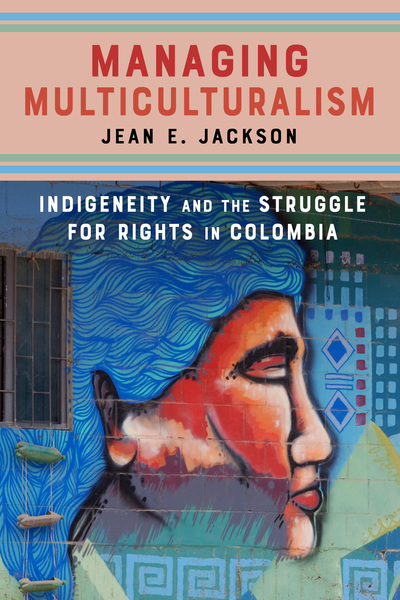
Jean E. Jackson's "Managing Multiculturalism"

Jean E. Jackson is Professor Emerita of Anthropology at Massachusetts Institute of Technology. Her books include Indigenous Movements, Self-Representation and the State in Latin America (2002), co-edited with Kay B. Warren, and "Camp Pain": Talking with Chronic Pain Patients (2000).

She applied the “Page 99 Test” to her new book, Managing Multiculturalism: Indigeneity and the Struggle for Rights in Colombia, and reported the following:
With respect to Ford Madox Ford’s statement about page 99 of a book revealing the “quality of the whole,” I have this to say: it depends on the reader. If we know very little about the genre called ethnography, then we will get a pretty good impression of what ethnographic description looks like from page 99 of my book, Managing Multiculturalism: Indigeneity and the Struggle for Rights in Colombia. That page describes the plight of a group of desperate naked women and children, members of a hunter-gatherer culture known as Nukak, who have decided to travel to a frontier town in a particularly lawless plains area of eastern Colombia and throw themselves on the mercies of the townspeople. We learn that various non-indigenous actors—missionaries, anthropologists, state agents—are searching for an effective humanitarian solution. We get a glimpse of my authorial position with the appearance of the word “putative,” and comments about government bureaucrats’ mistakes lead us to guess that the solution chosen will not be successful.

But a reader who knows much more about what good ethnographies do will feel, most likely, quite bereft. The page contains no discussion, theorizing, contextualizing nor history—no real analysis.
Learn more about Managing Multiculturalism at the Stanford University Press website.

--Marshal Zeringue

Friday, March 8, 2019

Margaret Mih Tillman's "Raising China's Revolutionaries"

Margaret Mih Tillman is an assistant professor of history at Purdue University.

She applied the “Page 99 Test” to her new book, Raising China's Revolutionaries: Modernizing Childhood for Cosmopolitan Nationalists and Liberated Comrades, 1920s-1950s, and reported the following:
From page 99:
In these early days of the Japanese Occupation, Westerners continued to run “the lone island” in ways that belied their true status as Western imperialists rather than auxiliary modernizers of the Chinese state. Nevertheless,the International Settlement also gave Chinese elites, especially those oriented to the West, an independent base to continue their operations during the war. Tensions in the International Settlement mounted as the United States increasingly came into conflict with Japan. In early 1941 the United States issued a blockade on Shanghai. Owing to concerns about the flight of financial assets from China, the U.S. Treasury froze Japanese and Chinese assets in the United States, rendering it difficult to wire money to China. The year 1941 thus marked a nadir for U.S. funding for Chinese child welfare, which halted temporarily before famine conditions forced the ROC to assume greater responsibility. In that same year Western missionaries noticed that collaborationist governments (established in 1938) also ramped up anti-Western sentiment and advised “loyal Chinese subjects” to build their own Christian Church, since all “religion must be united to the State,” in accordance with Japanese policies.

Even after the retreat of the ROC in November 1937, those who remained behind continued the work of the Shanghai NCWA [National Child Welfare Association]. National leaders like Kong Xiangxi left to serve the ROC, but many middling professionals stayed in Shanghai. Among them were Christians like Chen Heqin and Reverend Andrew Wu, as well as the Chinese Christian women who executed much of the wartime relief work. NCWA accountant Lin Kanghou (1876–1949), who had during the warfare of 1937 suggested diverting SFCO funds to attend to the wounded military, remained in Shanghai throughout the war. In 1938, acting as Shanghai NCWA treasurer from the Chung Wai Bank Building, Lin appealed to the French Settlement for funds to care for children sent by the court. To continue these operations after 1941, Lin registered the Shanghai NCWA with the Social Welfare Bureau of the Occupation government. He succeeded in petitioning ​the collaborationist Shanghai municipal government for subsidies. (In 1945 Lin was sentenced to six years imprisonment on charges of collaboration with the Japanese.) In Chongqing, Kong Xiangxi also continued correspondence via the International Settlement of Shanghai even after the bombing of Pearl Harbor. Kong probably considered these ... [channels a clandestine maneuver to fortify ROC legitimacy behind enemy lines.​]
Page 99 appears at the beginning of the conclusion for Chapter Three: "The Calculus of Child Welfare: the Democratization of Fundraising for Shanghai, 1937-1942." As such, it's less evidentiary based (as would be the case for a middle section), or theoretical/comparative (as might be the case for an introductory section), and more broadly synthetic and narrative. That chapter covers the withdrawal of the Nationalist Chinese government in the wake of Japanese aggression, and shows that Chinese Christians were able to continue to conduct charity work in Shanghai’s International Settlement based on the privileges afforded to Americans, which remained in effect before Pearl Harbor. This context, I argue, highlighted the semi-colonial dimensions of transnational philanthropy (even when led by local Chinese) in ways that had been less obvious before; the specifically Christian character of the children's charity I focus on, the National Child Welfare Association, also became more prominent with the absence of the Nationalist Chinese state. The privation of war and the refugee crisis also pushed charity organizations to cooperate with outsider groups such as Buddhists, and to become more transparent in their fundraising activities and accounts. In that chapter, I also examine what I call the "democratization" of fundraising, from large, elite donors to small, private donors in both the US and in China. I examine new and more popular methods of fundraising, as well as minutes from charity organizations and their published records, to indicate this expansion, which included the sale of materials directed at children for the benefit of other children. Fundraisers argued that children were both uniquely vulnerable as well as especially resilient and thus a good investment for charity. My point is to draw attention to the effect of the war on reshaping elite philanthropy for children.

The page is good indication of the rest of the work as a whole in terms of analyzing transnational organizations and political forces that shaped child welfare. The book spans the period from the 1920s to the 1950s. The chapter described above is but one of two chapters on the wartime period because it was a significant turning point with ramifications for postwar reconstruction. Despite the ultimate breakdown of significant Allied partnerships with the onset of the Cold War, Raising China’s Revolutionaries argues for the endurance of some of the social relationships and symbolic meanings of childhood, such as the conferral of national significance onto children.
Learn more about Raising China's Revolutionaries at the Columbia University Press website.

--Marshal Zeringue

Thursday, March 7, 2019

Kristen Ghodsee's "Second World, Second Sex"

Kristen Ghodsee is Professor of Russian and East European Studies at the University of Pennsylvania. Her books include Red Hangover: Legacies of Twentieth-Century Communism, Why Women Have Better Sex Under Socialism: And Other Arguments for Economic Independence, and the newly released Second World, Second Sex: Socialist Women's Activism and Global Solidarity during the Cold War.

Ghodsee applied the “Page 99 Test” to Second Sex and reported the following:
Page 99 is the second page of my 4th chapter, “A Brief History of Women’s Activism in Domestic Political Context – Case 2: Zambia.” This page is a record of a conversation that I shared with a woman named Chibesa Kankasa in January of 2013 in Lusaka, Zambia. Kankasa was the president of the United National Independence Party (UNIP) - Women’s League for many years, and today she is considered a national heroine in her country. Through her personal story of growing up under British colonialism and the efforts that she and her husband made to create a free and independent country in Southern Africa, this chapter explores the specific historical context of women’s organizing after Zambia’s independence in 1964.

On this page, Chibesa Kankasa tells me:
“This country was ruled by capitalists. It was ruled by colonialists before when it was the Federation of Rhodesia and Nyasaland. The colonialists ruled with an iron bar. The system was that of horse and the rider. Let the natives be the horses and the white settlers be the riders. Women of this country were looked down on as second-class citizens. We were not allowed to enter any European markets; we called them European butcheries. The reason was because [Europeans thought that] African women had a bad smell.”
Since the book focuses on the relationship between socialist women in Eastern Europe and socialist-leaning background information for why Zambian women later found their interests aligned with women from the Eastern Bloc, particularly during the United Nations International Women’s Year (1975) and the subsequent U.N. International Decade for Women (1976-1985). The major argument of the book is that socialist alliances of leftist women provided an important foil to Western liberal feminists on the international stage during the Cold War, and that superpower rivalries over which economic system could better emancipate women proved a catalyst for social progress for women across the globe.
Learn more about Second World, Second Sex at the Duke University Press website.

Writers Read: Kristen Ghodsee.

--Marshal Zeringue

Wednesday, March 6, 2019

Kieran Connell's "Black Handsworth"

Kieran Connell is Lecturer in Contemporary British History at Queen’s University Belfast. He is co-editor of Cultural Studies 50 Years On: History, Practice, Politics (2016).

Connell applied the “Page 99 Test” to his recent book, Black Handsworth: Race in 1980s Britain, and reported the following:
I was delighted when I turned to page 99 of Black Handsworth and found a photograph. I’m not sure how this fits in with Ford Madox Ford’s famous maxim that the 99th page of a book is a guide to the overall quality of an author’s writing. But it is certainly in keeping with an approach I have taken throughout my work – in Black Handsworth, which has nineteen illustrations and a chapter dedicated to the ‘politics of representation’, and beyond. The photograph on page 99 also encapsulates the wider arguments I am attempting to make in the book. It shows a performance by an African dance troupe based in Handsworth, an inner city area of Birmingham – Britain’s second largest city and my book’s case study. The troupe was made up of local black youth, most of whom had been born in Britain but – in the context of widespread societal racism and socio-economic disadvantage in Britain’s turbulent 1980s – were going through a profound crisis in identity. African dance, I argue in this chapter, like reggae music, the styles of Rastafarianism and a more general ‘sound system’ culture, helped facilitate an encounter with the politics and cultures of diaspora – one that had a critical impact in helping this generation come to terms with the many inequalities of the locale. In turn, I suggest toward the end of the book, this helped establish the diverse nature of the diasporic tradition as a forcible presence in the everyday landscapes of post-colonial Britain – in Handsworth and far beyond.
Learn more about Black Handsworth at the University of California Press website.

--Marshal Zeringue

Tuesday, March 5, 2019

Wendy Kline's "Coming Home"

Wendy Kline is professor and Dema G. Seelye Chair in the History of Medicine in the Department of History at Purdue University. She is the author of Building a Better Race: Gender, Sexuality, and Eugenics from the Turn of the Century to the Baby Boom and Bodies of Knowledge: Sexuality, Reproduction, and Women's Health in the Second Wave.

Kline applied the “Page 99 Test” to her new book, Coming Home: How Midwives Changed Birth, and reported the following:
The “Bowland Bust,” as I call it in the book, is one of the most surprising and significant moments in the history of alternative birth in the recent United States. So I’m delighted that a humorous description of the arrest, as well as a photograph of the undercover agents in hippie regalia, appear on page 99 of Coming Home:
The scene unfolding inside the Birth Center quickly drew media attention. The drama was enhanced by the appearance of two officers in hippie attire, much to the puzzlement and amusement of witnesses. Carol Bredsel, a registered nurse who was in the house during the raid, described the disguises as “really hysterical. I don’t know why they wore those hippy clothes. I told the guy, ‘your beads are getting caught up in your beard.” Linda Bennett reflected, “it’s as if you decided to dress as a hippie and you only had Woolworth’s.”
Because of the presence of the photograph, there isn’t very much text on the page, thus limiting the extent to which a reader can get a sense of the entire book. However, it’s such an intriguing moment – the reader knows that there’s been a raid, and that somehow, law enforcement believed that undercover agents disguised as hippies would result in greater acquiescence among the midwives and pregnant women located within the center. Readers might be familiar with the conflicts between the counterculture and law enforcement (particularly around illicit drug use), but unaware that the subject of home birth was equally, if not more, a source of major tension at the time.

Coming Home tracks the source of that tension – the rising tide of home births beginning in the 1970s along with the increasing visibility of midwives. For many, this came as a surprise. By the mid-twentieth century, two things appeared destined for extinction in the United States: the practice of home birth and the profession of midwifery. In 1940, close to half of all U.S. births took place in the hospital, and the trend was increasing. By 1970, the percentage of hospital births reached an all-time high of 99.4%, and the obstetrician, rather than the midwife, assumed nearly complete control over what had become an entirely medicalized procedure. Then, seemingly out of nowhere, an explosion of new alternative organizations, publications, and conferences cropped up, documenting a very different demographic trend; by 1977, the percentage of out-of-hospital births had more than doubled. Home birth was making a comeback, but why? A quiet revolution spread across cities and suburbs, towns and farms, as individuals challenged legal, institutional and medical protocols by choosing unlicensed midwives to catch their babies at home. Drawing on archival materials and interviews with midwives, doctors, and home birth consumers, Coming Home analyzes the ideas, values, and experiences that led to this quiet revolution and its long-term consequences for our understanding of birth, medicine, and culture.
Learn more about Coming Home at the Oxford University Press website.

--Marshal Zeringue

Monday, March 4, 2019

David McGowan's "Animated Personalities"

David McGowan is a professor of animation history at the Savannah College of Art and Design (SCAD) in Savannah, GA.

He applied the “Page 99 Test” to his new book, Animated Personalities: Cartoon Characters and Stardom in American Theatrical Shorts, and reported the following:
My manuscript argues that animated characters of the studio era should be viewed as legitimate stars – not just because they were given lead roles in Hollywood films, but because they were also regularly evoked in surrounding media texts as individuals with an apparent private existence. Page 99 of the book is part of a chapter on the Second World War. This particular page covers The New Spirit (1942), a Donald Duck cartoon made by Disney for the United States Treasury, in which the Duck learns the value of paying his taxes promptly and accurately to support the war effort. The film makes some surprising revelations about Donald’s life as an actor, including his $2501 annual salary from the Disney Studio. Such a figure was significantly lower than most human stars of the period and – although this was clearly just a fictional construct – it generated some positive responses in a number of contemporary publications. Time magazine, for instance, noted that the Duck’s modest salary – which also had to cover the childcare costs of his adopted nephews Huey, Dewey, and Louie – reflected “pure patriotism” on the part of Disney’s protagonist.

The New Spirit did, however, manage to generate some controversy. While a human actor could theoretically step in front of the camera and donate his or her services for free, animation was somewhat pricier. The budget of The New Spirit allegedly exceeded $40,000 and – while the film was broadly viewed as a success in its propaganda efforts – the production cost became the subject of debate in several quarters. Although the actual controversy surrounded the Disney Studio and the US Treasury, it is notable how often Donald Duck was personally brought into this discussion. Senator Sheridan Downey even spoke up for Donald in Congress, meaning that the official Congressional Record has an entry for “Duck, Donald” – as well as “Disney, Walt” – in its index.

The discussion surrounding The New Spirit reiterates my wider argument in the book that the animated status of cartoon stars was rarely a barrier to them being treated as distinct personalities in their own right – even, as page 99 indicates, by elected government officials! Cartoon characters proved their ability to create enough of a tangible impression on the screen to inspire a nation, and even generate some controversy in the process.
Learn more about Animated Personalities at the University of Texas Press website.

--Marshal Zeringue