Tuesday, March 26, 2019

Mark Wild's "Renewal: Liberal Protestants and the American City after World War II"

Mark Wild is professor of history at California State University, Los Angeles.

He applied the “Page 99 Test” to his new book, Renewal: Liberal Protestants and the American City after World War II, and reported the following:
Page 99 of Renewal marks the end of a section chronicling debates about the duties of mainline Protestant ministers after World War II. A movement within the church was pushing clergy to become more active in what had been considered secular affairs. Doing so, they hoped, would transform the church from an isolated, stilted institution into an instrument of social and spiritual transformation. But the idea raised a host of questions, not least about the potential impact on clergy: would ministers neglect their pastoral duties? Or might they burn out doing two jobs at once? On what grounds could clergy claim the right to intervene in the secular world anyway? And if they did, why have clergy in the first place? On page 99, individual church people weigh in on some of these issues and offer various answers.

I don’t know how well this page illuminates the book’s quality, but it certainly displays the book’s method. The mainline Protestant church bodies produced an astounding amount of evidence for historians to pick through. But these records—collected haphazardly and scattered across denominational and regional archives--are almost impossible to summarize in a simple narrative. So instead I tried to deliver a coherent account of a complicated, disparate set of issues that galvanized the renewal movement, most of which were never resolved. I don’t think there’s anything wrong with this. Many of the most important problems in our world have no clear resolution, or even a clear nexus of debate. Instead, different people engage with the problem, sometimes in conversation with each other, sometimes alone. The problem may evolve, splinter, subside, persist, fade away, return. The last sentences of the section ending on page 99 serve more to introduce a new problem than to resolve the one introduced in that section. This approach fits the theology of my subjects. Rejecting the idea that the church existed outside human history, they insisted that history acted on the church. No resolution (wrought by humans anyway) can ever be permanent. We are perpetually undergoing renewal.
Learn more about Renewal: Liberal Protestants and the American City after World War II at the University of Chicago Press website.

--Marshal Zeringue

Sunday, March 24, 2019

D.W. Pasulka's "American Cosmic"

Diana Walsh Pasulka is a Professor of Religious Studies at the University of North Carolina, Wilmington and Chair of the Department of Philosophy and Religion. Her research focuses on religion and technology, including supernatural belief and its connections to digital technologies and environments.

Pasulka applied the “Page 99 Test” to her new book, American Cosmic: UFOs, Religion, Technology, and reported the following:
I conducted the Ford Madox Ford page ninety-nine test on my current book, and I found it to absolutely confirm Ford’s assertion that the quality of the whole book is revealed to the reader in that one page. Allow me to explain…

Far be it from me to criticize Carl Jung, but after reading everything he has written on the topic of flying saucers, I noticed that he missed a key, and very important factor in its mythic, legend-making features. This is what I write on page ninety-nine:
Jung wrote that the UFO was apparently impossible. He didn’t say it was impossible. His point was not necessarily to dismiss its objective reality, but to move the study of it into the realm of the psyche, his field of expertise. It was a methodological strategy. Jung missed an opportunity to note that it is the potential physical reality of the UFO that causes it to be a living myth…
Furthermore, I elaborate on the point that the UFO “is both a myth and a potential future reality. [Jung] nods in this direction, noting that contemporary physics has revealed so many scientific truths that appear miraculous that ‘UFOs can easily be regarded and believed in as a physicists’ miracle.’”

Jung said that UFOs can be believed in as much as the stuff of physics. I didn’t say that, although I agree with him. What I said was that the fact that the possibility that there is life “out there” makes the UFO myth a particularly potent belief system. And, that is as defensible as stating that time is not linear. It may seem odd to tell your co-worker that you believe in UFOs, but it certainly is not as odd to suggest their real possibility.
Visit Diana Walsh Pasulka's website.

The Page 99 Test: Heaven Can Wait.

--Marshal Zeringue

Friday, March 22, 2019

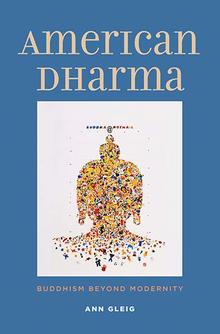
Ann Gleig's "American Dharma"

Ann Gleig is associate professor of religious studies at the University of Central Florida. She is co-editor of Homegrown Gurus: From Hinduism in America to American Hinduism and has published widely on contemporary Buddhism.

She applied the “Page 99 Test” to her new book, American Dharma: Buddhism Beyond Modernity, and reported the following:
Page 99 falls in chapter three “Sex, Scandal, and the Shadow of the Roshi,” which considers the ways in which American Zen Buddhist have incorporated psychotherapeutic and psychoanalytic discourses and practices into their communities as a response to reoccurring issues of sexual misconduct and abuse by Zen teachers. Using three case studies—Grace Schireson, Barry Magid, and Diane Hamilton—the chapter sets its specific aim as: (1) to reveal under what particular conditions psychotherapy had been incorporated into certain Zen communities; (2) to demonstrate which psychotherapeutic discourses have become dominant; and (3) how the introduction of psychotherapeutic has been legitimated within a wider Buddhist framework, which has produced new Buddhist discourses, practices and organizational forms.

The wider aim of the chapter is to show that American Zen Buddhists are employing dialogical rather than reductive approaches to psychotherapy. A reductive approach is one in which psychotherapy is privileged as the meta-discourse and religious (in this case, Buddhist) phenomena are assimilated and reduced to psychological discourse. A dialogical approach put religion and psychology into conversation as two distinct systems and generally employs psychology as a tool to extend the aims of religion. I argue that while most scholarly analyses of modern Buddhism focus on assimilative approaches, my research populations actually demonstrate dialogical approaches. This supports the overall thesis of the book, which is that development within American Buddhist communities cannot be contained within a modernist framework and show characteristics more associated with the postmodern, in this specific case the postmodern emphasis on difference rather than assimilation.

Both the specific and wider aims of the chapter as well as a glimpse of American Dharma’s basic thesis are illustrated on page 99, which overlaps between two of my case studies: Barry Magid and Diane Hamilton. In terms of its (longer) treatment of Magid, it notes that his work is particularly informed by relational and intersubjective theorists Jessica Benjamin and Philip Bromberg and that he explores the different ways in which attachment patterns play out in the teacher-student role. It also shows that he calls for the adoption of psychotherapy as part of Zen training in the U.S. and the development of an American Zen that acknowledges the emotional and relational needs of teachers and students. Most strikingly is the last paragraph in Magid’s section which notes that he explicitly differentiates between his dialogical approach and the mainstream medicalization of mindfulness in which Buddhist meditation has been completely assimilated to a scientific paradigm. As I conclude, “ Unlike this, his project is not concerned with the reduction of Zen to psychoanalysis but rather in fashioning a dialogue between the two as distinct systems that can each potentially correct the limitations of the other.” (2019:99).
Learn more about American Dharma at the Yale University Press website.

--Marshal Zeringue

Wednesday, March 20, 2019

Christopher Klein's "When the Irish Invaded Canada"

Christopher Klein is the author of four books, including When the Irish Invaded Canada: The Incredible True Story of the Civil War Veterans Who Fought for Ireland’s Freedom and Strong Boy: The Life and Times of John L. Sullivan, America’s First Sports Hero.

Klein applied the “Page 99 Test” to When the Irish Invaded Canada and reported the following:
When the Irish Invaded Canada is the true story of how a band of refugees from Ireland’s Great Hunger fought on both sides of the Civil War and undertook one of the most fantastical missions in military history—to hold the British colony of Canada hostage and ransom it for Ireland’s independence. The self-proclaimed Irish Republican Army attacked Canada not just once, but five times between 1866 and 1871.

I don’t think it’s too much of a spoiler alert to let you know the IRA’s best-laid plans did not come to fruition. However, they did have some stunning successes, and perhaps their high-water mark came on June 2, 1866, outside the small Ontario village of Ridgeway, 20 miles south of Niagara Falls. In the Battle of Ridgeway, which is depicted in the colorized lithograph on the front cover of the book, Colonel John O’Neill led an Irish army to a victory over forces from the British Empire for the first time since 1745.

Page 99 of When the Irish Invaded Canada drops the reader in the middle of the firefight. The most fun I had in writing my last book, Strong Boy: The Life and Times of John L. Sullivan, was in describing the bare-knuckled boxing bouts held during the Gilded Age. Fight scenes naturally lend themselves to the use of action verbs, which makes the prose flow freely and jabs the reader in ways that expository passages simply can’t.

So with the Battle of Ridgeway, I enjoyed the chance to write another fight scene, albeit one with far deadlier consequences:
They dashed from stump to stump, throwing them¬selves flat on the ground still wet with morning dew as a deluge of bullets struck the stumps and rattled the orchards, sending a shower of apple blossoms down upon the heads of the Canadians. Once the Fenians had emptied their single shots and worked to reload, the Canadians rose to fire their repeating rifles. The Canadian skirmish¬ers advanced so far in front of their main body that they began taking on gunshots from both the front and the rear.
Page 99 also details how O’Neill, who was thrust by fate into a commanding role at the Battle of Ridgeway, proved himself to be a talented military tactician. O’Neill is the thread that stitches the narrative together. He is “radicalized” by the horrors of the Great Hunger and thought it his purpose in life to lead an Irish army on the battlefield against the British. When he gets his chance at Ridgeway, he takes full advantage of it, and I’m glad to see him in the starring role on page 99.
Visit Christopher Klein's website.

--Marshal Zeringue

Tuesday, March 19, 2019

Jessie Morgan-Owens's "Girl in Black and White"

Jessie Morgan-Owens is the dean of studies at Bard Early College in New Orleans, Louisiana. A photographer with the team Morgan & Owens, she received her doctorate from New York University and lives in New Orleans with her family.

Morgan-Owens applied the “Page 99 Test” to her new book, Girl in Black and White: The Story of Mary Mildred Williams and the Abolition Movement, and reported the following:
I turned to page 99 of Girl in Black and White and found the opening page (mostly blank) for "Part Three: Becoming Ida May." The crazy thing is, Ford Madox Ford was right to an extent -- I cannot speak to the quality of the three words found on page 99, but I will say that "becoming Ida May" is what this book is about. Mary Mildred Williams, an unknown girl from an enslaved family, became known as a fictional character "Little Ida May," the title character of the novel Ida May by Mary Hayden Green Pike, for the three months following her manumission in 1855. This marks the moment where seven-year-old Mary leaves behind enslavement, and when Senator Charles Sumner pushes her to center stage of the abolitionist debates around race. In other words, the true heart of the story! The previous 98 pages are the story of her family's struggle toward freedom; the following will be their journey through the limelight to a private life.
Visit Jessie Morgan-Owens's website.

--Marshal Zeringue

Monday, March 18, 2019

Steve Luxenberg’s "Separate"

Steve Luxenberg is an associate editor at The Washington Post and an award-winning author. During his forty years as a newspaper editor and reporter, Luxenberg has overseen reporting that has earned many national honors, including two Pulitzer Prizes.

His first book was the critically-acclaimed Annie’s Ghosts: A Journey into a Family Secret, honored as a Michigan Notable Book and selected as the 2013-2014 Great Michigan Read.

Luxenberg's new nonfiction book is Separate: The Story of Plessy v. Ferguson, and America’s Journey from Slavery to Segregation. As a work in progress, Separate won the 2016 J. Anthony Lukas Award for excellence in nonfiction writing.

Luxenberg applied the “Page 99 Test” to Separate and reported the following:
Anticipation and trepidation.

Like inseparable twins, those emotions accompanied me as my fingers scrabbled to page 99 of my new book, Separate: The Story of Plessy v. Ferguson, and America’s Journey from Slavery to Segregation.

A smile came swiftly as I scanned the paragraphs.

New Orleans. Discrimination. The city’s free people of color. Their continuing struggle for full political and civil rights, long sought and long denied.

Of course.

New Orleans and its French-speaking, mixed-race group known as les gens de couleur libres are central to this story of racial separation and its roots. Ford Madox Ford may have gone overboard in saying that turning to page 99 of any book will reveal “the quality of the whole.” In the case of Separate, fortunately, that page offers a strong sample of the book’s sweep and depth.

Separate begins in the North at the dawn of the railroad age in the late 1830s and ends with the infamous Supreme Court ruling in the 1896 case of Plessy v. Ferguson. Drawing on letters, diaries, and archival collections, the book depicts indelible figures such as the many resisters to separation during much of the 19th century, including a young Frederick Douglass on a Massachusetts railroad car in 1841; Louis Martinet, a lawyer and crusading newspaper editor who led the New Orleans committee that brought the Plessy case, Homer Plessy’s lawyer, Albion TourgĂ©e, the country’s most famous white advocate for civil rights; Justice Henry Billings Brown, from antislavery New England, whose majority ruling endorsed the idea of separate but equal; and Justice John Marshall Harlan, the Kentuckian from a slaveholding family whose singular dissent cemented his reputation as a steadfast voice for racial justice.

The New York Times, in a review by Rutgers professor James Goodman, describes the book this way: “Absorbing ... contains so many surprises, absurdities and ironies ... Segregation is not one story but many. Luxenberg has written his with energy, elegance and a heart aching for a world without it.”

A brief excerpt from page 99 hints at the New Orleans part of this stirring story. At a Louisiana constitutional convention in April 1845, a wealthy and flamboyant delegate named Bernard de Marigny had the floor. He was a slaveholder, and the developer of a neighborhood where many free people of color lived.

Here’s what happened:
He asked [the convention] to consider a clause allowing the legislature to “confer the rights and privileges of citizenship” on free people of color, if they were native born. It was a small step, only giving the legislature the option, without tying its hands. Take time to think about it, he urged....

The proposal died an undignified death a week later, never debated, a casualty of a hostile reception that Marigny could not overcome. “I believe it is my duty to withdraw it,” he wrote in a statement brimming with disappointment, but “I trust that the members of the Convention ... will do me the justice to believe my motives were pure.”
I did a test of my own after reading page 99. I went to pages 199, 299, 399 and 499. Readers might want to do the same. I’m pleased to report that each reveals “the quality of the whole.”
Visit Steve Luxenberg’s website.

The Page 99 Test: Annie's Ghosts.

--Marshal Zeringue

Sunday, March 17, 2019

Kartik Hosanagar's "A Human's Guide to Machine Intelligence"

Kartik Hosanagar is the John C. Hower Professor of Technology and Digital Business and a Professor of Marketing at The Wharton School of the University of Pennsylvania. Kartik’s research work focuses on the digital economy, in particular the impact of analytics and algorithms on consumers and society, Internet media, Internet marketing and e-commerce.

Hosanagar applied the “Page 99 Test” to his new book, A Human’s Guide to Machine Intelligence: How Algorithms Are Shaping Our Lives and How We Can Stay in Control, and reported the following:
Page 99 of my book A Human’s Guide to Machine Intelligence, discusses two ways to design Artificial Intelligence (AI). Specifically, it discusses AI that can diagnose diseases. The first way is to interview medical experts and identify a set of rules that doctors use to diagnose diseases. For example, a doctor might say that if a patient has a fever for over a week, he/she might focus more on bacterial infections than viral infections. An alternative approach to build AI is to simply feed a lot of data to an algorithm and have it identify patterns in the data. An algorithm might be given data on medical test reports of over 100,000 patients along with the diagnoses human doctors had reached, and it then infers which medical markers predicted which medical conditions. The discussion goes on to clarify how AI researchers were focused on extracting rules from experts in the 80s but the resulting AI couldn’t match human intelligence. However, AI based on learning patterns from large quantities of data (without being programmed with diagnostic rules) are working incredibly well and beating humans at games like Chess but also with tasks such as medical diagnosis. But this switch from programming AI with explicit rules to AI that can teach itself from large quantities of data has many implications. For one, AI based on rules are highly predictable because they are governed by precise rules. AI that teaches itself through analysis of large volumes of data can be more unpredictable because it’s hard to know what exact patterns it might discover in the data. This is why we are seeing examples of racism in algorithms used to guide sentencing decisions in courtrooms and sexism in resume screening algorithms. No engineer is programming bias into these systems. Instead, the bias is being picked up by the algorithms by analyzing data on past decisions by humans.

The discussion helps set up some of the emerging challenges with AI-based decisions and why it’ll be non-trivial to solve. The rest of the book explores the complex interplay between humans and AI and how we will stay in control of seemingly unpredictable AI systems. In the book, I explain why we are not helpless against algorithms unleashed by powerful tech companies to make decisions for us or about us. Instead, we can take control. Further, technology companies and governments will have a role to play as well. I discuss the role of consumers, companies, and governments in the final chapter.
Visit Kartik Hosanagar's website.

--Marshal Zeringue

Saturday, March 16, 2019

Keith Laybourn's "Going to the Dogs"

Keith Laybourn is Diamond Jubilee Professor and Professor of History at the University of Huddersfield.

He applied the “Page 99 Test” to his new book, Going to the Dogs: A history of greyhound racing in Britain 1926-2017, and reported the following:
Going to the Dogs: A History of Greyhound Racing in Britain, 1926-2017 is the first academic book to examine the rise and fall of greyhound racing in Britain, although there have been some popular publications on individual tracks. Greyhound racing began in Britain at Belle Vue in July 1926 and within five years there were more than 200 greyhound tracks in Britain and about twenty-four million attendances per year, peaking at well over 32 million in the late 1930s. In the words of the title of the hit-song of 1927, Everybody's Going to the Dogs. From the start , greyhound racing was essentially a sport for the working classes, offering them easily accessible, and legal, on-track, gambling opportunities, and an 'American Night Out', with the bright lights, excitement and spectacle of six, or eight, dogs racing around an oval track chasing a mechanical hare. Indeed, greyhound racing became 'An Ascot for the common man'.

Portrayed as the 'casinos' and the 'Monte Carlos ' of the working class, greyhound tracks became subject to criticism from the National Anti-Gambling League - which feared that gambling on greyhound racing would cause poverty and corrupt women and children - the churches, and some politicians who regarded greyhound racing not being a rational recreation. Winston Churchill referred to greyhound tracks as 'animated roulette boards', and John Buchan suggested that they were 'illuminated ribbons of turf'. As a result the police were constantly being asked to survey the tracks for signs of illegal gambling by children, dog fixing and gambling rackets amongst the bookies. However, the police found little more than petty corruption at most tracks for they were few crime gangs like the Sabinis (headed by Ottavio Sabini) of the track at Brighton and Hove. In the end greyhound racing declined as a result of the Attlee Labour government of the late 1940s imposing a 10 per cent tax on tote betting and demanding the payment of licence fees for on-track bookies rather than the opposition of the anti-gambling fraternity. Nevertheless, whilst it was at its height, greyhound tracking attracted financial investment from the lower middle-classes, who hoped that they had discovered something more lucrative than 'King Solomon's mines', generated local employment, and stimulated a whole industry in breeding, training and racing greyhounds in which the working-class breeders and trainers were in conflict with the large tracks. Indeed, greyhound racing was deeply divided between the large National Greyhound Racing Society tracks, run to the rules of the National Greyhound Racing Club, and the smaller 'flapping tracks'. Most working -class trainers found it difficult to get their dogs run on the NGRS tracks, where the big races such as the Greyhound Derby were held, and where Entry Bridge and Mick the Miller made their reputations. In other words, greyhound racing was deeply divided sport with the NGRS tracks offering tote betting and trying to exclude the bookies and the 'flapping tracks', where the smaller owner and trainers ran their dogs and where many tracks relied upon the bookies for their gambling activities. This tended to mean that family groups attended the NGRS tracks for leisure as well as gambling whilst the flapping tracks were attended by smaller groups of more ardent male working-class bettors. By the late 1940s greyhound racing may have attracted up to 40 million attendances per year but taxation, alternative gambling opportunities, and changes in betting reduced attendance to about two million in 2017 and there are only about 24 major tracks now in existence, and about 9 smaller 'private' tracks. As a sign of the times, even the famous Wimbledon track was closed and sold off for housing development two year ago. The heyday of greyhound racing occurred between 1926 and 1950, and it has declined ever since and now faces oblivion.
Learn more about Going to the Dogs at the Manchester University Press website.

--Marshal Zeringue

Friday, March 15, 2019

Vanessa McGrady's "Rock Needs River"

Vanessa McGrady spends time thinking about feminist parenting, high-vibrational food, and badass ways to do things better. She often wonders why people aren’t more freaked out about plastic in the oceans. Whether in New York, the Pacific Northwest, or Glendale, California, she is grateful to call each place home.

After two years of waiting to adopt—slogging through paperwork and bouncing between hope and despair—a miracle finally happened for McGrady. Her sweet baby, Grace, was a dream come true. Then McGrady made a highly uncommon gesture: when Grace’s biological parents became homeless, McGrady invited them to stay.

McGrady applied the “Page 99 Test” to her new book, Rock Needs River: A Memoir About a Very Open Adoption, and reported the following:
From page 99:
I tried to explain that I was just helping on a call, getting my computer so I could work. I fought tears, scooped up Grace, and headed down to my car.

Grace had always been a strong traveler since her first ride in her daddy’s truck, but on this day, she wailed. I did everything I could do to calm her from the front seat, made sure she had a blanket, sang, offered toys and a bottle. Nothing worked.

Finally I took an exit, pulled over in a run-down, unfamiliar part of town, got in the back seat, and held her. We cried together.

That night, I had tickets to the Joffrey Nutcracker, in which my ten-year-old neighbor and BFF, Keya, was dancing as a snow angel. Peter was stuck working, so Grace and I put on our Christmas best and headed to the ballet.

We sat in the nosebleed section, getting the stink eye from the usher, who made sure I knew that if Grace made so much as a burp, we’d need to exit. Gracie settled in. The overture began, the lights dimmed, and guests began to arrive at Clara’s party. The Snow Queen floated, amid sparkly drifts, to her king.

Ballet is perfect for a six-month-old, by the way, as it’s all action and music, never a still moment, always changing light and something different to see. Grace was silently entranced on my lap for about twenty minutes, then settled into a deep sleep.
This part of the book discusses my struggle in going back to work with a new baby, and trying to balance it all. The book is about the path to becoming a parent, and the struggles afterward, as well as our relationship with my daughter’s birth parents. I loved this scene and also loved that feeling of escape and release in real life. To this day, seven years later, Grace adores the Nutcracker.
Visit Vanessa McGrady's website.

My Book, The Movie: Rock Needs River.

--Marshal Zeringue

Thursday, March 14, 2019

Jay Howard Geller's "The Scholems"

Jay Howard Geller Jay Howard Geller is the Samuel Rosenthal Professor of Judaic Studies and Professor of History at Case Western Reserve University. He is the author of Jews in Post-Holocaust Germany, 1945-1953 and co-editor of Three-Way Street.

Geller applied the “Page 99 Test” to his new book, The Scholems: A Story of the German-Jewish Bourgeoisie from Emancipation to Destruction, and reported the following:
From page 99:
member of the party was the Hamburg banker and German patriot Max Warburg. Reinhold Scholem joined the party in 1919 and was an active member in the 1920s. While there is no reason to think that Reinhold disapproved of republican democracy, he was certainly a German patriot.

Overall, the Reichstag elections of May 1924 ended disastrously for the two liberal parties. The German Democrats slumped from 39 representatives to only 28, despite the votes of Betty Scholem and her maid. Similarly, Reinhold’s People’s Party went from 66 seats to 45 seats. However, as Betty reported to Gershom in Jerusalem, “German Nationalists (read: antisemites) and the Communists received the biggest increase, the Communists from 16 seats to 60.” The German Nationalists won 95 seats—24 more than four years previously. The gains made by the Communist Party were even more extreme than Betty described: going from 16 representatives (with only four originally elected as Communist Party candidates in 1920) to 62 representatives. One of the new Communists in the Reichstag was Werner Scholem.

His career was nearing its zenith. After the failure of the Communists to mount a successful revolution during the unrest of autumn 1923, Werner Scholem and his allies in the left wing of the party exploited the situation to take over the leadership of the Communist Party. They mobilized the rank and file against party chairman Heinrich Brandler, who belonged to the party’s right wing. At the same time, they cultivated important comrades in Moscow, including Grigory Zinoviev, the chairman of the Comintern, and Joseph Stalin, then still an ambitious member of the Russian Communist Party central committee. While Stalin had earlier criticized the Left Opposition, now he sided with it. He proclaimed that the German working class sought true revolutionary leaders—such as Werner Scholem, Max Hesse, and Ruth Fischer—not theoreticians. He specifically criticized Brandler, who enjoyed the patronage of Stalin’s rival Karl Radek, the Comintern’s representative in Germany. At the German Communist Party’s ninth party congress, held in April 1924, one month before Reichstag elections, the so-called Left Opposition came to power.

While Jews comprised a minuscule percentage of the Communist Party’s membership, they had been vastly overrepresented in its leadership since the party’s establishment in 1919. Moreover, this overrepresentation was never greater than in 1924. Of the fifteen members of the party’s new central committee, five came from Jewish families: Werner Scholem, Ruth Fischer, Iwan Katz, Arkadi Maslow, and Arthur Rosenberg. Moreover, all five were university educated, a rarity in a workers’ party. In addition to serving in the Reichstag and on the party’s central board and politburo, Werner Scholem also directed the party’s Organization Bureau, giving him vast power
It’s the mid-1920s in Germany, and the Weimar Republic offers unprecedented opportunities to Jews. The professorate and judiciary are fully open to Jews. Jews sit in the Reichstag as representatives of center-left and left-wing political parties. But dark clouds also loom on the horizon. The First World War inflamed social tensions that were muted or latent, including antisemitism. Extreme German nationalists overtly call for excluding Jews from positions of authority. Popular perceptions of the Treaty of Versailles, war reparations, and even Western democracy induce many voters to support illiberal and anti-democratic political groups rather than the social democratic and liberal parties that are the mainstay of the Weimar Republic.

Under these circumstances, how did German Jews respond? What political options did they see available to them? These questions figure prominently in The Scholems and particularly on page 99, which captures the flavor of this book about German Jews and their society.

Betty Scholem—as well as her son Erich and most German Jews—gave their support to the left-liberal German Democratic Party. They maintained their belief in liberalism and saw the preservation of the progressive republic as the best defense against political extremism and antisemitism. Betty’s oldest son, Reinhold, served as an officer in the World War and still maintained a highly patriotic outlook after the war. He supported the national-liberal German People’s Party (DVP), whose social conservativism alienated it from the bulk of German Jewry. Son Gerhard (later Gershom), who does not figure on page 99, embraced Zionism and emigrated from Germany. He saw his future and that of the Jewish people in their historic homeland, the Land of Israel.

But son Werner turned to socialism and later communism. And 1924 was his moment. He and his circle on the left wing of the German Communist Party rose to power. He was elected to a seat in the Reichstag, Germany’s national parliament, and was selected to run the Communist Party’s internal bureaucracy. But his power base was narrow. Moreover, he soon came into conflict with Joseph Stalin as he outmaneuvered his rivals in the Soviet Union and other communist parties.

But at this moment, in 1924, it was unclear what the future held in store for the Jews of Germany.
Learn more about The Scholems at the Cornell University Press website.

--Marshal Zeringue