Thursday, February 10, 2022

Henry Richard Maar III's "Freeze!"

Henry Richard Maar III is Lecturer in History at the University of California, Santa Barbara, and California State University, Northridge.

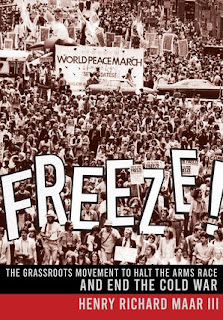
He applied the “Page 99 Test” to his new book, Freeze!: The Grassroots Movement to Halt the Arms Race and End the Cold War, and reported the following:
From page 99:
in June 1981 by Hamilton Fish (Republican, New York) expressed “the sense of the Congress that nuclear war represents a great hazard and should be prevented.” The resolution urged President Reagan to propose arms control negotiations that would reduce substantially the United States and the Soviet Union’s nuclear arsenals while encouraging all nuclear nations to “propose annual reductions and gradual elimination of all nuclear weapons.” That November, Senator Mark Hatfield introduced a bill expressing “the conviction of Congress that the United States should not base its policies on the belief that the United States can limit, survive, or win a nuclear war.” Both bills were referred to committee, though neither made it out.

In the public realm, fiscal conservatives became uneasy with the ballooning defense budget and subsequent deficits, while anxious town halls and churches across the nation began endorsing a nuclear freeze. Despite the momentum, Freeze activists were not ready to align themselves with Congress. In their first year “Structure Proposal,” activists sought to work on “a local, decentralized basis” creating Freeze Task Forces that would coordinate contacts with government officials at home and abroad, raise funds for the Freeze, develop educational and promotional resources, as well as coordinate national events or projects. In acting locally and building support in each Congressional district, the campaign hoped to secure bipartisan support from 150 Congressmen prior to the introduction of any resolution.

But Freeze activists did not have the luxury of building a longer campaign in each Congressional district. As SANE’s David Cortright lamented, “the train was already leaving the station ... and freeze leaders were powerless to stop it.” Within a year of the first Annual National Nuclear Freeze conference in Washington, D.C., eager Congress members began courting the movement. One was Boston’s Edward J. Markey (Democrat, Massachusetts). A four-term representative, Markey was a major critic of nuclear power and an opponent of nuclear proliferation who garnered attention from the antinuclear movement in the wake of the TMI accident. By early 1982, Markey was in the early writing stages of a book outlining his opposition to nuclear power and his concerns over nuclear proliferation when his administrative assistant Peter Franchot discovered Randall Forsberg’s “Call.” An antinuclear activist himself and a former lobbyist for the Union of Concerned Scientists, Franchot repeatedly told Markey that the Freeze movement would “sweep the country” and there was no reason Markey’s office “shouldn’t be in the middle of it.”

While Markey’s office began work on a freeze resolution, they soon ran into a major dilemma: Markey was on neither the House Armed Services Committee nor the House Foreign Affairs Committee (HFAC), making his claim to an arms control issue, such as nuclear freeze, a violation of legislative protocol.
If a browser were to open to page 99 of Freeze! the reader would be cast into the origins of the nuclear freeze debate as it entered the Congress. The reader would understand that nuclear freeze was an important political issue rapidly gaining momentum across the country. Likewise, page 99 would introduce readers to several important political figures who will come up later in the book (such as then-Rep. Edward Markey) and flags important activists (like David Cortright and Randall Forsberg). The reader would also gather the sense that the movement is a bit uneasy with the pace at which the Congress is proceeding, but ultimately cannot stop it.

The test, however, has its limits, as one page can never tell the whole story. If a reader were to judge the entire book on the basis of page 99, they may incorrectly conclude it is only about the efforts of Congress to respond to or enact a nuclear weapons freeze. But Freeze! demonstrates how a social movement manifests and gains support across society—from the Halls of Congress to the pulpits of the Catholic bishops and the squabbles among Evangelical preachers. The dangers of the arms race that the movement warned against saturated the popular culture of the period, from books and comics, to songs and music videos, in addition to major motion pictures and a made for TV movie that garnered over 100 million viewers (ABC’s The Day After). It became an important, bipartisan political rallying cry that the Reagan administration was forced to address—or face the ire of the public at the ballot box.

Although the page 99 test highlights important figures and an important moment, it ultimately misses the crux of the book’s argument. While we may think we know how the Cold War ended, it took more than just the willingness of Reagan to break with the hawks surrounding him, and it took more than just the new thinking of Gorbachev to make the peaceful outcome possible. Freeze! demonstrates that the diplomatic achievements that defined the end of the Cold War were a byproduct, not just of two giant personas of the era, but of a discourse between the United States and the Soviet Union that was transformed by the direct pressures of antinuclear activism and public opinion.
Visit Henry Richard Maar III's website.

--Marshal Zeringue

Wednesday, February 9, 2022

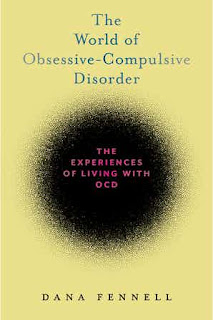
Dana Fennell's "The World of Obsessive-Compulsive Disorder"

Dana Fennell is Professor of Sociology at the University of Southern Mississippi.

She applied the “Page 99 Test” to her new book, The World of Obsessive-Compulsive Disorder: The Experiences of Living with OCD, and reported the following:
Page 99 puts you into the shoes, or rather the minds, of those with obsessive-compulsive disorder (OCD). In that sense, the Page 99 Test is a success. Page 99 is actually part of a table of quotes from people with OCD. The table contrasts how they felt before they were diagnosed, to after they labeled themselves as having the disorder or were professionally diagnosed. However, the Page 99 Test is only a partial success, as this table is not representative of the book as a whole, although it does symbolize core aspects of the book.

A central purpose of The World of Obsessive-Compulsive Disorder is to represent the life experiences of those with OCD, from when they first started asking if what they were experiencing was “normal” or not, all the way to treatment and learning how to manage and live with the disorder. I wanted to provide a variety of examples and quotes from those with the disorder, and the table beginning on page 99 is comprised of their words.

The table reveals an important moment in the “career” or trajectory of having OCD, the relevance of labeling one’s experiences with the words “obsessive-compulsive disorder.” The gap between the two moments of time captured within the table can be years, in part because this disorder is often stereotyped and trivialized as being much more limited in nature and scope than it actually is in reality. This makes it hard for people to recognize what they are experiencing as possibly falling under the heading of “OCD.” OCD is more than being concerned with order or contamination. Obsessions are unwanted and can involve people’s worst fears, with content involving religion, harm, sexuality, and more. Compulsions can even include mental rituals.

Diagnosis is a pivotal moment that provides some people with great relief. There is an explanation for what they are going through. Others have gone through the same thing and treatments are available. On the other hand, diagnosis means they do have a mental disorder, and they can fear the stigma and trivialization that come with such. Stigma and trivialization are two sociological themes that I discuss over the course of the book.

Overall, then, the Page 99 Test is useful as it brings the reader right into the heart of the thoughts and emotions of people with OCD.
Visit Dana Fennell's website.

--Marshal Zeringue

Tuesday, February 8, 2022

Jennifer Frost's "Let Us Vote!"

Jennifer Frost is Associate Professor of History at the University of Auckland in New Zealand, and author of “An Interracial Movement of the Poor”: Community Organizing and the New Left in the 1960s, Hedda Hopper’s Hollywood: Celebrity Gossip and American Conservativism, and Producer of Controversy: Stanley Kramer, Hollywood Liberalism, and the Cold War.

Frost applied the “Page 99 Test” to her new book, "Let Us Vote!": Youth Voting Rights and the 26th Amendment, and reported the following:
My book tells the story of how and why young Americans won the right to vote. The 26th Amendment to the US Constitution, passed and ratified in 1971, extended that right to citizens aged eighteen and up and prohibited discrimination in voting “on account of age.” This inspiring and important story about thirty years of efforts, campaigns, and eventual youth franchise movement is not explicitly evident on page 99. But what is there demonstrates a key argument of my book: civil rights organizing, legislation, and successes paved the way for youth voting rights.

Page 99 appears in a chapter on the Civil Rights Act of 1964 and Voting Rights Act of 1965. These two historic pieces of legislation restored the full citizenship rights of African Americans already recognized by the 14th and 15th Amendments. Prohibiting segregation in public accommodations and discrimination in employment was the purpose of the Civil Rights Act, while re-enfranchising African Americans was the point of the Voting Rights Act. When the Voting Rights Act came up for renewal in 1970, the revised version would include the right to vote for 18, 19, and 20-year-olds.

Prominent figures and events from 1963 feature on page 99. President John F. Kennedy sent his civil rights bill to Congress in June, setting the legislation in motion. The March on Washington for Jobs and Freedom in August put pressure on the president and Congress to act. The next month Dr. Martin Luther King, Jr. followed up on his famous “I Have a Dream” speech:

“The hundreds of thousands who marched in Washington marched to level barriers,” King emphasized in an essay in the New York Times Magazine in September. “They summed up everything in a word—NOW.” He underscored the urgency of the historical moment. “The long-deferred issue of second-class citizenship has become our nation’s first-class crisis.” New legislation was needed to curb the crisis. “Everything, not some of the things, in the President’s civil-rights bill is part of NOW.”

Passage of the civil rights bill fell to Lyndon B. Johnson after the terrible assassination of President Kennedy in November. Later President Johnson would also take the lead on the voting rights bill, and he considered adding youth suffrage to the bill. But he decided to focus first on ensuring and protecting black voting rights, and only in 1968 did he put his full weight behind youth voting rights.

Page 99 shows the civil rights movement pushing politicians and propelling progress toward a more inclusive American democracy. In turn, the youth franchise movement built on this progress to achieve the 26th Amendment.
Learn more about "Let Us Vote!" at the NYU Press website.

My Book, The Movie: Producer of Controversy.

The Page 99 Test: Producer of Controversy.

--Marshal Zeringue

Monday, February 7, 2022

Jennifer Forestal's "Designing for Democracy"

Jennifer Forestal is Helen Houlahan Rigali Assistant Professor of Political Science at Loyola University Chicago.

She applied the “Page 99 Test” to her new book, Designing for Democracy: How to Build Community in Digital Environments, and reported the following:
Readers opening to page 99 of Designing for Democracy will find me reintroducing the concept of ‘participatory democracy’ that serves as the book’s theoretical foundation. As a form of collective problem solving, democratic politics is the process through which members of a community are actively involved in making the decisions that affect their lives. But this work does not come easily; it requires certain habits, attitudes, and relationships among the community members involved. For one, they must recognize themselves as members of a community. They must also, second, form affective attachments to that community and their fellow members. And, finally, as I explain on page 99, they “must cultivate and act with an ‘experimental habit of mind’—a kind of empowered open-mindedness without which we cannot properly ‘do’ democracy.”

These fundamental civic practices—of recognition, attachment, and experimentalism—are what I call in the book democratic affordances; they are the activities that built environments, whether physical or digital, must facilitate if they are to support democratic politics.

In Designing for Democracy, I show how each of these affordances is tied to a specific design characteristic of built environments—in both the physical and digital realms. Page 99 comes at the beginning of chapter 4, in which I examine the characteristic of flexibility, which affords experimentalism. “[W]e can only develop the experimental habit,” I argue on page 99, “in a built environment characterized by flexibility, meaning spaces that (1) host a variety of perspectives and experiences and (2) are malleable, affording citizens control over their environment so they might reshape the space to fit their needs.” What this means, in practice, is that democracy requires us to build spaces like parks and playgrounds—and subreddits!—that invite many different people and uses.

Overall, page 99 does a nice job of introducing the reader to the concept of democracy upon which Designing for Democracy’s argument depends. But in focusing solely on the design element of ‘flexibility’—with its constituent parts, variety and malleability—page 99 might also leave readers with a distorted sense of what it takes to build democratic spaces in built environments. To be sure, flexibility is important. But, I argue throughout the book, flexibility alone is insufficient. In fact, a too-narrow focus on flexibility will result in a space like Twitter—one that is messy, chaotic, and prone to harassment or worse.

Instead, Designing for Democracy makes the case that democratic spaces—both physical and digital—must balance three characteristics: flexibility must be accompanied by boundedness and durability. In addition to being flexible, in other words, spaces that support a participatory democratic politics must also be clearly demarcated (like a neighborhood or a Facebook Group) and durable over time (like a city park or subreddit). Only when spaces are designed with all three characteristics in mind—boundaries, durability, and flexibility—will they facilitate the civic practices of recognition, attachment, and experimentalism that democratic politics requires.

Ultimately, while the page 99 test does help readers to identify major theoretical themes in Designing for Democracy, it also reminds us that a single page is not in itself enough to support a book’s entire argument; in much the same way, a single civic practice is insufficient to meet the needs of democracy.
Visit Jennifer Forestal's website.

--Marshal Zeringue

Sunday, February 6, 2022

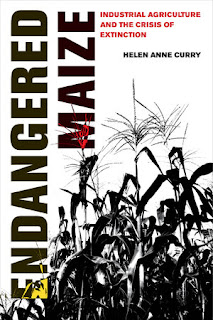
Helen Anne Curry's "Endangered Maize"

Helen Anne Curry is an associate professor in the Department of History and Philosophy of Science, University of Cambridge, and a fellow of Churchill College, Cambridge. She researches and teaches the history of recent science and technology, especially as it relates to food and agriculture.

Since August 2020, Curry has led the project From Collection to Cultivation, funded by the Wellcome Trust. This team of researchers is re-writing the histories of how today’s food crops came to be.

Curry applied the “Page 99 Test” to her new book, Endangered Maize: Industrial Agriculture and the Crisis of Extinction, and reported the following:
Open Endangered Maize to page 99 and you'll encounter a bit of background on an important institution in the history of efforts to conserve crop genetic diversity. After pinpointing the late 1950s as the period in which a new coordinated international response to concerns about the extinction of some crop varieties began to take shape, I introduce the UN Food and Agriculture Organization (FAO) as a key site of this coordination. Since it is the first time I discuss FAO, I offer readers a brief account of its early history:
Founded in October 1945, the FAO was tasked with bettering human nutrition, food production and distribution, and rural living conditions. The years leading up to FAO’s founding had seen world leaders increasingly accept adequate diet as a human right and an issue deserving of international action. During World War II the Allies had gone so far as to erect “freedom from want” as one of the pillars they envisioned for the postwar world, and FAO took shape as a means to ensure this freedom. The first FAO director general was the Scottish nutritionist John Boyd Orr, who initially advocated direct interventions to address hunger. Boyd Orr wanted to reorganize commodity markets, deliver emergency food relief, and devise credit schemes to foster agricultural development. These ambitions were quickly curtailed, not least by officials from the United States, who wanted to promote free markets, retain food aid as a means of influencing foreign governments, and disperse grain surpluses in ways that benefited US farmers. Thanks in part to US obstruction, and that of the United Kingdom too, FAO never received the funding or powers it needed to tackle hunger head-on, as Boyd Orr and others imagined. In its early decades its role was limited to offering technical assistance and compiling statistics.
On a straightforward reading, the Page 99 Test does not work: the book's central actors (scientists, activists, and farmers) and concerns (the long-term safeguarding of "traditional" crop varieties) are largely absent. Although the text identifies FAO as an institution central to both, the information here develops a general picture of the context in which conservation took place. By comparison the book's key contribution lies in detailed reconstructions of how and why diverse individuals and institutions came to be interested in saving seeds. I follow seeds, crops, and people on globe-spanning journeys—and none of this comes through on page 99.

Yet considered from another angle the test works as well as could be hoped. The history of FAO encapsulates the broader history of postwar agricultural aid. The second half of the twentieth century saw successive failed attempts to resolve global hunger by advocating technical interventions rather than, for example, controlling markets or initiating land reform. Experts dispatched from foreign aid offices, philanthropic institutions, and international bodies like FAO urged new seeds, farm equipment, and chemical inputs on farmers and encouraged governments to facilitate the industries that would produce these products. The result was decidedly mixed. Today accounts either celebrate or decry a process of agricultural industrialization that unfolded across parts of Asia and Latin America as "the Green Revolution." There could hardly be a starker illustration of contingency of this trajectory than the FAO being denied the opportunity in the 1940s to intervene directly in markets for staple foods or take other direct action to alleviate hunger.

This trajectory of aid also determined how and why seeds of farmers' heterogeneous local varieties—hundreds of thousands of strains of maize, wheat, potatoes, rice, and more—first came to be salvaged and set aside for long-term preservation. These "traditional" varieties were considered the "genetic resources" needed by professional breeders to develop ever-better "modern" varieties. They were necessary for the delivery of technical aid and as products of private agribusiness, rather than resources to directly sustain farmers, their families, and their communities. This outcome too was contingent. Readers of Endangered Maize will understand what other options were—and are—available to those who want not just to save seeds but to seed justice.
Visit Helen Anne Curry's website.

--Marshal Zeringue

Saturday, February 5, 2022

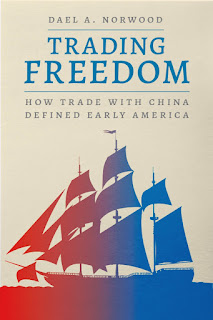
Dael A. Norwood's "Trading Freedom"

Dael A. Norwood is an assistant professor of history at the University of Delaware.

He applied the “Page 99 Test” to his new book, Trading Freedom: How Trade with China Defined Early America, and reported the following:
Page 99 of Trading Freedom introduces the reader to Asa Whitney, a former China trader who went on to briefly become antebellum America’s most famous promoter of transcontinental railroads. It also shares some of the details of his proposed scheme.

From page 99 of Trading Freedom:
Whitney’s journey toward his plan for a transcontinental railroad began when he set sail from New York City’s Pike Slip wharf on June 18, 1842. Twice widowed, his finances had collapsed in the lingering downturn following the Panic of 1837; he shipped out to recover his fortunes as well as his spirits. His destination was the rich port of Canton, where the chaos of the recent Anglo-Chinese conflict, the First Opium War, was creating new commercial opportunities for enterprising foreign merchants. A pious man but not an unassuming one—his physical resemblance to Napoleon was noted—Whitney hoped the voyage would improve his circumstances and perhaps lead to something grander. “It certainly is a great tryal at my time of life to recommence the work, too in a strange foreign Land,” he confided to his diary, but he hoped “above all things that I may yet be enabled to do some good to mankind & in some small degree make amends for the abuse of all God’s providences to me.”

He arrived in Canton on November 24, 1842, a few months after the Treaty of Nanking had confirmed the consequences of Britain’s successful invasion and opened new Chinese markets to Western traders. Amid the continuing commercial and political upheaval that followed the war, Whitney spent sixteen months engaged in business. During that time he conceived the plan whose scope and “vast importance” he hoped would rival the deeds of his doppelgänger and hero, Bonaparte. Returning to New York on September 9, 1844, with his finances restored, Whitney set about writing up his ideas and preparing to memorialize Congress about his railroad project.

The core details of Whitney’s plan remained largely the same from his first congressional proposal in 1845 to the end of his major public efforts in 1852. His plan’s outline was simple: Whitney proposed that the federal government set aside a sixty-mile-wide swath of public land, thirty miles on either side of his proposed road, running from the shores of Lake Michigan to the mouth of the Columbia River in the Oregon Territory. After building ten miles of track as a proof of concept, he would then sell five-mile-long blocks of this land grant to finance the rest of the road’s construction—all under government oversight. He estimated that the road would cost a little over $68 million, and to raise those funds he would need to sell seventy-eight million acres of what he termed “waste.” Crucially, he denied any pecuniary interest: the land would be sold only for construction costs, and the road’s tolls would go only to maintenance. If the road failed, all the property would revert to government ownership. “I have but one motive,” he explained, “and that is, to see this great work successfully accomplished.”
The Page 99 Test works pretty well for Trading Freedom. The book’s core argument is that Americans’ trade with China defined US politics and statecraft – and Whitney’s push for a transcontinental railroad is a great example of how this worked in practice. His trading experience in Canton convinced him that trade with China could be a powerful means to national wealth and greatness, if properly harnessed. Whitney imagined he could capture the China trade for the US by building a railroad across North America, thereby shifting global trading routes. His vision became popular because he framed his “Pacific railroad” as a solution to urgent “domestic” political problems: it would help implement Americans’ “manifest destiny” for a continental empire, and also leverage global commerce to solve the persistent problems of union within that empire – resolving tensions between Eastern states and Western territories, and diffusing the conflict over slavery. The argument Whitney and other promoters made was that the bonds of union should be rails of iron, bought, laid down, and worn smooth by China’s endless commerce. And while Whitney’s specific scheme didn’t win Congress’s final approval, the argument he developed later carried the day; and in 1869, the road he imagined became a reality.

That said, Whitney’s story is unique – and does not represent the full range of ways Sino-American commerce shaped US politics. For the most part, Trading Freedom’s other chapters detail much more direct and concrete intersections between the practice of trade and the nation’s political developments – why the problems of revolutionary sovereignty led the founding generation to incentivize direct trade with China in the nation’s first tariff, for example, or how panicked enslavers’ fears of Chinese migration contributed to the formation of a durable anti-Chinese xenophobic bias in American law.

But as a taste of how trade with China produced a global perspective that profoundly shaped Americans’ understanding of their place in the world, and their relationship to each other? You could do a lot worse than Asa Whitney on page 99.
Visit Dael A. Norwood's website.

--Marshal Zeringue

Friday, February 4, 2022

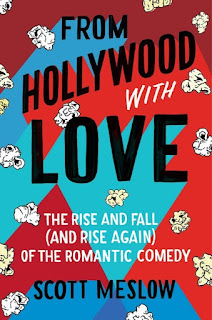
Scott Meslow's "From Hollywood with Love"

Scott Meslow is a senior editor at The Week magazine and a writer and critic for publications including GQ, New York magazine, and The Atlantic.

Meslow applied the “Page 99 Test” to his new book, From Hollywood with Love: The Rise and Fall (and Rise Again) of the Romantic Comedy, and reported the following:
Readers who turn to page 99 of From Hollywood with Love: The Rise and Fall (and Rise Again) of the Romantic Comedy will find one of the book’s many sidebars, which covers the debate over whether the 1996 film adaptation of Terry McMillan’s Waiting to Exhale falls back on racist and sexist imagery as it tells a story centered on four Black women.

Page 99 doesn’t exactly crystallize everything I’m doing in From Hollywood with Love — for starters, the book is a history and cultural analysis of 16 different romantic comedies, of which Waiting to Exhale is only one — but I do think it’s an interesting slice to pull out. I like that this page showcases a rigorous, meaningful debate about a movie in the rom-com genre, which is full of movies that were wrongly and snobbishly dismissed by film critics when they were released.

In her 1996 essay collection Reel to Real: Race, Sex and Class at the Movies, bell hooks argued that Waiting to Exhale trafficked in tired racist and sexist stereotypes but was given a pass because the creative team behind it was largely Black. Terry McMillan, the novelist and co-screenwriter of Waiting to Exhale, said she was telling a specific story about specific characters, and that treating Waiting to Exhale as if it was a document making blanket statements about all Black men or all Black women was, in itself, problematic.

Which argument carries more water? I think they’re both worth considering. The important thing, I'd argue, is that the movie itself is both important and sturdy enough to warrant the conversation.
Visit Scott Meslow's website.

--Marshal Zeringue

Thursday, February 3, 2022

Greg Brennecka's "Impact"

Greg Brennecka is a staff scientist and cosmochemist at Lawrence Livermore National Laboratory. After his doctoral work at Arizona State University, he received the prestigious Sofja Kovalevskaja fellowship from the Alexander von Humboldt Foundation to study the early Solar System at the Institute for Planetology in MĂĽnster, Germany, where he led the “Solar System Forensics” group for five years. Brennecka's research has appeared in Science, Nature, and Proceedings of the National Academy of Science. He lives in the Livermore Valley wine country and fully enjoys the local flavors.

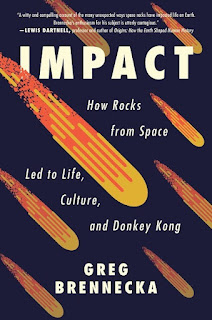
Brennecka applied the “Page 99 Test” to his new book, Impact: How Rocks from Space Led to Life, Culture, and Donkey Kong, and reported the following:
The focus of page 99 in Impact, and the chapter page 99 is part of, explores how most of “learned academia” in the late 1700s viewed rocks falling from the sky—[from page 99 of the book] "either completely ignored or cast away as senseless stories from attention-seeking simpletons with a flair for the dramatic.” While the great scientific mind of Aristotle set us on an incorrect path about the source of falling stones, many scientific heavyweights such as Sir Isaac Newton and Antoine Lavoisier reaffirmed those incorrect ideas. It took a handful of careful individuals, and some well-timed meteorite falls at the turn into the 19th century to convince “experts” that rocks could come from outer space and land on Earth.

I feel the test works for my book…on page 99 there are quotes from skeptical scientists at the time mixed in with mildly snarky commentary from yours truly, which is a reasonable summation of at least this section of the book.

Beyond the scientific debate about the source of meteorites that comically rages on page 99, Impact in general discusses the importance of meteorites on Earth as a planet as well as its human inhabitants. It is hard to imagine an Earth without the influence of meteorites…what would Earth be like without the Moon, or biology? What would humanity be like without electronics? What would Christianity or Islam be like without cosmic intervention? Sure, the dinosaurs were killed off by a meteorite setting the stage for mammals to take over the planet, but neither dinosaurs nor mammals would have existed in the first place if rocks from space pelting Earth hadn’t made it possible. My goal with Impact is to expose as many people as possible to the interesting and important history of meteorites on our planet. This includes how meteorites have influenced us, in raw materials, historical influence, and scientific discovery—and I try to do this through entertaining stories, poorly drawn figures, and a sense of humor.
Follow Greg Brennecka on Twitter.

--Marshal Zeringue

Wednesday, February 2, 2022

Peter Richardson's "Savage Journey"

Peter Richardson has written critically acclaimed books about the Grateful Dead, the iconic rock band; Ramparts magazine, the legendary San Francisco muckraker; and Carey McWilliams, the radical author, journalist, and editor of The Nation magazine.

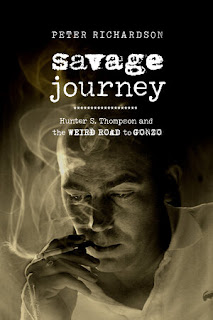
Richardson applied the “Page 99 Test” to his new book, Savage Journey: Hunter S. Thompson and the Weird Road to Gonzo, and reported the following:
That page of Savage Journey reflects four key themes in the book. First, it starts a chapter on the origins of Gonzo journalism. Eventually, Thompson's signature style would make him a cultural celebrity for decades. Second, that page discusses Thompson's relationships with his editors, which the book treats at some length. In addition to partnering with illustrator Ralph Steadman, Thompson benefited from the talents of very skilled editors. Third, that page mentions the assassinations of Dr. Martin Luther King Jr. and Robert F. Kennedy. The political violence of that period pushed Thompson toward political commentary, which was hyperbolic but often prophetic. Finally, that page mentions Richard Nixon's 1968 campaign in New Hampshire, which Thompson covered for Pageant. Thompson's contempt for Nixon was intense--so intense, in fact, that it brought out some of his best work. (One of Thompson's biographers called Nixon his muse.)
Visit Peter Richardson's blog.

--Marshal Zeringue

Tuesday, February 1, 2022

Harvey Whitehouse's "The Ritual Animal"

Harvey Whitehouse is a leading anthropologist whose research focuses on the role of ritual in the evolution of social complexity. One of the founders of the cognitive science of religion, his publications include Religion, Anthropology, and Cognitive Science (co-edited with James Laidlaw; 2007), Mind and Religion: Psychological and Cognitive Foundations of Religiosity (co-edited with Robert N. McCauley; 2005), and Modes of Religiosity: A Cognitive Theory of Religious Transmission (2004).

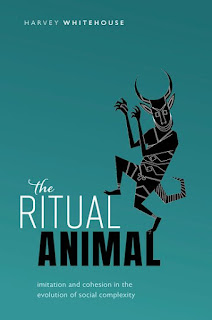
Whitehouse applied the “Page 99 Test” to his new book, The Ritual Animal: Imitation and Cohesion in the Evolution of Social Complexity, and reported the following:
Page 99 [inset below left; click to enlarge] of The Ritual Animal does indeed pass the Page 99 Test! It explains how certain kinds of collective rituals fuse our personal and group identities together (producing ‘identity fusion’) in a way that has had huge consequences for human behaviour across the ages and continues to shape the world we live in today. Why? The book goes into a lot of evidence on this topic but the nice thing about page 99 is that is summarises some of the key features. Firstly, collective rituals can remind us of events that have transformed both our personal and our group identities - this is one of the key reasons why they produce identity fusion. They can also create feelings of fusion temporarily by getting us to march, dance, or chant in synchrony. This creates the fleeting illusion that self and group are one single body. Think of soldiers marching in time or football fans shouting the same chant or crowds at a rock concert singing along together - these acts of social synchrony makes us feel like we and the group are one - which is the essence of identity fusion. Page 99 goes on to explain that when people are fused with a group they will stop at nothing to defend it and this is crucial to understanding acts of military heroism but also, much more darkly, forms of violent extremism such as suicide terrorism. It’s all there on one page of the book! But you have to read the rest to understand how extensively this is supported by psychological experiments, surveys, field studies, historical records, and even brain scans. The book argues that we need to get our head around these bodies of evidence to understand what makes people do extreme things for the sake of a group. And understanding this is the first step to discovering better ways of managing human nature to foster more consensual and peaceful outcomes.
Visit Harvey Whitehouse's website.

--Marshal Zeringue