Wednesday, January 5, 2022

Andrew R. Polk's "Faith in Freedom"

Andrew R. Polk is Associate Professor of History at Middle Tennessee State University.

He applied the “Page 99 Test” to his new book, Faith in Freedom: Propaganda, Presidential Politics, and the Making of an American Religion, and reported the following:
If readers were to open to page 99 of Faith in Freedom, they would find themselves near the beginning of the fourth chapter and at the point where the religious propaganda I uncover has just started to shift totally away from the control of religious representatives. The page discusses Harry Truman’s somewhat spotty record of fighting racial injustice throughout his administration, yet highlights his formation of the President’s Committee on Civil Rights. That group eventually released its report, To Secure these Rights, that explicitly condemned American bigotry and intolerance, past and present. Despite knowing the political consequences of his actions, Truman issued executive order 9981 a few months later, which called for the integration of the armed forces. That action nearly cost Truman the 1948 presidential election, but he overcame the defection of many southern democrats and numerous bad polls to win the election.

The page 99 test is somewhat of a mixed bag for my book. It works well in that it gives the reader a sense of my style and sets up the irony of Truman’s later acquiescence to his propagandists’ insistence that racial bigotry be ignored by patriotic Americans. However, the page misses the core argument of the book, which is that the Christian nationalism and civil religion people recognize in the Religious Right of the 1980s and in White evangelical supporters of Donald Trump today are actually legacies of the religious propaganda campaigns of Franklin Roosevelt, Truman, and Dwight Eisenhower in the mid-twentieth century. The politicians, advertising executives and military public relation experts who constructed the propaganda all agreed that even mentioning America’s racial injustices was tantamount to disloyalty bordering on heresy. However, race was not at the center of their construction, and readers who start on page 99 might think otherwise.

In truth, the point of the religious propaganda I document was to unite the nation in support of specific political objectives. At first, the goal was to unite the country to fight during the Second World War, but those early campaigns were used as a template for the much more robust campaigns during the early Cold War. To convince Americans that the nation needed a large standing military and in support of free market economic policies, these propagandists created massive public relations campaigns to convince the American public that the nation was religious at its core. Yet that patriotic religion also insisted that anyone who did not support the preferred policies and positions of its architects hated America, supported the communists, and opposed religion and God Almighty. The result was a strict dichotomy within American culture that combined religion and politics in dangerous and divisive ways. It’s that legacy that Americans are still wrestling with today.
Learn more about Faith in Freedom at the Cornell University Press website.

--Marshal Zeringue

Tuesday, January 4, 2022

Michael J. Rosenfeld's "The Rainbow after the Storm"

Michael J. Rosenfeld is Professor of Sociology at Stanford University. He is a social demographer who studies mating and dating, the Internet's effect on society, and family history and family law, especially as they relate to same-sex couples and their children. He is the author of many articles, and the books The Age of Independence: Interracial Unions, Same-Sex Unions, and the Changing American Family (2007) and The Rainbow after the Storm: Marriage Equality and Social Change in the US (2021).

Rosenfeld applied the “Page 99 Test” to The Rainbow after the Storm and reported the following:
From page 99:
Lessons of Romer and Baehr (1996):

When gay people appeared in court in the U.S. before the 1990s, the courts had not been required to take them seriously. Many people, especially gay men, were simply processed in local courts for offenses like solicitation that derived from the illegality of gay sex. If gay sex was illegal, as it still was in many states, gay people’s claims to equal citizenship were not likely to receive a fair hearing. Gay plaintiffs in civil cases often fared just as poorly. One jus­tice in the Minnesota Supreme Court actually stood up and turned his back on lawyers representing same-sex marriage plaintiffs Baker and McConnell in 1971. Justice White’s majority decision in Bowers v. Hardwick in 1986 expressed a fundamental disdain for the idea that the law should treat gay people as the equals of straight people, as if the very idea of equality of gay and straight people was preposterous.

Because U.S. courts had never had to take gay defendants or gay plaintiffs seriously, it was not obvious how gay rights issues would be adjudicated if and when they ever were taken seriously. Kennedy’s majority decision in Romer v. Evans showed for the first time from the nation’s highest court in an affirmative way that gay people were entitled to be treated as the equals of straight people. If gay people had to be treated as equal citizens, then a variety of discriminatory policies and assumptions were on the chopping block. The constitutional assumptions behind a variety of antigay discriminatory poli­cies were going to turn out to be grossly insufficient once they were examined closely.

Just as the flimsy constitutional bases for antigay discrimination had escaped scrutiny for decades, so too had the scientific and pseudo-scientific background for antigay policies escaped official scrutiny for decades. Social science had been making tremendous strides in understanding same-sex couples and their children in the 1970s, 1980s, and 1990s, but U.S. courts had rarely been forced to listen to the social science. Instead antigay poli­cies were backed by sham science, prejudice, and faulty assumptions. The Baehr v. Miike trial in 1996 put the defenders of same-sex marriage bans on the witness stand and showed them to be either unconvincing or charlatans. The empirical social science foundation on which antigay policies had been made and justified turned out, on close examination, to be vacant. If you held it up to the light, you could see right through it.
Does the text from page 99 give a good account of what the whole book is about?

Yes, page 99 is a good window into this book. The Rainbow After the Storm is about how marriage equality came to be the law of the US before almost anyone thought it was possible. One of the great turning points was the Baehr v. Miike same-sex marriage trial in Hawaii in 1996, where the marriage equality plaintiffs won. Prior to the Baehr trial the opponents of marriage equality had never faced a trial before so the public had never gotten to see how un-scientific and vapid the anti-marriage-equality arguments and experts were. The book of course ties together a lot of additional threads that are not present on page 99. The book has an in-depth discussion of the public opinion survey data and what it tells us about the change in gay rights over time. There is a deep discussion of the three important same-sex marriage trials, and of the social science and social scientists on both sides of those trials. And there is a discussion of why LGBT Americans have seen their status and rights improve so much in the US while other groups and rights claimants have not seen the same kind of progress.
Learn more about The Rainbow after the Storm at the Oxford University Press website.

--Marshal Zeringue

Sunday, January 2, 2022

Alexander B. Downes's "Catastrophic Success"

Alexander B. Downes is Associate Professor of Political Science and International Affairs and co-Director of the Institute for Security and Conflict Studies at The George Washington University. His book Targeting Civilians in War (2008) won the Joseph Lepgold Prize awarded by Georgetown University for the best book in international relations published in that year.

Downes applied the “Page 99 Test” to his new book, Catastrophic Success: Why Foreign-Imposed Regime Change Goes Wrong, and reported the following:
Page 99 of Catastrophic Success consists of a figure that shows the effect of experiencing a foreign-imposed regime change on the likelihood of a civil war occuring in that country over the ensuing decade. The figure, which is derived from a data set of all country-years from 1816 to 2008, demonstrates that suffering a regime change at the hands of a foreign power more than doubles the probability that a civil war breaks out over the following ten years. It also shows that different types of regime changes have different effects. Regime changes in which outsiders install a new (usually autocratic) leader have the largest effect on the likelihood of civil war, increasing it more than threefold. Regime changes that construct political institutions in addition to emplacing new leaders have a smaller positive effect, whereas such interventions that restore the most recent leader to power (typically reversing a coup or a regime change by another power) have no impact on the probability of civil war.

Anyone opening the book to page 99 would get a partial but somewhat misleading idea about the book as a whole. Page 99 is in the chapter on foreign-imposed regime change and civil war. But the book also includes chapters on how regime change affects the tenure of imposed leaders (they are more likely to be overthrown violently) and its effect on relations between the regime changer and its target (on average they do not improve, and regime changes that empower new leaders without institutional support increase the likelihood that the two states engage in militarized conflict).

The theory in my book explains these unhappy outcomes through two mechanisms. The first, which I call military disintegration, argues that foreign invasions for regime change sometimes cause the armies in target states to collapse and scatter. The dispersal of armed men around the country (e.g., Iraq in 2003) or across a border (e.g., Afghanistan in 2001) provides the raw material for ousted leaders or their allies to launch an insurgency against the new government and/or the foreign occupier. The second, which I refer to as the problem of competing principals, observes that while foreign-imposed regime change is meant to install leaders with similar preferences to the intervener's, it overlooks the fact that there is a second player in the game--the domestic public in the target state, which typically holds different preferences. Because the preferences of the new leader's internal and external "principals" diverge, and each can threaten the leader's survival in office, the leader faces a difficult dilemma: no matter what he does, he is likely to anger one or the other. If the leader hews to the intervener's wishes, internal conflict is the likely result; if she adheres to the domestic public's views, conflict (or at best poor relations) with the intervener is the likely outcome.
Visit Alexander B. Downes's website.

--Marshal Zeringue

Friday, December 31, 2021

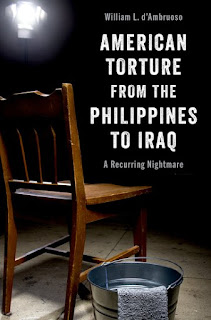
William L. d'Ambruoso's "American Torture from the Philippines to Iraq"

William L. d'Ambruoso is a fellow with the International Security Program and the Project on Managing the Atom at the Belfer Center for Science and International Affairs in the Kennedy School of Government at Harvard University. He previously taught courses on wartime violence and international security at Bates College.

He applied the “Page 99 Test” to his new book, American Torture from the Philippines to Iraq: A Recurring Nightmare, and reported the following:
The central puzzle of American Torture from the Philippines to Iraq: A Recurring Nightmare is why torture has recurred in America’s wars against weaker foes. Page 99 marks the dawn of the recurrence, following torture by U.S. soldiers in the Philippines decades earlier. Torture by the Central Intelligence Agency in Vietnam is best told as an origins story, beginning with how the CIA became empowered in the first place, and what the agency and its overseers understood to be its mission. Page 99 marks the rise of the CIA from the ashes of the Office of Strategic Services, the United States’ World War II intelligence agency. The OSS had garnered a reputation for daring and success during the war, and champions of a permanent peacetime intelligence agency wanted to retain the OSS’s clandestine capabilities and interest in “underhanded tricks.” Thus, the CIA became the agency to which presidents turned for activities that were “extra-legal and sometimes illegal,” according to an OSS agent who played a formative role in the agency’s creation. Harry Truman reluctantly signed off on the creation of the organization, and CIA research on “behavioral control,” among other interests, began. Dwight Eisenhower would prove much more enthusiastic about the CIA’s secretive arm, and his pick for CIA director, OSS veteran Allen Dulles, endorsed the development of psychologically coercive interrogation methods that eventually showed up in CIA interrogation manuals and in Vietnam. For Eisenhower, Dulles, and others, the United States was going to have to bend and sometimes break rules in order to compete with Communists who could fight the Cold War unencumbered by norms and laws.

The ninety-nineth page does not contain the heart of the book, but it functions as a bridge between the pre-CIA and CIA eras. Since the agency is a major character in my tale of American torture following World War II, Page 99 is, in a sense, the beginning of the rest of the story.

The “underhanded” and “psychological” methods were not just more easily hidden than scarring torture techniques; agents and supportive politicians could also attempt to play them down as something less than torture in the event of exposure. We see a similar pattern today with respect to democratic norms in the United States and elsewhere. Because democracy lies at the end of a sliding scale, vigilance is required to avoid slipping incrementally into quasi-authoritarian rule and beyond.
Learn more about American Torture from the Philippines to Iraq at the Oxford University Press website.

--Marshal Zeringue

Thursday, December 30, 2021

Jacob Doherty's "Waste Worlds"

Jacob Doherty is Lecturer in Anthropology of Development at the University of Edinburgh.

He applied the “Page 99 Test” to his new book, Waste Worlds: Inhabiting Kampala's Infrastructures of Disposability, and reported the following:
From page 99:
[Enviro Clean Services was the company that] “came closest to enacting the idealized geography of responsible disposal envisioned in the 2000 waste management ordinance. As such, they illustrated the challenges of operating strictly within the legal framework governing Kampala’s waste and reveal, by their absence, the constitutive role of parasites in the political ecology of disposal. Founded by Andrew Egunyu, a Soroti-born businessman who left Uganda to study engineering in the Netherlands, where he stayed on to work in the aviation industry for nearly twenty years, ECS entered the Kampala market in 2013. At the behest of old friends, now prominent in the Kampala business community, Andrew returned to Uganda with a business plan and an idealist’s urge to contribute to the development of his nation’s capital city. His urge for development led him to a principled commitment to formality, to operating exclusively above board and by the books, and to refusing to pay any bribes or cut any regulatory corners. This commitment to the normative waste stream’s infrastructure of responsibility, however, ultimately contributed to the collapse of the company.

Andrew ran ECS from a small office in a repurposed half shipping container situated on a dusty road across from a guesthouse in an emerging middle-income neighborhood in northern Kampala. Victor Opeda brought me to the office to meet his new boss on a rainy day in April 2013, and the three of us shouted through a conversation as rain loudly lashed the roof and walls of the office. After the downpour passed, Andrew told me that ECS had attracted capital from investors in Qatar to purchase six brand-new, modern garbage trucks. At the moment, however, they only had 150 clients, enough to send out one truck twice a week. Even then, the trucks reached the landfill only three quarters full and the company lost money every time they sent out a truck. Adding fifty more clients in the residential areas they were already serving would make the route profitable, and Andrew preached patience.

As a marketer for EnviroClean Services, Victor was trying to expand the company’s business to the suburbs on the south side of Kampala, near his home in Gaba. He needed just one big anchor client to open up the market. He targeted Speke Resorts, the plush lakeside resort owned by Uganda’s wealthiest man, Sudhir Ruparelia, known simply as Sudhir. Victor knew how much plastic went to waste at Speke Resorts and wanted to set up recycling bins to “get it when it is still clean.”…
Reading page 99 gives a good sense of Waste Worlds as a whole for both the argument being made and the way it is presented. The page introduces ECS, a private waste management company doing its best to comply with the legal framework governing waste in the city. This is the beginning of an ethnographic analysis of the company’s operations and their struggles to establish themselves in the market that illustrates the ways that the so-called formal and informal sectors of the waste economy depend on and mutually produce one another.

On page 99 itself we can see several critical elements of Kampala’s waste infrastructures in practice. Far from isolated or city-scale formations, they are entangled with trans-national movements of people, goods, and capital. Market incentives structure the provision of waste management services, making emergent middle class neighborhoods key sites for the elaboration of new modes of waste collection, marketing, and thus relations between people and their discards. Waste workers have an intimate knowledge of the materiality of the city’s waste streams and ways of capturing and realizing value from them; this knowledge is productive of new geographies of waste collection. The state plays a central role in the production of waste economies, differentially legalizing and criminalizing aspects of the city’s waste management infrastructure that appear as discrete economic sectors, but are in fact deeply enmeshed. This combination of the criminalization of and dependency on the so-called ‘informal sector’, Waste Worlds argues, is how disposability takes place not simply as exclusion, but as a form of injurious inequitable inclusion in contemporary urban space.
Learn more about Waste Worlds at the University of California Press website.

--Marshal Zeringue

Wednesday, December 29, 2021

Steven L. Goldman's "Science Wars"

Steven L. Goldman is Andrew W. Mellon Distinguished Professor in the Humanities, Emeritus, at Lehigh University. He earned a BS in physics from the Polytechnic Institute of Brooklyn and an MA and PhD in philosophy from Boston University. For two years, he taught at the Graduate Faculty of The New School for Social Research before becoming Assistant Professor of Philosophy at Pennsylvania State University. He taught logic and the history and philosophy of science and co-founded the STS Program at Penn State. He then moved to Lehigh where he held the Mellon Professorship for 39 years prior to his recent retirement.

Goldman applied the “Page 99 Test” to his new book, Science Wars: The Battle over Knowledge and Reality, and reported the following:
Page 99 uses Linnaeus' extremely influential system for classifying plants to illustrate my thesis that from its seventeenth century beginning, modern science incorporates an unresolved conflict between theories as interpretations of experience or accounts of reality.The difference is profound, especially with respect to the public's understanding of scientific knowledge claims with respect to public policies. The discussion of Linnaeus is one example of this with respect to taxonomies, which are employed at some point in all the sciences. Linnaeus was heir to a century-long debate among naturalists as to whether taxonomies of plants and animals could be 'natural", that is, could uniquely correspond to the way things were in nature, or whether they were only conventional, useful ways for us to organize available data, thus multiple and subject to change. On page 99 I explain that Linnaeus was deeply committed to formulating a natural taxonomy of plants, but ultimately was forced to acknowledge that his beautiful system (still in use today) was only conventional. I use an analogy with books to make the issue clear. Is there one correct way to classify a collection of books? Obviously, not. So why do scientists persist in seeking the one correct way to organize empirical data?

Opening my book to page 99 will give a browser a good idea of what this book is about as well as the historical approach I adopt, using concrete examples, of which there are scores, from Plato to Quantum Field Theory.

The test works as a window opened onto the central argument of the book, but, understandably, it gives only a partial view. From the beginning of the book, I use the words and ideas of scientists themselves to show how conflicted they are over the question of what the object of scientific theories is: experience or reality. From the seventeenth century to the present, scientists have known, intellectually, that it is logically impossible to prove that any theory corresponds to reality, no matter how many experiments confirm its predictions. Nevertheless, psychologically they seem unable to refrain from claiming that experimental confirmation "proves' that a theory does correspond to reality. This is just as true of the relativity and quantum theories as of Newton's theories of light and graviy. Through its examples, the book shows that scientists have been aware of this overestimation of scientific knowledge claims for centuries and have swept it under the rug, so to speak, in the face of increasingly strident criticism, climaxing in the Science Wars of the 1980s and '90s.
Learn more about Science Wars at the Oxford University Press website.

--Marshal Zeringue

Tuesday, December 28, 2021

Neil Richards's "Why Privacy Matters"

Neil Richards is one of the world's leading experts in privacy law, information law, and freedom of expression. He holds the Koch Distinguished Professorship at Washington University School of Law, where he co-directs the Cordell Institute for Policy in Medicine & Law. He is also an affiliate scholar with the Stanford Center for Internet and Society and the Yale Information Society Project, a Fellow at the Center for Democracy and Technology, and a consultant and expert in privacy cases. He is the author of Intellectual Privacy.

Richards applied the “Page 99 Test” to his new book, Why Privacy Matters, and reported the following:
From page 99:
Sometimes there is little or nothing we can do to prevent others from disclosing information about us. This can happen when companies set up pricing systems that rely on information disclosure, like “safe driver” discounts for car insurance contingent on your agreeing to have a black-box data controller in your car, especially if such boxes were to become standard in passenger cars. Or when your child’s school decides to use a “learning management system” or other software that has privacy practices only the school can agree to. Or when a company voluntarily discloses data it collected about you to the government. Or when someone discloses their genetic data to a company, which, since blood relatives have very high genetic similarities, means they have also shared sensitive information about their close family members.

This last example is how the notorious murderer and rapist known as the Golden State Killer was caught in 2018, using data from GEDMatch, a basic Florida website that allowed people to upload their genetic profiles to help with genealogical searches and filling in blank spots in family trees. Police took old genetic material from crime scenes and uploaded the sequenced genome to GEDMatch. That produced a pool of potential relatives of the killer, which the police used to identify Joseph James DeAngelo, a seventy-two-year-old man living in Citrus Heights, California. (They also confirmed his identity using DNA of his on a tissue they found in his trash, but that’s a different privacy issue.) And while it might be hard to muster too much sympathy for the privacy travails of a serial killer, the Golden State Killer example nicely illustrates how such privacy unraveling could also be used to reveal paternity, disposition to genetically linked diseases like breast cancer, and many other facts about us that (unlike being a serial killer) are no fault of our own. Perhaps even more important, the phenomenon of unraveling happens entirely outside the realm of consent, a gap in consent that is just further evidence that Privacy as Control cannot bear the tremendous weight that has been placed on it.

The limitations of Privacy as Control are thus numerous. Simple to state and noble in theory, it nevertheless operates in practice as a smokescreen under which companies control humans rather than humans controlling their data.
If someone were to open my book Why Privacy Matters randomly to page 99, they would get an excellent idea of what my book is about – and of why privacy matters! My book is about privacy, about human information, and about how our information confers power over us. To put it simply, privacy matters because in an information society, privacy is power. Privacy advocates, lawmakers, and even companies have argued for many years that the best way to protect privacy is to put us in control of our privacy by giving us choices about how our information is used. But in Why Privacy Matters, I show how control is an illusion in our modern, networked world. Thinking about privacy as control might seem great in the abstract, but in practice it is overwhelming, with innumerable choices about privacy for every one of the dozens of digital services and hundreds of websites the typical consumer uses or visits in a year. And on page 99, I argue that even if we could somehow solve the problem of overwhelming control, control is insufficient to protect our privacy because other people’s choices can affect what people know or do with our information. The example of the use of leaked DNA data to catch the Golden State Killer is one example of how other people’s choices about information can affect us, though there are many others. Instead of treating privacy as merely an individual value that can be bartered or frittered away by individuals, we need to recognize that the set of rules we put in place for how our human information is collected and used has social consequences for the society that we – and our children and grandchildren – will inhabit. We need better privacy rules, ones that advance the human values of letting us develop our political and personal identities as humans, securing our political and democratic freedoms as citizens, and protecting us as consumers and full members of the digital economy and society.
Learn more about Why Privacy Matters at the Oxford University Press website.

--Marshal Zeringue

Monday, December 27, 2021

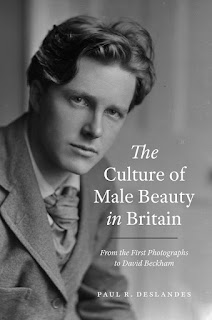
Paul R. Deslandes's "The Culture of Male Beauty in Britain"

Paul R. Deslandes is Professor and Chair of the Department of History at the University of Vermont. He is the author of Oxbridge Men: British Masculinity and the Undergraduate Experience, 1850-1920 and of the Great Courses lecture series and short book titled Notorious London: A City Tour. He has also published multiple essays and articles on the history of education, masculinity, sexuality, fashion, hair, and dress and written on higher education pedagogy. His interests in beauty have led him to an editorial role overseeing a multivolume collection (for Bloomsbury) titled A Cultural History of Beauty. Deslandes is currently at work on a new book that examines transatlantic architectural and design exchanges between Britain and North America between the 1870s and the present.

He applied the “Page 99 Test” to his new book, The Culture of Male Beauty in Britain: From the First Photographs to David Beckham, and reported the following:
Page 99 comes about a third of the way into the project’s third chapter, which is titled “Artists, Athletes, and Celebrities.” It is here that I examine how racial scientists, artists, and ardent physical culturists sought to define not only a particular vision of muscular and youthful manhood but also the peculiar abilities that late Victorian and Edwardian Britons thought they possessed to assess, judge, and categorize it. More specifically, page 99 discusses the important role that the painter Henry Scott Tuke (1858-1929) played in the culture of male beauty when he captured youthfulness, litheness, and Whiteness in his depictions of sailors and young men swimming off the Cornish coast. On this page, I focus on both reviews of his work and the ways in which certain same-sex desiring men like John Addington Symonds saw, within his canvases, great aesthetic potential. A full one half of my page 99 is taken up by a Tuke photograph of two unidentified male nudes on a beach.

In my own assessment of how the “Page 99 Test” holds up in my book, I would say, fair-to-middling. The project, which chronicles the history of male beauty, male body aesthetics, and male grooming and adornment from the rise of photography in the 1840s right up to the present, is concerned with documenting the influence that individuals, like Tuke, had in articulating standards of attractiveness and encouraging Britons to be active and informed consumers of the male nude. In this way, page 99 captures an important goal of the project: to illustrate the global reach of British artistic and body culture and to showcase how representations of certain physical types informed the complex racial histories and attitudes that characterized imperial Britain. Page 99 also contains a reference to a Cadbury’s Cocoa advertisement, highlighting the role that the beautiful male face and body played in commodity culture from the Victorian era on. The photograph that takes up fifty percent of the page’s space tellingly highlights the project’s great reliance on visual culture and visual sources in narrating this revealing history.

Despite the considerable insights about my book that might be gleaned from a quick glance at page 99, some topics are left unnoted. Not present on this page is the book’s prolonged emphasis on the role that good looks played in creating commercial or professional advantages in Britain’s capitalist society or the relationship that existed between grooming, attractiveness, and the rise of the modern psychological self. Also not evidently displayed on page 99 are personal accounts of grooming rituals, articulations of sexual desire, or aesthetic responses. Absent in the book, though, they are not. These are documented in the many places where I focus on letters, diaries, and, most interestingly, data gathered by organizations like Mass Observation (in the 1930s-1940s and, again from the 1980s) and projects like the National Lesbian and Gay Survey (in the 1980s-2000s). Intended to tell this story from multiple perspectives, The Culture of Male Beauty in Britain reminds readers not only that beauty matters but also that, when its history is uncovered, it is anything but skin deep.
Learn more about The Culture of Male Beauty in Britain at the University of Chicago Press website.

--Marshal Zeringue

Sunday, December 26, 2021

Rashmi Sadana's "The Moving City"

Rashmi Sadana is Associate Professor of Anthropology at George Mason University and author of English Heart, Hindi Heartland: The Political Life of Literature in India.

She applied the “Page 99 Test” to her new book, The Moving City: Scenes from the Delhi Metro and the Social Life of Infrastructure, and reported the following:
I think readers would get a fairly good idea of The Moving City by flipping (or scrolling) to page 99, which is a little less than halfway through the book. Page 99 does reveal the book’s style (accessible, first-person narrative), its main themes (metro/subway systems, the everyday life of city-dwellers, the impact of infrastructure on the urban landscape), and the “quality of the whole” (to quote Ford Madox Ford). Page 99 takes the reader into the home of Delhi’s former Chief Minister Sheila Dikshit, who was in office during the building of the first three phases of the Delhi Metro (the first multiline metro system in South Asia). She gives a view from above about the political wrangling involved in the project and the need the city had for this kind of transport. Yet this page also contains an intimate look at a politician at the end of her career, surrounded by aides and suffering from various forms of loss.

What page 99 does not show readers is how The Moving City is mostly about the people who ride the Metro and how the system has affected their daily itineraries, their sense of place, and their broader aspirations in life. It’s mostly a book about different forms and intersections of social mobility through the prism of transport. My interview with Sheila Dikshit on page 99 reflects the parts of the book where I talk to politicians, urban planners, and architects in order to understand their involvement with the making of the Metro and their ideas about the city and its development. It’s a key part of the book, but not the only part. What readers also might miss by only reading page 99 is that the book is told as a series of ethnographic vignettes, very short stories or scenes, each ranging from a paragraph to a few pages in length. The 75 vignettes that make up the book are interlinked, but I tell readers in the introduction that they could read them in or out of order. The Moving City is a set of narratives, but the book also questions the linear narratives of stories, lives, ideas of progress, and the meaning of Delhi’s Metro. The form of the book mimics the starts and stops of the Metro itself. Readers get taken on a ride, in a sense!
Learn more about The Moving City at the University of California Press website.

--Marshal Zeringue

Friday, December 24, 2021

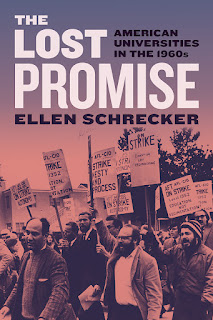
Ellen Schrecker's "The Lost Promise"

Ellen Schrecker is a retired professor of history at Yeshiva University and the author of numerous books, including No Ivory Tower: McCarthyism and the Universities, Many Are the Crimes: McCarthyism in America, and The Lost Soul of Higher Education: Corporatization, the Assault on Academic Freedom, and the End of the American University.

She applied the “Page 99 Test” to her latest book, The Lost Promise: American Universities in the 1960s, and reported the following:
If the book’s readers reach page 99, they will have read only 28.7% of The Lost Promise. It’s a long book, but page 99, which deals with the immediate aftermath of the 1964 Free Speech crisis at Berkeley, comes at a major turning point in the story of how American higher education coped with the social and political upheavals of the 1960s.

The Berkeley Free Speech Movement was the first and most well-known student protest of the entire decade. It provided a foretaste of what was to come – students taking over a campus building to protest an official policy and an administration under outside pressure calling in the police. As page 99 shows, some of Berkeley’s eminent, yet confused, professors first voted to support the students and then had second thoughts. Those regrets presage the academic community’s internal conflicts over the campus unrest of the late 1960s and early 1970s that constitute a central theme of The Lost Promise.

Ten years ago when I began to work on this book, I did not plan to write the first comprehensive account of the most turbulent moment in the history of American higher education. My original project was a short quasi-memoir about my own cohort of faculty activists in the 1960s. But I could not tell my people’s story without explaining how the academy handled the two main challenges of the sixties: its own massive expansion and the social and political ferment sweeping through the rest of the country.

As America’s public colleges and universities doubled and tripled in size, they sought to provide a low-cost, high-quality college education to all students able to take advantage of it. That mission changed the culture of academe -- not only because of the previously excluded students and teachers surging onto the campus, but also because of the newfound emphasis on research imposed by almost every school.

The conflicts these changes produced were exacerbated by the social and political turmoil of the sixties. From the start colleges and universities were pulled into the struggles for racial equality and against the Vietnam War. In fact, many of those struggles began or intensified on the nation’s campuses. As the student unrest spread from top-tier institutions to lesser-known ones, professors and administrators found themselves blindsided by the totally unprecedented challenges they faced.

Because of the negative publicity the protests attracted, the public’s support for America’s once highly respected institutions declined. Buffeted by the economic crises of the late 1960s and 1970s, increasingly hostile lawmakers ended their previously unlimited generosity to their states’ colleges and universities. The 1960s’ bright promise of near-universal public higher education disappeared. We feel that loss to this day.
Learn more about The Lost Promise at the University of Chicago Press website.

--Marshal Zeringue