Wednesday, September 15, 2010

Colin Dueck's "Hard Line"

Colin Dueck is associate professor of public and international affairs at George Mason University. He is the author of Reluctant Crusaders: Power, Culture, and Change in American Grand Strategy.

He applied the “Page 99 Test” to his new book, Hard Line: The Republican Party and U.S. Foreign Policy since World War II, and reported the following:
Hard Line tells the story of conservative and Republican Party foreign policy traditions in the United States since World War II. I argue that Republican foreign policies have long been influenced by a hawkish and intense American nationalism, but that specific approaches within that broad framework have been very much determined by presidential leadership. Page 99 of the book illustrates the point, by introducing President Eisenhower’s policies toward Latin America. As I describe on that page:
Eisenhower believed, as he said, that “in the long run, the United States must back democracies.” Nevertheless, he faced a dilemma that was also faced by every cold war president of either party: namely, whether to pressure allied yet autocratic regimes in the direction of democratic reform, when the very process of such pressure might simply undermine an American client and substitute a hostile autocracy in its place. Eisenhower’s instinct in such cases was to bolster American allies.
Interestingly, it was none other than fellow Republican George W. Bush who repudiated this “realist” approach to foreign policy, by embracing forcible democratization in Iraq as a solution to America’s national security challenges. Clearly there is a considerable range of specific foreign policy traditions on the Republican side, and I sketch out these differences through a series of biographical essays. But the leeway presidents receive on foreign policy, including from within their own party, means that future Republican presidents need not replicate Bush’s exact approach. I end the book with some predictions as to where Republicans may be headed on foreign policy issues, and also with some recommendations for a new conservative realism that gets beyond the frustrations of the Bush era.
Read an excerpt from Hard Line, and learn more about the book at the Princeton University press website.

--Marshal Zeringue

Tuesday, September 14, 2010

Steven Bryan's "The Gold Standard at the Turn of the Twentieth Century"

Steven Bryan is an attorney in Tokyo. He received his Ph.D. in history from Columbia University and his J.D. from Harvard Law School.

He applied the “Page 99 Test” to his new book, The Gold Standard at the Turn of the Twentieth Century: Rising Powers, Global Money, and the Age of Empire (Columbia University Press, 2010), and reported the following:
Surprisingly enough (for me) page 99 is fairly representative of the themes in my new book The Gold Standard at the Turn of the Twentieth Century: Rising Powers, Global Money, and the Age of Empire.

On page 99 I am in the final of three chapters about adoption of the gold standard in Argentina in the 1890s. In this chapter I discuss the law ostensibly establishing the gold standard – “Law 3871.”

The first two paragraphs wrap up a section about the Argentine statesman Carlos Pellegrini and his obsession with his “two utopias” of industrial protectionism (i.e., protective tariffs) and the gold standard (i.e., gold currency), which shaped his vision of the Argentine and world economy.

Pellegrini constructed a currency system for Argentina that took the core of nineteenth-century English economic institutions and turned it on its head to promote a protectionist, export driven model of the world economy more reminiscent of Friedrich List, or modern day China, than Adam Smith.

As a result, Argentine enthusiasts of English political economy opposed Pellegrini’s system because they believed it was not “the gold standard” in the English, laissez-faire sense that they knew.

And, in that, they were correct.

But rather than being an exception to the age, Pellegrini’s combination of English institutions with statist and protectionist ideas was common in what I call the “second nineteenth century” dominant in the years before World War I. It was here that a “first nineteenth century” reminiscent of globalization ideas and institutions of the 1990s gave way to a messier, less theoretical, and more power obsessed conception of the world economy.

As I write on page 99:
That Pellegrini would resort to a cobbled together arrangement of nominal conversion, paper issues, devaluation, and protective tariffs is not itself especially surprising given Argentina’s economic conditions and the not all that different combinations in countries such as the United States, Japan, and Germany. This combination, however, fit awkwardly with English economic theory and the English image of the gold standard. It was thus among adherents of English political economy and English ideas of the supremacy of gold currency that Pellegrini’s currency proposals and Law 3871 had their fiercest critics. And it was this opposition that underlined the considerable distance between Law 3871 and what its hard money and laissez-faire critics regarded as the only “true and universal money” – gold.
The final two paragraphs on page 99 start a new section about these traditional supporters of English political economy left behind by the protectionist and interventionist preferences of the age.

As I continue on page 99:
The fact that Pellegrini’s currency proposals and Law 3871 were predicated on the state’s intervening in currency markets (and devaluing paper to prevent it from appreciating toward its nominal parity) made support from advocates of English political economy unthinkable. Add in the motives of protectionism and industrial promotion and there remained virtually no common ground uniting Pellegrini and his free trade, laissez-faire opponents.
British institutions might be adopted, and the rhetoric of English liberalism might be employed in new nineteenth-century powers such as Germany, the United States, Argentina, and Japan. But the adoption worldwide of British economic institutions in the late-nineteenth century rested on bases fundamentally opposed to the British worldview and, ever more declining, British power. As a result, the late-nineteenth century world produced a globalized world economy radically at odds with that of the turn of the twenty first century.
Learn more about The Gold Standard at the Turn of the Twentieth Century at the Columbia University Press website.

--Marshal Zeringue

Monday, September 13, 2010

John Owen's "The Clash of Ideas in World Politics"

John M. Owen IV is associate professor of politics at the University of Virginia.

He applied the “Page 99 Test” to his new book, The Clash of Ideas in World Politics: Transnational Networks, States, and Regime Change, 1510-2010 , and reported the following:
On page 99 you catch me in the middle of describing the rapid spread of a new and potent branch of Christianity – Calvinism – in the third quarter of the sixteenth century. Why am I doing this in a book that is supposed to illumine world politics today, particularly in the Muslim world?

The Clash of Ideas in World Politics is about long struggles over the oldest question in politics, “What is the best regime?” – struggles that stretch across entire continents and decades. These struggles are over ideas, but also over which types of people and which countries have more or less power; and so they can draw countries into conflicts they might otherwise have avoided. Just as the Muslim world today is torn by a prolonged contest between various forms of secularism and Islamism, sixteenth- and seventeenth-century Europe was wracked by a prolonged contest over which was the true church. That early struggle seems non-political to us today, but most Europeans back then insisted that societal cohesion required religious uniformity. Religious uniformity in turn required state enforcement and hence intimacy between church and state.

The upshot was that Calvinism’s spectacular spread threatened the political order, and the actual power of actual people, in Catholic (and Lutheran) lands. Where Calvinists took power, as in Scotland or the Netherlands, any resurgence of Catholicism was, by the same token, a threat to order and the power of real people. In subsequent pages I go on to show how the back-and-forth contest between Catholicism and Calvinism triggered waves of civil war and foreign intervention, as when the Protestant Elizabeth I of England sent troops to France to help the Calvinists against the Catholics.

If this has an oddly familiar ring, it is supposed to. The substance of the disputes in the Muslim world today is quite different in many ways from that in Europe 450 years ago. But transnational contests over the right way to order society display some of the same dynamics today as they did then.
Read an excerpt from The Clash of Ideas in World Politics, and learn more about the book at the Princeton University Press website.

Visit John M. Owen IV's website.

--Marshal Zeringue

Saturday, September 11, 2010

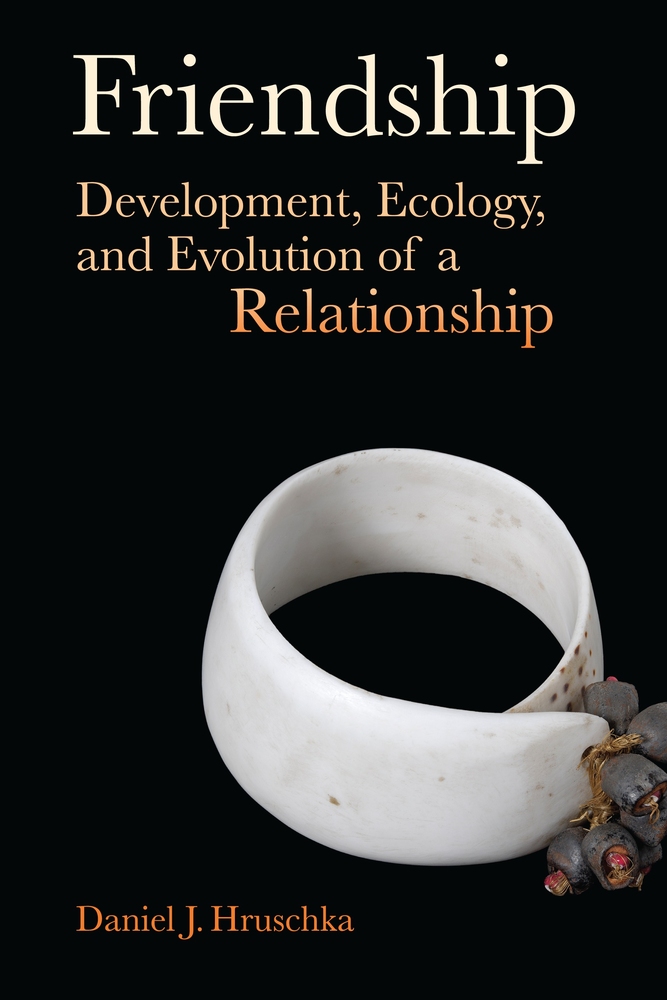
Daniel Hruschka's "Friendship"

Daniel Hruschka is Assistant Professor of Anthropology in the School of Human Evolution & Social Change at Arizona State University.

He applied the “Page 99 Test” to his new book, Friendship: Development, Ecology, and Evolution of a Relationship, and reported the following:
Friendship imagines the human bond of friendship as a living organism and poses a number of questions that a natural historian might ask. How does friendship work? How does it develop and change in diverse environments? And how did it evolve? On page 99, I examine why people devote so much time and energy to making friends when in many societies they have ready-made support networks in the form of parents, brothers, sisters, aunts, uncles, and cousins. Based on case studies from a wide range of human groups, including foragers, subsistence farmers, and nomadic herders, I describe a recurring reason for preferring friends. Put simply, kin may not be in a position to provide the right kind of support. Consider the case of Basuto farmers in southern Africa:
A single Basuto household rarely commanded all of the four resources—oxen, land, seed, and food for workers—necessary for farming. To remedy this situation, households frequently entered into cooperative partnerships called seahlolo, whereby each household provided some combination of these resources. The two seahlolo partners were expected to work together and harvest together, dividing the crop equally. While classical views of rural, non-industrial societies suggest that Basuto farmers would make every effort to enter into seahlolo with kin, in the majority of cases they chose unrelated households.
Based on accounts from Basuto farmers, Sandra Wallman, concludes that a key reason for preferring friends was that kin did not have the right resources to be good seahlolo partners. Specifically, two brothers may both own an ox, but neither owns necessary seed or land. Two cousins may possess seed, but no land or oxen. Similar problems arise in a wide variety of human societies.
In a small village in Andalusia, Spain, a farmer may have no kinsmen with a sufficient leverage to plead his case in a water dispute. In Melanesia, a gardener may need to travel to other islands to acquire obsidian and high-quality pots. Among Orokaiva gardeners in Papua New Guinea, there may be no kin in safe areas when warfare breaks out near home.
In each of these cases there are crucial gaps in the kin support network, and non-kin friends often provide a means to fill those gaps.

More generally, Page 99 captures a central concern in the book—understanding how human friendships articulate with other kinds of human relationships, such as those based on kin ties, sexual attraction, romantic attachment, and emotionally distant business-like transactions. Through such comparisons, the book identifies how friendship is a unique way of relating among humans.
Learn more about Friendship at the publisher's website.

--Marshal Zeringue

Thursday, September 9, 2010

Lawrence Culver's "The Frontier of Leisure"

Lawrence Culver teaches in the History Department at Utah State University. He is currently a Carson Fellow at the Rachel Carson Center at Ludwig-Maximillians University in Munich, Germany. In 2005, he received the Rachel Carson Prize for best dissertation in Environmental History.

He applied the “Page 99 Test” to his new book, The Frontier of Leisure: Southern California and the Shaping of Modern America, and reported the following:
The Frontier of Leisure explores the history of tourism, resorts, and recreation in Southern California, how this leisure culture shaped the development of the region, and in turn influenced American suburbia after World War II. Page 99 examines one local resort, Santa Catalina Island. In the 1920s and 1930s Catalina was one of the most popular tourist destinations in California. Page 99 discusses Catalina in the 1890s, when it first emerged as a summer resort. On this page, I describe the most common form of tourist housing at Catalina:
Tent cabins, with plank floors and canvas walls stretched over wooden frames, provided shelter for many vacationers, whether they built their own on lots they bought or leased, or rented tents in the Santa Catalina Island Company’s tent-cabin village. Some such “cabins” could be relatively elaborate. One tourist, writing in August 1898, bragged that her abode was “one of the most picturesque here,” with a view of “the whole bay, the town, and the mountains.”
In some ways, the most striking thing about this resort is how different it is from tourism in our own era. High-end resorts now try to out-“luxe” each other, and visitors rush from hiking to yoga to a day spa while still tethered to their daily work routine via a smartphone. The idea of spending summer in a tent sounds both spartan and stultifying. Yet, even in this seemingly quaint era, there are hints of changes to come in Catalina’s only town, Avalon:
In the summers of the 1890s, Avalon was often a place dominated by mothers and children. Husbands remained on the mainland to work, but spent weekends in the cooler, relaxed atmosphere of Catalina. In this regard, Catalina portended the stereotypical suburban family of the 1950s, with fathers traveling to work elsewhere and mothers remaining at home with their children. This arrangement divided spouses but offered a remarkable degree of autonomy to adolescents and young adults who accompanied parents or friends to the island.
At Catalina, restricted to the wealthy and white, teenagers and young adults found a remarkable degree of freedom. They roamed all over the island long after their parents had gone to bed. They ventured to places such as Lover’s Cove, hinting at amorous adventures forbidden on the mainland, but possible at Catalina. In this sense, tourism, whether in 1898 or 2010, offers an escape from the ordinary. Catalina’s Victorian tourists would have been scandalized by a tourism slogan like “What happens in Vegas, stays in Vegas.” Yet everyone travels to escape everyday life, even if only briefly.

In the case of The Frontier of Leisure, the “Page 99 Test” illustrates that tourism is a lens through which we can view cultural and social change. Catalina offered more freedom to young people, but future resorts would welcome a far more diverse clientele, from African Americans to gay and lesbian tourists, and elements of Southern California’s leisure culture, from ranch houses to backyard swimming pools and residential golf communities, would appear across the U.S. We may try to get away from it all, but tourism’s evolution reflects changes not only in our leisured life, but in our everyday lives as well.
Learn more about The Frontier of Leisure at the Oxford University Press website.

--Marshal Zeringue

Wednesday, September 8, 2010

Julian Cribb's "The Coming Famine"

Julian Cribb is an award-winning journalist and science writer and the author of The White Death.

He applied the “Page 99 Test” to his new book, The Coming Famine: The Global Food Crisis and What We Can Do to Avoid It, and reported the following:
On page 99 The Coming Famine says:
The role played by the oceans in our efforts to double the world’s food supply could thus be far below their potential – indeed, they could exacerbate the coming famine instead of helping to avert it.
Yup. We’re running out of fish. But were also running low on fresh water, good farming land, oil, mineral fertilisers, farming technology and stable climates. In short, everything the world is going to need to feed 10 billion people on richer diets sustainably by the 2060s will become more scarce.

Look at it this way: the world fish catch is currently 100mt a year – but it is stagnant due to overfishing (and ocean pollution). Marine scientists agree we’re very unlikely to get another 100mt of protein from the sea.

So we’ll have to get it from the land – from land animals or farmed fish. And that is going to take a billion tonnes of grain and 1000 cubic kilometres of water.

Add all this to the 185mt of extra meat which the UN Food & Agriculture Organisation thinks we’ll be eating by 2050 – and we’re going to have to discover three more North Americas to grow enough feed for these extra animals (or fish). A quick trip to Google Earth will tell you undiscovered continents are in short supply.

That’s the central contention of The Coming Famine – big demand for food, not enough resources to grow it using our present methods. So we need to change some things.

Is the problem insoluble (and famine inevitable)?

No way!

But we should take the necessary action, as individuals, as farmers and as governments, right now to avoid trouble and sustain our food supply. As to what the action is, you’ll have to read the other 200 pages.
Read an excerpt from The Coming Famine, and learn more about the book at the University of California Press website.

--Marshal Zeringue

Monday, September 6, 2010

Richard Toye's "Churchill's Empire"

Richard Toye was born in Cambridge, U.K. in 1973. He studied at the universities of Birmingham and Cambridge, and is now an associate professor at the University of Exeter. He has written extensively on British and international history. In 2007 he was named Young Academic Author of the Year by Times Higher Education magazine for his book Lloyd George and Churchill: Rivals for Greatness.

Toye applied the “Page 99 Test” to his new book, Churchill's Empire: The World That Made Him and the World He Made, and reported the following:
Page 99 of Churchill’s Empire is quite representative of the book, although it deals with an episode that seems in many ways distinctive in relation to Churchill’s imperial views over the course of his career. Part of my aim in writing was to show that Churchill’s reputation as a right-wing imperial Diehard, although not exactly incorrect, derives very much from his activities in the 1930s and after. P. 99 discusses events in 1906, when he was just starting his ministerial career, in a junior role at the Colonial Office. Two years earlier, he had left the Conservative Party for the Liberals (in the 1920s he would switch back). He now came under attack from his former colleagues for an alleged radicalism that was supposedly putting the Empire under threat.

The issue in question now seems an obscure one: the system of Chinese indentured labour in South Africa, which had played a surprisingly prominent part in the election campaign that the Liberals had just won. The Liberals had played it up as a humanitarian question, using the label ‘Chinese slavery’. Once in office, though, the new government took a more moderate line, restricting the system and leaving to the future the question of whether it would continue once the Transvaal (one of the two former Boer republics defeated in the South African war of 1899) had achieved self-government as part of the British Empire. This would be for the Transvaal parliament itself to decide. But Churchill stated to the House of Commons that no matter how well a proposal from the Transvaal was supported by public opinion there, the British government would not shrink from vetoing any new law that offended the principles of liberty and decency. Why was this controversial? As I explain on p. 99:
Traditionally, the use of the Crown’s right of veto of colonial governments’ decisions was restricted to matters affecting the rights of British subjects elsewhere or Britain’s relations with foreign powers. It now seemed as though Churchill was claiming a general right to interfere in the business of any self- governing colony that offended Liberal ministers’ sense of right and wrong. […] British South Africans were outraged by the speech. ‘The Cabinet must not forget it is dealing with its own flesh and blood’, declared the Rand Mail: ‘We will not forgo the birthright of freedom we have inherited.’ Another South African paper, the Star, thought the speech ‘a gratuitous insult to every self-governing colony’.
I believe that Churchill found such criticism quite bruising, and his ‘radical’ imperial phase, such as it was, was short-lived. Within months he had moved back onto safer and more conventional lines, although he did not yet become as right-wing as he did in the interwar period, when he returned to the Conservatives. However, Churchill underwent many changes throughout his career and demonstrated numerous contradictions; so in some ways p. 99 is typical of the book in its atypicality.
Read an excerpt from Churchill's Empire, and learn more about the book at the publisher's website.

--Marshal Zeringue

Saturday, September 4, 2010

Hal Brands' "Latin America's Cold War"

Hal Brands is Assistant Professor at the Sanford School of Public Policy, Duke University. He is the author of From Berlin to Baghdad: America’s Search for Purpose in the Post-Cold War World.

He applied the “Page 99 Test” to his new book, Latin America's Cold War, and reported the following:
Latin America's Cold War is a book about some very depressing subjects--violence, guerrilla warfare, great-power intervention, economic underdevelopment, and government repression, to name a few. These issues were at the heart of Latin American affairs during the Cold War, a period when superpower tensions joined together with political, social, and diplomatic conflicts within Latin America to make sharp and often bloody upheaval a prominent feature of the regional panorama. My book traces these tumults from the late 1940s through the early 1990s. It covers events like the U.S. intervention in Guatemala in 1954, the Cuban revolution and the Cuban missile crisis, the waves of insurgency and counterinsurgency that convulsed the region, the rapid swings between dictatorship and democracy in many countries, and the astoundingly bloody civil wars in Central America during the 1970s and 1980s.

Page 99 of my book covers the background influences that shaped one particular wave of disorder during this period--the violent guerrilla movements that popped up in much of South America during the late 1960s and 1970s. These movements drew inspiration from a wide array of sources--frustration with unresponsive or authoritarian rule, anger at declining economic conditions, a desire to emulate the upheaval that gripped much of the world in the late 1960s, and other factors. The urban guerrillas hoped that that, by kidnapping wealthy citizens and attacking police stations, they would lay bare the weaknesses of the South American governments and inspire the populace to rise up in revolution.

As it turned out, though, the actions of the urban guerrillas merely set the stage for a devastating response by South American conservatives and military establishments. The specter of violent revolution galvanized these groups, leading them to mount military coups and unleash a barrage of bloody repression against the guerrillas and anyone suspected of supporting them. The guerrillas had hoped to inspire revolution; they ended up provoking counter-revolution instead.

This theme played out numerous times in Cold War-era Latin America. Left-wing radicalism elicited right-wing radicalism (vice-versa), leading to brutal internal battles in countries from Guatemala to Argentina. All of this was frequently exacerbated by the global ideological tensions that characterized the Cold War, as well as the meddling of outside powers like United States and Castro's Cuba. The result was the violence, polarization, and tragedy that plagued Latin America during the Cold War.
Read more about Latin America's Cold War at the Harvard University Press website.

--Marshal Zeringue

Thursday, September 2, 2010

Rebecca Karl's "Mao Zedong and China in the Twentieth-Century World"

Rebecca E. Karl is Associate Professor of History at New York University. She is the author of Staging the World: Chinese Nationalism at the Turn of the Twentieth Century, and a co-editor of Rethinking the 1898 Reform Period: Political and Cultural Change in Late Qing China and Marxism beyond Marxism.

She applied the “Page 99 Test” to her latest book and reported the following:
In my newly published book, Mao Zedong and China in the Twentieth-Century World: A Concise History (Duke University Press 2010), page 99 begins the most difficult chapter I had to write. It is the about the promising premise but practical disaster of Mao’s version of socialist economics, promoted during the Great Leap Forward in the late 1950s. The chapter opens:
With the anti-rightist campaign in full swing, rural collectivization all but completed, and urban private property and industries now under state ownership, Mao was in a good mood in the summer of 1957. Even the Party leaders with whom he’d been at odds were back on his side. In a July article prepared for a meeting in Qingdao of provincial leaders, Mao noted that the difficulties China was facing were part of the struggle “between the two roads – socialism and capitalism.” He added, “Complete victory in this struggle will take a very long time. It is a task for the entire transition period.” Clearly, capitalism as an economic system no longer existed in China. Here, “capitalism” meant “bourgeois thought” and “rightism,” while “socialism” pointed to revolutionary consciousness, or, increasingly, loyalty to Mao himself.
Here, I’m setting a scene filled with individual and philosophical conflict: Mao vs. the Communist Party; collective vs. private ownership of property; and most important, socialism vs. capitalism as historical choices of economic and social organization.

The book has been leading to this particular series of conflicts, but this passage also exemplifies my general conceptual strategy of combining the individual (Mao) with the historical-philosophical forces that made Mao possible. The chapter that begins on page 99 was hard to write because so much written about socialism and Maoism is profoundly judgmental.

I wanted to write about these topics seriously by paying real attention to the theoretical and historical considerations underlying Mao’s choices in the late 1950s; thus, I did not want to dismiss it all as some crazy scheme dreamt up by a tyrant. What I wanted to do was to show that there was real thought and hope behind the choices that were made, all of which went disastrously and tragically wrong especially in the late-1950s and early-1960s.

In large part, page 99 does turn out to be representative of the book as a whole. I’d never heard of Ford Madox Ford’s saying, but I’ll now pay far more attention to writing a good page 99!
Read more about Mao Zedong and China in the Twentieth-Century World at the publisher's website.

--Marshal Zeringue

Wednesday, September 1, 2010

Samuel Moyn's "The Last Utopia"

Samuel Moyn is Professor of History at Columbia University.

He applied the “Page 99 Test” to his new book, The Last Utopia: Human Rights in History, and reported the following:
On page 99 of The Last Utopia, I am in the midst of a chapter on anticolonialism and human rights. I embarked on it because I had long been puzzled by the fact that, even though their most visible successes came precisely in the era of the Universal Declaration of Human Rights (1948) and after, anticolonialists didn’t seem to define themselves as a “human rights movement.” Why not?

Some scholars have seen in the emancipation of the world’s peoples from colonial rule a straightforward precedent for the human rights movements of a later era, while other, more sophisticated historians have looked more carefully at whether and when anticolonialists actually invoked the Universal Declaration or the notion of human rights. (For a state of the art assessment of where the discussion stands, let me also recommend Jan Eckel’s fine article in the inaugural issue of Humanity, a new journal that some friends and I are launching this fall.)

In my opinion, the general conclusion has to be that the concept of human rights remained wholly peripheral to anticolonial ideology in its different versions, for a series of reasons my chapter lays out. First, anticolonialism was forged earlier than human rights. Second, and far more important, human rights did not emerge as a definitively anticolonial political language.

After all, not only did the chief energies in the construction of post-World War II human rights concepts originate in the then colonial powers – Britain and France but also Belgium and the Netherlands – but they substituted for the much more emphatically anticolonial concept of collective self-determination as this construction took place. Self-determination had been one of the most inspirational promises of wartime, especially in the famous Atlantic Charter of 1941, but it did not make it into the Universal Declaration, and this was no accident. You could have human rights, apparently, without self-rule.

Page 99 tells the story of how, once they fought and negotiated their way to sovereignty, and therefore to power in the United Nations General Assembly, the “new states” that had not been present in 1948 took their revenge: they invoked human rights as a corollary of self-determination:
Most obviously, the epoch-making Declaration on the Granting of Independence to Colonial Countries and Peoples of 1960 confirmed the near equivalence of human rights and self-determination. According to its text, “faith in fundamental human rights” means the “inalienable right to complete freedom” of “all peoples.” Its essential significance was to make the UN a newly exciting forum for the fight against empire. “The colonial system ... is now an international crime,” Amilcar Cabral, Guinean scourge of Portuguese domination, exulted, in response. “Our struggle has lost its strictly national character and has moved to an international level.” Dramatically, this elevation of anticolonialism to the level of international institutions coincided with the Sharpeville massacre in South Africa, which amplified the country’s stigmatization and led to a number of UN resolutions on human rights grounds.

These resolutions and other kindred events show that human rights were defined by antiracism and anticolonialism more generally, fully reversing the imperialist entanglements of the concept of human rights in the postwar moment. Indeed, even as Portuguese Angola came in for immediate attention, India cited the 1960 declaration explicitly in its own December 1961 invasion of Portuguese Goa. In 1962, explaining how best to honor the fifteenth anniversary of the Universal Declaration, the General Assembly approved a resolution effectively linking the celebration of the advancement of human rights with that of the attainment of independence from colonial rule: it defined the hope for the future realization of human rights as another “decisive step forward for the liberation of all peoples.” The Declaration on the Elimination of All Forms of Racial Discrimination was proclaimed in the same spirit the following year, with a convention following two years later—the convention approved the same day as the Declaration on the Inadmissibility of Intervention in the Domestic Affairs of States and the Protection of Their Independence and Sovereignty with its remarkable paean to self-determination.
In the larger structure of the book, these events form an essential part of the background of the unexpected rise of “human rights” in our own time. Though anticolonialism skirted human rights in its glory years, its redefinition of them at the United Nations in the vein of collective self-determination proved fateful all the same. Human rights would have to be redefined again later, to bear the meaning they have today – in which independence and “sovereignty” are no barriers to their global applicability. As Arthur Schlesinger, Jr., put it in 1977, the breakthrough year of human rights, “States may meet all the criteria of national self-determination and still be blots on the planet. Human rights is the way of reaching the deeper principle, which is individual self-determination.”

Born by substituting for collective self-determination, human rights would depend on its suppression again to take on their meaning and role today. The circumstances in which that occurred are explored in the balance of my book.
Learn more about The Last Utopia at the Harvard University Press website.

--Marshal Zeringue