Thursday, June 30, 2022

Tanya Stivers's "The Book of Answers"

Tanya Stivers is a Professor of Sociology at UCLA. She is the Director of the Center for Language, Interaction, and Culture and the President of the International Society for
Conversation Analysis. She has studied social interaction in clinical encounters with a focus on the way that patient interaction with physicians shapes diagnostic and treatment outcomes. Her research on everyday conversation has explored a range of aspects of response design including timing of responses, who responds, and the design of the response. She is the author of Prescribing Under Pressure: Physician-Parent Conversations and Antibiotics and the co-editor of Person Reference in Interaction: Linguistic, Cultural, and Social Perspectives and The Morality of Knowledge in Conversation.

Stivers applied the “Page 99 Test” to her new book, The Book of Answers: Alignment, Autonomy, and Affiliation in Social Interaction, and reported the following:
If we open The Book of Answers to page 99, a reader learns the heart of the difference between answering a yes-no question with a “Yeah” type answer versus answering it with an “Of course” type answer. The difference hinges on whether the person answering the question does anything more than going along with the questioner’s agenda, agency, and design. Why might it matter? Well, let’s make this concrete with a question like “Do you wanna grab lunch?” Whereas “Yeah” goes along with the proposal hook, line, and sinker, “Of course” does something a little different: with that response, the answerer contests that the question didn’t really need to be asked because “No” wasn’t really a possible answer.

The page 99 test gives the reader a sense of this book’s mission. It happens to be partly a summary of the most common type of answers people given to yes-no questions: Yeah/Mm hm type answers or what I call “Unmarked interjections”. As such, the summary gives the reader a short version of that baseline type of answer and we get a brief introduction to one of the more unusual types of answers that contrast with unmarked interjections, “Marked interjections” like “Of course” or “Absolutely.”

At the heart of The Book of Answers is the idea that even something as small as a one or two-word answer to a simple yes-no question is part of how we build, maintain, or tear down our social relationships. Answers to the question of grabbing lunch like “Yeah”, “Mm hm”, “Sure”, “Okay”, “Of course”, “Definitely” or even “I do” or “Tomorrow” are all part of our continual interactional calibrations bringing us closer or making us more distant from those in our lives because we do a lot of our relating to one another through question-answer exchanges.
Learn more about The Book of Answers at the Oxford University Press website.

--Marshal Zeringue

Wednesday, June 29, 2022

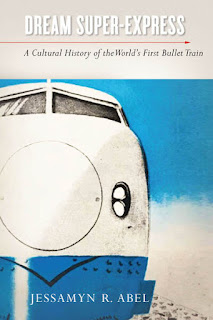
Jessamyn R. Abel's "Dream Super-Express"

Jessamyn R. Abel s a historian of Japan and Associate Professor in Asian Studies at Pennsylvania State University. She is the author of The International Minimum (2015).

Abel applied the “Page 99 Test” to her new book, Dream Super-Express: A Cultural History of the World's First Bullet Train, and reported the following:
A potential reader opening to page 99 of Dream Super-Express would get very little sense of the book’s argument and might not even understand that it was about the debut of the world’s first bullet train in 1964. But they would see an example of its methodology.

That page is almost entirely taken up by a 1965 Japanese monster movie poster, followed by a description of relevant aspects of its plot. It is undoubtedly one of the book’s more visually interesting pages, dominated by a picture of the monster Gamera astride an elevated track, grasping an unfortunate bullet train, with the ruins of its destructive rampage through Tokyo behind it: crumbling structures symbolizing postwar Japanese democracy, industry, and technological prowess. However, aside from the image of the titular “dream super-express” in the monster’s claws, it fails to convey a clear idea of what the book is about. The passage in question is a somewhat tongue-in-cheek discussion of the monster movie in a chapter on the bullet train’s transformation of the space of the Tōkaidō region linking Japan’s major cities of Tokyo, Nagoya, Kyoto, and Osaka.

A reader inspired to continue for two more pages would find an interpretation of the fictional creature’s ultimate fate as an echo of what that chapter’s analysis of the bullet train reveals about the social construction of space: though ruling forces may seek to shape space through development of new infrastructures and technologies, they can never control it completely, as other actors (including the train itself) constantly reinvent that space according to competing ideas, interests, and exigencies. This is fairly representative of the book as a whole, which shows how the bullet train, built over the course of the early 1960s, interacted with major historical trends of its times, including the development of popular protest movements, the emergence of the “information society” concept, the reconstruction of public memory of war and empire, and the use of technology in public diplomacy.

Therefore, the test works in that page 99 evokes the method of reading all sorts of materials—popular films, of course, but also government reports, news articles, essays, advertisements, novels, television shows, and more—to find out what people thought about the bullet train. Why, in the age of jet travel and the beginnings of space exploration, were people so excited about a train? Gamera doesn’t answer the question, but he shows us how.
Learn more about Dream Super-Express at the Stanford University Press website.

--Marshal Zeringue

Tuesday, June 28, 2022

Rebecca Cypess's "Women and Musical Salons in the Enlightenment"

Rebecca Cypess is associate dean for academic affairs and associate professor of music at the Mason Gross School of the Arts, Rutgers University. She is the author of Curious and Modern Inventions: Instrumental Music as Discovery in Galileo’s Italy.

Cypess applied the “Page 99 Test” to her new book, Women and Musical Salons in the Enlightenment, and reported the following:
Women and Musical Salons in the Enlightenment is about the extraordinary musicianship of a group of women who hosted social–musical gatherings in eighteenth-century Europe and colonial North America. At a time when few women had access to a formal education and when women’s roles in the public sphere were limited, these women used their musical salons to gain an education and have an impact on their broader musical environment.

Page 99 of my book is about the analogy between music and conversation. Both of these were central to the experience of musical salons: the salon hostess and her guests would play, sing, and listen to music together, and they alternated those experiences with commentary, eating and drinking, playing games, and other social activities. One of these salon hostesses was Suzanne Necker, whom I quote on page 99: “One of the charms of the spirit and of conversation is to be able to bend to the spirit, to proper love, and to the ideas of others, in waves, if one may use the expression, and like the accompaniment in music.” For Necker, musicians must learn to accommodate each other politely and artfully, just as conversationalists must do.

This idea is important to my book, but it doesn’t represent the whole story. Necker’s words about the analogy between conversation and music are rather vague. I’m interested in digging more deeply, and with greater detail, into the specific kinds of music-making that happened in salons. The book engages with compositions by women, their collections of musical scores, their letters, their diaries, and their performance practices, as well as specific observations that were made about them by some of the many visitors—both men and women—who attended their salons. Crucially, the book also features a companion website with audio examples that I made myself (I’m a historical keyboardist and director of the Raritan Players) as a way of trying out some of the salon performance practices that I was encountering. Those more detailed engagements with women and musical salons are more important to me than Necker’s generalization, interesting as it is.
Learn more about Women and Musical Salons in the Enlightenment at the University of Chicago Press website.

--Marshal Zeringue

Monday, June 27, 2022

Alexander M. Martin's "From the Holy Roman Empire to the Land of the Tsars"

Alexander M. Martin is Professor of History at the University of Notre Dame. He is the author of Romantics, Reformers, Reactionaries: Russian Conservative Thought and Politics in the Reign of Alexander I (1997) and Enlightened Metropolis: Constructing Imperial Moscow, 1762-1855 (2013).

Martin applied the “Page 99 Test” to his new book, From the Holy Roman Empire to the Land of the Tsars: One Family's Odyssey, 1768-1870, and reported the following:
Page 99 of From the Holy Roman Empire to the Land of the Tsars drops us into the middle of a family drama. In 1798, in the German town of Kassel, Johannes Ambrosius Rosenstrauch's marriage suddenly collapse. Why did Rosenstrauch's wife walk out on him? Page 99 explores what the fatal dispute could have been about: Money? Religion? His position as an outsider in Kassel? The low esteem in which his profession--he was a theater actor--was held by society?

Page 99 gives you an excellent sense of the book as a whole. This is a microhistory, that is, it uses something small as a lens for examining something big. The big thing is the Age of Revolution, from the late 18th to the mid-19th century, when the modern world came into being. The small thing is the colorful life of Rosenstrauch (1768-1835), an obscure but fascinating figure no one has ever heard of before.

Rosenstrauch was a lifelong migrant and seeker, and this makes him a microcosm of the Age of Revolution. He believed in the Enlightenment, then turned to religion. He was caught up in the Napoleonic Wars. Originally a Catholic barber-surgeon apprentice from Prussia, he ran away from home as a boy, eloped with a young woman, became an actor in Germany, a Freemason in Holland, a merchant in Russia, and finally a Lutheran pastor in Ukraine. Page 99 comes at a pivotal moment, because the breakdown of his marriage set in motion the series of events that led him to abandon Germany, Catholicism, and the theater, and make a new life for himself in Russia.

The point of the book is what one life can reveal about an era. The book has three leitmotifs. First, what was the world in which Rosenstrauch lived? To answer that question, I explore, for example, how German theater operated, how Enlightenment Europeans thought about love, or what it meant to take a carriage through the Ukrainian steppe.

Second, how did this world look to people at the time? Take, for instance, the moment when he moved to Russia: What might he have heard or read about the country? What challenges did such a trip entail? How did his own past memories affect his ideas about the future? In a word, what do we learn if we set aside our retrospective omniscience and put ourselves in Rosenstrauch’s shoes?

Finally, what can we actually know about a long-dead figure like Rosenstrauch? A lot of evidence survives for some aspects of his life, but for others—Who murdered his son? Why does his name appear in a letter from the Russian tsar? Was Rosenstrauch in fact his real name?—we can only speculate. A history like this, as the discussion of his marriage on page 99 shows, has much in common with the work of a detective.
Learn more about From the Holy Roman Empire to the Land of the Tsars at the Oxford University Press website.

--Marshal Zeringue

Sunday, June 26, 2022

Austin Sarat's "Lethal Injection and the False Promise of Humane Execution"

Austin Sarat is William Nelson Cromwell Professor of Jurisprudence and Political Science and Chair of Political Science at Amherst College. His books include Gruesome Spectacles: Botched Executions and America's Death Penalty (2014) and The Death Penalty on the Ballot (2019).

Sarat applied the “Page 99 Test” to his new book, Lethal Injection and the False Promise of Humane Execution, and reported the following:
Page 99 does not offer a particular insight into the whole of the book. It discusses one particular way in which states have responded to lethal injection's increasing problems. Three states, Arizona, Idaho and Oklahoma, include provisions in their execution protocols instructing officials what to do if a condemned inmate goes into cardiac arrest while being prepared for the execution. Those provisions instruct them that they should provide medical assistance and keep the inmate alive so the state can kill them on its terms. This is one of the most bizarre aspects of America's death penalty system.

My book offers many insights into the bizarre and often unusual world of lethal injection. But its real purpose is to offer both a short history of this execution method and its current status. That history shows that instead of being carefully designed, well thought out, the development of lethal injection was slipshod and unscientific. That is one of the reasons it has proven to be America's least reliable and most problematic execution method.

The problems with lethal injection have increased dramatically in the last decade as states have experimented with new drugs and drug cocktails. And, as they have encountered new problems, states have improvised and given officials responsible for carrying out executions either detailed instructions of the kind discussed on page 99 or enormous discretion with which to keep the machinery of death running.

My book exposes the illusory quality of this country's search for a humane method of execution.
Learn more about Lethal Injection and the False Promise of Humane Execution at the Stanford University Press website.

The Page 99 Test: Gruesome Spectacles: Botched Executions and America's Death Penalty.

--Marshal Zeringue

Friday, June 24, 2022

Susan H. Brandt's "Women Healers"

Susan H. Brandt is a Lecturer in the Department of History at University of Colorado, Colorado Springs. She received her undergraduate degree from Duke University and her PhD in History from Temple University. Brandt completed a fellowship at the University of Pennsylvania McNeil Center for Early American Studies. Her dissertation on women healers was awarded the 2016 Lerner-Scott Prize for the best doctoral dissertation in U.S. Women’s History by the Organization of American Historians.

Brandt applied the “Page 99 Test” to her new book, Women Healers: Gender, Authority, and Medicine in Early Philadelphia, and reported the following:
In her mid-eighteenth-century medical recipe manuscript Elizabeth Coates Paschall, a Philadelphia merchant and healer, asserted her ingenuity and authority with the bold strokes of her pen. Friends, kin, neighbors, and strangers sought her health care advice. On page 99 in my book, Women Healers, we find Paschall describing her experiments with the medicinal herb, nightshade. In addition to documenting her remedies, Paschall’s uniquely discursive manuscript describes patient interactions as well as women’s complex networks of medical information gathering and scientific experimentation.

Paschall transcribed a recipe for rheumatism that was “a True Copy” given to her by the healer Sarah Way of Chester County, who got it from her nephew Dr. John Pyle, who had migrated to North Carolina. With botanical precision, Paschall recorded the properties of Eastern black nightshade gleaned from her own experiences and from the botanical and medical texts that she checked out from the Library Company of Philadelphia. However, Paschall voiced concerns about the toxicity of nightshade. Before experimenting with this recipe on herself or using it to treat patients, Paschall jotted down a reminder to “inquire of John Bartram or Sons if that be wholesome taken inward.” Paschall’s cousin, John Bartram was internationally recognized as the King’s Botanist in North America, and his sons were pharmacists. They connected Paschall with transatlantic scientific networks that included luminaries such as Carl Linnaeus, the founder of botanical taxonomies. John Bartram’s wife, Ann Mendenhall Bartram, was a recognized healer who also participated in far-reaching webs of botanical information sharing and knowledge production. Page 99 describes how Paschall gave Ann’s medical expertise equal weight with that of the Bartram men. However, Ann Bartram exemplifies women healers who are almost invisible in an archival record that privileges the writings and accomplishments of male physicians and scientists.

A reader browsing page 99 would get an excellent idea of the key themes in my book, which include women’s engagement with eighteenth-century Enlightenment science and their appropriation of the authority of science to legitimize their healing practices. Elizabeth Paschall’s recipe book and her medical networks allow us to view the history of science from a grassroots rather than a top-down perspective. Paschall ignored prescriptive literature that denigrated women as too irrational to pursue medicine and science. Her recipe book is replete with her own innovative recipes and treatments, followed by the confident accolades “cured to admiration” and “cured when the doctors failed.” Euro-American, Native American, and African American women’s specimen exchanges and information sharing demonstrate that they were active participants in the construction of scientific knowledge at local, intercolonial, and transatlantic levels. Paschall and her colleagues recognized the emerging authority of empirical science, and they deployed its new rhetoric and methods of observation, experimentation, and documentation to authorize their healing practices. One of the main goals of my book is to write women healers back into the history of medicine and science.

Moreover, although women such as Paschall and Bartram were recognized as skilled healers in their communities, their practices are difficult for historians to recover. Women’s healing cultures were often transmitted through oral rather than written networks, leaving behind only shadowy traces.

Apart from a few foundational studies, women’s medical work, authority, and contributions to the health care labor force remain understudied. Page 99 highlights the variety of sources that I mined to unearth women’s practices, which include recipe manuscripts, letters, family papers, material objects, newspapers, local histories, and published herbals. My research demonstrates that Euro-American, Native American, and African American women continued to play a central role in health care in the greater Philadelphia area well into the nineteenth century. Professional women physicians, pharmacists, and nurses would later build on this foundation.
Learn more about Women Healers at the University of Pennsylvania Press website.

--Marshal Zeringue

Thursday, June 23, 2022

Paisley Currah's "Sex is as Sex Does"

Paisley Currah is a Professor of Political Science and Women’s & Gender Studies at Brooklyn College and the Graduate Center of the City University of New York.

Currah has written widely on transgender issues, including on topics such as discrimination, sex reclassification, and the transgender rights movement. He is the co-founder of the leading journal in transgender studies, TSQ: Transgender Studies Quarterly.

Currah applied the “Page 99 Test” to his new book, Sex Is as Sex Does: Governing Transgender Identity, and reported the following:
Opening up to page 99 of my book, one finds the beginning of a chapter titled, “Till Birth Do Us Part: Marriage, ID Documents, and the Nation-State.” On this page I describe both the left and the right’s criticism of identity politics, and of a transgender identity politics specifically: “For those critical of identity politics, the transgender rights movement often stands as its reductio ad absurdum, fixated as it seems to be on pronouns and bathrooms.” For the left, LGBT rights movements seek nothing more than inclusion and exclusion in the neoliberal order. For the right, it’s the erosion of traditional gender norms that’s the problem.

The Page 99 Test works very well for Sex Is as Sex Does: it introduces readers to the chapter that is, in my view, the heart of the book. In it, I ask, how is it possible that one might have an F on their driver’s license or birth certificate but be classified as M for other purposes? What should we make of the contradiction? On the following pages, I explain that, for identity documents like driver’s licenses, the standards for changing the M or F have generally been reformed to make it easier for transgender people to negotiate daily life—from opening a bank account to getting pulled over for a speeding ticket. But when trans people have had something to win or lose—in marriage cases involving money or child custody, for example—judges were much more likely to rule that one’s sex classification is fixed at birth for life.

This chapter articulates the book’s larger argument: when it comes to government decisions, sex as in M or F or now X, depends on the context, not on any ideal definition. The book’s approach is novel, and perhaps to many, a bit counter-intuitive. Rather than taking “transgender” and “transphobia” as analytical starting points, the book argues that decisions about the classification of trans people were historically a consequence not simply of transphobia but of other governing projects—from the gender-based oppression of women to mass incarceration to state surveillance.
Visit Paisley Currah's website.

--Marshal Zeringue

Wednesday, June 22, 2022

Matt Easton's "We Have Tired of Violence"

Matt Easton is a writer and a human rights researcher and advocate. The author of We Have Tired of Violence: A True Story of Murder, Memory, and the Fight for Justice in Indonesia, he has lived and worked in Indonesia, Timor-Leste, India, and Zimbabwe and now resides in New York.

Easton applied the “Page 99 Test” to We Have Tired of Violence and reported the following:
We Have Tired of Violence tells the story of one of the most remarkable and effective human rights lawyers Indonesia has ever seen. In September 2004, six years after he helped to bring three decades of authoritarian rule to an end, Munir boarded a plane in Jakarta, stopped briefly in Singapore, and then died on the long flight to Amsterdam.

Not long after Munir’s burial, his wife Suci asked to meet with the state airline, Garuda Indonesia, to learn more about what happened to her husband. She was also following up on a memory that nagged at her. A few days before Munir died, a man calling himself “Polly from Garuda” had called to ask when her husband was traveling. She’d told him, but immediately regretted it.

In October, at the end of a meeting with the head of the airline, Suci had asked if he had an employee named Polly. The airline employed thousands of pilots, but he’d answered without hesitation that there was, in fact, a co-pilot with the unusual name of Pollycarpus.

The scene on page 99 takes place soon after, in the beginning of November 2004. Accompanied by Munir’s friend and colleague Poengky, Suci is in the middle of a second meeting, this time with the crew from the first leg of Munir’s fatal journey, Jakarta to Singapore, on which he had eaten his last meal and spent his last healthy hours. Suci and Poengky have just learned a new and puzzling piece of information: Munir had been seated in business class.
“Why was he in business class?” Poengky asked. “Didn’t he have an economy ticket?”

[The purser from the flight] explained that while greeting passengers in business class, she’d been excited to recognize Munir, as she considered herself a fan. Munir had taken a seat that was assigned to a co-pilot flying to Singapore for an assignment. Onboard upgrades were very unusual, but the co-pilot assured her it was fine. His name was Pollycarpus.

Suci and Poengky asked to meet Pollycarpus.
The rest of the page describes the setting of her meeting with the co-pilot soon after. By the end of that meeting, Pollycarpus’s strange and inconsistent answers make Suci deeply suspicious:
Suci’s suspicions began to coalesce, until a thought came to her hard and sharp. It’s him. He did it, she told herself. Just keep him talking.
Just days later, a leaked Dutch autopsy revealed that Munir had been poisoned with a massive dose of arsenic.

The Page 99 Test gives a good sense of We Have Tired of Violence. The page reveals an early breakthrough in the unofficial murder investigation by Munir’s wife and friends, weeks before the police opened a file on his murder. You can see that the book has elements of a police procedural, charting the determined and creative efforts of Munir’s family and friends and a few committed police investigators to excavate the truth. But the story is also about the limits of investigation within a justice system corroded by its authoritarian past. Even years after the arrival of democracy, the system favors those with political influence, many of them familiar faces from the old regime.

Page 99 is also illustrative of the tone and style of the book. I tried to let the events and the protagonists speak for themselves, with just enough background to allow the reader to place them within Indonesia’s rich historical and political context. Like many narrative nonfiction authors, I sought to recreate scenes and dialogue based on any sources I could locate. For Suci’s meetings with the airline, I used contemporary notes of the meeting, a few photos, courtroom testimony, and interviews with participants in an effort to create an accurate, vivid scene with just enough details to allow readers to picture it, even though they may have little knowledge of Indonesia.
Visit Matt Easton's website.

--Marshal Zeringue

Tuesday, June 21, 2022

Matthew E. Kahn's "Going Remote"

Matthew E. Kahn is Provost Professor at the University of Southern California. He is author of eleven books, including Unlocking the Potential of Post Industrial Cities (joint with Mac McComas) and Adapting to Climate Change.

Kahn applied the “Page 99 Test” to his latest book, Going Remote: How the Flexible Work Economy Can Improve Our Lives and Our Cities, and reported the following:
On page 99 of Going Remote, I discuss how the locational choice of startup firms will be affected by the rise of Work from Home (WFH). In our recent past, startups ranging from Facebook to Uber moved to where the "action was" in order to be close to venture capitalists who finance such firms and to be physically close to the types of workers they needed to hire. Startups don't always succeed and this means that young workers have wanted to live in an area featuring many startups such that if one fails, they can move to another startup without having to uproot their lives by moving across the nation.

As more startups rely on WFH, these firms can even be virtual without having a physical location. This reduces their upfront costs and allows them to hire global talent. Such firms retain the option to open a physical location in the future. The nation's airport system, roads and trains allow such footloose workers to be physically connected to our major technology hubs such as Silicon Valley for face to face meetings.

Page 99 provides a good test for my book because it demonstrates how I think about the consequences of the rise of WFH in our Post-COVID economy. A "silver lining" of the COVID shock is that millions of us have experienced what we gain and lose from Working from Home. In my book, I argue that persistent WFH will change American's economic geography. Every firm and every qualified worker will have to think about the costs and benefits to them of engaging in WFH on at least a part-time basis. On page 99, I explore how startup firms can make the most of WFH. If we hadn't experienced the COVID shock, many startups would have followed the old tried and true method of renting real estate in some commercial building. The leadership of a startup knows what face to face interactions must take place in order for the firm to thrive. Such startups will be more likely to recruit a higher morale, more diverse workforce if the workers have the freedom to work from anywhere.

I do cringe at one typo I see on page 99. The grammar is correct but I used the wrong word and it changes the meaning of a key sentence. Cher has a hit song; "If I Could Turn Back Time." If I could turn back time, I would rewrite my sentence to make the following point. Urban economists cannot run randomized experiments where we randomly assign startups to locate in a Silicon Valley or to Nebraska or to be working from home. Since, we can't run such experiments we must rely on observational data as we observe which firms are productive and where they locate. These spatial patterns do not prove that the firm's location caused the firm to thrive. Why? We will never know the following "what if"; Facebook thrived when it located in Silicon Valley. Would it have been equally effective had it located elsewhere? My typo destroyed my attempt to teach the reader about whether great companies move to great places or do great places make companies great.
Follow Matthew E. Kahn on Twitter.

The Page 99 Test: Heroes and Cowards.

--Marshal Zeringue

Monday, June 20, 2022

John Suval's "Dangerous Ground"

John Suval is a Research Assistant Professor of History at the University of Tennessee, Knoxville, serving as an Assistant Editor of The Papers of Andrew Jackson.

He applied the “Page 99 Test” to his new book, Dangerous Ground: Squatters, Statesmen, and the Antebellum Rupture of American Democracy, and reported the following:
Page 99 of Dangerous Ground centers on pleas to Congress by American settlers and officials in Oregon for their region to gain official territorial status, recognition that would bring greater security, federal infrastructure, and, most crucially, U.S. patents for their land claims. The action takes place during the anxious period between the Oregon Compromise of 1846 and the Oregon territorial act of 1848, a time marked by bloodshed between whites and Native Americans and concerns over the abiding influence of Britain’s Hudson’s Bay Company. To their frustration, Oregonians faced stiff resistance to integration into the American fold from southern lawmakers because they had barred slavery several years earlier.

The Page 99 Test works surprisingly well for Dangerous Ground, with important dimensions of the book’s arguments and methodologies appearing in full view. The study reveals how Jacksonian Democrats rose to dominance in the 1830s and 40s by taking a novel stance towards squatters in the West, promoting an ethos of aggressive land-taking that contributed to an era of unprecedented territorial conquests. Unlike their Federalist and Jeffersonian forebears who denounced and sought to hinder illegal settlers, Democrats hailed squatters as patriotic pioneers and aided their land grabs with preemption laws, Indian removal, and saber-rattling toward rival empires. Squatters, in turn, helped secure U.S. claims to large swaths of the continent, while forming a strong, expanding base for Democrats. Such was the quid pro quo of Squatter Democracy, a marriage of interests that transformed the partisan landscape and map of North America. The U.S.-Mexico War proved a turning point, particularly after David Wilmot, in August 1846, attached a proviso to an appropriations measure barring slavery from any land conquered from Mexico. For southerners, the Wilmot Proviso posed an existential threat. Where Democrats from the North and South had previously unified behind a squatter-driven expansionist platform that paired the acquisition of Oregon with the annexation of Texas, slavery proponents now fiercely resisted organizing a territory for Oregon. Years later Stephen A. Douglas would recall the contentious debates over Oregon as the moment when “squatter sovereignty” began to bedevil the country.

Methodologically, the page captures the give-and-take between squatters in the West and politicians in Washington, an uneasy alliance that brought the U.S. to the shores of the Pacific and Democrats to power, but created fissures that would grow even more acute in the lead-up to the Civil War as squatters waged war over the place of slavery in America’s future.
Learn more about Dangerous Ground at the Oxford University Press website.

--Marshal Zeringue