Friday, January 20, 2023

Russ Crawford's "Women's American Football"

Russ Crawford has taught U.S., East Asian, and Sport History at Ohio Northern University since 2005. He earned his PhD from the University of Nebraska-Lincoln, and has published books and articles on the history of sport, among other topics.

Crawford applied the "Page 99 Test" to his new book, Women's American Football: Breaking Barriers On and Off the Gridiron, and reported the following:
From page 99:
"I kind of had an identity crisis. I didn’t know what to do in the world without sports.” As with many women football players, her road to joining a team started online. She found information about the Dallas Diamonds, and considered moving there, but then married and had children. “When we moved out to Seattle, I needed that competition in my life. I got on Google and saw that there was a Seattle team. I emailed the coach (Scott McCarron) and haven’t looked back since.” Since that beginning, she has become a member of the board that oversees the Majestics, and played on the U.S. National Team. She has also had injury issues. When asked about how her parents had reacted to her new football career, she told me “It surprised pretty much no one in my life. I’ve always been rough and tough, playing with the guys. I am super competitive with everything that I do, whether it is a spelling bee, or if I am drinking a glass of water with someone, I’ll still try to beat them. It didn’t surprise them, they were like, ‘welp, don’t get injured,’ which I have managed to do every season. So…” When I talked with her, she was recovering from a spinal surgery, and at the time of the world championship, she was “only about eleven weeks out of spine surgery when I went for the games. I got a doctor’s clearance, but yeah, that’s a very, very, intense injury. Just after our interview, she injured her knee, but at the Falconz game, she played through the pain.

Like Tolliver, Majestics linebacker Holly Custis has had to return from injury to play. Custis started playing for the Eugene Edge while studying history at the University of Oregon. After the Edge folded, she played three years for the Corvallis Pride and four more for the Portland Fighting Phillies for five years. She had played for the Majestics for the last four seasons when I interviewed her.

Just after returning from the Women’s World Games in Orlando, Custis was running a simple pass pattern in practice when her knee failed. She would face surgery and rehabilitation before she could play again. Custis blogged about the injury on her Relentless21: A Gridiron Mindset site, and the recovery process that followed.

On her injury and rehabilitation, Custis told me “My knee injury has been a huge process, and it’s only been about two years, actually just over two years..."
If a reader opened Women's American Football: Breaking Barriers On and Off the Field to page 99, they would get a decent taste of what the rest of the book is like. On that page, I discuss two players - McKenzie Toliver and Holly Custis, both of whom, at that time, played for the Seattle Majestics of the Independent Women's Football League. Both also had to play through injuries - spine and knee injuries in Toliver's case, and knee injury for Custis. They did so willingly in order to make it onto the gridiron. Custis, as is the case with many players, had played on several teams across the country. Toliver also played with the United States Women's National Team that won a gold medal in 2017.

My book explores the history of the major women's tackle football leagues from the 1970s to the present day, so page 99 is a bit narrow in focus. It does, however, give readers an idea of how I used oral history to flesh out the sparse documentary reports that I was able to locate. It also introduces the reader to the world of tough women that I discovered during my research and writing. They recognize that injuries are a part of football, and something to be overcome. Their reward is getting to play America's favorite game, and do so at a high level.
Visit Russ Crawford's website and follow him on Twitter.

--Marshal Zeringue

Thursday, January 19, 2023

Shiamin Kwa's "Perfect Copies"

Shiamin Kwa is an associate professor of East Asian languages and cultures and comparative literature at Bryn Mawr College. Her books include Regarding Frames: Thinking with Comics in the Twenty-first Century for the Comics Studies (2020).

Kwa applied the "Page 99 Test" to her new book, Perfect Copies: Reproduction and the Contemporary Comic, and reported the following:
Page 99 of Perfect Copies is a close reading of representations of “noise” in the artist Conor Stechschulte’s Generous Bosom four volume series (also republished as Ultrasound), in which sound recordings play a key role in a plot about mind control. I describe a conversation that has already been represented in an earlier section of the book, and is now shown again in a different setting. On this page, I perform a close formal reading of some pages of Stechschulte’s work, and discuss words as representatives of sound: in the language of conversation, but also in onomatopoeia (‘ssshhhh’ suggestive of the running water of a shower). I consider the contradictory meaning of noise as something that gives meaning, but that also can be used to mean something that interrupts or obscures meaning. This is all complicated by the facts of printed pages, whether they are all text or text and image, and how “noise” can be represented on a silent and unyielding page.

The Page 99 Test does genuinely give the reader a sense of how my book “works” across its five chapters and speaks to my approach to the analysis of texts in this book as well as in my other books and articles. The majority of the page is given over to close formal reading of a section of Stechschulte’s work. This example of my method of close analysis of the text conveys to the reader how reading small units of a text can reveal broader, wide-ranging meaning that adheres to the work of that particular artist, as well as to our understanding of the affordances of the Comics form. The last full sentence on page 99 reads: “The tools of technological reproduction are uncannily linked to the control of biological reproduction in Stechschulte’s text.” This sentence brings the close reading back to the central argument of the entire book: that the technological reproducibility of the Comics medium facilitates and complements fascinating and sometimes troubling explorations of biological reproduction. The browser of my book will understand, from page 99, that Perfect Copies will provide close and detailed analysis of primary source texts that are selected and arranged so as to highlight certain theoretical questions about the relationship between form and meaning.
Learn more about Perfect Copies at the Rutgers University Press website.

--Marshal Zeringue

Wednesday, January 18, 2023

Coretta M. Pittman's "Literacy in a Long Blues Note"

Coretta M. Pittman is associate professor in the Department of English at Baylor University. She teaches undergraduate courses on race and rhetoric and writing and social justice and graduate courses in African American literature and critical literacy studies. Her research focuses on literacy and rhetoric at the intersections of race, class, gender, and popular culture.

Pittman applied the "Page 99 Test" to her new book, Literacy in a Long Blues Note: Black Women's Literature and Music in the Late Nineteenth and Early Twentieth Centuries, and reported the following:
From page 99:
Evelyn Brooks Higginbotham writes about the cultural and class differences among nineteenth and twentieth century public voices for the race writing “the nineteenth century had witnessed the ascendancy of the middle class as the literate public voice of the race. The twentieth century witnessed the ascendancy of the black working class as the oral narrator of modernity” (“Rethinking Vernacular Culture” 165). Although Higginbotham is writing specifically about black religious content within a subset of the black religious working-classes who were then using race records to promulgate their public message for salvation, the race record market for classic blues was, in fact, “the oral narrator of modernity” (“Rethinking Vernacular Culture” 165) for a different kind of subset within the black working-classes who listened to classic blues by women who expressed themselves in a vernacular which they were intimately familiar. Sales of Smith’s “Crazy Blues” verified the public’s desire for music with secular themes. According to Adam Gussow, it has been estimated that “within seven months, hundreds of thousands of copies of ‘Crazy Blues’ had been sold nationally, perhaps even a million, the great majority of them to a black public delighted at the chance to consume, in endlessly replayable form, a commodified narrative of one black woman’s romantic abandonment” (9). After Smith recorded “Crazy Blues,” many more black women would were recorded singing blues.

Chris Albertson, blues writer and critic argues “Crazy Blues” would be an insignificant blues song but for it being the first blues record recorded. His summarily dismissive comment reads in part, “if ‘Crazy Blues’ cut on August 10, 1920, had not been the first vocal blues record issued, it would probably be long forgotten, for it is an undistinguishable blues composition rendered by a singer whose métier was the so-called sweet song” (24). Albertson’s criticism is harsh. Even though Smith’s vocals are not comparable to Rainey’s or Bessie Smith’s, it is the content of the song more than the vocals that render it a distinguishable blues composition. The song cannot be forgotten because 1) it expresses viewpoints and behaviors akin to a subset of the black working classes often ridiculed, rendered silent, deemed deviant, and 2) this record provides a window into the imaginative spirts of a working class artist with a working class ethos whose artistic contributions were as much a part of the formation of the new modern age as any writer of the New Negro in Literature Era. Another critic offers a less critical view of “Crazy Blues” writing, “overdetermined or not, the extraordinary success of ‘Crazy Blues,’ was at least partly a result of the complex symbolic rebellion it enacted, the truth it spoke to white power” (Gussow 12). Or rather I suggest the truth it spoke against white power and black middle-class constraints and repression.
These two paragraphs taken from page 99 speak to the larger concerns of the book. Black women from all social classes participated in discussions about the race in the 1920s and ‘30s. The challenge as I note on page 99 is that Black women singing the blues were often relegated to the margins on questions about the race. Yes, their blues lyrics openly discussed what was then taboo topics such as sex, same sex attraction, interpersonal violence, drinking, etc., but these modern women also cared about what happened to the people in their communities. Thus, their lyrics also described how tuberculosis ravaged their communities, how the criminal justice system harmed their men, how Black love empowered them to live within the restraints of Jim Crow as well as other pertinent issues confronting the race. Their secular efforts to entertain and their sacred efforts to heal disarmed some Black elites, those in the emerging professional class, and the religiously minded yet they pressed on.

As page 99 illustrates, rather than rely on the mythology of the classic blues singers as fun loving and fancy free, I turn to Mamie Smith’s recording of “Crazy Blues,” to offer an early view into women like her from the working class who plunged headfirst into the new modern age to add their voice alongside their contemporaries talking about the race in the New Negro Era. Like Angelina Weld Grimké, Jessie Fauset, and others Mamie Smith also had something powerful to say about Black people’s place in the world. That other classic blues singers were recorded after Mamie Smith signaled that Black women from the working class could speak for themselves.

Given this summation, I’d say the Page 99 Test passes in this case. Any reader can turn to page 99 to understand the motivations for the book but also some of its key assertions.
Follow Coretta M. Pittman on Twitter.

--Marshal Zeringue

Tuesday, January 17, 2023

Robert Dover's "Hacker, Influencer, Faker, Spy"

Robert Dover is Professor of Criminology, specialising in intelligence and national security, and the Head of the School of Criminology, Sociology and Policing at the University of Hull.

He applied the "Page 99 Test" to his new book, Hacker, Influencer, Faker, Spy: Intelligence Agencies in the Digital Age, and reported the following:
From page 99:
Developed Vetting (DV) allows material up to TOP SECRET. There are extended versions of the Developed Vetting, but that would be beyond the need of nearly all academics in all disciplines: bar some forms of sensitive engineering, and those writing official histories. The hosted workshop or equivalent keeps the security onus on the government department and its officials to ensure that official secrets are protected. This onus means that government departments are often unwilling to arrange events that make it clear what questions they are interested in. As an entirely fictitious example, an interest in hosting experts to discuss Chinese development or exploitation of 5G infrastructure would clearly hint at a preoccupation around future network security, although this would have been a more interesting and relevant topic five years ago, perhaps. The acknowledgment of a gap in knowledge is as relevant to understanding the state of the security community as it is reading the knowledge they have.

Greater levels of embedded engagement – such as the Special Officer programme, or working in some form for an agency – are a good opportunity for the agency to exploit academic knowledge and gain targeted insights on classified materials, and they are a good opportunity for the academic to experience practitioner life on the inside, rather a curated or carefully guarded snapshot of that life provided by workshops or interviews and the like. But embedded relationships require an agency to sponsor the academic’s security clearances (which has a financial cost and a cost to officer time), it requires them to manage the academic, to provide them with physical passes, internal-electronic passes and if they are to gain access to the intranet, or equivalent, a laptop and telephone, as appropriate. Such a level of expenditure would require the agency to put forward what they describe as a business case to justify the cost against the anticipated gain. For the academic, they have to be intellectually and politically sold on the idea that this wish to assist the government’s security effort – and that is by no means guaranteed across academia, they have to be willing to put themselves forward for the level of personal intrusion that a security clearance process entails, they have to manage the expectations of their university employer and gain consent for time away from the office, they have to be willing to accept the obligation that official secrecy and the surrounding processes entail and they have to accept a partial curtailment of their normal freedoms to publish.
The test has landed on one of the drier pages in the book! Page 99 sits in a section looking at how intelligence agencies use and could better use external expertise, and how this has been impacted by the digital age. In that sense it does give the reader a (dry) snapshot into what I was interested in, which is how the digital age is changing and framing the business of intelligence. Before I turned to page 99 I had wondered if it would land on a chapter opener or an intentionally blank page to scupper the test completely. I was pleased when it landed on something substantive, and in my office I picked a few books off my shelf and discovered the test works pretty well on those too.

The bits of the book the test didn’t pick up on were the small ‘p’ political role that government intelligence has in western democracies. The way that intelligence activity both frames and polices the underpinning logics from which we view politics, society and threats. I think that is a really important concept, and one I feed through in discussions about politics, but also through popular culture. I really enjoyed looking at spy novels, films, TV and video gaming to see how these framing logics are written through them, and iterate over time. I end the book with a brief example of futurology to speculate on where technology might take intelligence in the medium-term future. When we are teaching intelligence analysis we generally say that five years is the timeframe where a prediction will hold some water, and I have stuck to this. As a result automation, AI, quantum computing and the metaverse were my focuses.
Learn more about Hacker, Influencer, Faker, Spy at the publisher's website.

--Marshal Zeringue

Monday, January 16, 2023

Alexander Laban Hinton's "Anthropological Witness"

Alex Hinton is Distinguished Professor of Anthropology, Director of the Center for the Study of Genocide and Human Rights, UNESCO Chair on Genocide Prevention, and author or editor of seventeen books, including It Can Happen Here: White Power and the Rising Threat of Genocide in the US (2021), The Justice Facade: Trials of Transition in Cambodia (2018), and, most recently, Anthropological Witness: Lessons from the Khmer Rouge Tribunal (2022). In November, he received the American Anthropological Association’s 2022 Anthropology in the Media Award.

Hinton applied the "Page 99 Test" to Anthropological Witness and reported the following:
From page 99:
“Isn’t it true that Vietnam was the real enemy?” Koppe asks me as he turns to the last main topic of his questioning, Vietnam. “And [isn’t it true] that the fear of . . . the [Communist Party of Kampuchea was] real?”
A page 99 reader steps into the middle of the story about my March 2015 expert witness testimony at the Khmer Rouge Tribunal in Cambodia, which is the focus of Anthropological Witness. As the above excerpt suggests, page 99 reveals quite a bit. It gives a sense for the book’s writing style, which draws on creative non-fiction techniques including dialogue, narrative, character, tension, setting, and first-person voice.

One of the characters, international defense lawyer Victor Koppe, appears on this page as he presents the “crocodile defense” of a more major character, his client and the accused, Khmer Rouge “Brother Number Two” Nuon Chea. Working hand-in-hand with Pol Pot, Nuon Chea was responsible for enacting revolutionary policies that resulted in the death of a quarter of Cambodia’s 8 million inhabitants from January 1975 to January 1979. Now, more than thirty years later, he was on trial for genocide, crimes against humanity, and war crimes.

Page 99 foregrounds a key issue in the book -- genocide denial -- that I had to combat during my testimony when confronted with Nuon Chea’s “crocodile defense” that sought to displace blame from the Khmer Rouge to outside actors, especially Vietnam. Relatedly, page 99 anticipates the book’s denouement: the end of my three and a half days on the stand when, upset with what I had said, Nuon Chea broke his long silence at the court to try to rebuke my testimony, which had damaged his defense and denials. He also took the opportunity to pose two questions to me, one of which centered on the responsibility of the U.S. for the violence. The book tells my reply.

Page 99 doesn’t connect all the threads of Anthropological Witness. But it does involve significant ones, including some of the most important stakes of my testimony: justice, accountability, explanation, and truth in the aftermath of genocide and mass violence.
Follow Alex Hinton on Twitter and Facebook.

--Marshal Zeringue

Sunday, January 15, 2023

Verlan Lewis & Hyrum Lewis's "The Myth of Left and Right"

Verlan Lewis is a visiting Scholar in the Center for American Political Studies at Harvard University and the Stirling Professor of Constitutional Studies at Utah Valley University. Hyrum Lewis is an associate professor of history at Brigham Young University-Idaho.

They applied the "Page 99 Test" to their new book, The Myth of Left and Right: How the Political Spectrum Misleads and Harms America, and reported the following:
The body of our book is short, so page 99 is the first page of the conclusion. Here is a telling quote:
Ever since the terms “left-wing” and “right-wing” emerged during the French Revolution, we have been asking the wrong question. Instead of asking, “What is the essential characteristic that binds ideologues together?” we should have been asking, “Why do people share the same views on so many distinct political positions when there is no essential characteristic binding them together?” This book has shown that social conformism is the best answer.
Browsers opening to page 99 would get an excellent sense of what the book is about since the Conclusion is a summary that wraps up the research and sends the reader off with a compact explanation of everything they’ve just read. But more than anything, page 99 describes why we think our project is important: there are two theories of ideology that we address in the book—the essentialist and the social theory. To us, the essentialist theory, which says that left-right ideologies (such as “liberal” and “conservative”) are unified by a common philosophy or ideal, should wind up on the ash-heap of history. It is an obviously false model that crumbles under cursory examination, but, sadly, our society is currently in thrall to it. We are hoping that a “Copernican revolution” of sorts will help people see that their cherished ideologies are nothing more than sets of unrelated positions that are bound socially, not naturally, and that shedding the false notion that the many political positions considered left (abortion rights, higher taxes, affirmative action, etc.) or right (anti-abortion, lower taxes, against affirmative action., etc.) are somehow connected will lead to a more thoughtful, open-minded, charitable politics in which compromise and humility, rather than dogmatism and anger, are the norm.
Learn more about The Myth of Left and Right at the Oxford University Press website.

--Marshal Zeringue

Saturday, January 14, 2023

Jonathan Sperber's "The Age of Interconnection"

Jonathan Sperber is Curators’ Distinguished Professor of History, Emeritus at the University of Missouri. His book, Karl Marx: A Nineteenth-Century Life, was a New York Times bestseller and a finalist for the 2014 Pulitzer Prize in biography.

Sperber applied the "Page 99 Test" to his new book, The Age of Interconnection: A Global History of the Second Half of the Twentieth Century, and reported the following:
Page 99 describes commercial aviation in the 1960s and 1970s. Jet aircraft, invented during the Second World War, reached commercial use slowly, with only 12 commercial jets in the entire world in 1957. By the end of the 1960s, most commercial aircraft were jets; air travel had grown exponentially and was much much faster. There was widespread anticipation things would accelerate still more, with the manufacture of supersonic commerical aircraft. These proved to be a disappointment—giant sonic booms making them unusable over land and enormous fuel usage making them uneconomical even before the oil price shocks of the 1970s. Today, air travel is no faster than fifty years previously and, in view of air traffic congestion and the hub-and-spoke system of flights introduced with deregulation, generally slower.

This page is a good example of a more general point of my book about technology in the second half of the twentieth century. Crucial technologies were devised during the Age of Total War, 1914 – 45, especially in the Second World War, a hothouse of technological progress. Their initial use in the 1950s and 1960s brought with them great expectations—atomic power too cheap to meter, space flight leading to the colonization of the solar system, computers giant electronic brains thinking deep thoughts. Widespread deployment of these technologies in the 1970s proved disappointing: not working out as planned, too expensive, or prosaic, rather than utopian. The final two decades of the old millennium saw both the introduction of new technologies (think genetically modified organisms) or new uses for old technologies—GPS satellites, for instance—which characterize our contemporary condition.
Learn more about The Age of Interconnection at the Oxford University Press website.

The Page 99 Test: Karl Marx: A Nineteenth-Century Life.

My Book, The Movie: Karl Marx: A Nineteenth-Century Life.

--Marshal Zeringue

Friday, January 13, 2023

Erika M. Bsumek's "The Foundations of Glen Canyon Dam"

Erika Marie Bsumek is an associate professor of history at UT Austin. She is the author of the award-winning Indian-made: Navajo Culture in the Marketplace, 1848–1940 and the coeditor of Nation States and the Global Environment: New Approaches to International Environmental History.

Bsumek applied the "Page 99 Test" to her new book, The Foundations of Glen Canyon Dam: Infrastructures of Dispossession on the Colorado Plateau, and reported the following:
Page 99 picks up part of the story of Eugene C. LaRue, the first engineer to propose placing a dam at Glen Canyon, and his attempts to build a coalition of supporters for a dam at Glen Canyon in 1922. This occurred just as government officials from the upper and lower basin states were about to meet in November of 1922 in Santa Fe to divide up the water of the Colorado River in what became know as the Colorado River Compact.

The history that appears on page 99 is a minor part of the story – but an important one – as it shows how La Rue, like others before and after him, tried get support from Latter Day Saints officials for his plan.

While this is an important part of the overall history covered in the book, someone who only looked at page 99 would not necessarily get a good sense of the my book or the overall argument in it. The larger story the book details how settler colonialism worked on the Colorado Plateau and how Native Americans were dispossessed of their land and water. La Rue was certainly part of the larger settler colonial society – as were the LDS settlers he wanted to support his plan. He used his expertise in engineering to site potential locations for the river’s dams. He used the studies and knowledge of previous generations of scientists, explores, geologists and engineers to make plans for how to deliver vast amounts of water to the white residents of the region. Yet, whereas earlier generations of explorers and scientists worked directly with the area's Indigenous people, La Rue did not seem to consider them at all (except for naming his boat, “The Navajo.”) The actions of Native Americans are detailed more thoroughly in other parts of the book.

Still, La Rue was instrumental in helping to affix one of the key infrastructures of dispossession into place. He helped normalize the idea that the settlers, states, and the federal government could build on Indigenous lands without seeking their consent. In fact, it never even seemed to occur to La Rue that Indigenous people should be included in the regional planning discussions about the allocation of water.
Follow Erika M. Bsumek on Twitter.

--Marshal Zeringue

Thursday, January 12, 2023

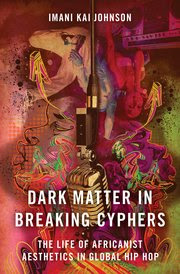
Imani Kai Johnson's "Dark Matter in Breaking Cyphers"

Imani Kai Johnson is Associate Professor of Critical Dance Studies at UC Riverside. She specializes in African diasporic ritual cultures, global popular culture, and Hip Hop. Johnson founded and directs of the Show & Prove Hip Hop Studies Conference Series. She is also co-editor of The Oxford Handbook of Hip Hop Dance Studies, and has published works in Women & Performance and Dance Research Journal.

Johnson applied the "Page 99 Test" to her new book, Dark Matter in Breaking Cyphers: The Life of Africanist Aesthetics in Global Hip Hop, and reported the following:
From page 99:
“Breaking is an opportunity to talk shit, be angry, and be a badass, and it’s cool. You suck if you can’t do that.”—Chyna

“But she [Mom] was like, ‘Well, one day, she will settle down and have kids.’ And, um, yeah— it didn’t happen!… I started doing more breakdance, she’s like, [shrugs] ‘Yeah, spinning on a dirty ground…? What are you doing?’ …So, I don’t even bother to explain it that much.”—Black Pearl
So begins page 99, with two excerpted quotes from b-girls: one featured in the We B*Girlz collection (Kramer & Cooper 2005) and the other I interviewed. Based on this test, while you wouldn’t likely know what the arguments in the chapter or the book are, readers will be immersed in qualities that I highlight to tell the story of Hip Hop dance circles (cyphers).

The Test is successful in conveying the spirit of the project, evident in key stylistic elements. Page 99, the first page of my third chapter— titled, “Badass B-girls Dancing the Dissonance of a Breaking Sociality”— begins by centering practitioner voices as both critical interlocutors and experts in the field. It also opens with familiar or common expectations of b-girls, including notions of being badass alongside narrow assessments of what it means for women to break. To make the writing accessible, I open with what we presume to know before diving more deeply into an underlying complexity embedded in those experiences. On a personal level, memories of completely overhauling this chapter during the first year of covid and sheltering (including protests and virtual community practices) brought into stark relief the book’s main thread: that centering Hip Hop’s Africanist aesthetics reveals radical social and political possibilities in global Hip Hop collectivities from which we can all learn. In this case, improvisation, an imperative toward originality, and ritual insult games reveal new possibilities in gender expression and forms of sociality in cyphers occupied by b-girls from around the world. That realization shaped the final round of revisions.

Ultimately, this chapter exemplifies the book’s subtitle, The Life of Africanist Aesthetics in Global Hip Hop; and page 99 is a doorway into deeper questions about gender, race, nationality, identity, and dance.
Learn more about Dark Matter in Breaking Cyphers at the Oxford University Press website.

--Marshal Zeringue

Wednesday, January 11, 2023

John C. Winters's "'The Amazing Iroquois' and the Invention of the Empire State"

John C. Winters is Assistant Professor of History at the University of Southern Mississippi and ITPS Research Associate in New York History at the Institute for Thomas Paine Studies at Iona College. A public historian, he has also worked in historic homes, museums, and other institutions.

Winters applied the "Page 99 Test" to his new book, "The Amazing Iroquois" and the Invention of the Empire State, and reported the following:
In the case of “The Amazing Iroquois” and the Invention of the Empire State, the Page 99 Test just so happens to reflect one of the important themes of the book. The 99th page lands on a vignette at the conclusion of Chapter 2. The chapter is a biography of Ely S. Parker, a Seneca chief of the mid-late nineteenth century who was General Ulysses S. Grant’s military secretary during the Civil War and later served as the first indigenous Commissioners of the Bureau of Indian Affairs (BIA).

On page 99, readers find themselves in Northern Virginia in December 2000 at a dedication of a BIA building in Parker’s name. Key among the officiates is the former Assistant Secretary of Indian Affairs, Kevin Gover, who suggests in a speech that Parker, by his very existence, was a “paradox.” This is a common enough assumption among those who feel that there must be some universal standard by which we can measure indigenous authenticity. This assumption typically casts any historical indigenous figure who embraces colonial influence or participates in colonial society as assimilated, and since assimilation cannot coexist with indigenous authenticity, at least according to this arbitrary cultural purity test, the two must be mutually exclusive.

Based on that assumption, Gover raises a few issues. He pokes at the idea that Parker, a person who tried so hard in life to be accepted into elite white society and moved away from his homeland permanently, is a paradox because he does not qualify as an authentic Seneca. That assumed, would Parker even appreciate that his name now graced a building of a notoriously unpopular government agency that many indigenous peoples have protested since its creation in the early nineteenth century?
Probably. Parker was, after all, a firm believer in the power of a just and powerful federal government to change Native American life for the better, even if he himself was not able to implement those changes. What he would not have understood quite as well was Gover’s comment on the paradoxical nature of his being an assimilated Indian. Parker thought that assimilation was the solution to the “Indian problem”… [and] in addition, his people his reputation and acceptance by white America shielded him and, he hoped, his people from the worst impulses of a society and a government that by the end of the nineteenth century proved violently intolerant of difference.

Gover’s…moral judgement about Parker’s life casts the nineteenth-century Seneca chief as morally ambiguous at best and inherently wrong at worst in his actions. [But these] flat portrayals of assimilated peoples as a historical “paradox” [is problematic]. There is no question people like Parker often regurgitated what white audiences wanted to hear, often for their own benefit, but a more critical analysis of Parker’s life reveals a far more complex history. He was indeed assimilated, in fact he took steps to ensure that happened, but by speaking on the colonizer’s own terms in their own language, he was also able to shape public opinion about the Iroquois in surprisingly sensitive ways. [It was the fact of his assimilation that enabled him to influence] the way future generations of New Yorkers remembered the Iroquois, even if they forgot that it was the Iroquois themselves who had popularized aspects of their own history and told those stories on their own terms.
Parker was, to call on a phrase evoked by the historian Philip Deloria, an Indian in an unexpected place. But this section also shows that he brought an unexpected ‘Indian-ness’ to spaces that white Americans thought belonged only to them. In “The Amazing Iroquois”, the Page 99 Test reveals a small part of a history in which Parker and his Seneca kin were not simply passive receptors of colonial influence—they were true agents who shaped aspects of New York and American culture and history in their own, and in their own peoples’, image.
Visit John C. Winters's website.

--Marshal Zeringue