Saturday, June 21, 2025

Ryan Cull's "Unlimited Eligibility"

Ryan Cull is Associate Professor of English at New Mexico State University.

He applied the "Page 99 Test" to his new book, Unlimited Eligibility?: Inclusive Democracy and the American Lyric, with the following results:
On the one hand, page 99 of Unlimited Eligibility? Inclusive Democracy and the American Lyric is uncharacteristically almost filled with a quotation of an entire poem. On the other hand, the quoted poem, Hart Crane’s “Possessions,” is pivotal to the presentation of the concept of “looking without recognizing,” a phrase introduced at the top of the page that also serves as the title of the chapter. Why is this distinction (looking vs. recognizing) important and how is it connected to a sequence of movements, from the St. Louis Hegelians to cultural pluralism to 60s/70s-era identity politics to more recent multiculturalism, that serve as the backdrop for the poets considered in this book?

Written in 1923, at a time when the New York state legislature amended a “disorderly conduct” law so that it could target gay men, Crane’s poem boldly invites readers to “witness” his life without “apprehen[ding]” him. The latter word, of course, can denote identifying and understanding – and also the act of arresting. A contemporaneous poem, “Recitative” similarly appeals to the reader to “look” without recognizing him. In these works and others, Crane studies how being seen can be a gateway either to greater social inclusion or to deeper social exclusion (or a messy mixture of both). He knows that those who are empowered predominantly determine a culture's ways of seeing and being seen. Brave appeals and demands by minority populations seeking greater social recognition, which have significantly structured a sequence of social movements (including some of those noted above), have secured important, incremental improvements for those populations. Yet participation within this inherently hierarchical system of social recognition (involving a recognizing class, those who are recognized, as well as those partially recognized, and those unrecognized) also can tacitly reinforce those hierarchies.

By inviting readers to “witness” and “look” without “recogniz[ing]” or “apprehend[ing],” Crane resists this approach to social inclusion. Instead, he is characteristic of a group of poets studied in this book (also including Walt Whitman, Jean Toomer, James Merrill, and Thylias Moss) who explore inclusion in terms of an affirmation of ontological proximity and equality rather than an epistemological confirmation of recognizability, locating an invitation to be-with rather than an urge to know-who at the core of their artistic practice. But the book traces how this approach has limits too. Prioritizing ontological affirmation rather than confirmation of recognizability too often comes close to indulging a naïve hope of establishing a world without labels.

Renarrating the sociopolitical dimensions of American poetry through the tension between these two models of inclusion helps us to reflect on the demand that we, albeit falteringly, keep trying to learn the language of democracy, a task we must continue today.
Learn more about Unlimited Eligibility? at the State University of New York Press website.

--Marshal Zeringue

Friday, June 20, 2025

Alexandre F. Caillot's "Late to the Fight"

Alexandre F. Caillot holds a doctorate in history from Temple University.

He applied the “Page 99 Test” to his new book, Late to the Fight: Union Soldier Combat Performance from the Wilderness to the Fall of Petersburg, and shared the following:
Page 99 marks the start of chapter four and features two quotes from members of the 17th Vermont and 31st Maine Volunteer Infantry Regiments, the subjects of Late to the Fight. These epigraphs set the tone for the chapter, which then proceeds as follows:
On May 23, 1864, New York Herald reporter Sylvanus Cadwallader rosily depicted the progress of Union arms in the Civil War. Reflecting on the Overland Campaign, he praised the 'transcendant genius' of Grant and Meade. This journalist proclaimed that the two generals had 'triumphed over all obstacles' and 'other glorious victories await[ed] our grasp.' Cadwallader made it appear as though the Union effort to crush the Confederacy depended solely on effective leadership and thus overlooked the contributions of the rank and file at the Wilderness and Spotsylvania Court House. Yet he anticipated 'hard fighting' should the opposing Army of Northern Virginia assume a defensive position along the North Anna River on the road to Richmond. Such a concession highlights an important question for this stage of the campaign: to what extent did the later arrivals overcome the stresses of their first two battles and continue to fight well as newly minted veterans? Contemporary historian John C. Ropes differed from Cadwallader by offering a bleaker assessment of Meade’s Army of the Potomac. Summing up the nature of this campaign, he noted that...
The Page 99 Test works well because the page draws attention to several concepts running through Late to the Fight. Its presentation of quotes from Vermonters and Mainers reflects the book’s focus on the perspective of the officers and men in these two regiments. Also, the page highlights a common tendency to credit Union victory to the generals’ decision-making instead of the soldiers’ efforts that made those plans a reality. To counter this trend, it asks how the New Englanders developed into reliable veterans amid the unprecedented conditions of the Overland and Petersburg Campaigns.

What this test does not reveal, however, is that Late to the Fight is a story about human motivation, endurance, and combat performance in which the Vermonters’ and Mainers’ voices frequently emerge. It examines the experiences of these New Englanders because they epitomized a population of approximately 820,000 soldiers who joined the Union Army after Congress passed the Enrollment Act, or draft law, in March 1863. This research challenges the consensus that contemporaries and historians alike have embraced, according to which these later arrivals lacked the patriotism and fitness for soldiering. It considers what drove them to enlist despite the bloody realities of military service so apparent by this point in the war. The book addresses what these troops faced on campaign and whether they proved worthy comrades of their predecessors in uniform, who have enjoyed greater esteem. Centering on the humble private, Late to the Fight demonstrates that the Vermonters and Mainers did their part to help achieve Union victory."
Learn more about Late to the Fight at the LSU Press website.

--Marshal Zeringue

Thursday, June 19, 2025

Erin Beeghly's "What's Wrong with Stereotyping?"

Erin Beeghly is Associate Professor of Philosophy and Director of Graduate Studies for the Philosophy Department at the University of Utah. Her primary research interests lie at the intersection of ethics, social epistemology, feminist philosophy, and moral psychology.

Beeghly applied the “Page 99 Test” to her new book, What's Wrong with Stereotyping?, and reported the following:
Page 99 drops you into the book’s fourth chapter. That chapter opens with a photo of Barbara Gittings, an early gay rights activist in the United States. She’s holding a sign at a pre-Stonewall rally, sporting short haircut, stylish sunglasses, and a smart mid-1960s dress straight out of Mad Men. Her sign says: homosexuals should be judged as individuals. She’s there to protest homophobic policies, rampant and shameless in that era: policies that required the federal government to fire gay employees because they were alleged security threats; that allowed businesses to refuse service to gender non- conforming and queer patrons; and justified police raids on gay bars. In these raids, queer, trans, and gender non-conforming patrons were manhandled, assaulted, and thrown in jail. All of this – and more – was perfectly legal.

The chapter wrestles with the idea on Gittings sign. What does it mean to treat someone as an individual? Is it plausible that all stereotyping – and, for that matter, all discrimination – is wrong because it involves generalizing on people, ignoring their individuality? Is there a moral right to be treated as an individual?

I’m at a point in the chapter where I’m grappling with the slipperiness of the ideal on Gittings’ sign. The most natural ways to interpret the sign’s message don’t work. They suggest, implausibly, that clocking anyone based on looks – as a certain gender, as queer, as belonging to a certain racial or ethnic group, as Republican or Democrat – is inherently wrong.

“For some theorists,” I write on page 99, “the upshot is this. We must stop explaining what’s wrong with stereotyping—as well as what’s wrong with discrimination—by saying that it fails to treat persons as individuals. The claim is philosophically corrupt. However, other theorists take the analysis so far as a challenge. The challenge is to articulate a new interpretation of failing to treat persons as individuals that does not generate the problem of absurdity.”

I am on the cusp of diving into nerdy attempts to vindicate the imperative on Gittings pre-Stonewall sign. If we take Gittings and other early gay rights activists seriously, we should be able to make sense out of that sign’s message, interpret it in a way that is not absurd, find the truth in its meaning.

It’s Pride month right now. Almost sixty years after this photo was taken, it’s still important to make sense of that sign. LGBTQIA+ stereotyping and discrimination continue to plague us, alarmingly so. Page 99 holds out hope that we can push back against anti-queer policies, and the dehumanizing stereotypes that underlie them, with the idea on Gittings sign. On the other hand, the book goes on to argue that individualistic wrongs are only ever part of the story of what’s wrong with stereotyping.

Using queer history as a touchstone, the book as a whole offers a nuanced picture of what’s wrong with stereotyping. It argues that stereotyping individuals – judging persons by group membership – is not always wrong. Nor is characterizing groups in generic ways: queers are fabulous after all. However, when stereotyping is unethical, you can tell because it is characterized by clusters of wrongs, travelling together for systematic reasons, targeting groups for violence and marginalization. All in all, my book provides a rich understanding of wrongful stereotyping that readers can use to identify wrongful stereotyping in their everyday lives. Page 99 exemplifies this, taking readers on a lively philosophical journey.
Visit Erin Beeghly's website.

--Marshal Zeringue

Wednesday, June 18, 2025

Joseph Kellner's "The Spirit of Socialism"

Joseph Kellner is a historian of Russia and the Soviet Union at the University of Georgia.

He applied the "Page 99 Test" to his new book, The Spirit of Socialism: Culture and Belief at the Soviet Collapse, with the following results:
Page 99 of The Spirit of Socialism: Culture and Belief at the Soviet Collapse finds one Sergei Chevalkov, formerly a colonel in the Soviet Union’s land-based nuclear defense forces, late in the process of converting to a millenarian sect. In keeping with one major theme of the book, he is explaining to me (in interview) why neither his former work (in both its technical and philosophical aspects) nor the Soviet worldview contradict the teachings of Vissarion, the sect leader who, in 1991, proclaimed himself the Second Coming of Christ. Chevalkov, who considers Vissarion to have reconciled all of the world’s spiritual and intellectual currents, was an early and zealous convert, who quickly became the high priest of the sect upon relocating to their survivalist commune in southern Siberia, where my interviews were conducted.

The Page 99 Test, in this case, has succeeded admirably. The book’s analysis shifts regularly between the experience of individual converts, believers and radicals of the early 1990s, and a broad cultural and intellectual portrait of late-Soviet and post-collapse Russian society. Here on page 99, the reader finds the former, in appropriately colorful form. It is a book of eccentrics, oddballs and heretics in some ways, but one that finds such people to be far closer to the center of Soviet society and culture than one would assume—with Chevalkov an excellent example. His story addresses a central question of the text, namely, how and why so many people, possessed of Soviet values and Soviet resources, came to adopt novel and radical worldviews that most would consider un-Soviet, all in the few years surrounding the country’s collapse. With these questions answered—read to see how!—the book then draws a new and I hope compelling picture of Soviet life and its legacies in the new Russian Federation. But its largest conclusions don’t concern the Soviet Union alone. The reader ought to come away thinking about the relationship between science and faith; reckoning with the conditional and fragile nature of their own worldview; and considering how different Russia’s crisis in the 1990s really is from our own crisis today. Page 99 won’t get you there entirely, but it’s not a very long book on the whole.
Learn more about The Spirit of Socialism at the Cornell University Press website.

--Marshal Zeringue

Tuesday, June 17, 2025

Eve Darian-Smith's "Policing Higher Education"

Eve Darian-Smith is a distinguished professor and the chair of the Department of Global and International Studies at the University of California, Irvine.

She applied the “Page 99 Test” to her new book, Policing Higher Education: The Antidemocratic Attack on Scholars and Why It Matters, and shared the following:
Page 99 talks about how attacks on universities and scholars are related to a wider set of attacks on journalists, librarians, writers, political activists and public intellectuals – in fact anyone who challenges repressive political power. This wider set of attacks by antidemocratic regimes, including the MAGA Republican regime, may take various forms. In places such as Brazil, Hungary or India, they can range from censoring what gets published, to closing news outlets, to arrests, detentions, and in some cases even torture, rape and death.

The Page 99 Test is pretty effective in conveying the overarching point of my book, which is that attacks on academic freedom are one strategy exercised by antidemocratic politicians to expel any criticism challenging their authority to govern. We see attacks on academic freedom increasingly under Trump’s second administration as students and scholars are policed and criminalized for public protest, as well as shuttled into cars and relocated to distant detention centers. And we see it in the widespread defunding of science and research that seeks to make universities and colleges bend to the far-right’s ideological agenda. These efforts have a chilling effect on learning. In a very material sense, people are being disciplined to self-censor and not speak up, afraid of real and imminent threats. This is what the far-right wants – to create an environment in which people are scared to think in ways that may question those in power.

Unfortunately, this isn’t just a US problem. My book looks at two interconnected global trends – rising antidemocracy and declining academic freedom. I argue that what is happening in the US needs to be understood as part of a global drift toward authoritarianism that includes aggressive control over knowledge production.

With this book, I hope to open conversations about the value of academic freedom and higher education in general. Despite US education being very expensive and historically exclusive, going to college is vital for training people to question their assumptions and think critically about their place in the world. And importantly, academic freedom is central to revisioning more inclusive democratic societies that respect diverse worldviews and encourage innovative ideas that drive new jobs and solutions.

Being able to think, study, discuss and share knowledge without fear of censorship is essential for everyone, irrespective of age, gender, sex, religion, class, race or ethnicity. This is an urgent and timely message as we face a new era of unparalleled political repression.
Learn more about Policing Higher Education at the Johns Hopkins University Press website.

The Page 99 Test: Global Burning.

--Marshal Zeringue

Monday, June 16, 2025

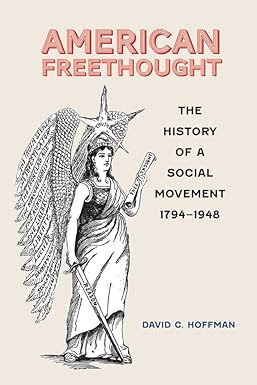
David C. Hoffman's "American Freethought"

David C. Hoffman is an associate professor in the Marxe School of Public and International Affairs at the City University of New York.

He applied the “Page 99 Test” to his new book, American Freethought: The History of a Social Movement, 1794–1948, and reported the following:
Page 99 of American Freethought takes readers right to the heart of the book’s subject matter. It begins a section devoted to a freethinking feminist named Frances Wright who lived from 1795 to 1852. The section is titled, “Frances Wright: Utopian Abolitionist and Apostle of Science.” It opens,
Frances Wright was one of the most luminous of the British activists who immigrated to the United States in the early nineteenth century. She is honored today as a pioneering feminist and abolitionist who was the first woman to go on a public speaking tour in America, but she also should be remembered for carrying forward [Thomas] Paine’s vision for science by promoting secular scientific education for both women and men.
By way of background, the revolutionary pamphleteer Thomas Paine, whose Common Sense set America on the path to independence, argued that science rather than traditional religion should be the common pursuit that unites a free republic. Wright promoted this idea in her public lectures, urging her followers to establish “Halls of Science,” where a free scientific education would be available to all regardless of gender or social standing.

I am glad to have the opportunity to introduce the readers of the Page 99 Test to Frances Wright, who was a major figure in the freethought, abolitionist, and feminist movements of the early nineteenth century that is all but forgotten today. In the 1820s she invented and pursued a workable scheme for ending slavery in the United States that might have changed the course of history if it had not been brought down by lack of funding and an outbreak of malaria. Wright’s collected works should have a place on the shelf of Penguin Classics next to her mentor Jeremy Bentham, but there is no modern edition of them in any series.

Wright is just one of the many freethinking women and men that readers will encounter on the pages of American Freethought. Among the others are Ernestine Rose, the atheistic daughter of a Polish rabbi who led efforts to establish married women’s property right in New York State; Frances Ellingwood Abbott, a radical Unitarian whose “Nine Demands of Liberalism” ignited the revival of American freethought after the civil war; Ida Craddock, a fervent spiritualist who was persecuted for writing a sex manual; and Queen Silver, a precocious child whose first public lecture in defense of atheism was given at the age of ten in the 1920s. These are some of the many characters in American history who have contributed to the freethought movement’s defense of every American’s right to believe or disbelieve by the light of their own conscience without state interference.
Learn more about American Freethought at the Johns Hopkins University Press website.

--Marshal Zeringue

Sunday, June 15, 2025

Robert N. Spengler III's "Nature's Greatest Success"

Robert N. Spengler III directs the Fruits of Eurasia: Domestication and Dispersal research project and leads the Domestication and Anthropogenic Evolution Research Group at the Max Planck Institute of Geoanthropology in Jena, Germany. He is author of the book Fruit from the Sands and has published dozens of scholarly articles while running research projects across Central Asia.

Spengler applied the "Page 99 Test" to his new book, Nature's Greatest Success: How Plants Evolved to Exploit Humanity, with the following results:
The ninety ninth page of Nature’s Greatest Success is bisected by two different and equally captivating topics; the page opens with the conclusion of a discussion of strawberry domestication. The popular narrative of strawberry domestication involves a farmer in the 1700s – a bit of a strawberry fanatic – who planted different species of strawberries in his garden, only to notice one day that something rather different was growing in his strawberry patch. I ask whether the process of stumbling across hybrid forms of a crop can be thought of as a proxy for some aspects of domestication in prehistory. If an ancient farmer suddenly discovered a unique form of a crop growing in their field, would they have tried to reproduce it, and, if so, which of the forms of plants in your produce market are a result of this process? The latter part of the page dives into the odd case of quinoa domestication, and I rationalize the ways that the process could not have involved human intentionality. In short, genetic features of the plant prevent active seed selection from fostering the process of domestication.

I believe that a reader picking the book up and thumbing to the page in question would gather enough of an understanding of the overall book that, if the topic catches their attention, they will return to page one and begin reading. The book spans a wide range of topics, using many case studies, with the goal of providing the reader with an idea of what domestication looked like in antiquity and how the foods they eat came into being.

Domestication remains one of the most captivating topics of scholarship across the sciences, as it is a key part of the story of what permitted humanity to become culturally modern. Without domesticated crops, you would not have any of the material goods that you take for granted, human populations would be low, cities could not exist, and the arts and sciences would not have developed. Geneticists, archaeologists, and ecologists have started to realize that humans in prehistory did not intentionally domesticate crops. This means that the evolutionary process that permitted human cultural development was a happy accident, as opposed to a great achievement of humanity. In Nature’s Greatest Success, I explore these new ideas about how domestication traits first evolved. In this book, I encourage the reader to think in different ways about ancient agriculture and the ongoing domestication processes all around you today. In short, the most important questions about humanity have remained unanswered because of long-standing misunderstandings about how ancient domestication occurred, and the true story of domestication is far more interesting than the long-standing narrative.
Visit Robert N. Spengler III's website.

The Page 99 Test: Fruit from the Sands.

--Marshal Zeringue

Saturday, June 14, 2025

Steve L. Monroe's "Mirages of Reform"

Steve L. Monroe is an Assistant Professor of Political Science at the National University of Singapore. He is a scholar of development, with a primary focus on the Arab world. His scholarship examines two of the region's most pressing developmental challenges: limited economic integration, and gender inequality.

Monroe applied the “Page 99 Test” to his new book, Mirages of Reform: The Politics of Elite Protectionism in the Arab World, and shared the following:
Page 99 defends how this chapter in Mirages of Reform measures the strength of Jordanian industries’ social connections to the state. This measure relies on data from publicly traded firms. It gauges industries’ social-connections strength as the share of chairmen and board members (CBMs) of publicly traded firms in an industry who belong to Jordan’s historically favored ancestral group – Jordanians of East Bank descent.

The first half of page 99 presents the pros and cons of this measure. On the plus side, data from publicly traded firms is publicly available. This helps me identify socially connected CBMs based on whether they have an “East Bank” last name, and cull information on their firms’ size and profits. On the downside, this measure assumes that industries without publicly traded firms have weak social connections to the state.

The second half of page 99 tries to validate this assumption. Compared to industries with publicly traded firms, Jordanian industries without publicly traded firms have on average smaller firms, lower tariffs and are devoid of State-Owned Enterprises (SOEs) – all signs of weak social connections. I then argue that if industries without publicly traded firms did in fact have strong social connections to the state, this measure would be a “hard” test of the argument as it would overestimate the social connections strength of weakly connected industries; differences in tariff cuts and profits between industries with strong and weak social connections would be even greater if I had a more accurate measure of industries’ social connections. Page 99’s last paragraph presents qualitative evidence from different industries that substantiates the chapter’s measure of social-connections strength.

The Page 99 Test on Mirages of Reform passes in spirit but not in substance. Page 99 gives the browser a whiff of the book’s essence – its challenges, assumptions, methodological orientations. Defining and measuring social connections was one of the hardest parts of this book project. Page 99 exhibits one of the book’s tactics in measuring social connections. I like how the page begins by acknowledging this measure’s limitations, then segues into an empirical and theoretical defense of the measure, before validating the measure with secondary sources and case expertise. I hope that a browser reading page 99 would infer that I understand the empirical challenges of studying state – society relations, and have made a good faith effort to overcome these challenges.

Nevertheless, page 99 does not reveal the book’s argument: industries with stronger social connections undergo more extensive but deceptive levels of trade policy reform when their state has greater support from the US and the EU. The Page 99 Test also excises the previous chapters’ lengthy explanation and definition of social-connections strength. I conceptualize the strength of industrialists’ social connections to the state as a function of the quality and frequency of their interactions with state officials. By this logic, the economic elite who belong to politically favored social groups have the strongest social connections to their regime – hence page 99’s focus on CBMs of East Bank descent. This information is key to assessing the social connections measure’s validity.

Lastly, in shrinking Mirages of Reform’s measure of social connections to CBMs from politically favored groups, the Page 99 Test excludes the multiple approaches this book uses to assess social connections across time and place. Instead, the page 99 reader might mistakenly conclude that this book restricts its measures of social connections to what is static and quantifiable. For a more complete yet condensed understanding of Mirages of Reform, I encourage the casual browser to skim the introduction.
Visit Steve L. Monroe's website.

--Marshal Zeringue

Friday, June 13, 2025

Marcus Alexander Gadson's "Sedition"

Marcus Alexander Gadson is Assistant Professor of Law at the University of North Carolina School of Law and the author of articles published in places such as the UCLA Law Review and the Georgetown Law Journal.

Gadson applied the “Page 99 Test” to his new book, Sedition: How America's Constitutional Order Emerged from Violent Crisis, and reported the following:
Page 99 of Sedition says:
…virulent white supremacy political campaign in American history to shatter the movement for interracial political cooperation. Meanwhile, Democrats in Wilmington conspired to overthrow a government they associated with Black political power, which culminated in an armed mob demanding the mayor’s resignation at gunpoint after a day of bloodletting. If both these efforts succeeded, white supremacists could end Black political involvement in the state and eradicate the spirit of 1868 once and for all.
Someone reading this would get an inkling of what my book is about, but miss important context and not truly understand the argument I make. They would know that they will eventually read a chapter explaining that white supremacy motivated some North Carolinians to overthrow Wilmington’s government and that their insurrection was violent. However, they would not know, just from the excerpt, that the book makes a larger claim: that constitutional crises have been common in American history and have shaped American constitutional law and history in dramatic ways. The Wilmington Insurrection of 1898 is part of that larger story I tell.

Sedition provides six examples of constitutional crisis in American history, most of which readers will never have heard of, such as the Buckshot War, Dorr Rebellion, and Brooks-Baxter War. And by “constitutional crisis,” I mean things like terrorist organizations overthrowing duly elected governments and militias loyal to rival candidates shooting each other dead in the street. I then explain how these crises have affected the drafting and interpretation of both state and federal constitutions. At a time when many commentators are arguing about whether we are in a constitutional crisis, I believe this book can give readers vital context as they assess the debates.
Learn more about Sedition at the NYU Press website.

--Marshal Zeringue

Thursday, June 12, 2025

Adam S. Hayes's "Irrational Together"

Adam S. Hayes is professor of sociology at the University of Lucerne. Before entering academia, he worked as an options market maker and equity derivatives sales trader and was licensed as a financial advisor.

Hayes applied the "Page 99 Test" to his new book, Irrational Together: The Social Forces That Invisibly Shape Our Economic Behavior, with the following results:
Page 99 is the hinge where the book moves from storytelling to method. It really distills the broader mission of the book: to show that economic choices are never purely about numbers or cognitive quirks—they’re also greatly influenced by social forces. The passage invites readers to see how experimental techniques can unpick the ways that price, convenience, and status jostle with trust, loyalty, and shared identity in everyday financial decisions. It’s not about dismissing “economic” explanations or romanticizing the social. Instead, the page makes a case for measuring these factors in tandem. Unraveling the way that our dollars interact with our culture, social contexts, socialization processes, and relationships is indeed a miniature of the book’s central framework.

Does the Page 99 Test work?

Absolutely. The entire argument of Irrational Together is that economic life is governed, in part, by social forces—and that we can measure these influences. Page 99 reveals how the book bridges disciplines, bringing sociology’s insights about things like norms, networks, and identity into conversations typically dominated by economic rationality or behavioral biases. It’s not a rejection of what's come before, but an insistence that to truly understand choice, we have to see how these perspectives mesh and rub up against each other. This page signals a book that’s more than just a critique of “rational economic man”; it’s a toolkit for better understanding how our choices get entangled with who we are, who we know, and what matters most to us.

If this page draws you in, the rest of Irrational Together offers an extended invitation to see economic life in high relief. From meme-stock booms to the hidden scripts of gendered money talk, from algorithmic investing to the moral boundaries of peer-to-peer transactions, the book uses familiar stories, original data, and lived experiences to explore how everything from culture and social identities to interpersonal ties and social networks shape even what we think of as our most private economic decisions. What emerges is a vision of economic life that is less about solitary individuals optimizing abstract curves or even hopelessly irrational beings with limited processing power & cognitive biases--and more about real people navigating the social landscape that is the economy. By the end, readers won’t just have a richer view of economic sociology; they’ll see how these insights can inform more reasonable efforts at navigating financial choices and the crafting of more effective policies. If page 99 made you curious about why you sometimes pay more to buy from a friend—or why an app can nudge you toward “rational” investing—you’ll find the rest of the book picks up that thread and runs with it.
Visit Adam S. Hayes's website.

--Marshal Zeringue