Friday, February 28, 2014

David Auerswald & Stephen Saideman's "NATO in Afghanistan"

David P. Auerswald is professor of security studies at the National War College. His books include Congress and the Politics of National Security. Stephen M. Saideman holds the Norman Paterson Chair in International Affairs at Carleton University. His books include For Kin or Country: Xenophobia, Nationalism, and War.

They applied the “Page 99 Test” to their new book, NATO in Afghanistan: Fighting Together, Fighting Alone, and reported the following:
Page 99 of NATO in Afghanistan contains key insights into our approach when examining NATO behavior in Afghanistan. The book looks inside NATO countries to explore how government structures and party politics shape how battles are waged by NATO militaries. Domestic constraints in presidential and single-party parliamentary systems - such as the U.S. and Great Britain - differ from those in countries with coalition governments - such as Germany and the Netherlands. Those domestic constraints influence how civilians provide direction to their military forces. A leader's type of government influences the guidelines given to their forces overseas, and which tools will be used to ensure that those guidelines are incorporated into battlefield behavior.

Page 99 is part of the chapter that discusses presidential governments - specifically the U.S., France, and Poland - and their contributions to the NATO effort in Afghanistan. Our expectation was that leaders in presidential governments would influence the behavior of their deployed military commanders through two tools: the careful selection of officers and the manipulation of incentives aimed at those officers. These expectations were borne out in the evidence presented in this chapter.

Our discussion on page 99 focuses on the selection of General David McKiernan to command ISAF in June 2008, and General David Petraeus to command U.S. Central Command (CENTCOM) in October 2008. To put these events into context, U.S. Secretary of Defense Robert Gates had been increasingly dissatisfied with the deteriorating situation in Afghanistan during 2007. McKiernan's predecessor, General Dan McNeill, was one of Donald Rumsfeld's last appointments as Defense Secretary. Rumsfeld had instructed McNeill to build the Afghan National Army and conduct counter-terrorism operations. With the situation in Afghanistan rapidly degrading, Gates changed U.S. mission priorities to be more in line with counterinsurgency (COIN) strategy, and then selected two senior generals to implement that strategy. McKiernan immediately focused on the behavior of ISAF troops in an effort to limit casualties, and Petraeus brought his population-centric COIN strategy to CENTCOM.

In short, the U.S. used the selection of commanders to effect change in the focus and behavior of its deployed troops. Careful selection of commanders is politically acceptable and indeed only possible in presidential and single-party parliamentary government. The same type of selection process would not have been possible in countries with coalition governments. Page 99, then, is a good representation of one of our book's main arguments.
Learn more about NATO in Afghanistan at the Princeton University Press website.

--Marshal Zeringue

Thursday, February 27, 2014

Virginia Berridge's "Demons: Our changing attitudes to alcohol, tobacco, and drugs"

Virginia Berridge is Professor of History and Director of the Centre for History in Public Health at the London School of Hygiene and Tropical Medicine, University of London. She has published widely on the history of illicit drugs, smoking, and alcohol and has worked in both historical and non-historical settings.

Berridge applied the “Page 99 Test” to her latest book, Demons: Our changing attitudes to alcohol, tobacco, and drugs, and reported the following:
Page 99 of my book Demons, Our changing attitudes to alcohol, tobacco and drugs tells how new technology led to mass production of beer and spirits, especially whisky, in the nineteenth century. By the end of the nineteenth century, whisky was the most popular spirit in England , promoted by advertising and labels which became household names. It was a consumer product.

This page is part of a chapter in the book where I discuss the key role of technology in pushing the substances- alcohol, tobacco and drugs –down different paths in the nineteenth and early twentieth centuries. Alcohol and tobacco became mass market commodities but opium did not, at least not in the same way. The invention of the Bonsack machine in the 1880s had an impact on tobacco. It enabled the mass production of the cigarette, which became a leading consumer commodity in the early twentieth century. Soldiers smoking in photos of the First World War testify to that change. But technology had a different impact on drugs such as opium. The invention of the alkaloids of morphine, codeine and heroin in the nineteenth century and the development of the hypodermic syringe saw a medical rather than a mass market model come into play. Opium had been a drug with wide cultural usage in the first half of the century but increasingly it was restricted to medical usage and control.

The role of technology is one of a number of factors which had this differing impact on the substances. I also talk in the book about the role of social movements; and of fear, whether of ethnic minorities-the Chinese and their opium smoking-, or of women consuming alcohol; the differing role of professional interests; and the dynamics at the international level.

Such issues have not gone away. In the final chapters of the book, I show how they have continued to help determine responses in the present, and the changing of boundaries between the substances. Technology has a role now through the rise of methadone as a substitute medication for drug users. For tobacco, the promotion of nicotine replacement therapy and more recently the electronic cigarette, delivering nicotine only, have demonstrated the compelling role which technical change can have. This technology has underpinned new directions for both these substances and the rise of what has been called ‘harm reduction’ approaches in policy which aim to mitigate the bad effects of substances rather than trying to stop use altogether.
Learn more about Demons at the Oxford University Press website.

--Marshal Zeringue

Wednesday, February 26, 2014

T. Birkhead, J. Wimpenny & B. Montgomerie's "Ten Thousand Birds"

Bob Montgomerie is Professor and Research Chair in Evolutionary Biology at Queen’s University in Kingston, Ontario. He and his coauthors, Tim Birkhead and Jo Wimpenny, wrote their new book Ten Thousand Birds: Ornithology since Darwin to explore the various ways that the study of birds was central to the development of the biological sciences in the 19th and 20th centuries.

Montgomerie applied the “Page 99 Test” to Ten Thousand Birds and reported the following:
Ernst Mayr was an icon of evolutionary biology in the twentieth century. Born in 1904 he lived to be 100 and oversaw much of the transformation of biology into a cutting-edge science. He was also an ornithologist, and we encounter him in chapter 3 on page 99 in a section called ‘Ernst Mayr’s Century’. That chapter—‘Birds on the Tree of Life’—is about the long and tortuous history of bird classification, a story in which Mayr was the dominant figure. On page 99 he is just 27 years old, having recently joined the staff of the American Museum of Natural History (AMNH) after a two-year-long and very successful bird-collecting trip to the South Pacific. Mayr was to stay at the AMNH for two decades before moving to Harvard for the next fifty years, laying the foundations for a synthesis of evolutionary biology, systematics and a philosophy of biology.

Page 99 provides a good example of some of the things we wanted to achieve with this book: stories about people who did meaningful studies of birds, and some insights into why the study of birds was—and is—so influential. To help us think about the page 99 question, we turned it on its head and asked whether any single page in our book would satisfy the “page-99 test” to be representative of the book. The answer is a resounding “no”. To meet that requirement a single page would have to tell a little-known story about an interesting character—like that of Baron Franz Nopcsa von Felsö-Szilvás, the eccentric, self-taught, Transylvanian palaeontologist who in the early 1900s developed original ideas about the origins of both birds and flight while traveling around Europe on a motorcycle with his male lover/secretary. It would also have to tell about some interesting discoveries about birds; to show some excellent photos and paintings of iconic birds; to include some historical pictures of interesting and influential people who studied birds—both amateur bird enthusiasts and professional ornithologists; and to provide historical context for the study of bird biology using both timeline diagrams and stories about the often serendipitous nature of discovery. Our book weaves together all those attributes and we have tried to do so in a way that makes the subject both interesting and accessible to anyone interested in learning more about birds and the people who have studied them.
Learn more about this book and the scientific study of birds at myriadbirds.com.

--Marshal Zeringue

Tuesday, February 25, 2014

Noel Leo Erskine's "Plantation Church"

Noel Leo Erskine is Professor of Theology and Ethics at Candler School of Theology and the Laney Graduate School of Arts and Sciences at Emory University. He has been a visiting Professor in ten schools in six countries. His books include King Among the Theologians and From Garvey to Marley.

Erskine applied the “Page 99 Test” to his new book, Plantation Church: How African American Religion Was Born in Caribbean Slavery, and reported the following:
From page 99:
“Jamie Parker’s grandfather, and fellow slave Scipio, was put to death for attempting to teach Jamie to read and spell from the Bible.” …The truth is that the relationship of the master to the enslaved person was not just one of the powerful in relation to the powerless, but of one who made decisions in matters of life and death in relation to enslaved families…. In order to institutionalize plantation ethics and etiquette, many masters devised and developed ways to ensure that enslaved persons internalized their own inferiority in relation to their beliefs and the superiority of their masters…. “Whatever his name, ‘every man slave is called boy until he is very old, then the more respectable slave owners call him uncle. The women are girls until they are aged, then they are aunts.’”
Plantation Church underscores the plantation as the new reality that confronted Africa’s children who were brought as human cargo to the New World. In spite of the inhumanity of the master class to enslaved persons they were open to the new religion of their oppressors. This is one of the mysteries this book seeks to answer – how could Africa’s children who were brought across the Black Atlantic as property in the holds of ships, turn to the religion of their captors and enslavers? A part of the answer is they found ways to maintain the integrity of their religious beliefs while at the same time they were open to the new that the sociological and theological environment suggested.

The book argues that for the first two hundred years of slavery Plantation Church was not a Christian but an African church guided by an African priest/herbalist. The priest was guided and supported by the world of spirits, good and evil. It was African religion carried by enslaved persons from the African homeland that engendered their survival “a long ways from home”, -plantations in the Americas.

The marks of Plantation Church are the embrace of African world views informed by the question, “Where do I stand in relation to Africa?” Other marks of this church are an openness to embrace the new in history in the quest for survival and liberation. An acknowledgement that there are evil forces in the world and a need to be protected from evil through the aegis of ancestors and the ministry of medicine man/woman or priest. The plantation was often seen as site of evil where drumming, dancing and “redemption songs,” serve as instruments of survival and liberation. There was the recognition that in Plantation churches the spirit often takes over the bodies of believers. To be possessed by spirit would mean that one’s body becomes an altar and medium through which the spirit would work.

The Black religious experience was born south of the border, in the Caribbean, and not in the United States. The African presence began in the Caribbean as early as 1502, well over a hundred years before Africans arrived in Jamestown, Virginia, in 1619. This calls attention to the historical and political priority of the Black religious experience being born in the Caribbean and not in the United States. Central questions are – What does it mean to be church when people of African descent are the political and cultural majority, which is the case in the Caribbean. And the converse is true. What does it mean to be church when people of African descent are the political and cultural minority, which is the case in the United States.
Learn more about Plantation Church at the Oxford University Press website.

--Marshal Zeringue

Monday, February 24, 2014

Jennifer Stromer-Galley's "Presidential Campaigning in the Internet Age"

Jennifer Stromer-Galley is Associate Professor in the School of Information Studies at Syracuse University.

She applied the “Page 99 Test” to her new book, Presidential Campaigning in the Internet Age, and reported the following:
So, when I open Presidential Campaigning in the Internet Age to page 99, which is embedded in the chapter that details the 2004 presidential campaigns, the following sentences that start the three paragraphs on this page jump out at me:
Of all the presidential campaigns, Howard Dean's organization established the digital media team as central in the campaign, a key component to the success the candidate enjoyed.

If the celebration for Dean's meteoric rise rested on DCTs [Digital Communication Technologies], part of the cause of the campaign's demise was in its organization and strategy.

A second cause of trouble [for the Dean campaign] was advertising.
In short, this page summarizes what were some of the factors of candidate Dean's success as well as factors that lead to his demise in 2004.

This page encapsulates well the work I try to do in this book, which is fourfold: a) provide a history of presidential campaigns—not only the winners, but the also-rans—and their strategic uses of digital media as part of campaigning since 1996; b) examine the uses of digital media in the campaign within the context of other elements of the campaign, including fundraising, organization, and the social, technological, and political context that drove strategy during the campaign, to name a few; and c) examine and explain the functions that campaigns see digital media having that might give them the strategic edge over their opponents; d) provide greater understanding of how strategies by the campaigns have changed over time, as we have moved from the age of mass messaging to that of networked messaging.

If readers are hoping for a starry-eyed assessment of how digital media contributes to democracy, they won't find that in this book. Unfortunately, campaigns aren't using digital media to try and lift up our democracy by genuinely engaging ordinary people in the political process. Instead, what I provide in this book are the stories of the ways campaigns, from Bob Dole to Barack Obama, provide controlled interactivity to citizens in order to mobilize enough of them to help the candidate win on Election Day.
Learn more about Presidential Campaigning in the Internet Age at the Oxford University Press website.

--Marshal Zeringue

Saturday, February 22, 2014

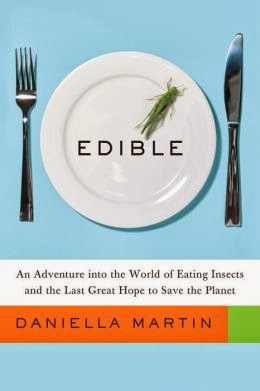
Daniella Martin's "Edible"

Daniella Martin is the host of Girl Meets Bug, the insect cooking/travel show. She also blogs about bugs for the Huffington Post.

She applied the “Page 99 Test” to her new book, Edible: An Adventure into the World of Eating Insects and the Last Great Hope to Save the Planet, and reported the following:
People generally have the wrong idea about insects. But adopting them into our food supply could help change the world in some of the areas that most need changing: resource usage, farming practices, food shortages, and even global warming. Eating bugs or “entomophagy” is like this logically elegant, yet irrationally reviled solution to a lot of our problems.

I tried to make my new book Edible interesting as a stand-alone work of nonfiction, and not only for people who might be interested in eating insects. Even for someone who has no interest in entomophagy, Edible breaks down what it currently takes for our protein to get from farm to table: species-by-species resource usage, production efficiency, nutrient density, and so on. It sets the scene for someone to understand why this aspect of our food production is so ripe for innovation. It also provides insight into how other cultures view this kind of food.

There have been a few other forays into this subject, but none I think with as much an attitude of normalcy. Getting past the ick-factor is where the real learning (and the real insight into an unseen world) begins. Sometimes the answer to our question lies in the place we're least likely, or least willing to look.

On page 99 of Edible, I interview attendees of the Stanford alumni dinner after serving them “Corn Caterpillar Tamales.”

From page 99:
Almost everyone agrees the tamales were, at the very least, tasty.

“They certainly weren’t any worse than regular tamales,” one discerning person said. “I don’t know if I’d go so far as to say they were better, but they weren’t worse.”

“Yeah, if they were similarly priced, I’d consider ordering them at a restaurant.”

I take that as a compliment.

“They were excellent,” says another guest. “They were my favorite food of the night.”

I’m particularly interested in what people think of the idea of bringing food pests to the table. Their reactions to this are mixed.

“I love the idea,” says John Openshaw, a medical doctor who researches infectious diseases. “I think it’s ahead of its time. But I think it will have its time.”

“‘Corn earworm’ is a terrible name,” puts in Paul Hsu.

“Maybe use their Latin name.” Heliothis zea tamales. Heliotamale?

“Also, ‘pest’ has bad connotations,” adds food blogger Rory Everitt. “Maybe make it into a symbol of purity, like they did with mezcal worms. It’s going beyond just farm-to-table, it’s like bringing the whole ecosystem to the table.”

Interesting.

“I liked the novelty of it. Something different, something that has a social-good factor. You’re doing something good for yourself and the environment. It’s a win-win,” someone else adds, chewing thoughtfully.

Why don’t we eat insects anymore? What caused the big “bug breakup”?

No one knows for certain why we stopped eating bugs…
(Excerpt by permission of publisher, Amazon Publishing/New Harvest. Copyright Daniella Martin © 2014. All rights reserved.)
Learn more about the book and author at Daniella Martin's website.

--Marshal Zeringue

Thursday, February 20, 2014

Charles Kenny's "The Upside of Down"

Charles Kenny is a Senior Fellow at the Center for Global Development.

He applied the “Page 99 Test” to his new book, The Upside of Down: Why the Rise of the Rest is Good for the West, and reported the following:
The Upside of Down is mainly about tackling all of the bad reasons for America fearing growth in emerging markets –that they’re going to take our jobs, that the US will lose out when it is no longer the largest economy, that the relative success of the rest of the world is because of something we’ve done wrong. Page 99 of the book is in the middle of a chapter about the one comparatively legitimate reason countries in the West has to fear economic progress in the Rest: that if they grow like we do, the planet won’t be able to bear the environmental cost. The page is tackling the idea that growing global wealth will lead to excess demand for limited resources.

Page 99 argues that growing and increasingly wealthy global populations will not lead to mass starvation in the future. It quotes Amartya Sen that famines are “so easy to prevent that it is amazing that they are allowed to occur at all,” notes that recent Food and Agriculture Organization estimates suggest hunger dropped during the recent food price spikes, and reports that one-third of food production is simply wasted worldwide—spoiled before it reaches consumers or thrown away after it does. That all suggests significant slack in the global food system. Again, a growing proportion of crops are used to feed the animals that end up as special-sauced patties between sesame seed buns. If those crops were eaten directly, the global food challenge would be over today.

The chapter goes on to discuss the more significant risk of over-consumption, and in particular the risk of carbon emissions and climate change. It suggests that if we stay on our present course, Atlanta in the summer will have all the charm of an easy-bake oven. But even here, the book suggests some hope: not least, China, India and other emerging markets are already responding to climate change with policies that favor renewable energy. The chapter suggests that the costs of moving to a low-carbon global economy are considerably less than the benefits, and that with even limited leadership from the West, the world can enjoy continued global economic growth that leads to a sustainable future for the planet. And the book goes on to explain the huge benefits the US and Europe could enjoy from such a scenario.
Visit Charles Kenny's blog and learn about his six favorite books.

--Marshal Zeringue

Wednesday, February 19, 2014

Steve Longenecker's "Gettysburg Religion"

Steve Longenecker is professor of History at Bridgewater College in Bridgewater, Virginia.

He applied the “Page 99 Test” to his new book, Gettysburg Religion: Refinement, Diversity, and Race in the Antebellum and Civil War Border North, and reported the following:
Page 99 of Gettysburg Religion begins a thumbnail sketch of Abraham and Elizabeth Brien, African Americans who owned a very small farm on what became the Gettysburg battlefield. They represent the local African American community, including an AME Zion congregation.

The Briens illustrate the capacity of religion in the small-town Border North to embody large trends in American life and often to anticipate the future. Abraham and Elizabeth Brien were free but impoverished, second-class citizens, which became the lot of all African Americans after the Civil War. Other tendencies in Gettysburg religion similarly reflected or even predicted national characteristics. Refinement, for example, was pervasive as fellowships pursued improvement through material goods, better music, upgraded facilities, and polished behavior. In subsequent generations refinement grew even more deeply embedded in American society. Likewise, diversity in Gettysburg and the region was a forerunner of modern America. With racial, ethnic, and doctrinal variety intermingling with an assortment of denominations, including Anabaptists, Scottish Dissenters, Roman Catholics, and a recent immigrant fellowship, Gettysburg boasted of a mixture surprising for a small town. In this, the region anticipated the complex diversity of modern America.

The great battle turned Gettysburg religion inside out, but congregations recovered quickly and caution against popular wisdom that the Civil War created a huge watershed. The war’s most permanent influence on religious life was civil religion, which is yet another way that Gettysburg religion serves as a predictor of America yet to come.

In many ways, then, Gettysburg and its surrounding Border North religion belonged to the future and signaled a coming pattern for modern America. But on another level, the book simply aims to resurrect small town society and congregational life during the antebellum and Civil War periods.

Postscript: The thumbnails of the Briens and several others in the community are called “divertimenti,” a musical term. A divertimento is light, entertaining music that is nevertheless serious and perhaps difficult, and in this spirit the book’s divertimenti are hopefully interesting and entertaining while making helpful points. This is the author trying to have fun with his book.
Learn more about Gettysburg Religion at the Fordham University Press website.

--Marshal Zeringue

Tuesday, February 18, 2014

Leah Vincent's "Cut Me Loose"

Leah Vincent is a writer and activist. The first person in her family to go to college, she earned a BA in psychology as a night student on a Presidential Scholarship at Brooklyn College before going on to earn a Master’s in Public Policy from the Harvard Kennedy School as a Pforzheimer Fellow. Her work has appeared in the New York Times, Unpious and The Jewish Daily Forward. Vincent is an advocate for reform within ultra-Orthodoxy and for the empowerment of former ultra-Orthodox Jews seeking a self-determined life. She is a co-producer of the It Gets Besser project and a member and board member of Footsteps, the only organization in the United States supporting formerly ultra-Orthodox individuals.

She applied the “Page 99 Test” to her new book, Cut Me Loose: Sin and Salvation After My Ultra-Orthodox Girlhood, and reported the following:
Page 99 of Cut Me Loose begins with “Hey Princess” --a symbolic quote, perhaps, in that it echoes one of the major themes in this book. In the general mythology of royalty, princesses are defined and made special by their relationship to the male authority figure, the king.

It was Nicholas, my 24-year-old Rastafarian boyfriend who was calling my 17-year-old self “princess” - a nickname that reminded me then of my estranged father’s nickname for me – Leahchke. Cut Me Loose explores how I defined myself by the love and then the rejection of both these men, how religion and sex and trauma shaped me to be a woman dependent on male approval (and then, how I broke free of that paradigm).

On page 99, I’m in the basement of a famous Manhattan club, and Nicholas asks me to take my clothes off. I was still wearing the modest attire of my ultra-Orthodox upbringing: a long skirt, long sleeve blouse, high socks. Although I had been branded a rebel, there were many pieces of my religious childhood I had not yet abandoned.

There’s a small amount of bittersweet pride captured on this page, for me, because I describe how, before complying, I asked Nicholas what his last name was (I didn’t know it). This basic question took a great deal of courage, as I was a quiet and shy girl, wary of ever questioning the men in my life.

I enjoy this page for many reasons, and it does seem to encapsulate the tone and ideas in this book. One other thing that is interesting to me about this page, is that it describes me getting undressed for the first time in front of Nicholas:
He watched with his arms folded as I flailed out of my shirt and skirt and removed my underwear and bra. He has never seen me without my clothes. No man ever had. My breasts, my stomach, my thighs-they seemed to take up too much space, chunks of unwieldy fat affixed to a trembling core. I backed up and sat on the bench, the metal cold on my bare behind.
I remember those sensations, and they reverberate within me now, as there seems to be some faint parallel between the raw and awkward vulnerability of revealing one’s body for the first time and the raw and awkward vulnerability of revealing the very personal secrets of my life to the world, in this memoir. Of course, the latter is an empowered act, a triumphant act, but it does, also, carry its intensities.
Learn more about the book and author at Leah Vincent's website and Facebook page.

--Marshal Zeringue

Sunday, February 16, 2014

Catherine Zuromskis's "Snapshot Photography"

Catherine Zuromskis is Assistant Professor of Art History at UNM with a focus on photography, contemporary art, and twentieth-century American visual culture.

She applied the “Page 99 Test” to her new book, Snapshot Photography: The Lives of Images, and reported the following:
At first glance, page 99 may seem to have very little to do with the snapshot photographs that are the central object of my book. Page 99 discusses literary scholar Lauren Berlant’s concept of infantile citizenship—the idea that American political culture is heavily invested in the figure of the child both as a symbol of innocence and the national future and as an iconic victim in need of constant monitoring and protection. As such, Berlant suggests, the seemingly innocuous representation of the child is often heavily weighted with ideological baggage, thinly veiling a ferocious dedication to American patriotism and family values.

Snapshot Photography is a book about photographs, but it is also a book about the way that personal and private images have broader public meanings. Though we often think of snapshots as the kinds of images we make just for ourselves, my book argues that the kinds of images we make—who we photograph, how, and when—and the way we use them, are guided by a strict sense of cultural convention. We encounter snapshots everywhere in mass culture: in advertisements, in movies and on TV, in political coverage of politicians, and even in picture frames we buy at the store. Whether or not we are conscious of it, these representations guide us to photograph a certain way, and in so doing to reinforce a dominant narrative about family life in contemporary American culture.

And at the center of that narrative is the child. The child is perhaps the most frequent subject of snapshot photography. Indeed, to leave the lens cap on during a child’s formative moments could be construed as bad parenting. To get to the root of why these images really are so important socially and politically as well as personally, my book explores both private photographs and those that find their way into the public spaces of popular culture and fine art. Ultimately, I find that the snapshot constitutes both a form of cultural conformity and a collective social force by making the private, public and the personal, political.
Learn more about Snapshot Photography: The Lives of Images at the MIT Press website.

Writers Read: Catherine Zuromskis.

--Marshal Zeringue