Tuesday, November 30, 2010

Karl Gerth's "As China Goes, So Goes the World"

Karl Gerth is a tutor and fellow at Merton College and an historian of modern Chinese history at Oxford University. His new book is As China Goes, So Goes the World: How Chinese Consumers are Transforming Everything, which Kirkus Reviews describes as “Nuanced, balanced and accessible—essential reading for anyone trying to make sense of China today.”

He applied the “Page 99 Test” to As China Goes, So Goes the World and reported the following:
Consider the book’s title. As China Goes, So Goes the World. If that weren’t promising a lot already, the subtitle goes even further: How Chinese Consumers are Transforming Everything. Not just a few things, everything! Yet at first glance, the Page 99 test seemingly catches me with my pants down. On page 99, I am describing the transition from government-run stores during the Mao Zedong era in the 1970s, through the mom-and-pop shops of the reform era in the 1980s and early 1990s, leading toward the present spread of Wal-Marts, 7-Elevens, Best-Buys, and other leading global retailers.

Page 99 focuses on the reemergence of private marketplaces in the 1980s where sellers set their own prices and buyers must again beware:
The end of fixed prices [during the market reforms in the 1980s] also saw the return of the image of the “cunning merchant” (jianshang). In traditional Chinese culture, merchants were generally viewed as making money not, like most Chinese, through hard agricultural labor in the hot sun or even making things by hand, but rather by manipulating prices and information. Even before the Communist Revolution [in 1949], in the early twentieth century merchants were often portrayed in popular culture as treasonous, helping to sell imported products from the imperialist powers, especially Japan, that then dominated China. Then, as now, not everyone sold the same product at the same price. Now price has again become, like so much else in China, relational, with premiums demanded from foreigners and anyone unfamiliar with the market or the seller. In this environment, no wonder bargaining quickly re-emerged as the quintessential marketplace experience.
But why should readers care that Chinese are changing where they shop? How is that changing everything? Of course, Chinese learning to shop at Wal-Mart is a small part of a much bigger picture. The book shows how hundreds of millions of Chinese adapting consumer lifestyles similar to yours is deepening the global commitment to consumer-driven economies and cultures. And, as China continues to participate in the world economy, in the coming years and decades, their brands will change your consciousness and lifestyle the way, say, Sony or Google have. China giving you countless new brands, products, and shopping experiences is a bit of the good news. But there are also serious downsides. What if global markets, including in your country, increasingly look like Chinese markets and are rife with counterfeits? Imagine buying a Coke and not trusting what is in it. Likewise, as the newly wealthy in China buy the things they want, they are consuming into extinction entire species. Will your local aquarium be as interesting a place without the shark exhibition? Big and small, these and countless other changes are underway.

As China Goes gives general readers a way to understand the tremendous and diverse global changes underway that have been triggered by Chinese consumers; it’s the Chinese people who are driving these changes rather than the political elites whom we usually read about. I hope As China Goes will also prompt readers to think about how their own consumer choices are driving global environmental, economic, and cultural changes. After all, what happens inside China is also deeply influenced by the actions of consumers in other countries.
Read more about As China Goes, So Goes the World at the publisher's website, and visit Karl Gerth's Oxford University homepage.

--Marshal Zeringue

Monday, November 29, 2010

Pauline Maier's "Ratification"

Pauline Maier is the William R. Kenan, Jr. Professor of American History at M.I.T. She received her Ph.D. from Harvard University in 1968. She is the author of several books and textbooks on American history, including From Resistance to Revolution: Colonial Radicals and the Development of American Opposition to Britain, 1765-1776, The Old Revolutionaries: Political Lives in the Age of Samuel Adams, and American Scripture, which was on the New York Times Book Review "Editor's Choice" list of the best 11 books of 1997 and a finalist in General Nonfiction for the National Book Critics' Circle Award.

Maier applied the “Page 99 Test” to her new book, Ratification: The People Debate the Constitution, 1787-1788, and reported the following:
Page 99 isn’t all that bad a test of Ratification: it happens to fall on the first page of the first chapter on a state ratifying convention--Pennsylvania, whose convention was the first to meet. Moreover, the chapter starts with Gouverneur Morris’s speculations in late October, 1787, on the Constitution’s chances of being ratified. “Failure,” it says, “was a strong possibility.”

The heart of the book is in the elected state ratifying conventions, which decided the Constitution’s fate. They were the events of the year that began on September 17, 1787, when the federal Convention adjourned, and September 13, 1788, when the Confederation Congress declared the Constitution ratified and made arrangements for the first federal elections. Once the conventions met, they had to find halls big enough to hold both the elected delegates and the large number of spectators who wanted to witness the debates and who could hardly be locked out of meetings called to make a major decision on behalf of “We the People.”

The book also includes a Prologue that looks at the background of the Constitution through the eyes of George Washington, who, as a retired general at Mount Vernon, pondered whether or not to attend the federal Convention in Philadelphia. (The federal Convention happens in the crack between the Prologue and Chapter One, where the delegates are packing their bags and leaving Philadelphia with printed copies of the Constitution in their bags.) It also has an Epilogue, which follows the emergence of the first amendments to the Constitution in the first federal Congress (surprise: nobody called them a bill of rights) and gets North Carolina and Rhode Island, which at first refused to ratify, back into the union. A Postscript tells what happened to some of the more obscure but remarkable members of the state conventions.
Browse inside Ratification, and learn more about the book at the publisher's website.

--Marshal Zeringue

Saturday, November 27, 2010

Duncan Kelly's "The Propriety of Liberty"

Duncan Kelly is a University Senior Lecturer in Political Theory in the Department of Politics and International Studies, University of Cambridge, and a Fellow of Jesus College, Cambridge.

He applied the “Page 99 Test” to his new book, The Propriety of Liberty: Persons, Passions, and Judgement in Modern Political Thought, and reported the following:
On p. 99, my argument concerns the relationship between legislative passions and civil religion in the political thought of Montesquieu, the famous eighteenth-century author of L’Esprit des lois. At this point in the book, I have already discussed some of the ways in which Montesquieu considers justice in relation to classical moral philosophical arguments about politics, friendship, and despotism, and have also explored his analysis of the human passions.

If we are to have political liberty, Montesquieu tells us, we must struggle to regulate our own passionate natures. Moreover, if we are to have the greatest possible political liberty, we will need to live under a moderate government that can adequately align itself with our natural desires and thereby help to cultivate our freedom. Balance, moderation, and prudence are crucial to the enterprise, and the combination of internal and external regulation this requires, according to Montesquieu, hints at the more general argument of the book. For in essence, this book considers the historical development of a particular idea of liberty as a form of propriety. In this history, propriety is understood both as an internal form of self-governing conduct concerned with the quality of individual agency, and also as an external standard of judgement for assessing the actions of others, rooted in a common conception of justice. The story begins with John Locke and ends with Thomas Hill Green, but covers the works of Adam Smith and John Stuart Mill (as well as Montesquieu) along the way. Here is a passage:
True political virtue, the spring (ressort) for action that unites the good man to the ideal republic, is neither moral, nor Christian, nor indeed classical and heroic virtue. Only political liberty, and hence moderation or propriety, can foster the promotion of political virtue through the artificial manipulation of natural passions, and while monarchy might best achieve this aim, part of the human ingenuity that makes this artifice possible stems from the wisdom of the legislator who knows how to relate religion to politics. Civil religion is another tool, like honour, for promoting a well-ordered polity. Just as intermediary powers help to balance moderate regimes by cultivating good citizens, so too should ‘religion and the civil laws’ aim ‘principally to make good citizens of men’. To the extent that one or the other ‘departs from this end’, the other force should attempt to counterbalance it.
Montesquieu clearly sees himself as part of a much broader political tradition here. As an earlier discussion from the same page suggests:
It is unsurprising therefore to find Montesquieu suggesting that the connections between laws, the constitution of the state and the various passions of the people, all ‘meet [in] the passions and prejudices of the legislator’. It was a claim that allowed him to present Aristotle and Plato, Machiavelli, Thomas More, and James Harrington as precursors of his argument. Balance, moderation and propriety structure Montesquieu’s political thinking, and he saw the need for it everywhere, whether in terms of balancing property and political power, or in terms of the need to balance our natural self-interest with the demands of political stability. It was equally vital, though, that the ‘genius’ of the legislator recognize the need for concision and simplicity in style. Laws should be like the Roman Twelve Tables, not the ‘Novellae of Justinian’ or the overly rhetorical laws of princes in the East. They certainly should not change ‘without sufficient reason’. They should also sit well with the mediocrity or generality of the middling sort, as Aristotle had proposed.
Outlining some of these connections in Montesquieu, and in the works of other major figures in the history of modern political thought, the book as a whole makes the case for reconsidering our current sense of the relationship between free agency and political freedom. By looking again at the intellectual history of the idea of liberty in modern political thought, it tries to show how such an account might help to move us beyond some of the conventional, and occasionally misleading, categories of contemporary political argument.
Read an excerpt from The Propriety of Liberty, and learn more about the book at the Princeton University Press website.

--Marshal Zeringue

Thursday, November 25, 2010

Giles Whittell's "Bridge of Spies"

Giles Whittell is currently the Washington bureau chief for the London Times. He has been based in Times bureaus all over the world, including Moscow and Los Angeles.

He applied the “Page 99 Test” to his new book, Bridge of Spies: A True Story of the Cold War, and reported the following:
On page 99 of Bridge of Spies a Brooklyn artist named Burt Silverman has just seen a friend on the front page of the New York Times. It's August 8, 1957, and Silverman is on his way home when he passes the news stand. He knows his friend as Emil, a fellow painter with a faint Scottish accent and a complicated past. The Times identifies him as Colonel Rudolf Abel, "the most important Soviet spy ever caught in the United States".

Silverman is stunned:
[He] rode the subway home in a daze that in a sense has yet to lift. Here was an answer to the Emil question, but it was other people's answer; an answer announced by people who didn't even know him. "The disconnect between public and private was wrenching," he says, half a lifetime later. "In fact, I still view this as a story somebody made up about my life, a chapter which is totally untrue."
It was true that Emil was a spy; untrue that his real name was Abel. He was William Fisher, for nine years the KGB's most senior undercover agent in North America. He had uncovered little and recruited no one of interest to Moscow, but as a prisoner he was magnificent. He admitted nothing but he floored his lawyer and the press with his erudition and his courtroom cool. In him, the legend of the Soviet masterspy was born.

He was exchanged five years later on a bridge outside Berlin for Gary Powers, the U2 pilot shot down in 1960 over central Russia. That shootdown changed the course of history in ten seconds flat, in ways not fully understood till now. Had Powers made it to his destination there might have been no Berlin Wall. As it was, a third man was caught on the wrong side of the wall, interrogated for five months, and released at Checkpoint Charlie into the arms of his parents as part of the same exchange. His name is Frederic Pryor, and he is still alive nearly half a century later.

Bridge of Spies is the story of how these three men came together in Berlin, and how, on the way there, one of them managed to destroy the fond hopes of the leaders of two superpowers for a new age of détente.
Read more about Bridge of Spies at the publisher's website.

--Marshal Zeringue

Tuesday, November 23, 2010

Sarahlee Lawrence's "River House"

Sarahlee Lawrence was born and raised on her family ranch in Terrebonne, Oregon. After a decade spent studying, traveling, river rafting, and earning an MS in Environmental Science and Writing from the University of Montana, she returned to the ranch, where she owns and operates an organic vegetable farm.

She applied the “Page 99 Test” to her new memoir, River House, and reported the following:
“The paralysis that comes with too much to do and not enough time was familiar to me. No matter if I was trying to travel the length of a continent or run the length of a river, I never had enough time.”

I cannot believe these words fall on page 99, representing the “quality of the whole.” They sum up my life’s struggle. In this case they referred to the construction of my house, a massive project I continue to whittle away at. The theme recurs throughout the book from rivers to continents. It was in the end of my marriage and the middle of my farming season.

Sometimes big ideas, hopes, and dreams get you in so deep that the pressure is nearly unbearable. River House deals repeatedly with going forward, digging deeper, and getting tough.
Read an excerpt from River House.

Writers Read: Sarahlee Lawrence.

--Marshal Zeringue

Monday, November 22, 2010

Jay Kirk's "Kingdom Under Glass"

Jay Kirk's nonfiction has been published in Harper's, GQ, the New York Times Magazine, and The Nation. His work has been anthologized in Best American Crime Writing 2003 and Best American Crime Writing 2004, and Best American Travel Writing 2009 (edited by Simon Winchester). He is a recipient of a 2005 Pew Fellowship in the Arts and is a MacDowell Fellow. He teaches in the Creative Writing Program at the University of Pennsylvania.

Kirk applied the “Page 99 Test” to his new book, Kingdom Under Glass: A Tale of Obsession, Adventure, and One Man's Quest to Preserve the World's Great Animals, and reported the following:
Weirdly enough, when I turn to page 99 I find the kernel of what first turned me on to my main character, Carl Akeley, the famous taxidermist who would not only revolutionize his grim art, and create the dioramas in the Hall of African Mammals at the American Museum in New York City -- after five harrowing expeditions to kill the animals he would later resurrect with painstaking verisimilitude -- but in the end who would become transformed as a great conservationist and save the mountain gorillas. The interesting thing here is that on page 99, we find Carl Akeley in the middle of strangling a leopard with his bare hands. I first came across this particular detail while conducting research on a story for Harper’s Magazine about extinct cats, specifically, the Eastern Mountain Lion, which, despite its status as extinct since 1888, still enjoys more “sightings” than Elvis Presley. I remember I was reading about the general historic background, when America was systematically exterminating cougars and wolves and all these great mammals that we thought were devil creatures but now consider charismatic (perhaps due to their harmless scarcity). In any event, it was during my research that I first ran across a mention in passing about Akeley and his death match with the leopard in Somaliland, in 1896. In the end, however, if it weren’t for the epiphany he had while collecting mountain gorillas, in 1921, paradoxically enough, the mountain gorilla would have gone extinct.

Page 99, Kingdom Under Glass:…it was too small a target. Then the other bird poked up its head, and figuring he stood a better chance of hitting at least one, he decided to take the shot, but by the time he took aim, the damn things had ducked out of sight. After repeating this several times, he tired of the game, and decided to climb down off the termite hill and go back into the grass after them.

All he found was an empty nest in a small clearing. The sandy ground was so scratched up with tracks, he couldn’t tell which way they’d gone off, and for a minute he stood there wondering what to do next. Then he heard a sound, a rustling in the grass, and the ostrich cock came running out. Akeley half-aimed and took a wild shot. But before he could chamber another round, the hideous bird vanished back into the bush and again he was alone.

When he saw that the last bit of the day’s sun was beginning to flare against the horizon, he started back. But, on his way, when he returned to the spot where he’d left the warthog, he found to his naïve dismay only vulture feathers and hyena tracks scattered in the dusty red soil. The entire day had been a complete waste.

He had not gone much further, however, when he saw a hyena duck ahead into the grass with what he was pretty sure was the head of his warthog in its jaws. He cursed when it slipped away before he could get in a shot, and decided to think about the stiff drink he’d have when he got back to camp. But then, a few steps later, he saw another shadowy figure in the grass and—in the mood to take vengeance for his loss—thoughtlessly fired.

In reply, a high chilling yowl came from the grass. It was not the cry of a hyena at all. Scared, now, he fired two more shots and then felt the dry click of the trigger on the third. His rifle was empty. Sensing that he had only wounded whatever he’d just blindly shot at, he ran up a nearby hill, trying to jam a cartridge into the magazine. He jumped over a bank into a dry, sandy river bed, and turned to see if he was being followed. But by the time he registered the black spots and long switching tail it was too late. Springing from the grass, the leopard knocked the rifle from his hands. It lunged for his throat. But, instinctively, Carl twisted—and just in time—as its jaws clamped down on his shoulder instead. Screaming and doing his best to dodge the giant cat’s scrambling hind claws, he managed to fall in the right direction and by dint of this accident pinned…
Read an excerpt from Kingdom Under Glass, and learn more about the book and author at Jay Kirk's website.

--Marshal Zeringue

Sunday, November 21, 2010

Joe Perry's "Christmas in Germany"

Joe Perry is associate professor of modern German and European history at Georgia State University.

He applied the “Page 99 Test” to his new book, Christmas in Germany: A Cultural History, and reported the following:
My book German Christmas: A Cultural History explores Germany's favorite holiday from about 1800 to the 1970s, so any single page will tell part but not all of the story. The material on page 99 does not spell out my main arguments—they are set out in the introduction. But if readers have made it that far, they know that I see German Christmas as a holiday of family affection and the birth of Jesus, but also as a time for celebrating ideas about civic belonging and German national identity. Competing political groups, including Nazis and Communists, Liberals and Social Democrats, all shaped their own versions of the holiday. Each tried to manipulate the intimate emotions evoked by family celebration to support their political agendas.

Chapters One and Two show that symbols like the Christmas tree and Father Christmas, and rituals such as opening gifts on Christmas Eve, were not timeless traditions with roots in an ancient past. Rather, they were inventions of the nineteenth-century cultured middle classes, and so at its core the Christmas we know today is a celebration of bourgeois love and domesticity. Across the nineteenth century, the family holiday was "nationalized." Christmas became a sign of a proud German identity rooted in domestic life, but these apparently natural values were contested. Protestants and Catholics clashed over the correct forms of religious observance. A "proper German Christmas" was too expensive for working-class Germans and too Christian for German Jews, and both groups remade Christmas in ways that both challenged and appropriated the mainstream holiday.

This brings us to Chapter Three, on what Germans called "War Christmas," and page 99. This chapter again underscores the political malleability of the German holiday. When Germans went to war—as they did in 1870, 1914, and 1939—Christmas became a sentimental celebration of German patriotism. Even as ordinary soldiers longed for absent loved ones, civic leaders and government propagandists used the holiday to remind soldiers at the front that they fought for Germany and their families at home. On page 99, I try to show the ways ordinary soldiers experienced frontline celebrations during the Franco-Prussia War—the war that led to German unification in 1871. As this passage suggests, in much of the book I use personal diaries and letters to try to recover personal responses to the holiday:
The burdens of war made recollections of childhood celebrations particularly poignant. "Never did our thoughts, never did our wishes fly more warmly to the beloved Heimat," remembered infantryman Florian Kühnhauser, a Bavarian soldier active in his local veterans group after the war. "Memories of past years, yes of childhood were awoken [by this] painful suffering and deprivation." Religious services, according to court chaplain Bernhard Rogge, made soldiers "whole" by reminding them of home. Such feelings were supposedly universal. As a Catholic chaplain noted in a typical comment, attempts to celebrate this "holy family celebration" led to common desires: "Who among our soldiers, whether sick or healthy, married or single, does not think of Heimat [the Homeland] on this night?" In numerous accounts, the sight of a tree in occupied France elicited feelings of Germanness and memories of home and childhood. General Hans von Kretschmann described the effects of the tree in a letter to his wife in December 1870, in an account of a religious service: "to the right and left of the altar stood candle-lit Christmas trees, surrounded by our good chaps, with long beards and serious faces; here one felt something akin to: the homeland." When he saw the decorated trees set up by soldiers quartered in a French town, Chaplain Rogge noted, "One could think one walked through a German village." […]

Rowdy barracks parties compensated to some degree for the lack of a conventional holiday. Soldiers repeatedly described wartime celebration as an unforgettable experience, when the intensified desire for wholeness and comfort inspired feelings of close comradeship and national fraternity. Such stories were idealized and often had propagandistic overtones: the jocular soldier's Christmas "in enemy territory" is one of the most enduring aspects of the War Christmas myth. First-hand accounts nonetheless reveal the existence of a rich celebratory culture within the lower ranks of the German army.
Chapter Three goes on to discuss Christmas on the frontlines during the First World War, and then the rest of the book examines the commercialization of the holiday, "People's Christmas" in the Nazi Third Reich, and the Cold War Christmases celebrated in East and West Germany before the Berlin Wall came down. The rich history of the holiday itself, with its cherished family traditions, is central to this story. Yet the book is about more than folklore or family customs. When Germans observed Christmas they celebrated family, faith and love to be sure, but they also grappled with the values and ideals that made them German.
Read more about Christmas in Germany: A Cultural History at the publisher's website.

--Marshal Zeringue

Saturday, November 20, 2010

Tim Brookes' "Endangered Alphabets"

Tim Brookes' books include A Hell of a Place to Lose a Cow (one of the Top Travel Books of 2000–the New York Times and Booklist), Guitar: An American Life (one of the Best Books of 2005–Library Journal), and Thirty Percent Chance of Enlightenment.

He applied the “Page 99 Test” to his latest book, Endangered Alphabets, and reported the following:
Page 99 of Endangered Alphabets consists mostly of a photograph of a piece of wood.

The piece of wood—more accurately, an inch-think slab of Vermont maple--is irregularly-shaped, sports a fair number of worm-holes, and is inscribed with a chain of what appear to be symbols.

Some look like letters; some look like mathematical symbols. The whole effect is very odd. The rough-cut nature of the wood, and the fact that these marks trail unevenly across the board, rather than being arranged in neat horizontal rows, make the whole ensemble look primitive—yet these marks are clearly man-made and demonstrably imply meaning. It’s like looking at the verbal equivalent of Stonehenge: it clearly means something, but what? Or maybe a crop circle—the fact that some of the signs are apparently mathematical makes it all seem eerie, almost alien. It is, in fact, two sentences in the endangered North African script known as Tifinagh.

By falling midway through the book, page 99 just happens to lie within a sixteen-page folio of photographs, and as such it unites both Endangered Alphabets, the book, and the Endangered Alphabets Project, a series of carvings that commemorate and preserve more than a dozen of the world’s writing systems in danger of extinction.

The whole thing started with the carvings. I got it into my head to carve Article One of the Universal Declaration of Human Rights (“All human beings are born free and equal in dignity and rights. They are endowed with reason and conscience and should act towards one another in a spirit of brotherhood“) in boards of Vermont curly maple to draw attention to the fact that the world’s unique writing systems are vanishing even more rapidly than the world’s endangered languages.

Once I started carving the Alphabets, though, I started noticing that seeing the same two sentences in such different scripts raised all kinds of questions about writing itself: how it was first conceived, how it developed, how it spread from culture to culture, how it was affected by developments in technology and vice versa, how it expressed not only meaning but individual character, cultural assumptions, even the surrounding environment. These insights, along with research into the Alphabets themselves, came to make up the book Endangered Alphabets.

Tifinagh was little more than a curiosity to me until I came across online photographs of the wall of a cave deep in the Sahara desert.

The site is called the Wadi Matkhandouch Prehistoric Art Gallery, near Germa in Libya. It's startling to find any evidence of human presence in such an inhospitable place, so far from what we think of as civilization. And this meandering strand of symbols occurs in the same set of rocks and caves as an incredible array of carvings of animals: giraffes, lions, crocodiles, elephants, ostriches, two cats apparently fighting.

This twisting strand of language looks so old and so deep it might just be the DNA of writing. Oh, and did I mention that the symbols or letters are in such a strange and vivid red pigment that they look as if they've been written in blood?

It’s like a missing link, the verbal equivalent of the famous prehistoric cave paintings at Lascaux in southwestern France. Written language was here, it says (and in other sites, too, such as the one between Tamanrasset, chief city of the Algerian Tuareg, an oasis high in the Ahaggar Mountains, and Djanet, deep in the desert), long before anyone thought to write in straight and level lines.

The individual letters have the same combination of angular purpose yet prehistoric crudity that challenge the sense at Stonehenge. Something is being born. It is a defining moment in human intellectual history: not just representation, a panorama of hunting, but early, early, unbelievably early symbolism. It’s as if we’re looking at the invention of meaning itself.
Visit the Endangered Alphabets Project website and blog.

--Marshal Zeringue

Thursday, November 18, 2010

Toby E. Huff's "Intellectual Curiosity and the Scientific Revolution"

Toby E. Huff is Research Associate in the Department of Astronomy at Harvard University (and Chancellor Professor Emeritus in the Department of Policy Studies at UMass Dartmouth.). He has been attempting to understand why modern science arose only in Western Europe and not in China or the Islamic world. He first explored this big question in The Rise of Early Modern Science: Islam, China and the West (1993, 2nd 2003).

His new book, Intellectual Curiosity and the Scientific Revolution: A Global Perspective, brings the discussion up to the end of the seventeenth century and Sir Isaac Newton’s grand synthesis, The Principia Mathematica.

He applied the “Page 99 Test” to the new book and gave this report:
The scientific revolution unfolded in Europe in the 17th century and needs to be seen against the backdrop of the cultural climates of China, Mughal India, and the Ottoman Empire. Not to be forgotten in this context is the invention of the telescope in 1608 and Galileo’s use of this discovery machine in 1609-10 to reveal the rough, cratered surface of the moon and the four satellites of Jupiter. These discoveries added weighty new evidence to support the Copernican, heliocentric hypothesis. Subsequently the telescope revolutionized the practice of astronomy in Europe by encouraging and enabling the constant search for celestial novelties.

So what if the telescope went to China, Mughal India, and the Ottoman Empire during these early years when it was transforming European thought and practice? Would it have the same impact outside of Europe where it is thought that astronomy had a glorious past?

Page 99 of my book takes the reader into the so-called Rites Controversy in China in the 1660s, approximately four decades after the telescope arrived. At that time Adam Schall von Bell, a Jesuit scientist who was a student in Rome and heard Galileo speak at the Roman College in 1611, was now at the helm of the Chinese Bureau of Astronomy and Mathematics. Because of the clear predictive superiority of European astronomy, still based on the geo-heliocentric models of Tycho Brahe (who died in 1601), the Chinese had been persuaded to adopt the new Western system. But being in charge of that Bureau meant that Schall had to make divinatory decisions within the traditional Chinese astrological system. In this case he had to choose an auspicious date and site for an Imperial burial. When Chinese scholars hostile to Schall and the new system repeatedly attacked Schall, his authority waned. He, his European and Chinese associates ended up under house arrest, sentenced to death.

This is perhaps the most dramatic encounter between “East” and “West” involving the new astronomy and the telescope. It was taken to the Mughals and to the Ottomans during the first quarter of the seventeen-century, where at least one merchant lost his life for using a telescope to view forbidden scenes.

The book, however, contains much more about revolutionary scientific discoveries in Europe in other fields such as anatomy, microscopy, hydraulics, and electrical studies that set Europe off from other parts of the world for the next four hundred years.
Learn more about Intellectual Curiosity and the Scientific Revolution at the Cambridge University Press website.

--Marshal Zeringue

Wednesday, November 17, 2010

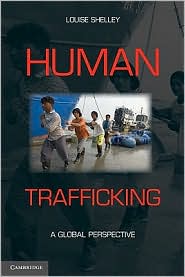
Louise Shelley's "Human Trafficking"

Louise Shelley is Professor of Public Policy and Director of the Terrorism, Transnational Crime and Corruption Center at George Mason University.

She applied the “Page 99 Test” to her new book, Human Trafficking: A Global Perspective, and reported the following:
My book, Human Trafficking: A Global Perspective (Cambridge, 2010) examines all forms of human trafficking globally, revealing the operations of the trafficking business and the nature of the traffickers themselves. Using a historical and comparative perspective, it demonstrates that there is more than one business model of human trafficking and that there are enormous variations in human trafficking in different regions of the world. I conclude that human trafficking will grow in the twenty-first century as a result of economic and demographic inequalities in the world, the rise of conflicts, and possibly global climate change.

Page 99 of the book is halfway into the third chapter devoted to Human Trafficking as Transnational Organized Crime. This section on the recruitment of trafficking victims addresses some of the major themes of the book that citizens of failed post-socialist transitions, individuals displaced by conflicts, and large scale natural disasters are likely victims of human trafficking. As the book shows, the last twenty years have been ones of significant growth in human trafficking as the Soviet Union and other socialist states collapsed, the end of the superpower conflict resulted in the rise of numerous conflicts internationally. Moreover, with increased problems of climate change, the number of natural disasters has increased leaving ever larger numbers susceptible to exploitation.

Page 99 focuses on two particular regions in which victims are recruited: the former Soviet Union and Iraq. In contrast to many books on human trafficking, this book focuses on labor as well as sexual trafficking. Trafficking from the former Soviet Union is not only the widely publicized trafficking of women for sexual exploitation. Rather a larger number of victims are those exploited within the countries of the former Soviet Union as laborers. Particularly numerous are the male trafficking victims from Central Asia who work in Russia and Kazakhstan where they often work long hours without days off for substandard wages or are even deprived of their wages. These illegal workers are often poorly educated, unlike their counterparts in the United States, who were once highly trained professionals but are now working in menial work in the American shadow economy.

The discussion of Iraq shows that human smuggling and trafficking out of Iraq preceded the invasion that ousted Saddam Hussein. In Kurdish Iraq, in the late 1990s, a sophisticated business existed that smuggled individuals out of the country. Families would sell their homes to pay for the high costs of smuggling hoping to get members out of the country who could repatriate money or establish a foothold overseas. This smuggling was not always successful and Kurds were sometimes imprisoned as illegal immigrants in Europe. Or, as is shown elsewhere in the book, those who started out in a consensual relationship with their smugglers wind up as trafficking victims.
Read an excerpt from Human Trafficking, and learn more about the book at the Cambridge University Press website.

--Marshal Zeringue