Friday, April 5, 2013

Charles Fernyhough's "Pieces of Light"

Charles Fernyhough is an award-winning writer and psychologist. His book A Thousand Days of Wonder: A Scientist's Chronicle of His Daughter's Developing Mind was a Parade magazine pick of the week and has been translated into seven languages. The author of two novels, The Auctioneer and A Box of Birds, Fernyhough has written for the Guardian, the Financial Times, and the Sunday Telegraph; contributes to public radio's Radiolab; blogs for Psychology Today; and is a Reader in Psychology at Durham University, UK.

Fernyhough applied the “Page 99 Test” to his new book, Pieces of Light: How the New Science of Memory Illuminates the Stories We Tell About Our Pasts, and reported the following:
Pieces of Light is a book about the science and stories of autobiographical memory. Many of us are still wedded to a view of memories as faithful representations of past events (for example, around half of people surveyed will wrongly liken memory to a video camera). I wanted to explore the new scientific consensus that memories are reconstructions, created in the present moment and shaped by who we are now. On page 99, I am about to indulge in that time-honored practice of psychologists experimenting on their own children. My father passed away some years before my kids were born, and I wanted them to have memories of him: not just factual knowledge, but real memories, in which they could picture him and hear his voice. There is plenty of scientific research to support the idea that it is possible to have vivid ‘memories’ of events that never actually happened or that you never genuinely experienced. Scientists understand these phenomena in terms of the brain stitching together many different kinds of information, some of which does not properly belong in the memory at all. If memories are reconstructions rather than literal records, I reasoned, it should be possible to give my kids the materials for making a memory of their grandfather, even though they never met him.

Ethically, of course, this is terribly problematic. What right do I have to try to ‘implant’ memories that my kids don’t genuinely have? I would argue that we are up to this kind of trick all the time. Parents are constantly making decisions, consciously or unconsciously, that will shape their children’s memories. Simply electing to take the video camera with you one day and not another; choosing what to talk about and what to cover up with silence: we are sculpting our children’s narratives of the past all the time, whether we mean to or not. And adults do the same with each other. I discuss some research that shows that adult siblings often claim another sibling’s memory as their own (often to portray themselves in a particularly good light). Just by talking about the past, we are constantly shaping each other’s take on it.

From page 99:
‘What did Grandad Philip always say?’

Isaac is doing some online shopping. He has some leftover holiday money to put towards a new game for the Wii, and I am trying to help him to work out whether, with a couple of weeks of pocket money thrown in, it will be enough.

‘Do I want it?’ His big sister starts enumerating criteria on a thumb and two fingers. ‘Do I need it? Can I afford it?’

I’m not sure that my dad always satisfied these three conditions when he went shopping. But his rule for parting with cash has become part of the children’s own decision-making processes. It is one of the mantras they know him by. He died more than a decade ago, too soon to get to know any of his grandchildren: Athena and Isaac, and their cousins Lucy and Annabel. As time has gone on, I have wondered more and more about how the children are to know him, how I myself should talk about him, and the rights and wrongs of negotiating the memory of someone who is no longer here.

Our memory of him is not a particularly visual one. We don’t spend a lot of time, as a family, going through photographs, and Dad died before digital pictures and video became ubiquitous. Talking to the children about Grandad Philip’s funny pronouncements means that he becomes more real for them than a photographic image. It allows the kids to own a bit of him, to incorporate him into their way of looking at the world. The stories of his outraged behaviour in restaurants and hotels, his subtle ploys for getting a drink when he needed one, have become real for the children, too. I want to say that they remember this affectionate, vulnerable, opinionated man, even though their stays on the planet did not overlap.
Learn more about the book and author at Charles Fernyhough's website.

--Marshal Zeringue

Thursday, April 4, 2013

Caetlin Benson-Allott's "Killer Tapes and Shattered Screens"

Caetlin Benson-Allott is Assistant Professor of English and Film and Media Studies at Georgetown University.

She applied the “Page 99 Test” to her new book, Killer Tapes and Shattered Screens: Video Spectatorship From VHS to File Sharing, and reported the following:
On page 99, I observe that David Cronenberg’s 1983 movie Videodrome stages essentially the same thesis as my book: “video means that movies no longer affect either their makers or their spectators in the same way”—that is, the same way they did when they were films. Since 1988, most US viewers have watched most of the movies they see on one video platform or another: Betamax, VHS, Laserdisc, DVD, Blu-Ray, or digital file. We still go to the theater, of course, but not nearly as often as we stay in with a video. Yet both academics and the movie industry still write about movies as though they were films, as though the cinema still dominated US movie culture. Killer Tapes and Shattered Screens argues that we need to acknowledge that watching movies on home video is different, that we experience movies differently when we pop in the tape, insert the DVD, or play the file. Filmmakers know the experience is different; Killer Tapes and Shattered Screens demonstrates how movies (specifically horror movies and thrillers) present their stories and spectacles differently for different kinds of home video spectators.

Videodrome was one of the first movies explicitly about home video technology, and as I explain on page 99, its dystopian vision of video culture seriously hampered its popular appeal. In Videodrome, a shadowy international corporation develops a new video format whose signal produces brain tumors in its viewers; these tumors produce hallucination and turn viewers into assassins for the corporation’s nefarious political schemes. Sounds like a sci-fi plot—and it is—but the same year that Videodrome was produced, two British newspapers inaugurated a public panic around “video nasties,” videotapes of foreign horror movies that were allegedly corrupting the minds and morals of British youth:
In May 1982 London’s conservative newspapers the Sunday Times and the Daily Mail ran multiple stories warning readers that “films which specialize in sadism, mutilation, and cannibalism” had become widely available to British children as video rentals. These movies were certified X or denied theatrical release by the British Board of Film Censors but were not clearly within that board’s jurisdiction once they came out on video. The Daily Mail coined the term video nasties to describe these tapes, and although the phrase was often deployed as a synonym for horror films, Julian Petley pointed out at the time that “a video nasty is not, apparently, simply a video of a film too violent to be given an X.” Rather, it was an alien threat. As James Kendrick would later prove, the video nasties were for the most part foreign—Italian or American—and were condemned as foreign assaults on British values. In fact, the nasties were routinely characterized as agents of US cultural imperialism bent on weakening the morals of working-class British teenagers regardless of their subjects or national origin.
Although Videodrome was a Canadian film about the horrors of Americanization (that shadowy international corporation seems to be headquartered in Pittsburgh), it was still suppressed in the UK. Confusion and fear about how video was different from film triggered many other social anxieties about class, gender, and sexuality.
Learn more about Killer Tapes and Shattered Screens at the University of California Press website.

--Marshal Zeringue

Wednesday, April 3, 2013

Elizabeth Cobbs Hoffman's "American Umpire"

Elizabeth Cobbs Hoffman earned a Ph.D. in American history at Stanford University, and now holds an endowed chair at San Diego State University. Her books have won four literary prizes, two for American history and two for fiction. She has been a Fulbright scholar in Ireland and a Fellow at the Woodrow Wilson International Center for Scholars in Washington, D.C, and is currently a National Fellow at Stanford University's Hoover Institution. From 1999 to 2005, she served on the Historical Advisory Committee of the U.S. State Department, advising on transparency in government and the declassification of top secret documents.

Hoffman applied the “Page 99 Test” to her latest book, American Umpire: The New Rules of World Order, 1776 to the Present, and reported the following:
One frets before a test. What if page 99 is a blank sheet between chapters, or worse, filled with antlike footnotes that spell geek?

Then, voila, Ford Madox Ford is proved right again.

On page 99 of American Umpire, the dramatis personae are all on stage. The year is 1823. The American president (played in this scene by cleft-chinned James Monroe) worries that the United States is unprepared for foreign threats. Craven Cabinet members echo and amplify his fears. The Secretary of State (starring the prickly, gimlet-eyed John Quincy Adams) suffers fools silently, if not gladly, and bides his time before introducing the solution he knows will take others by surprise. Off stage, British Foreign Minister George Canning is overheard in soliloquy, plotting the grand strategy of the Pax Britannica.

On this page and throughout, American Umpire re-examines the familiar terrain of U.S. foreign relations between 1776 and the present, discovering new overlooks and hidden trails that reveal the nation’s place on the terrain of world history.

The first thing it finds is that—contrary to many scholarly and even casual critics—the United States is not an empire. Instead, because of its unusual federal structure, the government has always functioned as a kind of umpire, compelling states’ adherence to rules that gradually earned collective approval.

This provocative reinterpretation traces America’s role in the world from the days of George Washington, Abraham Lincoln, and Franklin D. Roosevelt to the present. It argues that the United States has been the pivot of a transformation that began outside its borders, in which nation-states replaced the empires that had dominated history. The “Western” values that America is often accused of imposing were the result of this global shift. American Umpire explores the rise of three values—access to opportunity, arbitration of disputes, and transparency in government and business—and finds that the United States is distinctive not in its embrace of them but in its willingness to persuade and even coerce others to comply. Yet America’s leadership is problematic as well as potent. The nation has both upheld and violated the rules. Taking sides in explosive disputes imposes significant financial and psychic costs. By definition, umpires cannot win.

On page 99, the umpire looks outside the domestic ballpark for the first time, and onto the international playing field. Should America try to guarantee international security to ensure its own or not?

Excerpt from page 99:
The offer was an extraordinary compliment coming from the victor of Waterloo. For the first time in its brief history, the United States was being asked to sign on to a high-level international diktat. George Canning, foreign secretary of the United Kingdom and America’s former adversary, courted Washington’s opinion.

Only the U.S. secretary of state, John Quincy Adams, disagreed. He shrewdly waited until others had vented their enthusiasm and then appealed to every politician’s soft spot: vanity. Britain wanted to deter France and Spain from forcibly re-imposing imperial control over the breakaway Latin republics. This was splendid. Adams himself had acerbically lectured Britain’s minister in Washington that “the whole system of modern colonization is an abuse of government and it is time that it should come to an end.” But America ought to proudly issue its own preemptive declaration, he said, rather than rowing behind the Royal Navy. “It would be more candid, as well as more dignified,” Adams observed, “to avow our principles explicitly to Russia and France than to come in as a cock-boat in the wake of a British man-of-war.” Actually, it would have been more candid for the United States to acknowledge that the whole idea of a public protest had been England’s from the start.

By the end of the long afternoon, Monroe was nearly persuaded. The president certainly did not wish to be seen as deferring to the United Kingdom, not after the United States had just lost 2,200 men defending its honor on land and sea in the War of 1812. Not after the carpenters and painters had just finished restoring the burned-out shell of the White House, torched by British troops in 1814. But with the weight of the country on his shoulders, Monroe remained anxious that Spain, France, and Russia might send as many as 10,000 troops to quell republicanism in the Americas. He could not quite bring himself to adopt Adams’s breezy self-confidence. Britain was the only country equipped to stop the menacing European powers. Prudence counseled acceptance of its offer.
View the trailer for American Umpire, and learn more about the book and author at Elizabeth Cobbs Hoffman's website.

--Marshal Zeringue

Tuesday, April 2, 2013

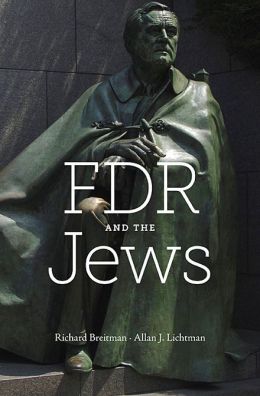
Richard Breitman & Allan Lichtman's "FDR and the Jews"

Richard Breitman is Distinguished Professor in the Department of History at American University. Allan J. Lichtman is Distinguished Professor in the Department of History at American University.

They applied the “Page 99 Test” to their latest book, FDR and the Jews, and reported the following:
Page 99 of FDR and the Jews offers a quick overview of Franklin Delano Roosevelt’s interest in moving large numbers of Jews out of Europe before the outbreak of possible war. The Neutrality Acts had sharply limited Roosevelt’s ability to shore up Britain and France against possible German expansion and aggression. By taking more German Jews into the U.S. and encouraging other Western Hemisphere countries to do so as well, in 1938 Roosevelt hoped to make a statement against Germany and at least to mitigate Nazi Germany’s “Jewish problem.” But he got precious little support from other world leaders and other major powers. Because of Roosevelt’s fear of anti-Semitism at home and abroad, Roosevelt preferred to use the term political refugees--to avoid giving the impression that most of those seeking to leave Germany were Jews.

Another part of p. 99 explains the relationship between FDR and Sumner Welles, who became undersecretary of state in 1937. Welles had ties to FDR that stretched back to his childhood, and he was more liberal than most high officials in the State Department. He was willing to serve as the facilitator of a president who, in effect, wanted to be his own secretary of state. Welles took charge of FDR’s refugee initiatives abroad, working them into a broader vision of American foreign policy.

Welles tried to appeal to American isolationists by arguing that finding refuge for these endangered populations in Central Europe might help to prevent war. Roosevelt’s and Welles’s refugee initiatives lasted into 1939, but did not survive the outbreak of war and his 1940 presidential campaign.

FDR and the Jews traces four stages of presidential attitudes and policies: an early first stage in which Roosevelt largely abstained from reactions to Nazi persecution; a second (1937-39) stage summarized above; a third stage in which Roosevelt became a narrow guardian of national security and manager of a war effort; and a fourth stage in which, under some pressure, he belatedly endorsed an effort to save the lives of Jews and others threatened by the Nazis. Our book seeks to place Roosevelt in his world--to explain him before we praise or condemn him. We present a great deal of new evidence, including some new material about his 1938 initiatives.
Learn more about FDR and the Jews at the Harvard University Press website.

--Marshal Zeringue

Monday, April 1, 2013

Ian Stewart's "Visions of Infinity"

Ian Stewart is Emeritus Professor of Mathematics and active researcher at the University of Warwick. The author of many books on mathematics, he lives in Coventry, England.

Stewart applied the “Page 99 Test” to his latest book, Visions of Infinity: The Great Mathematical Problems [UK title: The Great Mathematical Problems], and reported the following:
From Page 99:
There is a price to pay for this approach: you have to solve about 100,000 linear programming problems. The calculations are lengthy, but well within the capabilities of today’s computers. When Hales and Ferguson prepared their work for publication it ran to about 250 pages of mathematics, plus 3 gigabytes of computer files.

In 1999 Hales submitted the proof [of the Kepler conjecture] to the Annals of Mathematics, and the journal chose a panel of twelve expert referees. By 2003, the panel declared itself ‘99 per cent certain’ that the proof was correct. The remaining uncertainty concerned the computer calculations; the panel had repeated many of them, and otherwise checked the way the proof was organised and programmed, but they were unable to verify some aspects. After a delay, the journal published the paper. Hales recognised that this approach to the proof would probably never be certified 100 per cent correct, so in 2003 he announced that he was starting a project to recast the proof in a form that could be verified by a computer using standard automated proof-checking software.
Page 99 of Visions of Infinity is about the Kepler conjecture, a baffling mathematical enigma that remained unsolved from the time Johannes Kepler first posed it in 1611, in a book about snowflakes, until Thomas Hales and his student Samuel Ferguson solved it 387 years later. Is the most efficient way to pack spheres together the one that greengrocers use to stack oranges? The answer surely has to be ‘yes’, but proving it is another matter entirely.

The book as a whole is about the great mathematical problems, the ones that every mathematician would dearly love to solve. The obstacles that hold up mathematical progress, often for centuries. Whenever some genius answers one of these problems, the media start paying attention to mathematics.

However, media reports sometimes give the impression that finally, after decades of inactivity, mathematicians have produced something new. One of my aims in writing the book is to make it clear that modern mathematics is a hotbed of creativity, with new and important mathematics constantly being brought into existence. In fact, so creative are today’s mathematicians that most of the great problems of the past have crumbled under the onslaught of fresh insights.

However, the more we learn, the more we become aware of that we don’t know. So new great problems are arising all the time. The book is therefore a mixture of solved and unsolved problems. Each gets a chapter to itself, explaining how the problem arose, what mathematicians have done to tackle it, and either how someone eventually solved it, or why it remains as baffling as ever.

I have covered most of the famous problems, and all of the Clay Institute Millennium Prize Problems, with a million dollars on offer for each. I’ve included familiar problems like the four colour conjecture and Fermat’s last theorem, and others less well known, such as the P/NP problem: do genuinely hard mathematical questions exist?

My main aims in writing the book were to collect together in one place accessible descriptions of a selection of the greatest mathematical problems ever posed, and to demonstrate the ever-growing power and creativity of modern mathematics. The great mathematical problems open a fascinating window into the otherwise obscure workings of great mathematical minds.
Learn more about the book at the author's website.

See Ian Stewart's top ten popular mathematics books.

The Page 99 Test: Why Beauty Is Truth.

The Page 99 Test: In Pursuit of the Unknown.

--Marshal Zeringue

Sunday, March 31, 2013

Alex Sayf Cummings's "Democracy of Sound"

Alex Sayf Cummings is an assistant professor of History at Georgia State University, and co-editor of the blog Tropics of Meta.

He applied the “Page 99 Test” to his new book, Democracy of Sound: Music Piracy and the Remaking of American Copyright in the Twentieth Century, and reported the following:
Democracy of Sound is the story of all the jazzbos, Deadheads, DJs, pirates, politicians, and radicals who helped shape copyright law into what it is today.  I first became intrigued by the subject when Napster began to transform the ways people listened to music. I soon discovered that Congress did not provide copyright protection for sound recordings until 1971; it seemed bizarre to me that copyright law could have been so limited just a few decades ago, especially given how expansive and restrictive it is today.  To figure out why, I embarked on a project that uncovered a much longer history of piracy and bootlegging than I expected to find—reaching all the way to the wax cylinder era of the 1890s.

Page 99 [inset left, click to enlarge] is a really representative sample of the book.  It features an image of a bootleg recording of the San Francisco band It’s a Beautiful Day, and it points out the similarity between the pirate LPs of the late 1960s and the burnt CDs of the last decade or so.  The passage also discusses Great White Wonder, a Dylan bootleg that sparked an explosion of piracy in 1969:
These earliest rock bootlegs were minimalist by default, with plain white covers that gave little or no indication of what was contained inside…The blank design of the early Wonders recalled what became known as the Beatles’ White Album, released the year before. Designed by pop artist Richard Hamilton, the 1968 record originally featured a plain white cover, the lack of adornment mirroring its simple title: The Beatles.
Democracy of Sound is not just about law and technology, but very much about pop culture and the creativity of people who copy music outside the bounds of the law.  It’s also about the idea that bootleg culture has its own aesthetic—the fuzziness of a lo-fi copy, the simplicity of a Xeroxed cover, and the creative stamp that pirates put on music as they remix, reproduce, and recirculate it. (This is an idea I borrowed from one of my mentors, the anthropologist Brian Larkin.)  In this sense, piracy creates its own sort of folk or vernacular culture, whether it’s a Jelly Roll Morton LP in the 1940s, a Grateful Dead bootleg in the 1970s, or a DJ Clue mixtape in the 1990s.
Learn more about Democracy of Sound at the Oxford University Press website.

--Marshal Zeringue

Saturday, March 30, 2013

Anne A. Latowsky's "Emperor of the World"

Anne Latowsky is an Assistant Professor in the Department of World Languages at the University of South Florida.

She applied the “Page 99 Test” to her new book, Emperor of the World: Charlemagne and the Construction of Imperial Authority, 800-1229, and reported the following:
Page 99 of Emperor of the World is the first page of Chapter 3, entitled “Benzo of Alba’s Parallel Signs.” This was probably the chapter I most enjoyed writing because Benzo is such a colorful character. He wrote a lengthy verse panegyric to the German Emperor Henry IV, a work which contains some of the medieval world’s most famous anti-papal invective. Did anyone else refer to the pope as an ass in a stable or to the dining hall of the Lateran palace, the triclinium, as a dung heap, a sterquilinium?
In colorful, poetic, and sometimes foul language, Benzo of Alba promoted the Salian inheritance of the Roman Empire on behalf of Henry IV in his virulently anti-Gregorian Libri ad Heinricum IV Imperatorem. Throughout his voluminous work, Benzo composed multiple versions of the foreign embassy motif in a variety of forms and rhetorical contexts, including a version of the Last Emperor prophecy, an eerie visitation by the voice of Charlemagne to explain the prophecy, fabricated diplomatic communiqués, and lofty panegyric verse. More so than anyone before him, Benzo reveals his recognition of the encomiastic function of Charlemagne’s symbolic conquest of the East. He began his endeavor during the precarious period of Henry’s minority in the early 1060s, and finally completed the project in 1085, after Henry’s long-delayed imperial coronation.”
In this book I contend that we have long misunderstand the influential, yet apocryphal, story of Charlemagne’s peaceful encounters with Byzantium and the Holy Land, a prominent tradition too often erroneously tied to the Crusading movement. In six chapters that consider works written in Latin from the ninth to the thirteenth centuries, I lay out the case for seeing the evolution of the memory of Charlemagne and the East as the product of centuries of deliberate rewriting of a single episode in the emperor’s imagined life. That episode was based on a commonplace of imperial praise that proclaimed universal imperial authority by describing foreign nations peacefully surrendering to the victorious Roman emperor.

In the conversation that Benzo imagines between the ninth-century emperor Charlemagne and the eleventh–century Henry IV, the voice of Charlemagne promises Henry future victory over all of his enemies. The Carolingian emperor urges the Salian king to recognize the signs that have allowed him to predict his coming universal victory. These signs are none other than the similar diplomatic encounters that the two men have had with the East. Benzo’s parallel signs thus reveal a Charlemagne whose bloodless conquest of the East had nothing to do with the incipient Crusading movement, and everything to do with the battle to define imperial authority during the Investiture Contest that pitted empire against papacy in the late eleventh century.
Learn more about Emperor of the World at the Cornell University Press website.

--Marshal Zeringue

Friday, March 29, 2013

Stuart Banner's "The Baseball Trust"

Stuart Banner is Norman Abrams Professor of Law at the University of California, Los Angeles School of Law. A noted legal historian, he is the author of many books, including American Property: A History of How, Why, and What We Own; Who Owns the Sky? The Struggle to Control Airspace from the Wright Brothers On; and Possessing the Pacific: Land, Settlers, and Indigenous People from Australia to Alaska.

He applied the “Page 99 Test” to his new book, The Baseball Trust: A History of Baseball's Antitrust Exemption, and reported the following:
The Baseball Trust is about one of the oddest features of our legal system, the near-complete exemption of baseball from antitrust law. Every other sport, like virtually every other sort of business, is governed by the antitrust laws. Why not baseball?

The answer lies in a chain of court opinions beginning with Federal Baseball Club of Baltimore v. National League (1922), in which the Supreme Court held that baseball was not a form of interstate commerce. The decision was uncontroversial at the time, because “interstate commerce” was a term of art with a much narrower meaning than it has today. Soon after, however, the prevailing professional understanding of interstate commerce expanded dramatically. And that raised the question whether, given the new legal climate, the Federal Baseball Club case should be overruled.

The first court to confront this question was the U.S. Court of Appeals for the Second Circuit, in New York, in a 1948 case called Gardella v. Chandler. On page 99 of The Baseball Trust, Judge Jerome Frank, one of the most well known judges of the era, responds to the opinion of his colleague Harrie Chase, who argued that a lower court has no authority to overrule a Supreme Court opinion:
Judge Jerome Frank took the opposite view. “There is nothing new about a lower court announcing that a Supreme Court decision is dead,” he observed. He mentioned some examples, including a celebrated case from just a few years before, in which a district judge correctly predicted that the Supreme Court would overrule one of its own prior cases and decide that the First Amendment bars a school district from requiring children to salute the flag and say the Pledge of Allegiance. Frank concluded that there was no reason to wait for the Supreme Court to say that baseball was interstate commerce, when the Court of Appeals could say so for itself. He also concluded, however, that there was no need to predict that Federal Baseball Club would be overruled. The Court of Appeals could also find Federal Baseball Club inapplicable to Gardella’s case, on the ground that even if baseball was not interstate commerce in 1922, it had become so by 1948. Back in 1922, Frank noted, there had been no broadcasting of baseball games, but in 1948 the games were broadcast on interstate radio networks, and were just beginning to be shown on interstate television networks as well. That was enough, in Frank’s view, to bring baseball within the definition of interstate commerce. The weakness in this argument, as Frank acknowledged, was that accounts of baseball games had been transmitted by interstate telegraph in 1922. The only difference between the two cases was the presence or absence of a wire. To draw a distinction on that ground, Chase responded, “seems just silly.”
Learn more about The Baseball Trust at the Oxford University Press website.

The Page 99 Test: Who Owns the Sky?.

--Marshal Zeringue

Thursday, March 28, 2013

Marcus Anthony Hunter's "Black Citymakers"

Marcus Anthony Hunter is an Assistant Professor of Sociology at Yale University.

He applied the “Page 99 Test” to his new book, Black Citymakers: How "The Philadelphia Negro" Changed Urban America, and reported the following:
Black Citymakers revisits the Black Seventh Ward of W.E.B. DuBois's The Philadelphia Negro (1899), documenting a century of banking and tenement collapses, housing activism, black-led anti-urban renewal mobilization, and post-Civil Rights political change from the perspective of the Black Seventh Warders. Drawing on historical, political, and sociological research, I argue that black Philadelphians were not merely victims forced from their homes - they were citymakers and agents of urban change.

On Page 99, we find ourselves in the midst of the one of the most dramatic stories in the book. The year is 1937 and it is just months after a tenement collapse killed a young black widow Lucy Spease, and her three children Bernice (age 13), Samuel (age 6), and Helen (age 5). By February of 1937 the mayor razed dilapidated housing in the Black Seventh Ward near and around the site of the tenement collapse. Placing “Condemned, Unfit for Habitation” signs on the many properties where Black Seventh Warders were currently living. “Deploying the memory of the Spease family and others who were affected the by tenement collapse,” black political groups such as the National Negro Congress ignited “working-class blacks using housing reform as a means of generating a new generation of black political leadership that would be rooted in the Democratic Party.” In addition, “the response of black residents forced” the mayor of Philadelphia “to develop broader policies on housing reform. Realizing the scope of the problem and the need for a formal city entity to supervise housing reform, city officials under Wilson’s leadership formed the Philadelphia Housing Authority (PHA). The PHA, created in August 1937, was charged with the mission of clearing, reconstructing, and replanning ‘the areas in which slums exist’ and of providing ‘safe and sanitary dwelling accommodations for persons of low income’.”

“The funding for the PHA came from the Wagner-Steagall Act. The Wagner-Steagall Act, passed in 1937, was the federal law that created the United States Housing Administration (USHA) and contained a provision for low-interest loans that local authorities could use to cover up to ninety percent of costs associated with slum clearance and building housing projects.” That same year, the trial of the landlord of the tenement that collapsed, Abraham Samson, “was under way.” It was discovered during the trial that a black resident, Raymond Blackwell, “had complained to Samson just hours before the collapse, and his cousin Alberta Richardson testified at the trail.”
Learn more about Black Citymakers at the Oxford University Press website.

--Marshal Zeringue

Wednesday, March 27, 2013

Monte Reel's "Between Man and Beast"

Monte Reel is a former South America correspondent for the Washington Post, and he also reported for the newspaper in Washington and Iraq. His first book, The Last of the Tribe (2010), chronicles the story of the last surviving member of an indigenous tribe in the Amazon rainforest. After spending seven years in Argentina, he recently moved to the Chicago area, where he lives with his wife and two daughters.

Reel applied the “Page 99 Test” to his new book, Between Man and Beast: An Unlikely Explorer, the Evolution Debates, and the African Adventure that Took the Victorian World by Storm, and reported the following:
Ah, the famous “Page 99” test! I’d heard Ford’s quote before, but I never thought of applying his test to my own book (if I had, I might have tinkered with the page to rig this exercise in my favor. Alas…).

This book, Between Man and Beast, is a nonfiction narrative about the discovery of the gorilla in the mid-nineteenth century. The story traces that discovery’s impact on the evolution debate (it helped push it out of academia and to the masses), racial politics (the young explorer at the center of the story hid his African ancestry, while watching his specimens used to advance ugly racial theories and slurs), and even pop culture (his adventures provided the seed of the King Kong story, and they deeply influenced the birth of the action-adventure genre).

So let’s flip to page 99…

From the first line of the page, we’re thrust into a very famous episode in the early evolution debate: Thomas Huxley, in Darwin’s corner, has squared off against Bishop Samuel Wilberforce at a scientific meeting in Oxford in 1860. This debate is now considered a milestone: Huxley triumphed, according to almost all modern accounts, and Wilberforce was silenced and humiliated. But by the middle of page 99, we learn that the outcome of the debate was far from clear to the participants at the time. “I think I thoroughly beat him,” Wilberforce concludes.

By mid-page, we also discover that Richard Owen, a famous anatomist who had positioned himself as Huxley’s (and, by proxy, Darwin’s) greatest scientific adversary, also considered the debate very much alive. After the Oxford debate, both Huxley and Owen work harder than ever to prove their cases. Owen believes that what he really needs to prove his argument is a specimen of the recently discovered gorilla – believed at that time to be man’s closest relative. The page ends with the focus on Owen:
Within a couple months of the meeting, he’d receive a letter that began, “My dear Sir, let me present you with a gorilla skin.” The letter ended with the words “Sincerely, Paul du Chaillu.”
So I guess page 99 is representative enough. Du Chaillu is the young man at the center of the story. He is stumbling out of the forests of Africa and straight into a cultural debate that he’s not really prepared to enter. The page sets up Owen and Du Chaillu’s unlikely alliance, which will result in the young explorer traveling to London with his newly stuffed gorillas, which in turn will spark a massive public furor surrounding the “hellish dream creature” – and all sorts of other dominoes will fall, on both sides of the Atlantic. So let's flip to page 100...
Learn more about the book and author at Monte Reel's website.

--Marshal Zeringue