Thursday, May 2, 2013

Solon Simmons' "The Eclipse of Equality"

Solon Simmons is Associate Professor of Conflict Analysis and Resolution at George Mason University. He makes frequent appearances on radio, television, and in print media, discussing issues of politics and group conflict, and his work has been discussed on most of the major national news outlets, including the New York Times, the Washington Post, Good Morning America, National Public Radio, and Meet the Press itself. He blogs about U.S. politics and culture on Confrontations.

Simmons applied the “Page 99 Test” to his new book, The Eclipse of Equality: Arguing America on Meet the Press, and reported the following:
Page 99 of The Eclipse of Equality enters the arc of the larger story of the book at an oblique angle. The streamlined argument of the book is that American elites have become progressively less concerned with moral arguments about property and equality on both left and right, supplanted with a focus on prejudice and diversity on the left and personal freedom and anti-statism on the right. Eclipse of equality in this sense represents a temporary (perhaps) atrophy of a canonical category of the moral imagination. How I demonstrate this process of elite opinion change is by analyzing their Sunday morning conversations on Meet the Press—thought of as an extended collection of interviews and focus groups on the dominant topics of the day from 1945 to the our own time.

Page 99 picks up this story with an extended excerpt from a Meet the Press interview from October 18, 1959 with a corporate leader and then rising star of the Republican Party named Charles Percy. As with all the excerpts in the book, this extended passage says less about Percy and the mid-century Republican Party than it does about the arguments that were circulating in elite circles at the time and the ideals they embodied.

The work Percy does for the argument is to highlight the moment of transition in political party emphases when Democrats and Republicans were far closer in their economic arguments than they are today. What I wanted the reader to see was John Kennedy represented in the words of this idea man of “dynamic conservatism.” This would make it easier to see how important the Kennedy moment was in initiating the flight in moral emphasis in Democratic Party rhetoric from class to culture. Among other things, Percy calls for a moon landing by 1970, missile superiority and a “strong, efficient central government.” If you close your eyes and ignore the Midwestern accent, Percy sounds a lot like Jack Kennedy. From our vantage, Kennedy comes off, in context, as a progressive Republican.

This ideological convergence in 1959 is relevant for us in 2013 in that it marks the beginning of the end of the rhetoric of class struggle and the vilification of wealth. It also marks the last days before the return to Republican vilification of the federal bureaucracy that had emerged with the rise of professional corporate management prior to the Great Depression and the New Deal.

As Democrats after Kennedy came to recognize the electoral force of the anti-supremacist arguments given dramatic form in the Civil Rights Movement and Republicans exploited the racial anxieties of once loyally Democratic white ethnics to fuel their neoliberal rocket, the economic red lines of the New Deal faded into pink. Today, even to flirt with the virulent language of a Senator Paul Douglas, the Fair Deal economist and Senator who would lose his Illinois seat to Percy in 1966, is to mark one’s self as outside of the rhetorical mainstream. This is what it means to have lived through the eclipse of equality and helps explain why we have seen so little in the way of aggressive class politics from the Democratic administration that governed through this lesser depression we suffer through today.
Learn more about the book and author at Solon Simmons's website.

--Marshal Zeringue

Tuesday, April 30, 2013

Wendy Moore's "How to Create the Perfect Wife"

Wendy Moore is a writer and journalist. Her work has been published in a range of newspapers and magazines, including the Guardian, the Observer and the British Medical Journal and has won several awards. Her books include The Knife Man and Wedlock.

Moore applied the “Page 99 Test” to her latest book, How to Create the Perfect Wife: Britain's Most Ineligible Bachelor and his Enlightened Quest to Train the Ideal Mate, and reported the following:
Thank you Ford Madox Ford! His page 99 test may not work in every case but my latest book, How to Create the Perfect Wife, passes with flying colours. Nearly one-third of the way through the book, p. 99 opens at a crucial crossroads in the story. This is the precise point at which Thomas Day, an eccentric Georgian English poet and radical, has to decide which of two young girls he should pick to craft into his ideal wife.

My book relates the incredible true tale of Day’s efforts to find a soulmate to live with him in austere isolation devoted to doing good works. Day had a fixed idea of how he wished to live and a firm notion of the woman with whom he wished to share that life. She should be beautiful like a goddess and pure like a peasant maid. She should be clever enough to appreciate his superior intellect and hardy enough to survive a rough comfortless existence. And above all she must always defer to him. By the age of 21, Day had come to the conclusion that this fantasy creature did not exist in Georgian high society. And so he came up with a brilliant wheeze.

In June 1769 Day visited two orphanages – in Shrewsbury and London – and there he selected two girls. One was aged 12, with chestnut curls and brown eyes; the other was aged 11, with blond hair and blue eyes. He would educate them both and then choose the best pupil to train into his perfect wife. By page 99, Day is living in France, in a ménage á trois with his two young girls, poised to decide which of these prepubescent dolls – whom he had renamed Sabrina and Lucretia - would blossom into his future bride.
To make Day’s dilemma worse, the girls had equally pleasing but completely opposite characters too. So although he found himself drawn toward plump, fair-haired Lucretia with her sunny, jolly personality, he was also attracted to slender, chestnut-haired Sabrina with her quieter, more reserved nature and her eagerness to learn. What was a man to do?
By the end of page 99 Day has made his decision. He picks the girl he would then try to fashion into his perfect wife. Who was she? That would be telling.
Learn more about the book and author at Wendy Moore's website.

The Page 99 Test: Wedlock.

--Marshal Zeringue

Monday, April 29, 2013

David Malet's "Foreign Fighters"

David Malet is Associate Director of the School of Government and Lecturer in International Relations at the University of Melbourne.

He applied the “Page 99 Test” to his new book, Foreign Fighters: Transnational Identity in Civil Conflicts, and reported the following:
Foreign Fighters examines how rebel groups in armed conflicts persuade individuals to travel from other countries to join their fight. While the term is equated at the moment with Islamist jihadis fighting in Syria, Iraq, and Pakistan, there have been foreign volunteers in a significant number of modern civil wars fighting for causes ranging from international Communism to national independence for ethnic groups. Evidence from both current and historical cases show that most foreign fighters receive little pay; they are not mercenaries, but are motivated by appeals to defend their group against what recruiters portray as an existential threat to their community worldwide. Foreign Fighters presents a historical overview of this phenomenon, and examines current issues in counter-insurgency by comparing today’s jihadis to recruitment in four historical cases: The 1836 Texas Revolution, the 1936 Spanish Civil War, the 1948 Israeli War of Independence, and the 1980s Afghanistan War.

Page 99 picks up in the middle of an account of one of the more famous foreign fighters, author George Orwell, who joined a Marxist militia in Spain to stop the advancing threat of fascism. Communist Party members believed that the formation of the International Brigades to fight in Spain was a fulfillment of the Marxist call “Workers of the World, Unite!” It describes the recruitment effort being handled by the transnational Communist International (Comintern), and how its leaders strategically framed the conflict as one that was vital to people living in democratic societies and not just to Communists. The Comintern’s American branch created public front organizations in the United States to generate public support, and to direct donations to the Abraham Lincoln Brigade, the military unit of American volunteers who were fighting in Spain. Page 99 is representative of the book as a whole, and of how insurgencies recruit transnationally and expand their pool of potential volunteers using strategic message framing.
Learn more about Foreign Fighters at the Oxford University Press website.

--Marshal Zeringue

Sunday, April 28, 2013

Elinor Lipman's "I Can't Complain"

Elinor Lipman is the author of ten novels, including The View from Penthouse B and The Inn at Lake Devine; one essay collection,  I Can't Complain; and Tweet Land of Liberty: Irreverent Rhymes from the Political Circus. She lives in Massachusetts and New York City.

Lipman applied the “Page 99 Test” to I Can't Complain and reported the following:
Page 99 of I Can't Complain is not only the opening page of an essay, but the gateway to the section titled "Coupling Columns." They were all written for the Boston Globe Magazine, a gig in which I was one of five rotating writers representing different relationship categories (gay, straight, married, single, and long-married, which was me). This one, "Boy Meets Girl," was my audition, the 750 words that landed me the job. Campaigning against comradeship of the athletic sort, I wrote, "I'm not against hobbies, just the elevation of them to a relationship prerequisite. My bias springs from my own lack of intergender interests and my conviction that togetherness is overrated. My parents were happily married for 45 years. Did my mother ever toss a football around with my father? Did he knit or sew or tend the tomatoes? He'd been a tennis player before he broke his ankles in the war; she never held a racket unless it was used to dislodge a cobweb from a light fixture." The whole section, written in 2005-2006, now has a poignancy I couldn't anticipate. These nine essays were about my marriage and--by definition and as good material--starred my husband. I had no idea as I wrote them that he would not live to see them collected.
Visit Elinor Lipman's website.

The Page 69 Test: The Family Man.

--Marshal Zeringue

Saturday, April 27, 2013

Philip Lieberman's "The Unpredictable Species"

Philip Lieberman is the George Hazard Crooker University Professor Emeritus at Brown University. His books include Toward an Evolutionary Biology of Language and Eve Spoke: Human Language and Human Evolution.

He applied the “Page 99 Test” to his latest book, The Unpredictable Species: What Makes Humans Unique, and reported the following:
People can do, think of, or create the oddest things.

In language stripped of jargon, The Unpredictable Species introduces the reader to current research on how brains work and the evolution of the attributes that set us apart from other living species – enhanced cognition and cognitive flexibility. Darwin got it right. Natural selection acted on existing neural structures, some of which date back to the time of the dinosaurs, to craft the human brain.

Complex aspects of human behavior such as walking, talking, or comprehending this text are not regulated by localized “organs.” For example, Broca’s area is not the seat of language. Nor does the functional architecture of biological brains resemble that of digital computers. It instead reflects the opportunistic, Rube Goldberg, “logic” of evolution. Neural circuits linking activity in the cortex with the basal ganglia, structures usually associated with motor control, were modified to confer the enhanced cognitive flexibility that sets us apart from other living species. Ongoing research points to transcriptional genes that affect how other genes ultimately form muscles, bones and brains, enhancing information transfer and plasticity in human basal ganglia circuits about 250,000 years ago. In effect, mutations on transcriptional genes, such as FOXP2, supercharged existing neural circuits, creating brains that can form and learn new concepts, conceive and carry out novel acts, create new forms of art, and unpredictably turn on a dime.

The pace of human invention, expressed in different epochs and places in new stone tools, digital computers, new art forms or music, complex civilizations, or this season’s style of jeans, stems from these supercharged neural circuits. Fashion, ever changing, is a mark of human creativity Contrary to the theories proposed by Steven Pinker and in other recent books, there are no specific genes that make us moral, monogamous, or determine our taste in art. Culture is a potent force in shaping human behavior. Language does not entail having specific knowledge preloaded into one’s brain, as Noam Chomsky proposes. These new findings also provide insights on wide-ranging topics including Aphasia, Parkinson disease, associative learning, transcriptional factors, epigenetics, cognitive confusion on Mount Everest, developing the skills of a Samurai, and why we are susceptible to choking on food.

As is the case for the books of Ford Madox Ford's close friend, Joseph Conrad, no single page of my book will reveal its full message.
Learn more about The Unpredictable Species at the Princeton University Press website.

--Marshal Zeringue

Friday, April 26, 2013

Drew Maciag's "Edmund Burke in America"

Drew Maciag has taught history at the University of Rochester, SUNY Geneseo, and Nazareth College.

He applied the “Page 99 Test” to his new book, Edmund Burke in America: The Contested Career of the Father of Modern Conservatism, and reported the following:
Page 99 of Edmund Burke in America concludes the tale of Supreme Court justice Joseph Story, one of the three main characters in chapter 5: “American Whigs: A Conservative Response.” Each of these pre-Civil War politicos (the other two were Edward Everett and Rufus Choate) was an admirer of the British Whig politician Edmund Burke during the age of liberal Jacksonian democracy.

Joseph Story had been a reasonable man, a respected legal scholar, a judicial nationalist (no fan of states’ rights), and he was less nostalgically conservative than some of his Whiggish contemporaries. His late-career turn to the ideological right is surprising unless one understands that American recourses to Burke’s anti-revolutionary philosophy usually coincided with perceived threats to the social order. During the Cold War, the threat would be communism; after the 1960s it would be liberalism run amok. But in Story’s day it was the threat of abolitionism, which could precipitate civil war, and of radical democratization, which challenged the rule of established elites (as demonstrated by Dorr’s Rebellion in Rhode Island). Page 99 states the matter plainly:
Like Edmund Burke—in fact like most men—Joseph Story had found it easy to be moderate in moderate times. But as the general heat of ideology returned in the late antebellum period, the temperature of Story’s opinions rose along with those of the nation at large.
After 1840, the Era of Good Feelings was only a memory and the more contentious “second two-party system” of Whigs and Democrats was in full force; worse, the westward expansion of slavery was back on the agenda. Within this context (again to page 99):
Story linked abolitionism with Dorr’s Rebellion and saw them both as evidence of “The tendency to ultraism of all sorts.” [He further stated…]“The spirit of the age has broken loose from the strong ties, which have hitherto bound society together by mutual cohesions and attractions of habits, manners, institutions, morals, and literature.” He called for a return to the values of Burke…and a rejection of “those mad men, who…in the name of conscience, liberty, or the rights of man…are willing to bid farewell to that Constitution…which I trust may be transmitted, unimpaired, from generation to generation for many centuries to come.”
Story’s words contain, in microcosm, the theme of Edmund Burke in America: When conservatives evoked Burke, it was out of fear that stability, order, tradition, or hierarchy, were at risk. When liberals evoked him (which was less often and less urgently), they recalled his own reform efforts and humanitarian sensibility. The “real” Edmund Burke was often in the eye of the beholder. Liberals were less compelled to cite his legacy because they drew from a larger list of “heroes,” “fathers,” or ideological predecessors than was available to conservatives—especially in a nation founded by revolution and devoted to freedom, equality, and the personal pursuit of happiness. When Americans contested the philosophy of Edmund Burke, they were really debating alternative moral visions, historical interpretations, and national ideals. In short, citizens’ opinions about Burke reflected their own conceptions of what it meant to be an American.
Learn more about Edmund Burke in America at the Cornell University Press website.

My Book, The Movie: Edmund Burke in America.

--Marshal Zeringue

Thursday, April 25, 2013

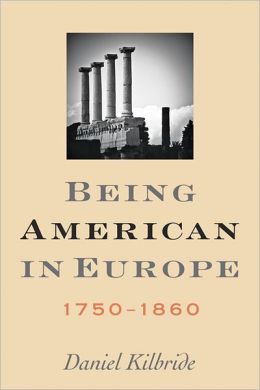
Daniel Kilbride's "Being American in Europe, 1750–1860"

Daniel Kilbride is an associate professor of history at John Carroll University in Ohio. He is the author of An American Aristocracy: Southern Planters in Antebellum Philadelphia.

He applied the “Page 99 Test” to his new book, Being American in Europe, 1750–1860, and reported the following:
Why would Americans in the decades before the Civil War travel to Europe? It was hard to do in those days – you didn’t board a plane in Chicago, watch a few movies and have a couple of drinks, and land at Heathrow eight hours later. Also, Americans in those days were hard-core patriots. Visitors like Alexis deTocqueville were continually pestered by Americans to affirm their smug convictions of their superiority to the supposedly feeble, corrupt, and despotic Old World. And if Americans were inclined to listen to their intellectuals, they would have gotten the same message: “It is for want of self-culture that the superstition of Travelling, whose idols are Italy, England, Egypt, retains its fascination for all educated Americans,” Ralph Waldo Emerson insisted.

In researching Being American in Europe, 1750-1861, I discovered neither creaky ships, patriotism, nor intellectual nagging kept Americans from sailing abroad: they went, and they went in ever larger numbers. What were they doing there? It turns out that American exceptionalism was more flexible than we have been accustomed to think. Yes, Americans saw themselves as special. But they also thought that, over time, other peoples would share in that specialness: they would become more democratic, more egalitarian, and more progressive. From the 1750s and 60s, when Americans went abroad to affirm their Englishness, until 1860, when Americans had developed a mature sense of their national identity vis-à-vis Europe, travelers struggled to situate themselves within western civilization. How could Americans reconcile with Britain? How could they see Catholicism as anything but superstition? How could they accommodate themselves to gentility? What did Europe mean to them? Those are the questions that I address in Being American in Europe.

Page 99 explores these themes nicely. There, we find Americans struggling to come to grips with European corruption. Martha Richardson, a refreshingly realistic woman, does not expect her nephew to avoid vice: she just implores him not to dive in head first. Joshua Fisher unconvincingly tells his mother from Paris that the “haunts of vice” have no allure for him. And Elizabeth Salisbury begs her son to resist temptation by clinging to faith. All those negative associations of Europe, it is important to note, didn’t stop these young men (and an increasingly large number of women) from going: they visited anyway, because the imperative to connect the young nation to Europe was stronger than the impulse to separate.

From page 99:
It was the rare family that did not fret for the moral health of traveling sons. Martha Richardson told her nephew, “I would not keep you from a knowledge of vice,” but she hoped he would not indulge so deeply that he would spurn the path of righteousness. Most advice givers thought it was best to avoid temptation altogether. As her son Stephen set off on an extensive tour, Elizabeth Salisbury implored him to shun sinfulness. She admonished her young son to “resist temptation and return to your widow’d mother improved in every venture which can adorn the man--fix’d or established in religious principles.” Young men tried to reassure their families on this point. Joshua Francis Fisher told his mother that every day he spent in Paris taught him to appreciate the “worldly advantage & pleasure that is to be derived from religion and virtue.” Although as an explorer of sorts he felt compelled “to visit many of the haunts of vice,” he reassured his mother--not very convincingly--that they would “offer no allurements” for him.

Americans struggled to explain the extent of crime, prostitution, sexual license, and other forms of vice they saw abroad. Henry Colman saw things in Edinburgh’s slums he hesitated to describe in print lest the paper become “absolutely offensive to the touch.” Poverty was to blame, he concluded: only “the most disgusting and loathsome forms of destitution” could explain the depths of depravity he witnessed. Charles Rockwell, a U.S. Navy chaplain, thought that standing armies, and the monarchies they supported, created a demand for mass, almost institutionalized, vice. Separated at a young age from family and community, soldiers became corrupted by their comrades, resulting in “a kind of systematic and licensed concubinage, as directly opposed to the principles of morality as it is to the cultivation of all the higher social and domestic virtues.” Few Americans failed to blame the Catholic Church for the Continent’s low moral state. John Clark specifically blamed Rome for corrupting Europe’s women. Catholicism--what Clark called “Heathenism and paganized Christianity”--reduced women to the level of a slave, he explained. Only Protestantism elevated women to “the sphere for which she was intended by her Creator.” Travelers’ favored explanations for European vice--poverty, militarism, and Catholicism--served to underscore the distance between the Old and New Worlds.
Learn more about Being American in Europe, 1750–1860 at the Johns Hopkins University Press website.

--Marshal Zeringue

Wednesday, April 24, 2013

Steven Nadler's "The Philosopher, the Priest, and the Painter"

Steven Nadler is the William H. Hay II Professor of Philosophy at the University of Wisconsin--Madison. His books include Rembrandt's Jews, which was a finalist for the Pulitzer Prize; Spinoza: A Life, which won the Koret Jewish Book Award; The Best of All Possible Worlds: A Story of Philosophers, God, and Evil, and A Book Forged in Hell: Spinoza's Scandalous Treatise and the Birth of the Secular Age.

He applied the “Page 99 Test” to his latest book, The Philosopher, the Priest, and the Painter: A Portrait of Descartes, and reported the following:
The book is a study of Descartes, but (I admit) a rather eccentric one. It takes as its starting (and ending) point a portrait of Descartes painted by a great Dutch master and uses questions about the biographical and historical context of this painting as a frame for looking into Descartes's life and thought. The "philosopher" of the title is, of course, Descartes; the painter is Frans Hals, arguably the greatest portrait painter of his time; and the "priest" is Augustijn Bloemaert, a friend of Descartes's living in Haarlem who reportedly wanted a keepsake by which to remember the philosopher when the latter left for Sweden in 1649. The book looks at Descartes's life in seventeenth-century Holland and the political and religious turmoil of those decades (ca. 1620s to 1650); it also offers, for the general reader, an accessible overview of Descartes's philosophical and scientific ideas. This book thus brings together philosophy, art history, and religious and political history to create what I hope is a rich portrait of the "father of modern philosophy" and his times.

What the reader will find on p. 99 is Descartes at the beginning of his philosophical project of trying to determine if and how true knowledge is possible. At this point, he is considering, in his Meditations on First Philosophy, what he really knows for certain, and therefore is seeing how far he can take skepticism before he hits upon an indubitable certainty -- which he will, with "I am, I exist" (or, "I think, therefore I am").
Learn more about the book and author at Steven Nadler's website.

The Page 99 Test: The Best of All Possible Worlds.

The Page 99 Test: A Book Forged in Hell.

Writers Read: Steven Nadler.

--Marshal Zeringue

Tuesday, April 23, 2013

Thomas O. McGarity's "Freedom to Harm"

Thomas O. McGarity holds the Joe R. and Teresa Lozano Long Endowed Chair in Administrative Law at the University of Texas at Austin School of Law. He is the author of The Preemption War: When Federal Bureaucracies Trump Local Juries and Reinventing Rationality: The Role of Regulatory Analysis in the Federal Bureaucracy.

He applied the “Page 99 Test” to his new book, Freedom to Harm: The Lasting Legacy of the Laissez Faire Revival, and reported the following:
Page 99 of Freedom to Harm is the first page in a chapter on environmental regulation. That chapter contrasts the potential of the environmental statutes enacted during the Public Interest Era (the late 1960s and early 1970s) to protect human health and the environment with the reality of the implementation of those statutes by the Environmental Protection Agency, the Corps of Engineers, the Office of Surface Mining, and the Minerals and Management Service (the agency responsible for the regulatory failure that led to the Deepwater Horizon disaster).

The book argues that these regulatory failures and those of many other federal agencies was the result of a 35-year campaign by the American business community and its allies in conservative think tanks and the media to roll back federal regulation and the civil justice system to a late nineteenth century laissez faire benchmark.

Six similarly organized chapters document the impact of the resulting laissez faire revival on the agencies responsible for worker safety, drug and device safety, food safety, transportation safety, financial protection, and consumer protection and on the state courts that are responsible for administering the nation’s civil justice system.

Each of these chapters also details the adverse consequences of the three assaults that the business community and its allies launched against federal regulatory programs and the common law system of civil justice. The result was a “confluence of crises” during the last half of the first decade of this century that had the potential to inspire legislation bringing about fundamental changes in the incentives motivating American companies.

Instead of enacting fundamental changes, however, Congress and the Obama Administration put into place “patch and repair” fixes designed to address the narrow problems that caused the particular crises.

We are now in the midst of a fourth assault on the governmental institutions that were designed to protect vulnerable workers, consumers and neighbors from irresponsible companies and to hold them accountable when they behave irresponsibly. In anticipation of the next confluence of crises, I offer suggestions for more comprehensive governmental protections for consumers, workers, and the environment.
Learn more about Freedom to Harm at the Yale University Press website.

The Page 99 Test: Bending Science: How Special Interests Corrupt Public Health Research by Thomas O. McGarity & Wendy E. Wagner.

--Marshal Zeringue

Monday, April 22, 2013

Eran Shalev's "American Zion"

Eran Shalev is a senior lecturer in the History Department at Haifa University, Israel, and the author of Rome Reborn on Western Shores: Historical Imagination and the Creation of the American Republic.

He applied the “Page 99 Test” to his new book, American Zion: The Old Testament as a Political Text from the Revolution to the Civil War, and reported the following:
Page 99 of American Zion introduces us to the rich biblical imagination of antebellum Americans, who consistently understood themselves as the New Israel, a nation favored by God and guided by providence. The page examines a long-winded History of the Late War (1819), an account of the War of 1812 against Britain, which was thoroughly written as a biblical text: the language, diction, rhythm and verses are all recognizably biblical, while the content of that history is, of course, American. That patriotic tract was not a parody or satire. In referring to modern inventions such as cannons as “battering rams” who “cast forth weapons of destruction, which were not known in the days of [biblical] Jehoshophat,” The History of the Late War rendered a biblical-American chronicle, which was intended to manipulate readers into understanding their nation as a latter day Israel set to inherit the American Promised Land. The significance of this pseudo-biblical style is evident when recognizing the abundance of similar texts that are detailed and contextualized in the pages surrounding 99. This distinct pseudobiblicism compelled Americans to articulate their history and present it as if it belonged to a sacred historical dimension. It provides a good example of the other now alien manifestations that demonstrate the centrality of the Old Testament as a political text. That eccentric biblical imagination, exemplified by The History of the Late War, stand at the core of American Zion and constitutes an important aspect of the formation of American nationalism. Test 99 prevails!
Learn more about the book and author at Eran Shalev's website.

--Marshal Zeringue