Tuesday, December 2, 2014

Lisa Wilson's "A History of Stepfamilies in Early America"

Lisa Wilson is the Charles J. MacCurdy Professor of American History at Connecticut College and the author of A History of Stepfamilies in Early America (University of North Carolina Press, 2014). She is also the author of the award-winning, Ye Heart of a Man: The Domestic Life of Men in Colonial New England (Yale University Press, 1999) and Life After Death: Widows in Pennsylvania, 1750-1850 (Temple University Press, 1992).

Wilson applied the “Page 99 Test” to A History of Stepfamilies in Early America and reported the following:
Page 99 of my book demonstrates the early nineteenth-century attempt to retrain stepchildren to treat their stepmothers with more respect and teach stepmothers to be more loving. As middle-class families became mother-lead and child-centered at the end of the eighteenth century the prejudice against stepmothers worsened. Since mothers could no longer behave badly and fit this new ideal the traditionally evil stepmothers took on the baggage of cruelty they left behind. Mothers were seen as angelic so stepmothers became more devilish. In the early nineteenth century there was an effort to alleviate the plight of stepmothers and stepchildren. Primarily in women's and children's magazines, stepmothers were taught to be kind to their stepchildren and stepchildren were urged to be more respectful to their stepmothers. This literature argued that stepmothers were the best replacements for mothers. Likewise children were told that not all stepmothers were evil. Although a fascinating cultural intervention this magazine campaign failed to change our characterization of the stepmother/stepchild relationship even today.
Learn more about A History of Stepfamilies in Early America at The University of North Carolina Press website.

--Marshal Zeringue

Monday, December 1, 2014

Oleg Benesch's "Inventing the Way of the Samurai"

Oleg Benesch is the Anniversary Research Lecturer in History at the University of York. He obtained his PhD from the University of British Columbia, and was Past & Present Society Fellow at the Institute of Historical Research, University of London.

He applied the “Page 99 Test” to his new book, Inventing the Way of the Samurai: Nationalism, Internationalism, and Bushido in Modern Japan, and reported the following:
Inventing the Way of the Samurai is a study of the Japanese concept of “bushido,” or “the way of the samurai.” Bushido is popularly understood as an ancient ethic with origins in Japanese warrior traditions going back centuries. It is frequently portrayed as an intrinsic part of the Japanese “national character,” and even as the very “soul of Japan.”

In this book, I counter much of the mythology that has arisen around the samurai and bushido, arguing that bushido is largely a modern invention. Inventing the Way of the Samurai shows that bushido was not a continuation of any past ideal, but developed from a search for identity that occupied Japanese thinkers during the rapid modernization of the late nineteenth century. The first formulators of bushido in the Meiji period (1868-1912) drew far greater inspiration from Victorian ideals of chivalry and gentlemanship than they did from the historical samurai. It was only after Japan’s victory over China in the Sino-Japanese War of 1894-95 that bushido became widely understood, with the word itself essentially unknown before this time.

Page 99 of Inventing the Way of the Samurai is in the middle of the Chapter “The Early Bushidō Boom, 1894-1905,” which discusses the period when bushido was first popularized and came to be interpreted as a uniquely Japanese ethic. Page 99 introduces the influential philosophy professor Inoue Tetsujirō’s (1855-1944) early attempts to transform bushido from a supposed Japanese equivalent of Western ideals to a chauvinistic national ideology with emperor-worship at its core.

From page 99:
Inoue’s writings in the early 1890s contained a similarly nuanced nationalism [to that of his contemporaries], but by the turn of the century Inoue’s nationalism was anything but defensive or subtle, and bushidō served as an ideal vehicle for its dissemination. Inoue’s involvement would have a profound impact on the development of general bushidō discourse after this time... By the end of Meiji, Inoue was by far the most prolific author and editor in the field of bushidō studies, publishing until shortly before his death in 1944. This has often been overlooked in the post-war period, and most assessments after Inoue’s death have been in line with [Winston] Davis’ description: ‘Though he claimed to be the greatest philosopher east of Suez, his logic was tendentious, his arguments forced and artificial. In fact his philosophy was little more than a smorgasbord spread with the leftovers of former ideological feasts, East and West’. In spite of this, Inoue’s impact on modern bushidō was tremendous, and his early involvement with the subject was reflected in A Collection of Bushidō Theories by Prominent Modern Thinkers (1905), a volume of thirty-three articles on bushidō from the previous fifteen years, eight of which were written by Inoue. Even in works he did not write himself, Inoue was quick to offer a brief preface or introduction, and many pre-war works on bushidō bear his mark. The addition of a few words from Inoue signified that a work was in line with the officially sanctioned imperial interpretation of bushidō, and therefore presumably suitable for use as educational material.

In 1901, Inoue held a lecture at the Military Preparatory School (Rikugun yōnen gakkō), which was subsequently published and widely distributed under the simple title Bushidō. This lecture concisely manifested Inoue’s multifarious roles in bushidō discourse, and also outlined themes that would become prominent in his later work in other fields. In addition to emphasizing patriotism and loyalty to the emperor, Inoue’s bushidō activities were defined by several characteristics: a close relationship with the military as an educator and ideologist; ultranationalism and the emphasis on a unique Japanese spirit; pronounced anti-foreignism framed in the rhetoric of Japanese superiority; aggressive intolerance of other views as a self-appointed defender of imperial bushidō orthodoxy; and the exaltation of [the seventeenth-century strategist and critic of China] Yamaga Sokō as one of the most important thinkers in Japanese history.”
Inoue’s bushido interpretation would come to dominate views of the subject as it reached unprecedented levels of popularity after the Russo-Japanese War of 1904-05. Bushido penetrated virtually all aspects of Japanese cultural and public life, featuring in politics, religious life, educational materials, literature, martial arts, and the military. It became a key pillar of the ruling ideology of the imperial state until 1945, after which time it was widely rejected along with other concepts closely identified with militaristic totalitarianism. Unlike other nationalistic ideologies, however, bushido was soon revived in the postwar period, and Inventing the Way of the Samurai explores the dynamics that have allowed bushido to retain its high profile and influence into the twenty-first century.
Learn more about Inventing the Way of the Samurai at the Oxford University Press website and Oleg Benesch's website.

--Marshal Zeringue

Sunday, November 30, 2014

Gavriel D. Rosenfeld's "Hi Hitler!"

Gavriel D. Rosenfeld is Professor of History and Director of the Undergraduate Program in Judaic Studies at Fairfield University.

He has written a wide range of books, including the newly released Hi Hitler! How the Nazi Past is Being Normalized in Contemporary Culture and the edited collection, "If Only We Had Died in Egypt!" What Ifs of Jewish History From Abraham to Zionism. Rosenfeld is also the author of Building after Auschwitz: Jewish Architecture and the Memory of the Holocaust, The World Hitler Never Made: Alternate History and the Memory of Nazism, Munich and Memory: Architecture, Monuments and the Legacy of the Third Reich, and the co-edited work, Beyond Berlin: Twelve German Cities Confront the Nazi Past.

Rosenfeld applied the “Page 99 Test” to Hi Hitler! and reported the following:
Symbolically, it would make more sense to turn to page 88 than 99 of Hi Hitler! to get a sense of the book. In Germany today, neo-Nazis use the number 88 to communicate their admiration of the Führer (the reason is that the number 8 corresponds to the letter H, and two H’s stands for “Heil Hitler.”) Whichever of the two pages readers turn to, they will discover an analysis of the ongoing debate about the Holocaust’s uniqueness.

Since the 1990s, the idea that the Nazi murder of the Jews differs substantially from other cases of genocide has been intensely discussed among historians, journalists, and other writers. Of late, critics of uniqueness, such as Timothy Snyder, Donald Bloxham, and Dirk Moses, have clashed with defenders of the concept, thereby shedding light on the ongoing struggle to shape the memory of the Nazi past.

The debate about the Holocaust’s uniqueness is one of many topics that Hi Hitler! examines as part of its larger analysis of the normalization of the Nazi era in contemporary western life. The book casts its focus both high and low, analyzing historiographical debates about the origins of the Second World War; scholarly and literary “what ifs?” about the Third Reich, and popular novels, films, and internet memes about Adolf Hitler. All of these works reveal how larger social, political, and cultural forces in the new millennium are promoting the relativization, universalization, and aestheticization of the Nazi legacy. They show how Hitler and the Third Reich are increasingly being viewed as symbols of humor instead of horror.
Visit Gavriel D. Rosenfeld's website.

Writers Read: Gavriel D. Rosenfeld.

--Marshal Zeringue

Friday, November 28, 2014

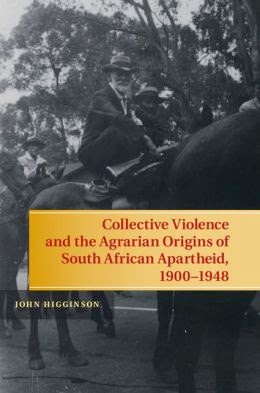
John Higginson's "Collective Violence and the Agrarian Origins of South African Apartheid, 1900-1948"

John Higginson is Professor of History at the University of Massachusetts, Amherst. He is also a research Fellow in the College of Human Sciences and the department of history at the University of South Africa in Pretoria, South Africa. He is the author of A Working Class in the Making: Belgian Colonial Labor Policy, Private Enterprise and the African Mineworker, 1907–1951 (1989).

Higginson applied the “Page 99 Test” to his new book, Collective Violence and the Agrarian Origins of South African Apartheid, 1900-1948, and reported the following:
Page 99 of Collective Violence and the Agrarian Origins South African Apartheid, 1900-1948 centers on the book’s preoccupation with large scale instances of violence as outcomes of capacity as opposed to instinct. The generalized perception among many Afrikaners at the end of the Anglo-Boer or South African War was that they had not just lost war but a way of life. By May 1902, British forces, combined with fifty thousand African irregulars (Jan Smuts’s “ Frankenstein monster created by fatuous policy”), had burned 3,700 square miles of enemy farmland to the ground, sequestered more than 200,000 Afrikaner and African women, children and old people of both sexes, and foiled the desperate attempt of the most capable enemy generals to foment an Afrikaner insurrection behind the war’s frontlines in the Cape Colony. Not only had the Boer republican army been defeated, in both its conventional and guerrilla iterations, but the prewar institutional supports of white supremacy had also been incinerated along with thousands of white farms.

At the bottom of page 99 we find, G. G. Munnik, the former minister of Mines, bemoaning the war’s devastation and the way it had apparently empowered an African majority, if only for a brief period of time. Munnik’s generation of leadership was succeeded by men and a handful of women who surfaced during the closing phases of the war. More bloodthirsty and endowed with what Max Weber called “high animal spirits,” they wanted more than just revenge. Instead they determined to transform the entire political and social order in a manner that strenuously limited British interference in South Africa’s affairs and transformed the African majority into so many monitored strong backs and hands and little else.

Undeterred by the tragic outcomes of the failed white rural rebellion of 1914, the 1922 Rand Rebellion, and the 1932 depression and drought for both Africans and rural whites, they passed a corporatist and authoritarian vision of the future down to the next generation of Afrikaans speaking whites. Upon the triumph of the Afrikaner National Party in the all-white national election of 1948, this corporatist vision transformed itself into the Janus-faced policy of apartheid. Even though apartheid became a kind of fascism by fiat, the African majority fought back in myriad ways against the entire spectrum of violence –producing policies it generated, demonstrating just how contingent apartheid’s attempt to hijack the future of the African majority was.
Learn more about Collective Violence and the Agrarian Origins of South African Apartheid, 1900-1948 at the Cambridge University Press website.

--Marshal Zeringue

Wednesday, November 26, 2014

Diana Walsh Pasulka's "Heaven Can Wait"

Diana Walsh Pasulka earned her B.A. degree from the University of California at Davis, her M.A. from the Graduate Theological Union in Berkeley and her Ph.D. in Religious Studies from Syracuse University. She is an Associate Professor in the Department of Philosophy and Religion at the University of North Carolina, Wilmington, and has published on the subject of conceptions of the afterlife and Catholic history.

Pasulka applied the “Page 99 Test” to her new book, Heaven Can Wait: Purgatory in Catholic Devotional and Popular Culture, and reported the following:
From page 99:
He [England] specifically addressed two other aims of the periodical: to unify the faithful and to correct misperceptions of Catholicism:

“By its means [the paper] the thousands of Roman Catholics spread through these states, from Maine to Florida and from Kansas to the Atlantic may hold constant communion; by its means they may also learn the state of their brethren in communion with them in other parts of the globe; by its means those persons who have been misled into erroneous opinions of the principles of their neighbors, will be enabled to judge correctly of their tenets and to form rational opinions of their practices.”
On page 99 of Heaven Can Wait, we enter the world of the nineteenth century Irish Catholic immigrant bishop, John England. England was a dynamic figure in American history and was the first Catholic Bishop of the diocese of Charleston, South Carolina. In Ireland he had been an articulate and outspoken advocate for Irish independence from England, for which he was probably sent to the United States. In the United States he quickly became an American citizen and launched the Catholic Miscellany, the young country’s first Catholic periodical.

England was a colorful figure and, as a Catholic priest, a rare sight to Southerners. He was eloquent and popular. Reports of the era portray him as a handsome gentlemen who made his calls on horseback and who preferred wine to whiskey. England is an important figure in the book because he represents how the French Enlightenment impacted belief and representations of the Catholic doctrine of purgatory. Like many within the North American elite, England was a staunch advocate of Enlightenment reason. He was also combating anti-Catholic sentiment and trying to counter nativist charges of superstition that were associated with Catholic devotions and beliefs like purgatory. This caused England to denounce stories and anecdotes about a popular Irish pilgrimage called St. Patrick’s Purgatory.

St. Patrick’s Purgatory was, and still is, an actual place. It was a cave in Northern Ireland on the island Lough Derg (Red Lake). Today, instead of a cave there is a church, but the island still receives about sixteenth thousand pilgrims per year. England’s efforts were representative of how clerics would write about and represent purgatory in the nineteenth and twentieth centuries —as a condition of soul, but not an actual place. Earlier, in the early modern and medieval eras, many Europeans believed that purgatory, or at least its entrance, was in Ireland, on Lough Derg.
Learn more about Heaven Can Wait at the Oxford University Press website.

--Marshal Zeringue

Tuesday, November 25, 2014

David M. Carr's "Holy Resilience: The Bible's Traumatic Origins"

David M. Carr is professor of Old Testament at the Union Theological Seminary in New York City and a leading specialist on how the Bible was formed.

He applied the “Page 99 Test” to his new book, Holy Resilience: The Bible's Traumatic Origins, and reported the following:
In Holy Resilience, I tell the story of how the Bible, Judaism and Christianity took shape during a series of communal traumas, from the Assyrian destruction of Israel and domination of Judah to the Roman destruction of Second Temple Judaism and prohibition of Christianity. The Jewish and Christian scriptures reflect these traumas, as well as hard-earned lessons of survival.

Page 99 of my book finds me discussing stories about Abraham in Genesis as stories about an ancient ancestor that are actually comforting words to much later Judean exiles in Babylon. These exiles have come to see themselves as an emblem of "curse" among their neighboring nations. The prophet Zechariah, for example, speaks of how the people of Judah, in exile, became so pathetic that foreigners used them as a byword of the sort of curse they would wish on others (Zech 8:13).

This, I argue on page 99, is the background for the reshaping and retelling of Abraham's promise in Genesis 12, a promise that concludes with a phrase often translated as "all the families of the earth shall be blessed through you." I point out at the outset that the famous Jewish commentator Rashi argued strongly for a different translation of this promise, one where Abraham is promised instead, that "all clans of the earth shall bless themselves by you."

Page 99 continues:
The idea is not that other nations will be blessed, but that they will bless themselves. Abraham will have become such a beacon of blessing that other nations will wish on themselves the kind of divine blessing that Abraham is famed to have.

Understood this way, God’s promise to Abraham in Genesis probably builds on the model provided by an older prayer for the king found in Psalms, one that prays that all nations will “bless themselves by” the Davidic king and “declare him happy” (Ps 72:17). We see a similar idea later in Genesis where Jacob blesses Joseph’s sons, Ephraim and Manasseh, saying “may Israel bless itself by you, saying ‘May God make you like Ephraim and Manasseh’” (Gen 48:20). The exilic storyteller who wrote Genesis 12 took these ideas and applied them to Abraham. Countering the perception of Judeans as cursed, he describes their forefather, Abraham, as receiving a promise that “all clans of the earth shall bless themselves by you.” When the exiles “looked to” this “father Abraham” in Genesis, they found an answer to concerns about their supposed cursedness. As Abraham’s children, they too were destined to be examples of blessing not curse. And Genesis reinforces this message as this promise is repeated by God to Abraham’s heirs. Jacob, for example, is told “all clans of the earth shall bless themselves by you and your descendants” (Gen 28:14). For the exiles, "and your descendants" meant them. This exilic story about ancient Abraham’s divine blessing comforted and encouraged them.
Learn more about Holy Resilience at the Yale University Press website.

--Marshal Zeringue

Monday, November 24, 2014

Deana A. Rohlinger's "Abortion Politics, Mass Media, and Social Movements in America"

Deana A. Rohlinger is an associate professor in the department of sociology and a research associate at the Pepper Institute of Aging and Public Policy at Florida State University.

She applied the “Page 99 Test” to her new book, Abortion Politics, Mass Media, and Social Movements in America, and reported the following:
From page 99:
Not all movement actors have the same advantages with moderated media. Organizational dynamics affect reputation and how a group navigates the media field. A well-funded, well-staffed organization can write a letter to the editor, craft and post an op-ed, contact mainstream journalists and writers working in sympathetic outlets, and create an advertising campaign at the same time. Likewise, groups with substantial financial resources can afford to invest in market research to refine movement messages as well as purchase professional campaign materials and advice. This is not a small advantage. While most groups rely primarily on “earned” coverage, activists recognize the value of speaking directly to an audience without distortion or distraction, particularly when they want to reframe a debate. It was not a coincidence that the National Right to Life Committee (NRLC) used direct media to launch its campaign to end partial-birth abortion. Paid advertising allowed NRLC to introduce a new way to think about the abortion procedure without the interference of its opponents.

Financially flush organizations can also spend more time and money framing themselves in ways that resonate with the general public. A well-to-do organization can finely tune a public image so that it appeals to a broad cross section of the citizenry and, then, use its mainstream appeal to build its credibility with journalists. I am not suggesting that there is a particular financial threshold that organizations must cross in order to be effective in the mass media field. As seen in the NRLC case, an organization can set itself apart from its allies on a relatively small budget if it draws on culturally resonant values and institutional credibility. I am arguing that a resource-rich organization can craft a brand for the group that can be leveraged across institutional fields and issues.
Page 99, which is the first page of Chapter 6: Branding and the Success of Planned Parenthood, sets up the benefits of branding for non-governmental organizations. A brand, as I note on the next page, creates a connection between an organization and a target audience; a connection that relies on emotion rather than logic.

What does branding have to do with abortion and social movements?

A lot. It turns out that financially-flush, politically savvy groups such as Planned Parenthood can use their brands to side-step rancorous, public debates over abortion while they push forward their political goals behind the scenes.

Surprised?

You shouldn’t be. We are so focused on the public battles over legal abortion – violence at abortion clinics, filibustering in the state legislature, and protests in the streets – that we give little thought to what happens outside the view of the camera. These made-for-TV moments intentionally overshadow non-governmental organization’s more subtle media manipulations that affect how we, the citizenry, understand the abortion issue.

My book uncovers how non-governmental organizations use mass media to forward their political goals. While sometimes groups opposing and supporting legal abortion adopt a “go big or go home” approach to media, more often groups find themselves either avoiding the media spotlight or struggling to publicly respond to something their allies have said or done. I tell the tales of four non-governmental organizations – National Right to life Committee, National Organization for Women, Planned Parenthood, and Concerned Women for America. Drawing on archival data and interviews with past and current activists as well as journalists, editors, and producers, I show how these groups embrace (and avoid) direct marketing, mainstream news, and internet communication technology during good (and bad) political times – and outline how their reputation affects their ability to do so.

Scholars will appreciate the theory developed in the book. I use sociology, political science, communication studies, and administrative sciences to shed light on when non-governmental groups use media to advance their goals. As the title of Chapter 6 suggests, an organization’s reputation and its ability to create a brand play an important role in its decision-making.

Of course, there is a lot more to the book than strategy. Readers interested in politics will be taken with the tale of the battle over legal abortion. I uncover the bitter rivalries, political miscalculations, and media faux pas that have shaped abortion politics in America. Readers will be surprised by how much there is to learn about a seemingly well-trodden, political territory.
Learn more about Abortion Politics, Mass Media, and Social Movements in America at the Cambridge University Press website and Deana A. Rohlinger's website.

--Marshal Zeringue

Sunday, November 23, 2014

Gary Schmidgall's "Containing Multitudes"

Gary Schmidgall is Professor of English at Hunter College at the City University of New York. His books include Shakespeare and Opera, The Stranger Wilde: Interpreting Oscar, and Walt Whitman: A Gay Life.

Schmidgall applied the “Page 99 Test” to his new book, Containing Multitudes: Walt Whitman and the British Literary Tradition, and reported the following:
The Page 99 Test does seem to work for Containing Multitudes. Its page 99, in a chapter on Milton and Whitman, draws attention to the radically disparate styles of the two poets: "The unique Milton and Whitman styles, both endlessly mimicked but almost never successfully, seem at first glance an Atlantic Ocean-sized distance from each other. Whitman's admonition to himself, 'No ornamental similes at all,' would alone seem to sink the notion of discussing his style and Milton's in the same breath." And yet...the chapter is devoted to bringing the two poets (their affinities, shared views of the human condition, and the likenesses of the arc of each career) into intimate conversation. I set out in Containing Multitudes to write a book that should not exist, and page 99 is like most of its other 367: the author who famously declared America deserved a literature of its own, distinct from the "feudal" and anti-democratic literature of Britain, was deeply influenced by his transatlantic forebears. Though, Whitman seems to have made a conscious effort to downplay or conceal the extent to which the literary heritage of "that wonderful little island" seeded Leaves of Grass. In a cheeky unsigned self-review of the first edition, he boasted he would "make no allusions to books or writers; their spirits do not seem to have touched him." Containing Multitudes seeks to reveal that, though he largely kept his vow about allusions, his second assertion was decidedly disingenuous. My study's chapters argue that several odd literary couples--Shakespeare and Whitman, Milton and Whitman, Burns and Whitman, Blake and Whitman, Wordsworth and Whitman--are not so odd after all. In shorter essays five other important 19th-century authors are also associated with Whitman: Scott, Carlyle, Tennyson, Wilde, and Swinburne.
Learn more about Containing Multitudes at the Oxford University Press website.

--Marshal Zeringue

Friday, November 21, 2014

Malcolm Gaskill's "Between Two Worlds"

Malcolm Gaskill is Professor of Early Modern History at the University of East Anglia. His books include Witchfinders: A Seventeenth-Century English Tragedy. A Fellow of the Royal Historical Society, Gaskill lives near Cambridge, England.

He applied the “Page 99 Test” to his new book, Between Two Worlds: How the English Became Americans, and reported the following:
Given the size and sophistication of the USA, it’s hard to conceive how precarious were its beginnings. Trace Virginia’s history, say, and a sort of inevitability emerges – like it was always bound to succeed. But leap straight back 400 years and you find the original settlement, Jamestown, in big trouble. Too little of everything: food, shelter, law, government, peace. It’s amazing it survived; so many colonies did not. But what is really amazing is that speculators threw good money after bad to keep ailing colonies going and start new ones.

By page 99, where we reach the 1620s, a lot has already gone wrong since Jamestown’s foundation in 1607. The Pilgrim Fathers are ensconced at Plymouth, but life is far from easy, and they are a long way off satisfying their financial backers. North of there, the plantation at Wessagusset is doomed, settlers having tried “to build castles in the air”, to quote one contemporary. Life was hard in the wilderness, and the challenges of building a new society manifold. The deeper problem, however, was always that English monarchs insisted on granting permission for colonial enterprises, but refused to bankroll them. This meant reliance on private investors, and persuading them that colonies were a reasonable bet despite overwhelming evidence to the contrary.

Earnest entreaties were made, but America remained a hard sell:
The usual suspicions dogged colonial enterprise, pushing projects back into the realms of fantasy. In 1623, James I encouraged the city of Exeter to invest using the Council for New England’s proposals. The arguments were conventional: plantations enlarge the nation, advance religion, stimulate navigation, and supply commodities. The benefits to the depressed western counties would be huge, provided enough shares were sold.
By then the English imperial heart was beating, and the crown urged to see colonies as a way to expand trade and subordinate foreign rivals. Furthermore, as the Council for New England suggested, colonization could improve domestic conditions:
The key to victory [against Spain and Holland], it was proposed, was not just ruling the waves but sending paupers to plantations: as the northern fishing industry contracted, for example, workers should go to Newfoundland. Mass emigration – 10,000 people a year – would not only solve England’s begging problem, but also create export markets and customs revenue. A venture to unlock America’s potential could be funded by taxing alehouses.
Yet still monarchs were reticent and investors either sceptical or interested in a way that benefited the nation only incidentally. The citizens of Exeter were unmoved by noble sentiments. They decided that the best land had already gone, and declined to be anyone’s tenants in the New World. Most of those who did invest did so not from pious altruism, or because they believed the adventurers’ propaganda, but because, like all serious gamblers, they saw in high risk only glittering prizes. Greed, like hope, springs eternal.
Visit Malcolm Gaskill's website.

--Marshal Zeringue

Thursday, November 20, 2014

Erik J. Wielenberg's "Robust Ethics"

Erik J. Wielenberg is Professor of Philosophy at DePauw University. He works primarily in ethics and the philosophy of religion and is the author of Value and Virtue in a Godless Universe and God and the Reach of Reason. His work has appeared in such journals as Ethics, Ethical Theory and Moral Practice, Synthese, Faith and Philosophy, The European Journal for Philosophy of Religion, and Religious Studies.

He applied the “Page 99 Test” to his new book, Robust Ethics: The Metaphysics and Epistemology of Godless Normative Realism, and reported the following:
Where do our moral beliefs come from? Psychology has seen an explosion of competing answers to this question in recent years. Page 99 of Robust Ethics highlights an important area of agreement in the midst of this ongoing debate. Despite their differences, many psychologists who study moral cognition accept the following:
The Hidden Principles Claim: Our conscious moral judgments typically conform to general moral principles; such principles are often but not always hidden from us in that we cannot become consciously aware of the conformance of our conscious moral judgments to such principles in any direct way. This phenomenon is a consequence of the heavy involvement of System 1 cognition in the production of our conscious moral judgments.
System 1 cognition is thinking that happens quickly, effortlessly, and automatically; it also often operates behind-the-scenes, outside of conscious awareness, with the result that we often lack insight into its operations. When System 1 thinking drives our moral thinking, we often find ourselves with firm moral convictions that seem simply to appear in our minds and which we struggle to justify. For example, many of us will judge that it’s permissible to flip a switch that diverts an out-of-control trolley onto a sidetrack where it will kill one person rather than killing five. However, many who make that judgment will also judge that it’s wrong to push a large man in front of an out-of-control trolley, killing him in order to save five. Ask us to explain how we can consistently hold both convictions and we’ll typically illustrate what psychologists call “moral dumbfounding” – we’ll hem and haw, offer various inadequate justifications, and most likely stick to our judgments about the two cases even if we can’t justify them.

Zooming out a bit, the discussion of moral cognition in Robust Ethics is part of an attempt to provide a plausible account of how human beings could have knowledge of objective moral truths. Providing such an account and answering objections to it is the main task of the second half of the book; the account combines ideas from philosophy and psychology in a new (and hopefully plausible!) way. Zooming out a bit further, Robust Ethics as a whole could be characterized as an attempt at answering these questions: what are objective moral facts? Where do they come from? How do we know them? The answers I give to these questions imply that (i) moral facts and features are not the sorts of things that can be investigated by empirical science (contra some of the “new atheists”) and (ii) there can be objective moral facts and that we can have knowledge of at least some of them even if ours is a godless universe (contra many theistic philosophers).
Learn more about Robust Ethics at the Oxford University Press website.

--Marshal Zeringue