Friday, July 5, 2024

Leslie Beth Ribovich's "Without a Prayer"

Leslie Ribovich is an educator and scholar of American religion, race, and education. She is the Director of the Greenberg Center for the Study of Religion in Public Life and Associate Professor of Religious Studies and Public Policy & Law at Trinity College in Hartford, CT.

Ribovich applied the "Page 99 Test" to her new book, Without a Prayer: Religion and Race in New York City Public Schools, and reported the following:
Page 99 of Without a Prayer analyzes how the 1958 final report of the New York City Board of Education’s Commission on Integration articulated the Board’s understanding of integration as a value in what the Board called its Judeo-Christian tradition. The Board established the Commission following the 1954 Brown v. Board of Education decision. On page 99, I explain that while “the Commission’s recommendations could have contributed to desegregation, had they been acted upon,” a close reading of the report shows that “the Board’s version of integration, the value, involved researching, meeting, and discussing, but not necessarily desegregating.” I also discuss how the report refers to “residential segregation,” but does so without mentioning redlining or other discriminatory practices that led to residential segregation. The page concludes by referring back to a quotation from the final report, citing the Board’s reaction to Brown, that appears on page 97 of Without a Prayer in which the Board said that Brown was “a legal and moral reaffirmation of our fundamental educational principles.” Page 99 explains that “Although the report offered possible actions, because of lack of funding, it ultimately described a value, not an action, and a value that did not require action. The value mythologized the new tradition, Judeo-Christianity, and rendered change unnecessary. In moments of fleeting togetherness, the schools already enacted integration as a moral value.”

This page provides an excellent concrete example of the book’s argument as it addresses how the failure of schools to desegregate happened alongside the persistence of liberal religion in New York City public schools. Someone reading this page alone would get a clear sense that New Yorkers debated the meanings of integration and desegregation and that New York City was home to segregated schools where a centralized Board of Education supported particular religious values. They might also want to know more about the Judeo-Christian tradition the Board cultivated.

The book is structured in three parts to show that while we don’t often think of secularization relating to race and desegregation as relating to religion, in fact, these processes and structures intersect. The first two chapters fall under “Secularization | Race,” the second two under “Desegregation | Religion,” and the final two under “Purposes of Public Education.”

Page 99 comes from chapter 4, “Conflicting Religious Visions of Integration” in Part II. The chapter shows that the Board framed integration as a positive value in what its president called “the morality of our American heritage and of our Judaeo-Christian tradition” (p. 94) in 1963, as schools were supposed to be removing religion due to U.S. Supreme Court cases declaring school prayer and Bible-reading unconstitutional. Yet, New York City schools remained segregated. Instead, the Board supported what I name on page 99 “fleeting moments of togetherness,” such as multicultural celebrations, in which “the schools already enacted integration as a moral value.” At the same time, Black and Puerto Rican communities presented their own visions of integration, some of which included the act of desegregating. For instance, the top of page 99 mentions two major Black Civil Rights Movement figures who served on the Commission, Ella Baker and Kenneth Clark, who held this view of integration. Elsewhere in the chapter and book, I describe Black New Yorkers who adopted narratives of Black redemption in the U.S. nation, as well as Pan-African theologies that rejected public schools in service of new, Black publics.

The Commission’s final report also informs my ongoing research. With a demographer and ethicist, I am working on comparing this 1958 report to a 2019 report on integration in New York City schools to identify what problems and proposed solutions remain consistent and which differ over 60+ years.
Visit Leslie Ribovich's website.

--Marshal Zeringue

Thursday, July 4, 2024

Kathryn Hughes's "Catland"

Kathryn Hughes is emerita professor of life writing at the University of East Anglia and a literary critic for The Guardian. She is the author of Victorians Undone: Tales of the Flesh in the Age of Decorum and George Eliot: The Last Victorian.

Hughes applied the "Page 99 Test" to her latest book, Catland: Louis Wain and the Great Cat Mania, and reported the following:
Page 99 of Catland drops us into the world of Frances Simpson, a leading cat breeder who packaged her expertise and sold it in a series of advice columns under titles like ‘Practical Pussyology’ and ‘Cats for Pleasure and Profit’. Here we encounter Miss Simpson telling her readers how to show their kittens off to their best advantage. An orange ribbon on a ‘blue’ (that is smoky grey) cat looks striking, although you should avoid tying it in such a way that it spoils the animal’s ruff. If you’re worried about your cat getting cold when it is travelling either to the stud or to the cat show, then by all means put it in an appropriate wrapper. Dolls’ clothes are not a good substitute, though, since the arm holes are in the wrong places. Simpson describes her amusement at recently receiving ‘a little lady’ at her stud who was ‘clothed in a very smart jacket, through which her front paws were placed…This puss had also a pair of washleather boots on her back legs, so that her appearance was a little startling’.

When it comes to selling your kittens for a profit, Simpson suggests that eight weeks is the ideal age. This is when they are at their cutest – leave it any longer and they will become leggy, truculent teenagers and much harder to shift. Ever financially practical, Simpson, who is writing in 1903, warns that prices for pedigree kittens are dropping – the best you can expect these days is 3 guineas. Finally, she suggests that a good way of shifting your feline stock is to have professional pictures which you can then use to advertise your wares. As always, Simpson is happy to share the details of a good contact – Mr Landor of Ealing ‘whose clever pictures of kittens are so well known’.

I was initially sceptical, but the Page 99 Test works rather well for Catland. Page 99 showcases one of its major themes, which is the way in which cat breeding had become commodified by the beginning of the 20th Century. Frances Simpson was a clergyman’s daughter, not the sort of person who would usually get tangled up in ‘trade’. And yet, here she is taking a soundly practical and economically-motivated attitude to the whole business – and it was a business – of breeding cats for profit. With her readiness to suggest paid-for goods and services, she invent what might be called cat capitalism. I like the way that we see her here drawing on her aesthetic sense – she was known for her own elegant dress sense - to give advice on how to show your cats off to their best advantage. And there’s a strong dollop of anthropomorphism in evidence here too, which neatly loops back to the work of Louis Wain, who was known as the man responsible for putting cats in pants.

Catland tells the story of how Britain and America transformed their attitudes to cats at the beginning of the 20th Century. Where felines had once been tolerated as ambient mouse-traps, now they were welcomed onto the domestic hearth as much-loved family members. Genteel breeders like Frances Simpson, meanwhile, started to develop distinct breeds from the previous genetic soup: the smooth Siamese with burnt browned tips or the silky Angora that felt like a rabbit to the touch. Zig-zagging through the text is the life story of Louise Wain, the commercial artist whose anthropomorphising illustrations opened an imaginative space in Edwardian culture. Now, when your much-loved tabby slipped out of the bathroom window at dusk, it was quite possible to imagine that she was heading for a session at the hairdresser, a visit to the theatre, or simply the chance to climb up to the rooftops to sing her heart out.
Learn more about Catland at the Johns Hopkins University Press website.

--Marshal Zeringue

Wednesday, July 3, 2024

Alison L. LaCroix's "The Interbellum Constitution"

Alison L. LaCroix is Robert Newton Reid Professor of Law and Associate Member of the History Department at the University of Chicago. She served on the Presidential Commission on the Supreme Court and is the author of The Ideological Origins of American Federalism.

LaCroix applied the "Page 99 Test" to her new book, The Interbellum Constitution: Union, Commerce, and Slavery in the Age of Federalisms, and reported the following:
Page 99 lands a reader in the midst of Chapter 2, which focuses on a gripping but largely forgotten legal controversy over a ship that docked in Norfolk, Virginia, in 1819, and from which debarked three individuals described in court records as “persons of Colour” – likely free Black seamen who had joined the crew in a Caribbean port. The ship, a brig named the Wilson, and its owner and its captain ended up at the center of a federal-court case that came before two of the great judges of the early-19th-century American bench: U.S. district judge St. George Tucker and Chief Justice John Marshall (both of whom were also Virginians).

Page 99, part of a chapter section titled “The Brig on Trial,” discusses Judge Tucker’s views on whether the Constitution gave Congress the power to regulate the migration or importation of free Black people into the United States. Tucker was “unmoved by arguments” pressed by the brig’s owner “against the constitutionality of the federal statutes” and “launched into a full-throated endorsement of the two species of congressional authority at issue in the case: the power to reinforce state law, and the power to regulate the migration and importation of persons.”

As this synopsis suggests, there is a lot happening on page 99. And the page nicely distills several of the main themes of the book. The subtitle of the book is “Union, Commerce, and Slavery in the Age of Federalisms,” and the focus is the period from 1815 to 1861. I call this the “interbellum period” because it falls between two wars: the War of 1812, and the Civil War. Constitutional history has tended to overlook this era for a number of reasons. First, it didn’t yield changes to the text of the Constitution – there were no constitutional amendments between 1804 and 1865. Second, because of this lack of change to the text, it’s easy to assume that nothing about the Constitution changed during this period. Third, the period appears to lack the grandeur of either the founding era or what the historian Eric Foner calls the “second founding,” the Civil War and Reconstruction. The interbellum period, by contrast, is filled with ugliness and tragedy, including the expansion of slavery, the forced “removal” of Native nations from their land, the rise of anti-immigrant sentiment, and the subordination of women. For all these reasons, the interbellum period is often – mistakenly – treated as what I term “constitutional flyover country.”

Page 99’s tale of the Brig Wilson is a vital piece of the book’s larger effort to recover this overlooked period in U.S. constitutional history. Moreover, the book focuses on stories and people, using narrative to build a rich picture of this complex, sometimes-rollicking, sometimes-violent era. The tale of the brig gives us larger-than-life characters such as the unforgettably named Captain Ivory Huntress, and it provides a new account of familiar figures like Judge Tucker and Chief Justice Marshall.

This forgotten episode also recasts the way that we understand American constitutionalism today. In modern constitutional law, the federal government derives much of its authority to regulate across a broad sphere – from highways to marijuana to healthcare to civil rights – from Congress’s commerce power. The standard understanding of the commerce power begins with the Supreme Court’s 1824 decision in Gibbons v. Ogden, a case involving steamboats in New York Harbor. But, as the case of the Brig Wilson shows, the law of the commerce power originated several years earlier, and it was deeply entangled with fraught and fascinating questions of race, slavery, maritime power, and the borders between state and federal authority.
Learn more about The Interbellum Constitution at the Yale University Press website.

--Marshal Zeringue

Tuesday, July 2, 2024

Marjorie Feld's "The Threshold of Dissent"

Marjorie Feld is Professor of History in the History and Society Division at Babson College. She is the author of Lillian Wald: A Biography and Nations Divided: American Jews and the Struggle Over Apartheid.

Feld applied the "Page 99 Test" to her new book, The Threshold of Dissent: A History of American Jewish Critics of Zionism, and reported the following:
To turn to page 99 in my book is to read the tail end of my analysis of how the Six-Day War between Israel, Jordan and Syria—also called the June War—proved pivotal to unconditional American and American Jewish support for Israel and to the growth of anti-Zionism in the US and around the world. The page also captures analysis of the significance of the 1973 war between Israel, Egypt, and Syria, known as the Yom Kippur War, the Ramadan War, and the October War. Because the 1973 war was far longer and had far more tragic casualties, American Jewish support for Israel was seen as even more important at its conclusion.

Page 99 attempts to connect these two events with a key dynamic in American Jewish life: the low threshold for dissent with regard to Israel and American Zionism. The book offers new evidence for the role of American Jewish leaders in maintaining that low threshold, marginalizing and even silencing American Jews of diverse backgrounds who did not agree that unity on unconditional support for Israel kept American Jews, and all Jews, safe. In connecting global political conflicts to foreign policy and to domestic narratives of Jewish safety, page 99 offers a useful window into the book’s overarching themes.

The book rests on archival evidence, specifically on the voices of American Jewish critics of Zionism from across the twentieth century, and for this reason the page 99 test does not work well as a browser’s shortcut overall. The analysis on page 99 relies on the work of several of my smart colleagues—Shaul Mitelpunkt stands out above all—as it is setting the scene for the third chapter titled “‘Israel—Right or Wrong’: Anticolonialism, Freedom Movements, and American Jewish life.” Scholars of Israel and Cold War politics such as Mitelpunkt helped me to understand how American Jews carefully positioned themselves in the 1960s and 1970s. Israel and the US formed a Cold War partnership in these years, just as the antiwar, Civil Rights, and other anticolonialist movements gained momentum. Activists in these movements linked Western militarism and colonialism to the oppression of Palestinians in Israel, before and after the 1967 war. Page 99’s information on ideas about Israel’s vulnerability, coupled with deep faith in Israel as central to Jewish safety, is vital to understanding how American Jewish leaders and laypeople navigated these difficult decades. If page 99 is used to test the waters, I hope that readers will dive into the entire chapter and book to learn from the evidence I present.
Learn more about The Threshold of Dissent at the NYU Press website.

--Marshal Zeringue

Monday, July 1, 2024

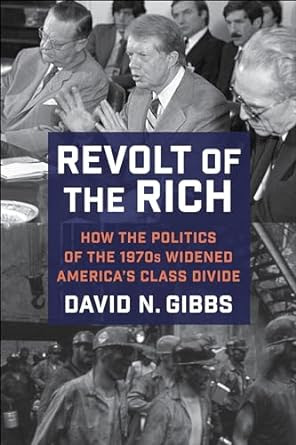
David N. Gibbs's "Revolt of the Rich"

David N. Gibbs is professor of history at the University of Arizona, with a courtesy appointment in Africana studies. His books include First Do No Harm: Humanitarian Intervention and the Destruction of Yugoslavia (2009).

Gibbs applied the "Page 99 Test" to his new book, Revolt of the Rich: How the Politics of the 1970s Widened America's Class Divide, and reported the following:
Revolt of the Rich starts from the fact that inequality of wealth and income in the United States has increased exponentially during the past four decades, beginning in the late 1970s, as documented by the French economist Thomas Piketty. My book seeks to answer the question of why inequality increased. The answer, based on fifteen years of archival research, is that there was a massive influence campaign by business interests and wealthy individuals that sought to direct a greater share of resources to themselves, at the expense of the majority. Business interests set aside their differences and combined forces, acting with great discipline. In essence, this influence campaign was successful, thus transforming US politics in a plutocratic direction that endures to this day.

Page 99 would not be a good place to gain an understanding of my overall argument about wealth inequality. It addresses a secondary theme, which is: How was it possible to achieve such inegalitarian policies – that were harmful to the majority -- in a Democratic political system? Page 99 addresses this question by looking at how weak the leftist opposition was. During the 1970s, the left lost its traditional focus on the working class and instead directed its appeals to the highly educated. I note how left culture increasingly disparaged working-class males – especially white males – as ignorant, violent, and racist, thus introducing a basic wedge issue into American politics. The elitist character of the left greatly reduced its effectiveness, which ensured that the business led lobby groups met little opposition. The focus on the educated also opened the left to accusations from right-wing politicians that it had become a snob left – an accusation that contained an element of truth.
Learn more about Revolt of the Rich at Columbia University Press website.

--Marshal Zeringue

Sunday, June 30, 2024

Jonathan Connolly's "Worthy of Freedom"

Jonathan Connolly is assistant professor of history at the University of Illinois at Chicago.

He applied the "Page 99 Test" to his new book, Worthy of Freedom: Indenture and Free Labor in the Era of Emancipation, and reported the following:
Worthy of Freedom is about a system of indentured labor migration created shortly after the abolition of slavery in the British Empire. From the early 1840s to the end of the First World War, this system brought more than a million Indian workers to sugar-producing colonies across the empire. As such, it played a crucial role in shaping the “history of emancipation”—a complex history of conflict and change—and the meaning of “freedom” after slavery.

Opening the book to page 99 parachutes the reader into a set of arguments about the discursive normalization of indenture during the 1850s. Earlier chapters explain that indenture caused a public scandal when planters began recruiting (and policing) migrant workers fifteen years earlier, in the immediate aftermath of abolition. At that point, many British observers denounced indenture as a covert revival of slavery. But this changed over time, alongside broader conceptions of free labor and emancipation. Chapter 4 explains how and why. The chapter argues that new forms of social-scientific analysis reshaped debate on indenture, displacing older antislavery critiques. Drawing on wide-ranging scholarship on nineteenth-century race thinking, it then shows that hardening attitudes toward race, linked to a growing consensus that emancipation had “failed” economically, served to legitimize the penal structures surrounding indenture. Finally, it explains that an important economic shift—increases in sugar production and profit following large-scale labor migration—consolidated public support for indenture as the 1850s wore on. Page 99 introduces this third strand of argument:
The prospect of economic failure had been a catalyst for indenture from the beginning. But starting in the mid-1850s, a new economic story—a story of growth rather than decline—altered the material basis of support for indenture. By the end of the decade, nearly 370,000 Indian workers had arrived in the colonies. In Mauritius, British Guiana, and Trinidad, the impact was transformative. Against the “failure” of emancipation, indenture soon stood for economic success.
So, does this encapsulate something important about the book as a whole? Yes! It brings us to the heart of one of the book’s core subjects, which is how indenture gained legitimacy as “free labor” and how perceptions of the system related to wider conflicts over the meaning of emancipation. Page 99 also hints at the book’s general interest in relating ideas and political culture to economic change. But because change over time is so important to the book, skipping to page 99 also leaves a lot out. One’s sense of what’s shifting in chapter 4 depends on earlier material. When one reads the Times of London celebrate indenture on page 98, the impact of such language is amplified having read the same newspaper stridently condemn indenture nearly two decades earlier on page 21. The book’s core arguments concerning ideology, law, and state power all move forward chronologically. It’s of course easy for me to say this, but to appreciate the book’s arc of historical change, it’s best to start at the beginning.
Learn more about Worthy of Freedom at the University of Chicago Press website.

--Marshal Zeringue

Saturday, June 29, 2024

Jared Schroeder's "The Structure of Ideas"

Jared Schroeder is Associate Professor of Media Law at University of Missouri School of Journalism. He is the author of The Press Clause and Digital Technology's Fourth Wave: Media Law and the Symbiotic Web (2018) and co-author of Emma Goldman's No-Conscription League and the First Amendment (2019).

He applied the "Page 99 Test" to his new book, The Structure of Ideas: Mapping a New Theory of Free Expression in the AI Era, and reported the following:
The Supreme Court, for a brief moment, was of two minds about the nature of the space for discourse. Justices both sought to create an expansive marketplace of ideas that protected the most amount of speech possible and, concurrently, protect the space from forces that would distort the flow of ideas. That’s what page 99 of The Structure of Ideas covers.

I would not pick page 99 as a representative of the entire book. The passage catches me in the middle of identifying the conceptual development of the Supreme Court’s understandings of the space for discourse. Justices eventually tossed aside the idea that the marketplace of ideas should be protected from distortion and leaned fully into an expansive, generally unregulated space where almost any expression is protected.

A reader opening to that passage, and that passage alone, would get the kernel of an idea about one of the book’s narratives about the past, present, and future of the space for human discourse, but they would not engage with the overall context of the book. Overall, that passage is doing somewhat specialized work and is far less thematic than many other areas of the work.

Page 89 gets at crucial themes about the overall structure of the space for discourse and Page 119 begins to explore the impact of non-human speakers, such as AI, on the space for discourse. So, perhaps, I was both early and late. In either case, page 99 is a foot soldier passage in a work filled with historical narratives and crucial concepts about the development and future of the space for human discourse.
Learn more about The Structure of Ideas at the Stanford University Press website.

--Marshal Zeringue

Friday, June 28, 2024

Robert Goodin's "Consent Matters"

Robert E. Goodin, Emeritus Distinguished Professor of Philosophy at Australian National University, specializes in political theory and public policy. He was founding Editor of the Journal of Political Philosophy and General Editor of the eleven-volume Oxford Handbooks of Political Science. A Corresponding Fellow of the British Academy, he has been awarded the Johan Skytte Prize in Political Science and the Stein Rokkan Prize for Comparative Social Science Research.

Goodin applied the "Page 99 Test" to his new book, Consent Matters, and reported the following:
Ninety-nine is an odd number and it is an odd page in my book Consent Matters. It comes at the end of a long chapter introducing various different 'modes of consent' – explicit consent, tacit consent, presumed consent and implicit consent. All of those can, in suitable circumstances, be valid ways of giving consent. What I discuss on page 99 – David Estlund's 'ought-to consent' – is not. Just because you ought to give someone your consent to do something does not mean that that person actually has (or may properly proceed as if they had) your consent to doing it. As I had argued in chapter 1, to consent is to do something, internally (mentally) in the first instance and externally (performatively, typically communicatively) in the second. Until and unless you have actually done those things, you have not consented. It may have been wrong not to have done so, but that does not make it all right for others to treat you as if you had done when you haven't.

Most of my book is devoted to operational questions about consent: evoking it, invoking it, revoking it. There are some things we should ask consent for before doing, but even asking for consent to do them would be offensive. Revoking consent would be wrong after someone else has already performed the consented-to action. And if you revoke it before that, you must at least compensate others for the costs that they reasonably incurred in preparation for acting on your now-revoked consent. And so on.

Mistakes about consent loom large in the book. Jack says or does something that has led Jill to think – reasonably but, as it happens, wrongly – that she has Jack's consent to her doing something. Those are not genuine cases of consent because Jack lacked the requisite internal mental attitude (he did not intend to consent). But externally he has said or done something that has led Jill to reasonably conclude that he had consented. If Jack knew, or could and should have known, that Jill would understand his words or deeds that way, then Jack should be treated 'as if' he had consented. Jack should permit Jill to do what he seemingly consented to permitting her to do, or at least Jack should compensate Jill for her reasonable costs in acting in reliance on his seeming consent. That is not because he genuinely consented but, instead, because he led her on (in ways he could and should have realized) in thinking that he consented. If Jack misled Jill 'deliberately fraudulently', he should be regarded as having literally forfeited the rights that his deliberately false consent purported to waive. Where consent was falsely signalled through 'innocent error' or 'culpable negligence', then Jack should be allowed to 'correct the error' and 'take back' his apparent consent – but not without compensating (to a greater or lesser extent) Jill for costs she bore in reasonable reliance on Jack's misleading indications of consent.

Consent Matters finishes with a discussion of three 'special cases'. One concerns political consent conferred through voting. Two others involve 'consent of the uncommunicative', one concerning 'simulated necrophilia' and the other a hunger striker who internally wishes for assisted feeding but cannot externally say that they consent for fear of betraying the other hunger strikers.
Learn more about Consent Matters at the Oxford University Press website.

The Page 99 Test: On Complicity and Compromise by Chiara Lepora and Robert E. Goodin.

--Marshal Zeringue

Thursday, June 27, 2024

Don H. Doyle's "The Age of Reconstruction"

Don H. Doyle is the author of The Cause of All Nations: An International History of the American Civil War and other books on America and the world in the Civil War and Reconstruction era. He is professor emeritus of history at the University of South Carolina and has had visiting appointments at universities in Britain, Italy, France, and Brazil.

Doyle applied the "Page 99 Test" to his new book, The Age of Reconstruction: How Lincoln's New Birth of Freedom Remade the World, and reported the following:
Page 99 of The Age of Reconstruction is an excellent illustration of Ford Madox Ford’s axiom. It is the opening of chapter four and the place to tell readers where we have been, where we are going, and what I am trying to make of it all. Chapter Three, “The Mexican Lesson,” tells the little-known story of the United States’ role in forcing France to withdraw the armed forces they sent to protect the throne of Maximilian, the ill-fated Austrian archduke Napoleon III had installed as Emperor of Mexico. Chapter Four, “Russia Exits,” takes up the evacuation of North America by another European empire when, at the end of March 1867, a few days after the French left Mexico, Secretary of State William Seward concluded a treaty between the United States and Russia to purchase what became Alaska. Historians have routinely treated the Alaska Purchase as a lark, which skeptical members of Congress ridiculed as “Seward’s Folly” or, my favorite, “Walrussia.” The treaty did meet stiff opposition in Congress, partly because many Republicans were at odds with Seward due to his loyalty to President Andrew Johnson and because taking over non-contiguous territory, never mind the colony of a European empire, seemed to contradict republican principles. Charles Sumner, a Radical Republican leader in the Senate, turned the tide with a magnificent speech that portrayed the Alaska Purchase, just as I interpret it in the following chapter, as part of a massive geopolitical shift in which European empires retreated from the Western Hemisphere. Out of this came a new Monroe Doctrine whose slogan, “America for Americans,” expressed a Pan-American vision of the Americas as a haven for independent republics free of European imperialism and slavery.

The epigraph for Chapter Four has Sumner telling Congress that by this treaty, “we dismiss one more monarch from this continent. One by one they have retired; first France; then Spain; then France again; and now Russia; all giving way to that absorbing Unity which is declared in the national motto, E pluribus unum.” Unlike France, Spain, and Britain, Russia had befriended the Union during the Civil War. On the contrary, the Alaska treaty stimulated a popular idea that Russia and America, despite their vast differences, were forging a bond based on their common enmity toward European powers and commitment to the abolition of unfree labor. Though the friendship between Russia and America may have been exaggerated, it served to justify the Alaska Purchase and ennoble America’s post-Civil War vision for the hemisphere.
Learn more about The Age of Reconstruction at the Princeton University Press website.

The Page 99 Test: The Cause of All Nations.

--Marshal Zeringue

Wednesday, June 26, 2024

Aziz Rana's "The Constitutional Bind"

Aziz Rana is the incoming J. Donald Monan, S.J., University Professor of Law and Government at Boston College. His writing has appeared in the Washington Post, Dissent, n+1, the Boston Review, and Jacobin. He is the author of The Two Faces of American Freedom.

Rana applied the "Page 99 Test" to his new book, The Constitutional Bind: How Americans Came to Idolize a Document That Fails Them, and reported the following:
Page 99 explores the early twentieth century changes various reformers and activists proposed to the federal courts, given the growing sense that the judiciary was beholden to business interests in a way that thwarted essential and widely backed policies for addressing extreme economic inequality and workplace domination. These judicial reforms would have “dramatically restructured” the bench through everything from term limits to checks on the power of judges to overturn legislation, such as by requiring “supermajorities for Supreme Court decisions to be binding” or “granting Congress the power to override court rulings through legislative action.” The page then highlights how discontent with the Supreme Court spilled over into concerns about whether “the constitutional system as a whole was truly democratic.” For a range of activists at the time, the Court’s intransigence seemed of a piece with how numerous features of the constitutional system, as embodied by the state-based structures of the Senate and the Electoral College, placed profound hurdles in the path of broad sentiment.

Taking a step back, the goal of the discussion on page 99 is to underscore a feature of that era’s constitutional culture that would be surprising for many Americans today. In those years, politically relevant politicians, commentators, and activists thought seriously about the need for radical constitutional change. They treated the existing text as a template for legal-political governance, just one among many possibilities, and that increasingly failed to fulfill collective ends. In recent decades, however, the Constitution instead has become deeply enmeshed with a pervasive and shared story of national peoplehood. It is not simply a decision-making apparatus, but also stands for a vision of the American project—intertwining liberal equality, market capitalism, and extensive checks and balances at home with the promotion of American primacy abroad. By contrast, at the beginning of the last century none of these ideological components of today’s constitutional compact would have been taken for granted. These were disparate strands that did not necessarily fit together and the document itself faced real skepticism during a period of profound political uncertainty.

The Constitution Bind is thus not an ideal fit for the Page 99 Test, since the page only captures a small slice of the book’s overall arguments. Still, page 99 does offer context for the book’s larger animating question: How did Americans come to embrace, so deeply, their Constitution along with a very specific account of text and nation? I argue that this particular embrace is a distinctly twentieth century development, one tied—perhaps surprisingly—as much to transforms in the global system as to those at home. It was bound up with the United States’ move from a regional settler polity to a globally dominant power. In hinting at this shift, page 99 speaks to the pre-history of modern constitutional veneration. It presents the conflicts that swirled before our more familiar narratives took hold.

At the same time, page 99 also provides a glimpse into another central element of the book. I discuss how the official story of the Constitution is exhausted today. This is because many of the critiques from that first Gilded Age have proven accurate, and the existing legal-political system—along with the vision of U.S. exceptionalism that eventually grew around it—does not now serve most Americans. As a consequence, there is value in thinking deeply again about the range of alternative constitutional visions that once circulated in public debate. In this way, the reforms on page 99 are an initial invocation of the vast array of ideas developed by Black, Indigenous, feminist, labor, and immigrant reformers across large swathes of the twentieth century. Today, their visions remain vital, if under-utilized, starting points for confronting our own dilemmas.
Visit Aziz Rana's website.

--Marshal Zeringue